Blog

Church 101 – “And the Survey Says…”

Image

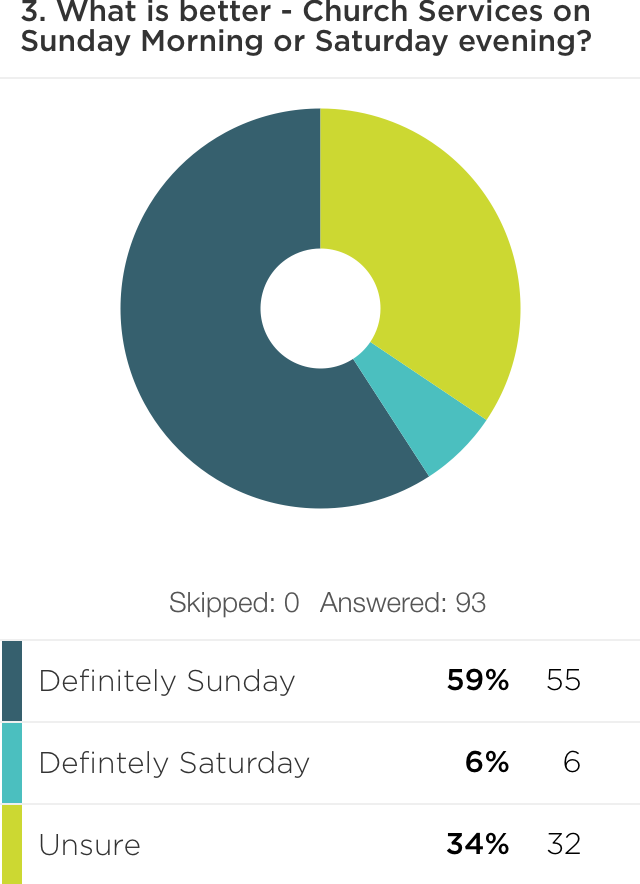
Below are 8 questions within a survey that, if you have the time, would you please click and fill it out.  
This survey is through “SurveyMonkey” it’s safe and you won’t be asked to give any information other than answering these quick and painless multiple choice questions.  

Next Monday I will share with you the results of this Church 101 survey.  Please help me in gathering as much data as I can by your participation in this survey, from you my fellow readers and bloggers.  Thank you in advance for your cooperation.  

This should be interesting!

Image

Here’s the link – 

https://www.surveymonkey.com/s/5B33GZQ

Stay tuned Monday as I explore results and please comment and help explore this topic with me!  

“The Jesus Fan Club”

Image


Perhaps you’ve seen the bible study or read some books which ask the question are you a “Fan” or are you a “Follower” of Jesus?  A fan would be one who sits on the sidelines, cheers (also complains when things aren’t going the way they expect them to go) but never really gets onto the field to do any of the real labor within the realms of faith.  

I don’t mean to rail against the Church…well maybe I do a little.  This isn’t about not loving people, actually it’s quite the opposite.   What can we do to change the perception of the Church?  What can we do to change the perception of the “Fan Club”?

Image

1.  It begins with You & Me:

We can’t change the polarizing views of some people who use the name “Christian” but do not act like Christians.  BUT we can change the way that we conduct ourselves and how we live in community with those around us.  It has to begin with you and me!  Without this internal determination to change, the “Fan club” wins.  

2. Move with Love:

When we allow it to begin with us and allow the Holy Spirit to move us we can’t but help to love and serve.  It’s about loving and serving the Almighty as well as loving and serving other people around us.  Faith has to have feet in order for it to change lives including our own.  We aren’t merely fans of Jesus, we MUST be His followers.  Love compels us forward even into places that we would never consider going because it is no longer about “Me” but it’s about “Him”.  

Image

We can tear down these walls that separate the Church from the “real world”…but it means that we can’t just take shelter in our buildings and presume people will find us.  Jesus didn’t hang out in temples for the entirety of His ministry here on Earth, He went to people, and if we are to be like Him, if we are to follow Him then we  ought to go to people too!  

Jesus doesn’t need anymore fans…He needs followers who are willing to do the hard work, not because hard work will get us into heaven, but rather because we have put feet with our faith.  Are you ready to move?  

-Just a thought.  

5 Myths About Christianity…

Image

There are preconceived ideas floating around about what a Christian is and isn’t.  I am most certainly not the end all and be all of answers here, but from my experience and knowledge of what a Christian should and shouldn’t be, let me make a list of a few myths for everyone today.  I am sure this may spark some conversations and hopefully help to clarify this thing we call “Christianity”.   These aren’t in any specific order, just placed as I write them now…so here goes.

Myth #1 – “Salvation saves my soul and after conversion there is no need for further repentance or spiritual growth.”

Image

Let us be clear. 
Salvation is just the first step towards spiritual growth.  Without Salvation we are lost, but at the moment of conversion the Holy Spirit begins this transforming work within us.  To say that we only need repentance once and that growth isn’t needed is foolish and closes the door to a deeper, more fuller relationship with God.   We should also look more closely at the need for further repentance.  Repentance is crucial in our continued growth as Christians or Christ-followers.  As Spiritual maturity takes root in our lives so must we come face to face with lingering or flawed recesses of our hearts, souls and minds.  These are fragments of the old life still living within us.  The Holy Spirit’s work in us leads us towards Holiness which is the image of Christ, but we cannot fully realize this until we are willing to repent and surrender these lingering fragments.  Continued repentance is crucial for our continued spiritual growth.

Myth #2 – When you become a Christian you are no longer allowed to have fun

Image

This may sound funny to you, but I’ve heard it said of Christians that once you become “saved” you have to stop having fun.  Sorry to tell you this, but some of the craziest (by crazy I mean funny) people I know are Christians.  I believe God has a great sense of humor (afterall He created you and me didn’t he?)  and so did Jesus.  I can almost hear even a sense of sarcasm in some of Jesus’ words at times.  Humor is vital to life.  We need to be able to laugh at ourselves and revel in the frivilous from time to time.  The fellowship of believers shouldn’t only be about serious content and plastered frowning/pious faces, we should also seek to have fun in this life as well!  I seriously think that many people who are not Christians think we all wear funny clothes, and sit around singing hymns in latin.  If that was the case, perhaps I would seriously think of heading for the exit as well.  But I know Christians who are just plain down to earth people.  These same people have a very humorous, sharp sense of humor.  When people become Christians and embrace faith in Christ they do not (or should not) lose their sense of humor.  Humor is not only refreshing but many times intrinsic to a person.  It is almost like a fingerprint and is essentially tied into the identity of that person. 

Myth #3 – Christians are just out for YOUR money.

Image

Let me just say how much I despise certain types of Televangelists who prey on the false hopes of the weak.  These charlatans will tickle the ears just enough to score another buck from the naive and the hurting.  This type of Christianity is more parlor trick than it is an accurate reflection of a real Christ-follower.  I usually stay away from churches that essentially beg for more and more money.  There is a big difference though between the discipline of tithing to the Lord and supporting a ministry that uses much of its funds to empower and provide luxury to the pastor/televangelist.  One should consider the fruits of the labor within those “religious” entities and look very closely at where the funds go. 

Christ certainly didn’t go around asking people to give Him money.  He did ask of a Samaratan woman for water and He did ask His disciples to do extraordinary things, but money was not in the asking.  Jesus did talk a lot about money and possessions but it primarily centered around the questions of “what possesses you?  What are your idols?  Does your material wealth and pursuit of such earthly riches consume all of your time?” 

In the same way, we are to emulate Christ when it comes to earthly possessions and the uses of riches.  Money can be a resource to help us provide for our families, to put food on the tables and to support missions of a loving and caring church.  Christians are not…(or should I say) should not be all about the money, money. 

Myth #4 – Christians are hate-mongers

Image

I at times bristle at this accusation.  In the same breath though I know that there are those segments of the Church (like the Westboro Baptist church – sorry to name names) who have made it a mission to condemn and judge any and every people group that they deem worthy of their condemnation.  This is NOT the Christ that I know, and If Jesus had lived this way while on earth I doubt I would have followed Him.  The harshest words that Jesus ever spoke were directed at the teachers of the law, the “religious” people of the day who knew better but certainly DID NOT live as they demanded others to live.  Jesus’ message was one of hope and love and restoration.  He breathed this into His disciples who in turn continued that mission throughout their lives regardless of the consequences (even death).  

Jesus actively engaged Himself within many sub-cultures of His day even the outcasts who  the “Religious” teachers despised.  He went to the homes of tax collectors, he healed lepers, He talked with women of questionable backgrounds…His message was of love not hate. 

Salvation doesn’t come to us by shoving Heaven and Hell down someone’s throat, but rather through real genuine concern and love.  Any church out there that relays Christ’s message any other way other than love has misplaced His purpose for coming in the first place.  “The thief comes only to steal and kill and destroy; I have come that they may have life, and have it to the full.” -John 10:10

There is a difference between preaching repentance within the realms of Salvation and preaching hate and condemnation.  Christianity, if lived out in the hearts of the genuine Christ-follower, should reflect and possess the same aroma of Christ in His love for the sinner and the saint regardless of where they’ve come from.

Myth #5 – Christian are all hypocrites and gossipers

There’s a funny sign that reads:

ImageUnfortunately the truth may hurt a bit at times, but there are no perfect people in church.  The church should be a place where both sinner and saint come for Spiritual triage and are not judged or condemned by the “righteous”.  Romans 3:10 says “There is no one righteous, not even one…” 

Truth be told, it would serve the church and the church member well to bring this verse to mind when considering other children of God. 

Can I say that the church never has this problem with hypocrites and gossipers?  NO!  In fact this may be the only myth that I think hits too close to home sometimes.  BUT if Christians can be humble, truly humble and loving towards everybody who chooses to enter the church doors, what a real opportunity that would be!  Think of the difference and what may transpire if  this one small issue was completely eradicated from the Christian heart?  How would lives be changed and transformed?  Think of the opportunities to save souls!? The Church is NOT full of Hypocrites and Gossipers, although we certainly have our fair share. 

These are just five myths about Christianity.  There are many more, but for now this is enough. 

For the Christian: 
Consider what it means to truly be a Christ-follower.  How you might be perceived (right or wrong) by those who have yet to make a decision for Christ.  Be open minded, full of grace and purposeful with friends, family and neighbors who aren’t Christians.  Remember we are not the judge, God is.  Just as we are in need of His love and grace, so too are others who live in this world as well.  Real evangelism doesn’t begin with a tract or a bullhorn, but with a handshake and a hug of compassion and genuine love.  Get to know people.  Spend time with them.  Tear down these false perceptions by the way that YOU live and conduct yourself.  There isn’t enough lip service in the world that can out-do faith in action! 

For the questioning soul out there:
The Church should be a place of safe harbor to ALL people.  Christ was the only perfect person who ever lived and He came to save us all.  Don’t’ judge the merits of Christ by what you may have experienced (most likely bad experiences) in a church setting.  Imperfect people exist in and out of church.  People make mistakes, even Christians.  I am not apologizing for all Christians, but I am saying this: be open minded and perhaps, just perhaps some of these myths might be debunked.

Thanks for allowing me time to share these thoughts. 


Why The Salvation Army isn’t for everybody, but it is for everyone!

Image

It was founded as an outreach, a mission, a cause.  

The mobile Army wasn’t created to be another church but rather a fighting force equipped to fight sin and its stranglehold on humanity.  Its members were to fight side by side for the purpose of relieving human suffering while administering the annocuational cure which is Christ to the dying soul.  Life replacing death.  

Humility walks in close step to the sounds of marching feet in an Army of spiritual combatants.  Without this vital component, one might have the temptation to become self-righteous and prideful.   But this fight, if total commitment is the goal and holiness is the aim, offers little time for selfish desires and ambitions.  

Thus, The Salvation Army is not for everybody.  Within its ranks there are few benefits of receiving human praise and awards of personal prestige.  Payment for services as Officers, Soldiers and Lay persons are minimal at best and carry with it responsibilities of a full-time commitment.  If one were searching for a higher paying position which afforded more luxury and freedom The Salvation Army certainly would not be for everybody in search of these physical comforts.  If the mission is at the forefront, which is also an extension of the Great Commission, such desires for personal acclaim and earthly wealth is diminish over time.  Don’t get me wrong, however, these temptations will still occasionally occur, but if Holiness and humility are present as tools for utilization in a Soldier’s armor then that soldier can withstand this assault with the power of the Lord.  

…but it (The Salvation Army) is for everyone!

 In recent years struggles have arisen.  Lifestyle questions have been raised.  Accusations (even at times correct) have been made.  Yet if the mission is still intact, and the purpose for which The Salvation Army was established is still sought after, then the true love of Christ will shine and be seen by all who are seeking love and acceptance.  

Christ came for the whosoever, and as we continue our fight against sin and its stranglehold on humanity we must not lose our identities as first Children of God and secondly Soldiers of the Army.  When we can look at others through the lens of love as Christ first loved us, we then can see both sinner and saint still very much in need of hope and grace.  The sinner and the saint do not need more condemnation and warfare of the spiritual kind flung at them as if they are the opposing enemy.  “For our struggle is not against flesh and blood, but against the rulers, against the authorities, against the powers of this dark world and against the spiritual forces of evil in the heavenly realms.” Ephesians 6:12.  

If we are an Army marching ever forward we must consider what it means to truly “march forward” while engaging the REAL enemy of this world that seeks to envelope the hapless victims in sin, hopelessness, and death.  

I don’t mean to sound harsh, but in warfare, even in this spiritual fight, we need Soldiers and Officers who are willing to engage the enemy for the sake of others and with the power of the Holy Spirit…we do not need more sidelines cheerleaders, pretenders, or the “half-committed”.  It’s either all or nothing.  

The Lord doesn’t want a part-time commitment or what is MOST convenient for us.  He wants from us a full surrender, and in our full surrender we may be lead to do some revolutionary things in our time.  It may be uncomfortable.  It may stretch us.  But extending God’s love, hope and grace to our communities and fields of service will mean life or death to ones in which we invest our time, talents and treasures.


Image

-Just a thought.  

“Ambassadors of Reconciliation”

Image

“We are therefore Christ’s ambassadors, as though God were making his appeal through us. We implore you on Christ’s behalf: Be reconciled to God.” -2 Corinthians 5:20

One of my favorite words in the English language is “Reconciliation”.  The etymology of the word reconcile comes from the Latin “reconcilare” which means “to bring together again”.  

When Jesus came into this world and identified with humanity as the God-man He sought to bring together again the original creation of man with God the Father.  Did you catch that?  At one time, in our original state, we were together with God.  He would walk with Adam and Eve.  He would fellowship with them in the garden of Eden.  He actually, physically, walked WITH them.  

But.

Because of original sin, which entered the picture, we became separated from God.  Think of it like a great big, messy divorce…except we were the offending party and God the Father did nothing to deserve our infidelity.  How it must have wrecked His heart to find us unfaithful to Him.  To find out we (Adam and Eve) deliberately and consciously disobeyed Him.  But we all know this story don’t we?  We understand the consequences of the fall of man…don’t we? 

Yes Jesus came. 

He came to set things right with us.  

He came to Reconcile us (back again) into the Father’s arms.  

Think about that for a moment.  Isn’t that beautiful?  Doesn’t that evoke in you some sort of longing to physically be embraced by God the Father as you enter into the wedding feast?  Jesus came to restore us.  He came for the whosoever…those who would actually come seeking Him.  

But, wait…there’s more. 

When we face the God-man, Jesus Christ, for who He is and what He came to do, we make a vital decision.  We, who have then become Christ-followers, we choose to become like Him in our daily living.  A part of this “becoming” is to pick up where Jesus left off.  We follow in the footsteps of the Rabbi, but in so doing we shuck off our old identities and adopt (not just imitate, but become) Christ in  our everything!  

Taking it a step further, we are to be Christ’s ambassadors to the world relaying the vital message of reconciliation to the whosoever. There is a misnomer though that I think we buy into once in a while – “Reconciliation is only for the sinner”.  This is simply not true.  Though we have become like Christ in every way, shape or form (or so we think thus far) we are still in need of THAT reconciliation daily!  

The Hebrew words associated to the word “Ambassador” are: “tsir” or “melits” and “malak”.  Essentially they mean “an interpreter” or “a messenger”.  

When we think of Ambassadors today we think of politicians from certain countries whose job it is to broker peace and trade agreements with other countries.  But we as Christ-followers are also called to be ambassadors of reconciliation to the sinner and the saint.  Taking it a step further being an Ambassador also implies that we are to literally breathe Christ’s message into other people by our words and more importantly by our actions.  

How can we provide clear interpretation of God and that of His love to those around us if we have not fully adopted and reconciled ourselves to His love as well?  If this reconciled life is not within us then we cannot breathe this into other people’s lives.  So as an Ambassador it has to begin with You…and it has to begin with me.  

It first must become personal…daily, even moment by moment breathing Christ’s holiness and likeness into our own hearts and minds through the power of the Holy Spirit. (Philippians 4:8).    

Prayer: 

Dear Lord, let it begin with me.  Breathe on me breath of God, allow me to be reconciled to You daily.  Help me to see that I am called to be your messenger to others, even other saints.  Help me to be the best Ambassador for you that I can be.  May it be my lifelong passion which begins moment by moment with you.  In Your Holy name I pray these things, -Amen.  

Perspectives – Day 5 Featuring Dr. Bob Whitesel (Book Excerpt – ” Cure for the Common Church: God’s Plan to Restore Church Health”)

Image


Dr. Bob Whitesel’s book is available at  BobWhitesel.com, as well as other book sites including Amazon.  

Image

Excerpt: 

Chapter 2 “Grow O.U.T. HOW?”

St. George Meets His Match at St. Mark’s


            George was a likable man with high hopes for his pastorate at St. Mark’s Church.  The church had been founded some sixty years earlier to reach the sprawling new neighborhoods of the area.  In the years after World War II the church grew as young families with good jobs spread into the neat streets and shaded cul-de-sacs.

            Sometime after 1970 the church started to plateau in attendance.  The neighborhood streets were now filled with nice and tidy homes, but even newer subdivisions began to sprout eight miles to the north.  Because of its size of 400 members, St. Mark’s still enjoyed a favorable reputation in the denomination and few saw the plateau as troubling. 

In the 1980s a new emerging middle class of Korean Americans began to move into the neighborhood.  “I’ve got many neighbors that are Korean,” stated one church board member.  “They are good friends of mine. But, once they visit our church they don’t come back.  I thought Pastor George would be the answer.”

            George was a Korean American who had successfully grown a large church of the same denomination in Rosemead, California.  The board of St. Mark’s Church had felt that George would help them reach out to their neighbors.  And try George did.  George spent many hours walking the nearby streets and cul-de-sacs asking residents about their needs.  One pressing need was for after school programs for children of two wage-earning families.  Another need was for Sunday School programs that would appeal to youth.

To meet this need George tirelessly launched into a Wednesday after school program and two new Sunday School classes.  “I got the best workers and most experienced volunteers of the church to help me,” recalled George.  “But I never expected this.” The church board had called the district superintendent and requested a different pastor.  “We tried to reach the community,” summarized George, “but it was just me who had the vision.  The church’s leaders had a burden in their mind, but not in their hearts.  I guess they only heard about the neighborhood’s needs second-hand, through me.  I should have taken them with me to walk the neighborhood themselves.”

It was this conversation with a wise pastor almost two decades ago that launched me on a quest to discover why the common church has trouble connecting with the communities around it.  Over the years I discovered that well-meaning pastors like George were insufficiently equipped to connect a church with the burgeoning needs of non-churchgoers.  The task is too large for a staff to manage.  Rather, for a church to be uncommon today, it will be necessary for all congregants to go out into their neighborhoods and connect with the needs of non-churchgoing people.

            The story above still occurs.  New churches are being planted that within a few years succumb to the same problems that St. Mark’s Church experienced.  They have different names, but they still fall prey to the same marginalizing commonness.  Yet, as I counsel these congregations I find that most genuinely want to reach out to those outside their fellowship.  They intuitively (and biblically) know that Christ calls them to reach inward and outward.  But, they are at a loss to stem the tide.  They are in need of a cure for the commonness of ingrown ministry.

Rx1for the common church = GROW O.U.T.

3 Cures: A Therapeutic Method

             The cure for the ingrown church is to keep a church focused both inward and outward.  In fact, history indicates that churches that stay connected to outsiders often do a better job at inward ministry too.  For example, an Anglican pastor named John Wesley was so ashamed and alarmed at the depravity of the people outside of his church, that he took his sermons outside the church walls and began ministries to better serve their spiritual and physical needs.[i]  Balancing this emphasis upon people inside and outside the church required a rigorous structure his critics mockingly called: “Wesley’s Methods.”  Soon his followers were know as “Methodists,” a term which endures to today and should remind us that we need a clear method if we are going to avoid focusing only on people inside the church. After 20+ years of consulting, I believe this method here lies in three organic remedies.  These cures, if taken together, can foster a healthy balance between inward and outward focus.


Rx 1 for the Common Church = Grow O.U.T.  

 In this cure, as well as in all of the cures in this book, the remedies spell out the name of the cure.

CURxE O:  Observe whom you are equipped to reach

CURxE U:  Understand the needs of those you are equipped to reach.

CURxE T:  Tackle needs by refocusing, creating or ending ministry programs.

[i] Wesley urged discipleship via small groups which he called “class meetings” to help non-churchgoers grasp the basics of Christianity.  These “class meetings” were a type of discipleship group, which we shall discuss in greater detail in the next chapter.

CURxE O=

OBSERVE WHOM YOU ARE CALLED TO REACH


Two Common Options

 The main reason most churches become common is because they forget (and sometimes just don’t know) to whom God has equipped them to reach out and minister.[i]  They know they aren’t supposed to be ingrown, but exactly who should they be growing out to serve?  Usually, there are two options that can be discovered by asking two questions:

  1. Has God equipped your church to minister to people in a geographic community
    1. If you answered yes, you might be a “Geographic  Church.”
    2. Geo- means “of an area.”   This is a church whose ministry has been directed toward people in a geographic area (often those who live nearby).
    3. These churches meet the needs of people in one or more geographic communities.
    4. Examples:  a neighborhood church, a village church, a rural church, a church in a housing development, a downtown church, etc. (For more examples see Figure 2.1.)
  2. Has God equipped your church to minister to people like us
    1. If you answered yes, you might be a “Demographic Church.”
    2. Demo- means “of a people.”  This is a church whose ministry has been directed toward a people group (e.g. those who share common characteristics).
    3. These churches meet the needs of one or more sections of the population that share common characteristics, such as age, ethnicity, socio-economics, common interests, etc.[ii]
    4. Examples: generational churches, ethnic churches, aging traditional churches, blue-collar churches, middle-class churches, Café Churches, college churches, etc. (For more examples see Figure 2.2.)

Your road to uncommon church life begins with understanding if you are a church equipped to meet the needs of a specific “geographic” area, or if you are equipped to minister to one or more “demographic” sections of the population.  Both geographic churches and demographic churches are legitimate and both are needed.  And, the process begins by observing your surroundings, your history and how God has moved in your church’s history.[iii]


Are You a Geographic Church?

Some churches are primarily equipped by God to reach a geographic area such as a neighborhood, a borough, a small town, a rural area, a township, a neighborhood, a school district, a suburb, an urban district, etc.  Geographic churches often have a long history of ministering in a specific area.  And, if the culture of the geographic area changes, because the geographic church is called to that locale, the geographic church will stay put but change with that culture.  

This is not always easy, nor quick.  In Appendix 2.A you can find the story of Kentwood Community Church, a Michigan congregation that has successfully changed ethnicity and grown while remaining in the same (changing) geographic area.

Today many churches are forced by their location and/or history to be geographic churches.  Figure 2.1 lists some more common examples of “Geographic Churches:”


Figure 2.1 Examples of Geographical Churches


Churches constrained[iv] by distance

  • Churches located in small towns and/or rural districts with very little outside traffic may have no other option than to become geographic churches meeting the needs of those people living nearby.
  • Churches that are elsewhere off the beaten path.


Churches constrained by natural features

  • Churches located in wilderness areas, valleys, etc. with very little outside traffic.
  • Churches located in back road areas.
  • Churches located on river deltas, islands or peninsulas.


Churches constrained by traffic patterns

  • Suburban churches may be geographic churches if they are in an area of a suburb not traveled by many people from outside of the area.
  • Suburban churches can be geographic churches if their buildings are hidden in a housing development or subdivision.


Churches constrained by owned assets

  • Churches that own their own facilities (and market or geographic conditions make selling and moving impractical)
  • Churches that own significant or valuable acreage (and market or geographic conditions make selling  and moving impractical)


Churches constrained by image

  • Churches that are located in a neighborhood with its own identity (e.g. blue-collar, artist, urban, young professional, college student, etc.)
  • A old, established downtown church that cannot move to the suburbs because there are other denominational churches already there.
  • A church residing in one of the inner city’s labyrinth of neighborhoods, may be limited by that neighborhood’s identity.


Special Attributes of Geographic Churches


Geographic churches will stay put and change as the cultures around it change.  If the cultural makeup of a community changes, a geographic church will change to reflect those changes.  Rather than moving out of an area if the culture changes (like a demographic church might do), the geographic church is a chameleon, staying put and changing its appearances to reflect its changing environment.

Geographic churches can reach out to several cultures at the same time.  A geographic church in an urban area might be comprised of a Mexican congregation, an Asian congregation and a young professionals congregation. 

There is power in multicultural geographic churches.  Because a geographic church wants to mirror the changing mosaic of its locale, geographic churches often seek to create a partnership of multiple sub-congregations, reflecting the proportions of these cultures in the community.  These churches are discovering the power of partnership, for while some community residents may be leaving the area, geographic churches are reaching out to emerging groups who are moving into the area and taking their place.

Geographic churches may be the majority of churches today.  From Figure 2.1 we can see that most churches today may be geographically limited, and thus are best able to reach out to their geographic communities.  But now let’s look at another increasingly popular option, Demographic Churches.


Are you a Demographic Church? [v]

Today people can drive a great distance to attend a church they like.  As a result more and more churches are drawing people from several sections of the population rather than just ministering to those in the geographic area nearby.  

Demographic groups are sections of the population that talk alike, behave alike and in which members can tell who is in their group and who is not.[vi]  Thus, though the names and designations are always evolving, Figure 2.2 highlights some examples of Demographic Churches.


Figure 2.2  Examples of Demographic Churches[vii]


Generational churches[viii]

  • Senior adult (b. 1945 & before) churches[ix] also called Silent Generation or Builder Generation churches[x]
  • Boomer (b. 1946-1964) churches
  • Generation X (b. 1965-1983) churches
  • Generation Y (b. 1984-2002)  churches, etc.

Socio-economic churches,[xi]

  • Churches in working class neighborhoods, etc
  • Urban churches among the working poor
  • Middle-class suburban churches

Ethnic Churches[xii]

  • Latin American churches
  • Hispanic American churches
  • African American churches
  • Asian American churches
  • Native American churches
  • Caucasian churches,[xiii] etc.

Affinity churches

(focused around a common interest)

  • Cowboy Churches
  • NASCAR churches
  • Motorcycle churches
  • Emerging-Postmodern Churches
  • Café Churches
  • Art Churches,
  • College Churches, etc.[xiv]


            Special Attributes of Demographic Churches


Demographic churches (like geographic churches) can reach out to several cultures at the same time.  A demographic church could be comprised of a Latino/Latina congregation, an Asian congregation, an aging retiree congregation and an Emerging-Postmodern congregation.   

There is power in multicultural geographic churches.  When a demographic church sees a people group on the wane (e.g. senior adults) they often intentionally reach out to an emerging demographic such as young professionals or young postmodern adults.  Unlike the geographic church whose decision on who to reach is guided by who is coming into the area, the demographic church focuses on an advantageous demographic.

Demogrpahic churches will change locations, following a people group as they leave to live in new locales.  If the demographic group they are reaching moves out of the area, a demographic church moves along with the culture.  For example, a Boomer church may move from an urban area to the suburbs as its congregants move to those suburbs.  And, an Asian church I know moved to a nearby town when most of its Asian members moved to that town. 


[i] A depiction of God equipping a church to best reach a specific geographic area or demographic is an unpleasant image for those who wish all churches to be all things to all people.  But, even in New Testament times we see congregations emerging with specific calls, such as Antioch’s emphasis upon missionary training, Corinth’s impact upon the Roman intelligentsia, and Jerusalem’s influence upon the structures and doctrine of the fledgling church.  While churches should not limit themselves as to what God can do, it is helpful for churches (just like people, c.f. Rom. 12, 1 Cor. 12, Eph. 4) to ascertain how God has gifted them and to whom they may best be able to minister.

[ii] “demographic,” Collins English Dictionary – Complete & Unabridged 10th Edition (New York: HarperCollins Publishers, 2011).

[iii] This is not to say that all churches are called to a geographic area or to a demographic.  Some churches are mixtures. Yet, observing how God has equipped and empowered your church is the first step toward ascertaining whose needs you are called to meet.

[iv] When using the term constrained I am not saying that God cannot call and equip a church to overcome a restricted geographic area and reach an entire region. There are many examples of such congregations (see Bob Whitesel, Inside the Organic Church: Learning From 12 Emerging Congregations, [Nashville: Abingdon Press, 2008].)  However in my consulting practice I have observed that God often calls churches to a geographic locale and does so in part by geographically delimiting their sphere of impact.  Because many churches are not aware of a call to a locale, they often stumble ahead trying to minister to a demographic that has left the area, and subsequently refuse to adapt and minister to the changing demographic in their neighborhood.

[v] See Appendix 2.B for an explanation of John Perkins’ “3 Rs.” These three lessons from this pioneer in civil rights and Christian community development can ensure that cultural churches do not become mono- demographic enclaves.  It is the conclusion of my case study research and this book that a healthy church is not a mono- demographic church but a congregation partnering across cultural boundaries to produce a reconciliation between cultures that modern society so desperately needs.

[vi] The phrase “talk alike, behave alike and can tell who is in their group and who is not,” is expanded by Paul Hiebert in more detail as a matrix of behaviors, ideas and products (Cultural Anthropology [Grand Rapids, Mich.: Baker, 1976). P. 25.

[vii] These demographic examples are not meant to be exhaustive nor definitive, because demographic designations are still evolving (for more on this see Bob Whitesel, Preparing for Change Reaction: How to Introduce Change in Your Church [Indianapolis: Wesleyan Publishing Company, 2007], pp. 50-62).

[viii] For characteristics of generational churches see lists and charts in Bob Whitesel, Preparing for Change Reaction: How to Introduce Change in Your Church (Indianapolis: Wesleyan Publishing Company, 2007), pp. 52-65.

[ix] Today, probably the most widespread church demographic are those who prefer “traditional worship” (and all of its various permutations), Hispanic Churches (and all of their wonderfully diverse Hispanic cultures), African American Churches (with their many vibrant variations) and youthful churches (orientated toward attendees under 35 years of age).

[x] This generation has been labeled the “silent generation” to emphasize their stoic nature in the midst of the Great Depression and World War II by historians William Strauss and Neil Howe in their seminal book Generations: The History of American’s Future, 1954-2069 (New York: Quill, 1992).  Tom Brokaw popularized them as the “Greatest Generation” in his book, The Greatest Generation (New York: Random House, 2004).  They have also been called the “Builder Generation” for their propensity to honor God with their handicraft as exemplified in their church buildings (Gary McIntosh, One Church, Four Generations: Understanding and Reaching All Ages in Your Church [Grand Rapids, Mich.: Baker Books, 2002] and Bob Whitesel and Kent R. Hunter, A House Divided: Bridging the Generation Gaps in Your Church [Nashville: Abingdon Press, 2000).

[xi] For more on socio-economic levels see David Jaffee, Levels of Socio-economic Development Theory (New York: Praeger 1998), and Organization Theory (New York: McGraw-Hill, 2001).

[xii] Defining ethnicity can be challenging, with terminology and designations constantly evolving.  I have employed here (only as an example) ethnic designations used by the US Census Bureau.

[xiii] Historically, many of the churches in America began as churches reaching out to specific demographics.  For example Norwegian Lutheran Churches were started in the small towns of Wisconsin and Minnesota to offer culturally relevant worship for non-churchgoing immigrants in their native language and music.  But these immigrant churches also displayed many of the characteristics of geographic area churches because in those days most demographic groups were located in specific geographic communities.  This fact is sometimes hard for congregants with long histories in a church to understand, for they may want to retain their cultural and geographic focus long after their culture has moved to another part of town.

[xiv] For examples of affinity churches see Bob Whitesel, Preparing for Change Reaction: How to Introduce Change in Your Church [Indianapolis: Wesleyan Publishing Company, 2007], pp. 56-58 and Bob Whitesel, Inside the Organic Church: Learning from 1 Emerging Congregations (Nashville: Abingdon Press, 2006).

Perspectives Day 4 Featuring Dennis Strissel (Colonel) “Opinion8ed”

Image


Opinion–8-ed

(A series of eight installments)

Number Three – Be Careful Little Feet

 Image

By the time you read this opinion column we should be well within the season of Lent and our journey following Christ to the cross, his sacrifice, death and resurrection. For many, following the Lenten season is a wonderful and memorable faith tradition.

I must confess that I was already a responsible adult before becoming aware of this church tradition. The Army I grew up in shied away from symbols of “churchiness”. We were nonconformists, though we had our symbols and a form of liturgy, we just didn’t call it that.

I recall seeing a cartoon one day in some religious magazine with a little boy declaring to his rather religious mother, that for Lent he was willing to make the extreme sacrifice of giving up baths. I thought that fairly creative and used it as my own for many years when asked the question about my own “giving-up” during Lent.

Following that train of thought brought me to the intimate, if not embarrassing dialogue when Jesus wanted to wash Peter’s feet. Do you remember it? Let me refresh your memory…


John 13:6-11


6 Then He came to Simon Peter. And Peter said to Him, “Lord, are You washing my feet?”

7 Jesus answered and said to him, “What I am doing you do not understand now, but you will know after this.”

8 Peter said to Him, “You shall never wash my feet!”

Jesus answered him, “If I do not wash you, you have no part with Me.”

9 Simon Peter said to Him, “Lord, not my feet only, but also my hands and my head!”

10 Jesus said to him, “He who is bathed needs only to wash his feet, but is completely clean; and you are clean, but not all of you.”  11 For He knew who would betray Him; therefore He said, “You are not all clean.”

NKJV

When I read that I get a little twinge of guilt because I think I understand Peter’s intent and desire. I suspect I might have reacted in a similar manner… perhaps you may identify with Peter too. Peter serves as an example to his fellow and future disciples regarding our daily walk with Jesus.

The strength of translation is the translator’s ability to express the thought and context of the speaker and their words. What we miss in the translation is the correction Jesus gives to Peter through his choice of words. We are fortunate to live in an age when we do not need to be an expert in translation of languages because the experts have already captured the meaning and our software aids us in detecting nuance of terms used. It is in this exchange that we find such an example. Jesus is using the word ‎pous– ‎pou/$ that literally and figuratively mean a foot; that is, a walking around and kicking implement on the end of your leg. When Jesus answers Peter’s request he uses another word, ‎nipto – ni/ptw that means to cleanse hands, feet, and face as one might do before entering the temple for worship. That’s why we hear Jesus telling Peter that he doesn’t need an entire bath. Jesus draws this distinction for a purpose…and what would that be? I’m so glad you asked…

Do you remember this little Sunday school chorus? “Be careful little feet where you go, be careful little feet where you go. There’s a Father up above, looking down in tender love, so be careful little feet where you go.” While the chorus is very elementary, its essence was the message Jesus was attempting to communicate in this exchange.

Jesus was very concerned about the walking around, the living around, and talking around of his followers. He wanted a close and intimate relationship with his followers in the first century as much as he wants a close and intimate relationship with his followers in the twenty-first century. The first step of that intimacy is keeping our feet clean…figuratively. The world in which we live invites the believer to frame the word of God through the eyes and opinions of the current societal trends and norms. The believer whose feet are washed daily frames the world, its opinions, trends and norms through the truth of God’s word. The bathing or washing came through his shed blood, making us clean. The walk, or keeping our feet clean, is symbolism of holy living. Perhaps a different translation of the same verse might be helpful to your understanding:    

John 13:10

10 Jesus said, “If you’ve had a bath in the morning, you only need your feet washed now and you’re clean from head to toe. My concern, you understand, is holiness, not hygiene. THE MESSAGE

 And why is it so important to keep our feet clean? It’s related to keeping an intimate relationship with Jesus;”Unless I wash you, you have no part with me.” (John 13:8 – NIV). End of story! If our feet are not clean that means our communion with God is nonexistent.

 There is an inherent risk in offering a list of do’s or three easy steps to a kingdom relationship, when we know that it is not about what one does as much as it is about what one is; but you might be asking now, how do I nurture that intimate (keeping my feet clean) relationship with him? Here’s a good starting point.

 1)    A daily acknowledgement that God is God and you are not. I would call that a surrendered life. It is amazing how many get off on the wrong step every day asking God to follow them rather than following God.

2)   A daily setting apart a quiet time where you can hear God speaking to you through his word. You simply cannot sustain a long term relationship without consistent communication. In this case, let God do the talking.

3)   A daily diet of healthy and nutritious input. The believer should be just as concerned about those things that go into the mind as they are about those things that go into the mouth. If we are surrounded by a spiritually unhealthy atmosphere, the chances are good for that to make of feet unclean, infecting and affecting our relationship with our Savior.

 I am certain you could come up with your own list, so why not give it a try. In the meantime, note the way the “clean feet” or (holy living) experience is contrasted with in a figurative manner by Eugene Peterson; “Lives of careless wrongdoing are tumbledown shacks;holy living builds soaring cathedrals” (Prov 14:11 – THE MESSAGE). Is your daily living providing the key to your cathedral?


Blessings

Dennis L R Strissel


Reference

Biblesoft’s New Exhaustive Strong’s Numbers and Concordance with Expanded Greek-Hebrew Dictionary. Copyright © 1994, 2003, 2006 Biblesoft, Inc. and International Bible Translators, Inc.


Perspectives – Day 3 Featuring Stephen Court “The Salvo Way: In Defence of The Salvation Army System”

Image

The Salvo Way: In Defence of The Salvation Army System

by Major Stephen Court

It’s not trendy. And for those who grew up with it or are quite familiar with it, the Army system, with its unique vocabulary and peculiar traditions, might even been regarded as defunct.

Corps Sergeant-Majors? Recruiting Sergeants? Quarter Masters? I mean, come on!

But our discipleship and leader training system, from junior soldiers through corps cadets, into senior soldier training and local officership and corps council, complete with orders and regulations, followed by options in candidateship and officer training, works.

Part of the problem is that we’ve forgotten what we are. As Major Harold Hill explains, in “Four Anchors From The Stern” (http://www.armybarmy.com/JAC/article2-64.html):

The Army’s own history, the history and doctrine of the church, the pattern of sociology, the Word of Scripture, all testify against any great need to be “a church”. Our own history provides us with a clear precedent for retaining our identity without resorting to denominationalism; the history and doctrine of the church provide an ecclesiological and theological base, the sociology of religious movements provides a rationale, and Scripture provides a mandate.

We are not a social agency only. We are not a church. We are not a denomination. We are an order.

And we have orders and regulations, not suggestions and recommendations.

‘Obedience to properly constituted authority is the foundation of all moral excellence’ (Catherine Booth). That is fine in regard to ethics. But Florence Booth takes it further when she testifies:

Looking back over 44 years of officership, it seems to me impossible to speak too highly of the value and importance of Salvation Army discipline… I realised very clearly that if all leaders had a truer idea, a stricter ideal, of obedience to rules and regulations, a much greater advance would be made throughout the Army world. (cited in A Field For Exploits, 2012)

This isn’t popular today. But the issue is not that obedience to Orders and Regulations has been tried and found wanting but found ‘irrelevant’ and ‘obsolete’ (and maybe a little too ‘hard’?) and not tried.

Our desperation for success has sometimes led us far astray from Salvationism. You can possibly see for yourself corps in your division more or less imitating the Baptists, Pentecostals, and Anglicans and others (including poor substitutions of ‘church’ for ‘corps’, ‘service’ for ‘meeting’, ‘pastor’ for ‘officer’, ‘offering’ for ‘collection’, ‘committee’ for ‘council’, ‘member’ for ‘soldier’, etc.). The problem is that most of these methods and terms don’t work very well when clothed in Salvationism.

We are not free to make things up on the fly. We’re part of an Army. We’re actually obligated to apply the Army system. If you aren’t applying it, you are compromising The Salvation Army and limiting the pace of advance of the salvation war.

Applying non-salvo methods and programmes with non-salvo doctrines and non-salvo theology in attempts to mimic their success while we play the role pastor and church is doomed to failure.

Strategically, it is mistaken. The significant majority of Canadians have voted with their feet that ‘church’ is irrelevant. Why would we pretend to be a church?

Biblically, it is near-sighted. There are all kinds of biblical metaphors for the people of God – body, temple, vineyard, building, flock, etc. But the Army of God is not a metaphor – it is not compared to something it is not. We are engaged in actual spiritual warfare. Biblically we are on solid ground.

So, to present as a ‘church’ is neither accurate nor effective.

What goes for church goes for its leaders. In NIV ‘pastor’ turns up once – Ephesians 4:11, though the Greek word ‘poimen’ appears 18 times in the New Testament, 17 times being translated ‘shepherd’. ‘Pastor’ is a biblically rare synonym for the much more popular ‘shepherd’, which it makes much more strategic and biblical sense to use instead of the term ‘pastor’, packed as it is with negative connotative accretions today.

…Oh wait, except that shepherd relates to flock – a metaphor, in contrast with Army, in a very real spiritual war against the forces of evil.

So, let’s agree that ‘pastor’, being unbiblical and unpopular, is another term we should avoid.

Let’s stop pretending. Let’s embrace The Salvation Army. Let’s embrace Salvationism, its leadership system and structure (for more detail on this, see http://www.armybarmy.com/JAC/article11-75.html).

We’re not embracing these things out of tradition or loyalty or some desperate insane stubbornness (or stubborn insanity). It’s just that our crucified and resurrected Lord and Savior, Jesus Christ, has lavished His love on us, transforming us from dreary, hopeless ne’er-do-wells slouching to heaven into mighty warriors who live to fight and fight with love,and has commissioned us to this wonder-working, world-winning mission through this divine marvel called, “The Salvation Army… the extremity of an extraordinary imagination made history. The wildest dream of the wildest dreamer materialized” (Evangeline Booth, The World’s Greatest Romance).

—-

Twitter.com/StephenCourt


“Perspectives” Day 2 Featuring Larry Thorson (Major)

Image


“The Importance of Marriage” 

by Larry Thorson


The Importance of Marriage

????????????????????????????????????????????????????????

What is your most valuable possession? I believe that those who are Christian would first respond that it is their gift of salvation and would agree with Jesus’ words in Matthew 16:26 questioning the profit of gaining everything this world has to give, only to lose their own soul. There is no question about that being a losing strategy.

Let me suggest to you, especially those who are married, the second most valuable possession, second only to your salvation, is your spouse.  Some of you may be uncomfortable with the notion that I consider your spouse a possession, but I am not saying that he or she is a thing. They are only a possession in the sense of exclusiveness. It is similar to the Song of Solomon saying, “My beloved is mine, and I am his” (3:16; 6:3; 7:10). Certainly in the marriage relationship, we individually possess that other person in a way that is exclusive to all other relationships. Though jealousy can be an awful sin when its reasons are unfounded, it also can be a “God given” warning sign that something is wrong in that exclusive relationship of marriage.

The Scriptures give us wisdom and invite us to care for that most sacred of relationships. Here I share a few of my favorite portions. The first is Proverbs 5:15-19. I won’t take the space to quote this rather long portion, but there is merit to looking it up yourself in your favorite translation and letting the Holy Spirit speak to your heart. Concentrate on the various metaphors which are used here. Scripture is using the language of poetry to tell us to be faithful in our marriage. I particularly like the reminder of God’s watchfulness in verse 21, it reminds me of that old Sunday school chorus:

                                                                 Be careful little eyes what you see…               

                                                                Be careful little hands what you do…                                                                                        

                                                          Be careful little feet where you go,                                                                                      

  Because the Father up above is looking down in love.

The second portion is found Ecclesiastes 9:9, just the first few words: “Live joyfully with the wife whom you love all the days of your life….” Each life is full of joy and sorrows (a theme of the book) and here we are commanded to “live joyfully” in marriage. Perhaps a joyless marriage should be a warning to any married couple.

The third portion is Malachi 2:14-16 (again, read it for yourselves). What does it say about the “wife of your youth” (vv. 14 & 15, cf. Prov. 5:18)? How is she to be treated? Review Malachi 2:10-12, “Judah has profaned the Lord’s holy institution which He loves….” One of Malachi’s themes is that of covenant breaking of any kind. I wonder what God thinks of our marriage situation in our changing social view of marriage today (no fault divorce, open marriages, multiple spouses, gay marriage, etc.)?

From where did marriage begin? In Genesis 2:18-25, we can clearly see that marriage was a gift from God to his human creation. Verse 24 states: “Therefore a man shall leave his father and mother and be joined to his wife, and they shall become one flesh.” Perhaps you’ve preached from this verse and had these three words as your main points: the exclusiveness of marriage means that we must (1) “leave”; (2) “cleave” and (3) “weave” with that other person like we do with no other person in this world. It is also clearly referring to the marriage union of two separate genders. It is difficult to overlook this conclusion because we find that Jesus supports it in the Gospels (Matthew 19:4-6; Mark 10:6-9).

In Ephesians we also find the Apostle Paul telling us thick-headed husbands to, “love your wife” three times (5:25, 28, and 33) and yet many preachers beat the drum on the “submission” theme in verse 22. If we back up one verse, we find that “submission” is a two way street: “submitting to one another in the fear of the Lord” (v. 21). And again in verse 31, we find Paul supporting the words from Genesis and Jesus regarding the importance of marriage.

From this I would conclude that marriage was God’s idea, it is to be an exclusive relationship, and it is to be jealously protected by both the husband and wife. If you are married, I pray for your marriage, but also I encourage all officers (married and single) to pray for the marriages of those people for whom you are responsible as a corps officer. And “therefore, what God has joined together, let no man separate” (Matthew 19:6).