The Danger of Comfort and the Need to Lean In.

Picture a classroom.

Maybe you’re in seventh grade. Maybe you’re in a crowded seminary lecture hall. The teacher is talking. The fluorescent lights are buzzing. And you are… somewhere else.

You’re doodling in the margins of your notebook. You’re thinking about lunch. You’re staring out the window, watching the clouds drift by. The words washing over you are just noise. It’s a comfortable, predictable, safe drone.

And then. It happens.

The teacher says your name.

What happens to your body in that exact fraction of a second? Your spine stiffens. Your eyes snap to the front of the room. You literally, physically, shift your weight.

You lean in.

Because suddenly, the lecture isn’t abstract anymore. It isn’t just noise. It’s highly personal, and it demands your immediate attention.

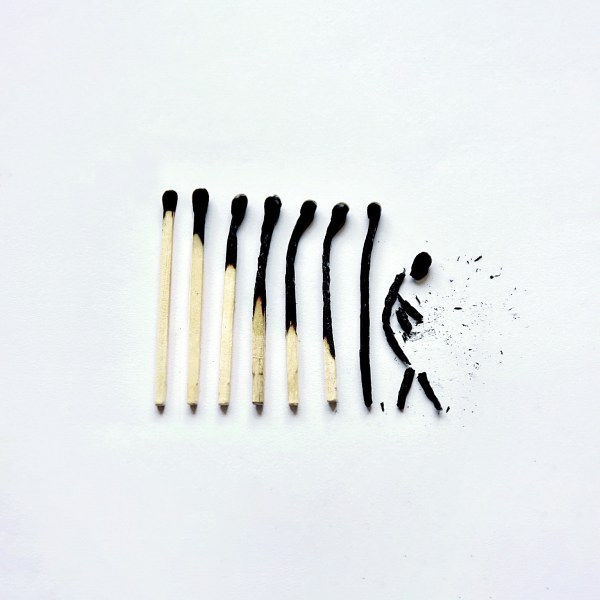
That comfortable drone? That slow, subtle lulling to sleep? That’s exactly what happens to us in ministry.

You’ve been doing this for a while. You know how the meetings run. You know which songs get the congregation moving, which sermon structures get the nods, how to balance the budget, and how to keep the machine humming.

The machine is safe. The machine is predictable. And let’s be honest: the machine is incredibly comfortable.

But here’s the thing about the machine. It doesn’t have a pulse.

We start out in ministry completely leaned in. We are wide awake to the calling. But over time, the wear and tear of the job takes its toll. People are messy. People are unpredictable. People will break your heart, and they will exhaust you, and they will ask questions you don’t have the answers to.

So, what do we do?

We build structures. We retreat to our offices. We dive into the thick theology books. We spend hours tweaking the graphics for the new sermon series. We step back into the spaces we are used to, the spaces where we are the experts, where we are insulated and in control.

Because leaning out is easy. Leaning back is safe.

But out there in the mess, our name is being called.

God is speaking through the unraveling marriage in your congregation. He is speaking through the doubting young adult sitting in the back row. He is calling your name through the marginalized family in your neighborhood who just needs someone to show up.

When we retreat to the comfortable spaces, we stop hearing our name. We start managing instead of ministering. We start preserving instead of pioneering.

Think about the life of Jesus. He didn’t spend a lot of time in the comfortable, predictable spaces. He didn’t build a machine and manage it from a corner office.

John 1:14 says, “The Word became flesh and made his dwelling among us.” He didn’t shout instructions from the safety of the heavens. He moved into the neighborhood. He got dirt under his fingernails. He crashed dinner parties with the wrong kind of people (Mark 2:15).

And he was constantly calling names. He didn’t just wave at Zacchaeus in the tree; he stopped, called him by name, and invited himself into the mess of a despised tax collector’s home (Luke 19:5). He saw Mary weeping at the tomb, blinded by her grief, and the thing that finally broke through the noise wasn’t a theological explanation. It was him, simply saying her name: “Mary” (John 20:16).

He leaned in. And he asks us to do the same.

The heart of ministry isn’t found in the green room. It isn’t found in the flawless, down-to-the-minute execution of a Sunday morning service.

It’s found in the living room. It’s found in the hospital waiting area. It’s found in the quiet, desperate, heavy moments where all you have to offer is your presence.

When we get comfortable, we miss the miracle. We miss the moment the lights finally come on in someone’s eyes. We miss the raw, beautiful redemption of a shattered life being put back together. We miss the very heartbeat of the Divine.

So, here is the invitation.

Listen closely. Through the hum of the church machinery, your name is being called.

How will you respond?


Questions to Consider:

  • Where are your “safe spaces”? What are the tasks, rooms, or routines you retreat to when the messy reality of people becomes too overwhelming?
  • Who is currently “calling your name”? Is there a specific person or situation in your church or community that you have been actively avoiding because it requires you to step out of your comfort zone?
  • When was the last time you felt the “jolt”? Think back to a recent moment in ministry where you were suddenly, acutely aware that God was using you in a raw, unscripted way. How can you posture yourself to experience that more often?
  • Are you managing a machine, or ministering to a movement? If you stripped away the lights, the budget, and the Sunday morning production, what would be left of your ministry?

Step out of the office. Leave the safety of the well-worn path.

Will it be hard? Yes. Will it break your heart? Almost certainly.

But hear your name. Shift your weight. Lean in.

From the Basin to the Bread and Wine: The Beautiful Heart of Maunday Thursday

Hello friends, and welcome back to the blog.

As we journey through Holy Week together, we land on a day with a rather unusual name: Maundy Thursday. If you’ve ever wondered where the word “Maundy” comes from, it’s actually derived from the Latin word mandatum, which means “command.” It refers to the new commandment Jesus gave His disciples on this very night: “Love one another. As I have loved you, so you must love one another” (John 13:34).

But before Jesus ever spoke those words, He gave the disciples—and us—a living, breathing, shocking demonstration of exactly what that kind of love looks like.

If you have a few minutes today, I want to invite you to step into the Upper Room with me. I want us to look at two powerful moments from that evening: the washing of the feet, and the breaking of the bread. Because when we put them side by side, they paint the most beautiful picture of our Savior’s heart.

The Shock of the Basin

Imagine the scene. It’s the Passover feast. Jesus and His closest friends are gathered in a private room. In the ancient Middle East, walking in sandals on unpaved, dusty, animal-trodden roads meant your feet got utterly filthy. It was customary for a servant to wash the guests’ feet as they arrived.

But there was no servant in the Upper Room. And none of the disciples volunteered for the job.

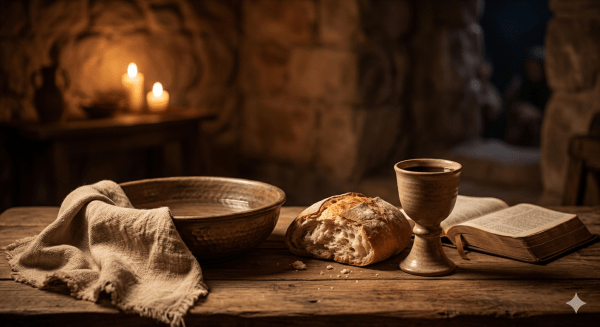
So, in the middle of the meal, Jesus stands up. He takes off His outer clothing, wraps a rough linen towel around His waist, pours water into a basin, and kneels down.

Can you imagine the pin-drop silence in that room? The Creator of the universe, the Messiah, on His knees, washing the grime from the calloused feet of fishermen, tax collectors, and even the man who was about to betray Him. Peter, in classic Peter fashion, tries to put a stop to it: “You shall never wash my feet!” It just felt too wrong, too backward. Kings don’t wash the feet of peasants.

But Jesus was showing them a different kind of kingdom. He was physically acting out the very nature of the Gospel: God coming down, taking the posture of a servant, to cleanse us from the dirt we could never wash off ourselves.

The Bread and the “Remembrance”

With the towel put away and the basin set aside, Jesus returns to the table. And here is where He transitions from the water to the wine.

He takes a loaf of bread, gives thanks, breaks it, and hands it out to those same men whose feet He just washed. He says, “This is my body given for you; do this in remembrance of me” (Luke 22:19). Then He takes the cup, explaining that it represents His blood, poured out for the forgiveness of sins.

We say those words so often in church—“do this in remembrance of me”—that sometimes they can lose their weight. We often think Jesus was just setting up a church ritual for us to follow. And while Communion is a beautiful, sacred sacrament, I think Jesus was asking for something even deeper.

How the Basin Explains the Bread

Why did Jesus wash their feet right before breaking the bread? Because the basin explains the bread.

The foot washing was the prequel to the cross. By kneeling with the towel, Jesus was saying, “Pay attention. What I am doing for your feet tonight, I am about to do for your souls tomorrow.”

When Jesus says, “Do this in remembrance of me,” He isn’t just saying, “Eat this bread and drink this juice so you don’t forget my name.” He is saying, “Remember the basin. Remember the towel. Remember how my body was broken and my blood was poured out to serve you and save you. Now, live your life in that exact same way.”

To “remember” Jesus at the Communion table is to embrace His servant heart. We remember His sacrifice by becoming living sacrifices ourselves. We remember the bread He broke for us by breaking our own pride to serve others. When we forgive an offense, when we show radical hospitality, when we stoop down to help someone who can offer us nothing in return—we are remembering Him. We are passing the bread, and we are picking up the towel.

A Word of Encouragement

Friends, as you step into the heavy, holy reality of Good Friday and the joyous triumph of Easter Sunday, I want to encourage you to linger in the Upper Room for just a moment today.

Before you go out and try to serve the world, let Jesus wash your feet. Let Him love you. Let Him cleanse the guilt, the shame, and the spiritual dust you’ve picked up along the road this week. You don’t have to clean yourself up before you come to His table; He is the one who does the washing.

Accept His profound, humble, beautiful love today. Take the bread. Drink the cup. And then, fueled by His incredible grace, let’s go out and find some feet to wash.

Grace and peace to you this Holy Week,
-Pastor Scott.

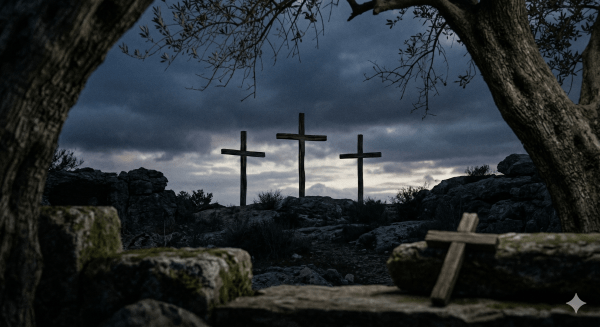
A Pondering on the Shadows: Sitting in the Darkness of Good Friday.

Hello again friends,

Earlier this week, we talked about the temptation to skip straight from the parade of Palm Sunday to the empty tomb of Easter morning. It is so deeply ingrained in our human nature to avoid pain and rush toward the celebration. But as we arrive at Good Friday, I want to gently remind us all: we cannot bypass the cross.

There is a heavy, sacred gravity to today. If Palm Sunday was characterized by loud shouts of “Hosanna,” Good Friday is defined by a profound, agonizing silence.

Think about the sky going dark in the middle of the day. Mark 15:33 tells us, “At noon, darkness came over the whole land until three in the afternoon.” Creation itself couldn’t bear to watch its Maker suffer. We read about the mocking, the physical torture, and the weight of the sins of the world being placed on the shoulders of the sinless Son of God.

It makes me think of another profound thought from C.S. Lewis, this time from Mere Christianity:

“Fallen man is not simply an imperfect creature who needs improvement: he is a rebel who must lay down his arms.”

That is what we see on the cross. Jesus didn’t just die to make bad people good; He died to make dead people alive. He took the rebellion that was rightfully ours and paid the ultimate price to secure our pardon. When Jesus cries out, “My God, my God, why have you forsaken me?” (Mark 15:34), He is experiencing the holy separation that we deserved.

My challenge to you today is this: Do not rush past the shadows.

Take 15 minutes today to just sit in the quiet. Read the crucifixion accounts. Turn off the radio in your car. Put your phone in another room. Let the reality of what it cost to secure your salvation wash over you. We call it “Good” Friday not because the events were pleasant, but because the outcome was the greatest good the world has ever known.

Let’s lay down our arms today, friends. Let’s sit in the quiet reverence of the cross, holding our breath, and waiting for Sunday.


Walking the Path: A Holy Week Scripture Guide

To help you stay grounded in reverence and contemplation this week, I’ve put together a short, daily scripture reading guide. I encourage you to read these passages each morning, perhaps with your coffee, and let them set the tone for your day.

  • Palm Sunday: The Triumphal Entry * Read: Matthew 21:1-11
    • Ponder: Am I seeking a Savior who submits to my will, or am I submitting to His?
  • Holy Monday: Cleansing the Temple
    • Read: Mark 11:15-19
    • Ponder: What distractions or idols need to be cleared out of my own heart this week?
  • Holy Tuesday: Teaching and Controversy
    • Read: Luke 20:19-26
    • Ponder: Am I giving to God what rightfully bears His image—my whole life?
  • Spy Wednesday: The Betrayal
    • Read: Matthew 26:14-16
    • Ponder: In what small ways do I compromise my faith or trade my devotion for worldly comfort?
  • Maundy Thursday: The Last Supper and the Garden
    • Read: John 13:1-17 & Matthew 26:36-46
    • Ponder: Jesus washed feet and surrendered to the Father’s will. How can I serve others and pray, “Not my will, but yours be done” today?
  • Good Friday: The Cross
    • Read: John 19:16-30
    • Ponder: “It is finished.” Rest quietly in the magnitude of His sacrifice.
  • Holy Saturday: The Tomb
    • Read: Luke 23:50-56
    • Ponder: Sit in the silence of waiting. Trust that God is working even when we cannot see it.
  • Resurrection Sunday: The Empty Tomb!
    • Read: John 20:1-18
    • Ponder: He is risen! How does the reality of the resurrection change the way I live today?

Grace and peace on the journey, friends. Let me know in the comments how these readings are shaping your week!

A Pondering on Palms and a Path to the Cross.

Hello friends,

As I sit here looking at the calendar, I realize we are standing right on the threshold of Palm Sunday. It’s hard to believe we are already nearing the end of our Lenten journey, isn’t it?

Whenever this time of year rolls around, I find myself thinking deeply about the stark contrast of the days ahead. Palm Sunday is a day of high energy. We love the waving of the palm branches, the upbeat hymns, and the shouts of “Hosanna!” It feels like a long-awaited victory parade. But as we prepare our hearts for this coming Sunday, I want to invite you to look a little closer at the man riding in on the donkey.

The crowds that day were thrilled. They were throwing their cloaks on the road and cheering for a conquering king. Luke 19:37-38 paints the picture perfectly: “The whole crowd of disciples began joyfully to praise God in loud voices for all the miracles they had seen: ‘Blessed is the king who comes in the name of the Lord! Peace in heaven and glory in the highest!’”

They wanted a political savior. They wanted someone to kick out the Romans and make their lives easier. But Jesus wasn’t riding into Jerusalem to make them comfortable; He was riding in to save their souls. Just a few verses later, as He approaches the city and hears the cheers, Jesus actually begins to weep over Jerusalem. He knew that the very same voices shouting “Hosanna” on Sunday would be shouting “Crucify Him” by Friday.

This brings a profound thought to mind from C.S. Lewis. In his classic The Chronicles of Narnia, Mr. Beaver famously describes Aslan—the Christ figure of the story—by saying:

“Safe? … Who said anything about safe? ‘Course he isn’t safe. But he’s good. He’s the King, I tell you.”

The crowds on Palm Sunday wanted a “safe” king—a tame lion who would do their bidding and fit neatly into their worldly agendas. But Jesus is not a tame lion. The path He was walking didn’t lead to an earthly throne; it led straight to the agonizing wood of the cross. Lewis reminds us that following Christ isn’t about God improving our current circumstances; it’s about a total, reverent surrender of our very lives.

Here is my challenge to you this week:

Do not rush the journey. It is so tempting for us, in our modern, fast-paced world, to show up for the parade on Palm Sunday, check out for the week, and then show up again for the empty tomb on Easter morning. We love the triumph, but we shrink back from the tragedy.

This Holy Week, I challenge you to sit in the uncomfortable, quiet reverence of the season:

  • Pause and reflect: Spend time reading through the events of Maundy Thursday.
  • Sit in the shadows: Allow yourself to feel the heavy, somber reality of Good Friday.
  • Embrace the silence: Recognize the profound stillness of Holy Saturday.

You cannot fully appreciate the blinding, glorious light of Resurrection Sunday until you have spent time contemplating the deep darkness of Friday. Let’s not reduce Jesus to a tame lion this week. Let’s approach the cross with awe, repentance, and a quiet, contemplative reverence for the sheer magnitude of what it cost to save us.

Grace and peace to you all on the journey ahead.

The Sacred Art of the Lukewarm Coffee

So.

It’s February 4th.

We’re officially deep into that “middle” space. The holiday glitter has long since been vacuumed up. The New Year’s resolutions? They’re likely sitting in a drawer or in that “Christmas” closet under the stairs or attic somewhere, right next to that “extra” button you saved but will never actually sew onto your coat.

Maybe you woke up today feeling a little…ordinary.

A little dusty.

A little “I forgot to buy milk and now my cereal is just a bowl of crunchy sadness.”

And we’ve been told, haven’t we?

We’ve been told that the Divine lives in the spectacular. In the mountaintop experiences. In the moments where the music swells, the lights dim, and everything feels “perfect.” We often go out and try to capture that kind of “feeling” over and over again. Sometimes we have bought into the lie that this is the only place or only moment(s) that God shows up.

But what if that’s not the whole story?

What if the Spirit isn’t waiting for you to get your act together?

What if the Creator of the stars and the galaxies is just as interested in your Tuesday morning commute as He is in a cathedral service where everything is on point and the music is studio quality?

Think about it.

The ancient Hebrews had this word: Ruach.

It means breath. It means wind. It means spirit.

It’s the thing that animates everything.

And you’re doing it right now.

(Go ahead. Take a breath. I’ll wait.)

See?

You didn’t have to earn that breath.

You didn’t have to fill out a form or prove you were “holy enough” today to deserve that oxygen.
You didn’t have to perform well enough to receive a nod and an approval for that last inhalation of O2 – no, it’s a gift.

It was just… given.

Gift. Grace. Flow.

There is a rhythm to this life, it’s the cadence beneath the noise of your notifications and your “to-do” lists. And that hum, that cadence is saying one thing over and over:

You are here. You are seen. You are loved.

Not the “future, improved version” of you.

Not the you that finally loses the ten pounds or finally masters that sourdough starter (I see you, friend on facebook).

This you. The one with the mismatched socks and the slightly-too-full inbox.

So today, if things feel a bit messy?

If you drop your toast face-down or the dog barks right when you start your Zoom call?

Smile.

Maybe even laugh.

Because the Light isn’t waiting for the cracks to be fixed. The Light is specifically designed to shine through the cracks.

The mess isn’t an obstacle to the sacred.

The mess is the sacred.

May you find the wonder in the mundane today.

May you realize that your very existence is an act of worship.

And may you know, deep in your bones, that you are exactly where you need to be.


Grace & Peace,
-Pastor Scott.

The Grace Expert & The Eight Year Secret.

The news about Philip Yancey is the kind of thing that makes you set your coffee down and just stare out the window for a while.

If you’ve spent any time in the “thinking” corners of the church, Yancey has probably been a companion of yours. His books—What’s So Amazing About Grace? and The Jesus I Never Knew—weren’t just bestsellers; they were lifelines. He was the guy who gave us permission to admit that faith is often a mess of doubt and shadow. He made grace feel like something sturdy enough to hold our weight.

And now, we’re processing this: an eight-year affair. With a married woman. All while he was the face of modern Christian grace, writing the books and speaking at the conferences. He came forward himself, stepped down, and admitted he had “disqualified” himself.

It’s a gut-punch. Not because we’re naive enough to think Christian leaders don’t fail—we know better by now—but because of the specific nature of this failure. It forces a terrifying question: How does someone spend nearly a decade describing the heart of God while their own heart is miles away?

The Art of the Split Life

History is littered with this kind of thing. King David wrote the most beautiful poetry in the Bible while his hands were literally stained with the blood of a man he had murdered to cover an affair. Peter preached the gospel after denying he even knew Jesus.

But Yancey’s situation feels like a very modern, very quiet tragedy. Eight years isn’t a “moment of weakness” or a one-time lapse in judgment. It’s thousands of small, daily choices to live a double life. It’s a sustained effort to keep the “Public Grace Expert” and the “Private Transgressor” from ever meeting in the same room.

It makes you wonder about the words he wrote during those eight years. Were they hollow? Or were they something more tragic—a cry for help from a man who knew the truth of grace but felt he had drifted too far out to actually touch it?

The Myth of Compartmentalization

We like to think we can keep our lives in separate boxes. We tell ourselves, “This secret part of me doesn’t affect my work for God.” But the soul doesn’t work that way. When we live in contradiction, something begins to atrophie.

In church circles, we talk about accountability and integrity so much that the words have lost their teeth. We’ve turned accountability into a polite “how are you doing?” over lunch. But real integrity isn’t about being perfect; it’s about alignment. It’s making sure the person people see on the stage is the same person sitting alone in a hotel room.

When that alignment snaps, we start performing. We use the right “Christianese,” we hit the right emotional notes in our prayers, and we learn how to fake the glow of a spiritual life that has actually gone cold on the inside.

The Quiet Creep of Atrophy

Spiritual decay doesn’t usually happen overnight. It’s a slow, subtle erosion.

  • It starts when you’re “too busy” for your own soul because you’re doing “the Lord’s work.”
  • It grows when you justify a small compromise because, hey, look at all the good you’re doing.
  • It solidifies when you realize you’re good at pretending—and that everyone believes the act.

Eventually, you aren’t living a faith; you’re managing a brand. You become a professional at describing a God you no longer talk to in private. That is the real danger of ministry: you can become so familiar with the language of God that you lose the fear of Him.

Where Does This Leave Us?

The “good” news—if we can call it that—is that Yancey chose to stop the clock. He chose to step into the light, however late, and own the wreckage. That is an act of integrity, even if it’s the final, painful act of a career.

But his story should be a mirror for the rest of us. It’s a warning not to wait for the “big fall.” It’s a call to look at the gaps in our own lives—the places where we are pretending, the secrets we’re guarding, and the ways we’ve let our public persona outpace our private character.

Grace is big enough for Philip Yancey. It’s big enough for the woman involved. And it’s big enough for us. But grace is never an excuse to stay in the dark; it’s the power that allows us to finally come clean.

Let’s stop posing and start being honest. Because a broken person who is honest is much more useful to God than a “godly” person who is lying.

Grace, Peace & Accountability
-Pastor Scott.

Rediscovering the Liminal Spaces: Finding God in the In-Between

Hey friends & fellow ponderers, I hope you’re having a great beginning of this new year!
If you’re anything like me, your days feel like a whirlwind of notifications, to-do lists, and that ever-present thrumming in my brain of “just one more thing” before I collapse into bed.

Lately, I’ve been pondering those elusive moments we call liminal spaces—the thresholds, the pauses, the in-between spots where life isn’t quite one thing or another. You know, like the quiet drive home after a long day, or the hazy dawn before the coffee kicks in. But in our hyper-connected, always-on kind of world, these spaces seem to be shrinking, swallowed up by distractions and stresses that leave us breathless and a little bit lost. And so I find myself in search of the liminal, quiet self-reflection moments where I can re-charge my spirit, body and soul.

I truly believe that the sacred is very real and present with us in our daily lives. God desires to enter into our hearts and minds moment by moment, but our days are often consumed with distractions and noise. The sacred is closer than our next heartbeat, His presence fills our lungs, but we must become aware of this sacred space! That’s the kind of presence and spirit I’m trying to remind us of today as we talk about rediscovering these liminal spaces. Because if I’m honest: in the rush of parenting, work deadlines, social media scrolls, and even church commitments, we’ve forgotten how to linger in the thresholds where God often whispers the loudest.

What are liminal spaces, anyway? I’m sure some of you are wondering about that and what the definition could be. Well, think of them as the doorways between what was and what will be. In anthropology, they’re those rites of passage—leaving home for college, the wait between a diagnosis and treatment, or even the silence after a heated argument. Spiritually speaking, they’re the wilderness wanderings in Scripture: Moses on the mountain, Jesus in the desert, or Mary at the tomb before the resurrection dawn. These aren’t just empty voids; they’re fertile ground for transformation, where the old self sheds and something new emerges. But here’s the rub: in our culture of constant stimulation, we fill every gap with podcasts, emails, or endless streaming. We avoid the discomfort of limbo because it feels unproductive, even scary. Yet, it’s in those very uncertainties that we encounter the divine mystery—not in neat answers, but in the holy questions. Amid the distractions—those pings that pull us away from presence—and the stresses of living (bills, relationships, global chaos), we’ve lost touch with the rhythm of rest that God built into creation.

Remember the Sabbath? It’s not just a day off; it’s a liminal space baked into the week, a threshold where we step out of striving and into being. But how often do we treat it like another slot to fill? The same goes for our prayer lives. Prayer isn’t a checklist item – and it was never meant to be a checklist to cross off when we complete them. No, instead, it’s an invitation to solitude, to sit in the in-between with God, where the noise fades and the soul finally gets a chance to breathe.

So, how do we rediscover these spaces? It starts with intention, with carving out disciplines that feel countercultural. A healthy prayer life isn’t about eloquent words; it’s about being present, even when it’s awkward. And what about solitude? It’s not loneliness—it’s the deliberate choice to unplug, to walk in the woods or sit in a quiet room, letting the liminal wash over us. I’ve found that starting small helps: five minutes of silence before checking my phone in the morning, or turning off the radio during my commute to let thoughts wander toward God.

But let’s get a little more practical and a bit more introspective, shall we? Here are some crucial questions we can ask ourselves to rediscover the importance of seeking out these liminal spaces, nurturing a vibrant prayer life, and embracing the discipline of solitude. I encourage you to jot them down, mull them over in your journal, or share them with a trusted friend. They’re not meant to guilt-trip but to gently guide us back to the thresholds where grace awaits:

Questions to Ask Ourselves

  • When was the last time I allowed myself to linger in uncertainty without rushing to fill it? What fears come up when I think about pausing in the in-between?
  • How do my daily distractions—social media, work, even good things like family obligations—keep me from noticing God’s presence in the ordinary transitions of life?
  • What does my prayer life look like right now? Is it a hurried monologue, or am I creating space for listening, for the liminal dialogue where God might surprise me?
  • In what ways have I avoided solitude, and why? Could embracing alone time—without devices or agendas—open me up to deeper spiritual growth?
  • Looking back, can I identify a past liminal space where transformation happened? How might seeking similar spaces now help me navigate my current stresses?
  • What one small step could I take this week to invite more liminality into my routine—like a tech-free walk or a bedtime reflection—and how might that strengthen my connection with God?

Friends, rediscovering liminal spaces isn’t about adding more to our plates; it’s about subtracting the noise to reveal what’s already there: a God who meets us in the thresholds, not despite the chaos, but right in the midst of it. Faith isn’t about certainty; it’s about wrestling, wondering, and waiting together. So, let’s commit to seeking those in-between moments, to praying with open hands, and to solitarily savoring the sacred. Who knows what new life might emerge on the other side?I’d love to hear your thoughts—drop a comment below or shoot me an email. Until next time, may you find peace in the pauses.

Grace and ponderings,
-Pastor Scott

The Threshold of 2026: What if we stopped “Fixing”?

We’re standing on it again. That invisible line.

One second it’s 11:59 p.m. on December 31, 2025, and the next, we’ve crossed over into 2026. We act like the air changes, don’t we? Like the molecules of the universe suddenly rearranged themselves because a calendar page turned.

We call them “Resolutions.” But if you look at that word—resolution—it’s about finding a solution. It implies that you, as you are right now, are a problem to be solved. A leak to be plugged. A glitch in the system that needs a software update.

But what if 2026 isn’t about “fixing” the old you?

What if the “New Year” isn’t a demand for a better version of yourself, but an invitation to finally meet the real one?
I’ve met so many people in my life, and I don’t want to sound judgmental, but I can automatically tell when someone is simply putting on a mask and living a fake life for others to see. Sometimes people do this to impress others, while some pretend instead of live a real life because they fear what people might think if they ACTUALLY ‘let their hair down’.

But what would happen in 2026 if we all just stopped pretending, and started living our lives with authenticity without fear of judgement?

The Rhythm of the New

In the Hebrew scriptures, there’s this beautiful, recurring idea that God is “doing a new thing.” But “new” in the biblical sense isn’t usually about replacement. It’s about renewal. It’s like a tree in winter. It looks dead. It looks stagnant. But deep in the soil, in the dark, silent places where no one is taking selfies or posting updates, something is shifting.

The tree isn’t trying to be a different tree in the spring. It’s just becoming more of what it already is.

So, as we stare down the barrel of 2026, I have some questions. Not the “How much weight do you want to lose?” kind of questions. The other kind. The kind that sit in the pit of your stomach:

  • What are you carrying into this year that isn’t actually yours to carry? Is it a parent’s expectation? A former version of yourself that you outgrew three years ago? A shame that has already been forgiven but you keep in your pocket like a lucky charm?
  • What would happen if you stopped trying to “arrive”? We spend so much energy trying to get somewhere else. To the next job, the next relationship, the next tax bracket. But what if the Divine is actually in the here? What if the burning bush is right in your backyard, but you’re too busy looking at a map of a different forest?
  • Where is the “New” already happening? Look at your life. Not the big, flashy stuff. Look at the small, quiet pulses of grace. The friend who actually listens. The way the light hits the floor at 4:00 p.m. The fact that you’re still breathing.

The Sacred Middle

2026 will have its share of mess. We know this. There will be moments of stress, anxiety, problems – and much more. There will be moments where you feel like you’re failing at everything. I don’t want to dismiss that these kinds of events will most likely happen to us all in 2026.

But the Gospel—the “Good News”—isn’t that life becomes a straight line of success. It’s that even in the mess, even in the “not-yet-resolved” parts of our lives, there is a Presence. A “With-ness.”

Jesus didn’t say, “I have come so that you might have a perfectly organized life and a 401k.” He said he came so we might have Life. Abundant, vibrant, messy, holy, complicated Life. Emmanuel = God – with us. God connected to us. God in relationship with us every. step. of. the. way. (full stop, no flimsy/flip-flopping decisions – He’s all-in with your life! He’s fully invested in YOU!)

A Pondering for the Road

As you step across that threshold into 2026, maybe skip the “To-Do” list for a minute. Try a “To-Be” list.

  • To be… present.
  • To be… kind to yourself when you stumble.
  • To be… open to the idea that God likes you exactly as you are, even as He invites you into who you are becoming.

The calendar is turning tomorrow at 11:59pm.
The sun will rise. And the Spirit is already there, whispering, “Let’s see what we can make of this together.”

Grace and Peace to you in 2026.
-Pastor Scott.

Christmas For The Burned Out & Lonely

Hey there,
You know, Christmas rolls around every year like clockwork, with all the lights and carols and that relentless push to feel jolly. But what if you’re just… not?

What if the whole thing feels like one more obligation in a world that’s already worn you thin? Maybe religion has left you bruised—too many rules, too much hypocrisy, or just a sense of “been there, done that, and it didn’t fix anything.”

Or perhaps life’s handed you a raw deal this season: loss, loneliness, that ache that won’t quit. If that’s you, pull up a chair.

Let’s talk about this birth story in a way that doesn’t demand you fake a smile or force some festive vibe. Think about it: the original Christmas wasn’t some Hallmark movie with perfect snow and warm fuzzies. It was messy. A young girl, Mary, pregnant out of wedlock in a culture that could’ve stoned her for it. Her fiancé Joseph, wrestling with doubt and whispers from the neighbors. They’re trekking to Bethlehem because some distant emperor decided it was census time—no choice, no comfort. And when they get there? No room. Just a stable, probably smelling like hay and animals, with a feed trough for a crib.

Friends, God shows up not in a palace, not with fanfare and fireworks, but in the dirt and the dark, right in the middle of our human exhaustion. Isn’t that something? I think we have to pause right here and now and truly appreciate that God comes to our level, when we least expect it and when we are far from prepared.

The divine slipping into our world NOT when everything’s polished and pretty, but when it’s all falling apart. Jesus’ first breath wasn’t in a cathedral, or a stately Martha Stewart like Maine Mansion decked out for a Hallmark movie filming; no, it was in the chaos. Shepherds—outcasts, night-shift workers—were the first to hear the news, not the religious elite.

And those wise men? They came later, from far away, following a star that didn’t make a lick of sense. This story whispers that the sacred doesn’t wait for you to get your act together. It meets you where you are: burnt out, skeptical, hurting. So if you’re not feeling the “spirit” this year, maybe that’s okay. Maybe the real spirit of Christmas is the one that says, “I see you in your weariness, and I’m here anyway.” I mean, come one, how encouraging and relieving is there?! God sees us, and he desires to be present with us – not to fix it all with a bow on top, but to sit with you in it. To remind you that love—the kind that’s bigger than religion’s boxes—enters quietly, like a baby in a manger. It’s not about mustering up faith or forcing joy; it’s about noticing that glimmer, however faint it might be, in the ordinary mess that is your life right now.

What if, just for a moment, you let that in? No pressure, no guilt. Just breathe. Look around at the people who show up for you, the small acts of kindness that sneak through. Or, perhaps, stare at the stars and wonder if there’s something more, something that doesn’t demand perfection from you.

Jesus’ birth was an invitation to the weary: come as you are. You’re not too broken, too doubtful, or too done with it all. In fact, that’s exactly where the light breaks through.

So – hang in there. The story’s not over. And neither is yours.
Perhaps just rest in the knowledge that Jesus came to this earth because of you. Let that wash over you, and ponder on it.
Grace and peace,
-Pastor Scott

Blog at WordPress.com.

Up ↑