Breaking the Silence: A Pastor’s Pondering on Mental Health

Hey there, friends, happy Monday! In just a few days it will be May, and May is Mental Health Awareness Month. So, I thought it would be helpful to write about this topic today. Mental health can, unfortunately be a taboo topic often tiptoed or whispered about in church hallways or avoided altogether because it feels too raw, too messy, too…unspiritual. But what if I told you that mental health is as much a part of our sacred journey as prayer, worship, or loving our neighbor? What if the struggles we face in our minds are not a sign of weakness but an invitation to deeper grace?

A while back, I sat down with a colleague at work (I work for a Mental Health non-profit), we’ll call her Lisa (that’s not her real name), a counselor who’s spent years walking alongside folks wrestling with anxiety, depression, and everything in between. I wanted to know: Why is it so hard for us, especially in the church, to talk about mental health? Why do we slap a stigma on it like it’s something to be ashamed of? And what would it look like for us to tear that stigma down, brick by brick, and build something new in its place?

Lisa leaned back in her chair, her eyes soft but piercing, and said something that stuck with me: “Scott, we’ve got this unspoken rule in a lot of churches. It’s like, if you’re struggling mentally, you’re somehow failing at faith. Like your depression means you don’t trust God enough or your anxiety is a lack of surrender. But that’s not how it works. That’s not how any of this works.”

And I felt that. Deep in my gut. Because I’ve seen it. I’ve seen the way we sidestep conversations about mental health in our congregations. I’ve seen the way people hide their pain because they’re afraid of being judged, of being told to “just pray harder” or “give it to God.” I’ve seen it in my own life, too. There was a season when I was carrying so much—pastoring a church, raising kids, trying to be a good husband—and I felt like I was drowning. I didn’t have the language for it then, but looking back, I was wrestling with anxiety. And you know what? I didn’t tell a soul. Not because I didn’t want help, but because I was terrified of what people would think. A pastor with anxiety? Come on, Scott, pull it together.

But here’s the thing: God didn’t create us to hide. From Him, from each other, from ourselves. Genesis tells us we were made in God’s image, fearfully and wonderfully crafted, every part of us—our hearts, our minds, our messy, beautiful, complicated souls. And when our minds hurt, when our thoughts spiral, when the weight of the world feels like too much, that’s not a betrayal of God’s design. It’s part of being human in a broken world.

Lisa put it this way: “Mental health struggles are like any other kind of pain. If you break your leg, you don’t sit there and pray for the bone to magically heal while refusing to see a doctor. You get a cast, you do the physical therapy, you let people help you. Why should it be any different with our mental health? Therapy, medication, support groups—these aren’t signs of failure. They’re tools. They’re gifts.”

That hit me hard. Gifts. What if we started seeing mental health care as a gift? Not just for the person struggling, but for the whole community? Because when one of us is hurting, we’re all hurting. And when one of us finds healing, we’re all lifted up. That’s the body of Christ, right? We carry each other’s burdens. We celebrate each other’s victories. We don’t leave anyone behind.

So, let’s talk about the stigma. Where does it come from? I think part of it is fear. We’re afraid of what we don’t understand. Mental health can feel like this big, mysterious thing, and it’s easier to push it away than to lean in and listen. Part of it is history, too. For a long time, the church hasn’t known what to do with mental health. We’ve leaned on spiritual answers for everything, and while I believe with all my heart that God is our ultimate healer, I also believe He gave us brains to create medicine, hearts to offer compassion, and communities to hold each other up.

And let’s be honest: sometimes it’s pride. We want to look like we’ve got it all together. We want to be the strong ones, the faithful ones, the ones who never waver. But you know what’s stronger than pretending you’re fine? Being honest. Saying, “I’m not okay right now.” That takes courage. That takes faith. That’s the kind of vulnerability Jesus modeled when He wept in the garden, when He cried out on the cross. If the Son of God can be honest about His pain, why can’t we?

So, what do we do? How do we start breaking the silence? I don’t have all the answers, but I’ve got a few ideas, and I’d love to hear yours. First, let’s talk about it. Like, really talk about it. In our sermons, in our small groups, in our coffee shops and living rooms. Let’s normalize conversations about mental health the way we normalize conversations about physical health. Let’s share our stories—not to compare pain, but to remind each other we’re not alone.

Second, let’s educate ourselves. Pastors, I’m looking at us. We don’t have to be therapists, but we can learn enough to recognize when someone’s struggling and point them toward help. We can partner with counselors, host workshops, create spaces where people feel safe to say, “I need support.” And we can preach about mental health with the same compassion we bring to any other part of the human experience.

Third, let’s be the church. The real church. The one that shows up with casseroles and prayers and listening ears. The one that doesn’t judge or fix, but just sits with people in the mess. The one that says, “You are enough, just as you are, and God loves you right here, right now.”

I think about Jesus a lot when I ponder this stuff. Jesus, who met people where they were. The woman at the well, carrying her shame. The man possessed by demons, crying out in torment. The disciples, scared and doubting. Jesus didn’t turn them away. He didn’t tell them to get their act together first. He saw them, loved them, and offered them a way forward. That’s our model. That’s our call.

So, friends, here’s my invitation to you: Let’s be a community that breaks the stigma. Let’s be a place where people can say, “I’m struggling,” and hear, “I’m here with you.” Let’s be a church that doesn’t just talk about grace but lives it, especially when it comes to mental health. Because the God who knit us together, who knows every thought before we think it, is not ashamed of us. Not ever.

What do you think? What’s one step you could take to start this conversation in your own life or community? Drop a comment below or shoot me an email—I’d love to keep this going. Until then, keep pondering, keep praying, and keep showing up for each other. We’re in this together.

Grace and peace,
-Pastor Scott.
The God of Hope in the Mess of Now

Hey friends, so let’s talk about this thing called hope. Because if you’re anything like me, you’ve looked around lately—March 11, 2025, to be exact—and thought, What is even happening? The news is a dumpster fire of chaos, your inbox is a landfill of urgent emails, and maybe your own life feels like it’s teetering on the edge of something you can’t quite name. Uncertainty—it’s the air we’re breathing these days, isn’t it? Like the weather can’t decide if it’s winter or spring, and neither can we.

And yet, there’s this line. This ancient, electric line from a guy named Paul, who wrote it in a letter to some friends in Rome. He says, “May the God of hope fill you with all joy and peace as you trust in him, so that you may overflow with hope by the power of the Holy Spirit” (Romans 15:13). I mean, come on. Read that again. The God of hope. Not the God of certainty, not the God of perfect five-year plans, not the God of “everything’s fine if you just try harder.” The God of hope. That’s who we’re dealing with here.

What if that’s the point? What if hope isn’t about knowing how it all turns out, but about trusting that there’s something—Someone—holding it all together, even when it feels like it’s falling apart? Because let’s be honest: we’re not great at uncertainty. We like maps. We like GPS. We like “arrival time: 6:42 p.m.” But life doesn’t work that way, does it? Life is more like those old sailing ships, where you’re out on the water, the wind’s howling, and you’re just hoping the stars show up at night to tell you where you’re going.

I was thinking about this the other day while drinking coffee—black, no sugar, or cream – because, like every day for me, you just need the bitter to wake you up. I was sitting there, watching some people from next door rush by outside the window, and it hit me: we’re all carrying something. A worry. A question. A what if. Maybe it’s the job that’s hanging by a thread, or the kid who’s not talking to you anymore, or the planet that feels like it’s groaning louder every day. And in the middle of that, Paul’s got the nerve to say, “May the God of hope fill you with all joy and peace.” Joy? Peace? Now? Really, Paul?

But here’s the thing: he’s not talking about a feeling. He’s talking about a filling. A pouring-in. Like the way rain soaks the ground after a drought. It’s not instant. It’s not a switch you flip. It’s a process, a trusting, a leaning into this God who doesn’t run from the mess but steps right into it. The same God who, a couple thousand years ago, showed up in a body—Jesus—and said, “I’m here. With you. In this.” That’s what hope looks like. It’s not the absence of uncertainty; it’s the presence of something bigger.

So what does that mean for us, today, in the thick of 2025? Maybe it means we stop waiting for the uncertainty to clear up before we start living. Maybe it means we take a deep breath—right now, try it—and let that joy and peace sneak in, even if it’s just a crack of light through the blinds (my bedroom blinds are currently broken at the bottom and a lot of light seems to peak in). Maybe it means we trust that the Holy Spirit that Paul is talking about and is already at work, stirring something up in us, something that overflows. Not just trickles. Overflows. Like a cup that can’t hold it all, spilling out onto the people around us.

I don’t know what your uncertain thing is today. Maybe it’s huge, global-sized, or maybe it’s small, quiet, the kind you don’t tell anyone about, but the anxiety is still building inside you. But what if you didn’t have to carry it alone? What if the God of hope is already there, in the middle of it, whispering, “I’ve got this. And I’ve got you. And I’m not going anywhere, I’m here with you!”? What if hope isn’t about escaping the storm, but about dancing in the rain —not because you’re naive but because you know the One who made the clouds? And you know the One who can calm that storm with just His words – He’s in the boat with you, right now.

So here’s your invitation: trust. Just for a moment. Lean into that God of hope. Let the joy and peace fill you, even if it feels ridiculous at first. And see if that hope doesn’t start to spill over. Because the world? It’s thirsty for it. And you might just be the one carrying the cup.

Grace and Peace,
-Pastor Scott.

Untangling the 3 AM Knot: God, Fear, and Your Bank Account.

Alright, friends, happy Wednesday!
Let’s talk about that knot in your stomach. Yeah, that one. The one that starts small, maybe a little flutter, and then BAM! It’s full-blown, industrial-strength worry leading into the spiral that is anxiety.
It’s the kind that keeps you up at 3 AM, staring at the ceiling, wondering if you’re ever going to catch a break.

We’ve all been there, right?
The bills pile up, the job situation gets shaky, and the future looks like a blurry, anxiety-inducing mess.
And fear? Oh, fear loves to whisper those “what ifs” into your ear, painting worst-case scenarios like a twisted Picasso.
It’s like your brain is running full-speed into its own horror movie, and you’re the star, and not in a good way.

Now, here’s the thing. We live in a world that sells us solutions.
“Just work harder!” “Invest smarter!”
“Manifest your dreams!” And sure, there’s some truth in taking action, in being responsible.
But what about when you’ve done all you can, and the weight still feels crushing?
When you’re running on empty, you have blisters on the palms of your hands from holding on so tightly and doing all that you can, but it’s just not enough? What about these times?
We’ve all been here in this place, right? It’s a very unsettling place to live, let alone linger because you have no other choice.

That’s where we get to the heart of it.
That’s where we get to the wild, beautiful, utterly disruptive message of Jesus.

See, the ancient Hebrew word for “worry” is related to the word for “divided.”
Think about that.
When we’re caught in the spin cycle of worry, our attention is split.
We’re pulled in a million directions, our focus fractured, our peace shattered. We experience that unsettling place some of us call ‘limbo’ and we’re living in a state of internal civil war.


I hope that as you read this, you’re not experiencing anxiety symptoms because let me share with you the cure.
It’s not a one-shot-one-cure, it’s a gradual thing. It’s a prescription that will help to pull us back from whatever ledge we find ourselves standing on in those limbo moments. So here it is:

Jesus invites us to something different. He says, “Don’t worry about tomorrow, for tomorrow will worry about itself. Each day has enough trouble of its own.” (Matthew 6:34). Now, he’s not saying we should be irresponsible. He’s not saying we should ignore our problems. He’s pointing to something deeper, something more fundamental.

He’s saying, “Pay attention. Look around. See the birds of the air? See the lilies of the field? They don’t toil or spin, yet your heavenly Father feeds and clothes them. And aren’t you worth much more than they?” (Matthew 6:26, 28-30).

I’ve written about this topic before, and I have to admit this is still hard for me…how about you?

This isn’t about some simplistic, “just have faith” platitude. It’s not some sort of stupid mantra about “if you just pray harder…” It’s about recognizing the reality of God’s presence, the reality of God’s care.
It’s about shifting our gaze from the swirling chaos in that limbo space where we’re just treading water…shifting our gaze to the steady, unwavering love that surrounds us.

Think of it like this: you’re in a boat in the middle of a storm. The waves are crashing, the wind is howling, and you’re terrified you’re going to sink. But then, you remember that the ocean itself is held in God’s hands. (please don’t sing “He’s got the whole world in His hands”)


But seriously, the storm doesn’t change that. The fear doesn’t change that.
But KNOWING that God’s got you changes that.

And yeah, the financial burdens? They’re real.
The stress is real. The “insufficient balance notices” – they’re real.
But here’s the thing: God isn’t surprised by your bank statement.
God isn’t shocked by the state of the economy. (or the cost of eggs)
God’s bigger than all of that.

He’s invited us to a life of trust, a life of surrender. Not a blind, passive surrender, but an active, engaged surrender.
A surrender that says, “God, I’m in way over my head. I’m scared. But I trust that you’re here. I trust that you’re working, even when I can’t see it. I trust that you’re making a way, even when it looks impossible.”

And sometimes, that way might look like a new job opportunity.
Sometimes, it might look like a helping hand from a friend.
Sometimes, it might look like an appointment made with a therapist (I’m serious, your mental health is important!)
Sometimes, it might look like a deep, inexplicable peace that settles over your soul, even in the midst of the storm.

It’s not about getting everything figured out – it’s never been about that.
It’s about knowing that you’re not alone.
It’s about remembering that you’re held, you’re loved, you’re seen.
And that, dear friends, that’s enough. That’s more than enough.

So, take a deep breath today in whatever limbo you find yourself in.
Let go of the knot in your stomach.
And remember, you’re not divided.
You’re held. You’re whole. You’re loved.
And that changes everything.

Grace & Peace,
-Pastor Scott.

Bits and Peaces

“Peace I leave with you; my peace I give you…” John 14:27

We all find ourselves in places of anxiety and stress from time to time.
There are moments when such stress can lead to health issues and at the very least panic attacks.
Stress like this is never helpful or healthy, it can debilitate us and leave us feeling beaten and broken.
There are moments in my life when I have felt as if I am barely staying afloat as the waters seem to crest over me…it isn’t a pleasant feeling…it is often a very frightening and unsettling moment.

stormsPerhaps you too have experienced these ebbs and flows of stress and anxiety.
Like wading at high-tide the waves crash into you go back out only to collect more strength in order to do it all again…If left unchecked they can eat away at you, hollowing you out until you are just a shell of what you once were.  When moments like these come sometimes we buy into a lie.  What is this lie you ask?  It is the lie that we accept as truth…the lie that tells us that we never truly trusted God…the lie that sometimes even extends to include “God has never actually been here for you anyway…where is He now?”

Just like that ebb and flow of the ocean of stress, these lies can seep into our hearts until we accept them as truth.  BUT the truth is amidst the cascading surge of anxiety there is STILL hope!  There is STILL love.  There is STILL protection and grace…there is STILL RESCUE AND PEACE.  Jesus, the very same Lord of our lives who promised to provide His peace to His followers (which includes me and you) is with us, His life sustaining presence can give us peace and He can calm the storms in our lives no matter how fierce they may be.

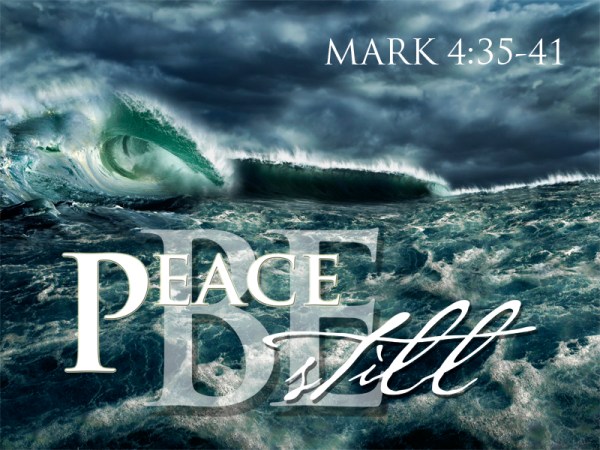
storm1Do you remember the disciples thrashing about in a boat in fear as a mighty storm threatened to capsize them?  Do you remember where Jesus was at that moment?  (Read Mark 4:38)  He was asleep in the stern of the boat.  ASLEEP!  His disciples were extremely afraid and their Rabbi and teacher was asleep.  They call out to Him, they wake Him with their concerns…so what did Jesus do?  He got up and commanded the storm to be still.  Sure, the disciples were scolded for having little faith, but consider the might of Jesus -with. His. Words. He. Calms. The. Storm.  – WHAT???  Yes, with mere words spoken by Jesus, the storm completely stops.

Do you have any storms in your life that need to be stopped?
Are the storm clouds brewing around you?
Is your stress level through the roof and you can’t seem to find that peace that was promised?
Are you picking up the bits and pieces?  Do not be afraid, He is with you!  Even if you doubt, He can come through for you.  Don’t buy into the lie that you are beyond saving or that He isn’t listening…He can will calm the storms…just cry out to Him!

**I should also point out that if you suffer from depression, stress, anxiety and a slew of other constant struggles that it isn’t a sign of weakness to seek out counseling and help.  God has placed some very gifted counselors around us to help us.  Don’t ignore the warning signs.  Don’t feel as if you can “manage” it on your own, seek help and find this peace too!**

God can help you pick up the bits and pieces replacing it with peace.
Trust Him!
Something more to ponder today…To God be the glory!

Blog at WordPress.com.

Up ↑