
Running on Lukewarm Coffee: Grace for the Long Middle

Hey everyone, let’s talk about something we all go through but rarely enjoy: the middle.

You know exactly what I mean. The middle is that awkward, sometimes exhausting space between starting a journey and actually arriving. It’s the long stretch of highway where the adrenaline of the departure has completely worn off, but the destination is still nowhere in sight.

Think about the start of any grand adventure. The beginning is always fueled by vision, fresh energy, and an upbeat playlist. You are running on the sheer, intoxicating excitement of stepping out in faith. The end of the journey is just as compelling, fueled by pure anticipation. You can finally see the finish line, the relief is palpable, and the promise of rest gives you a sudden, miraculous second wind.

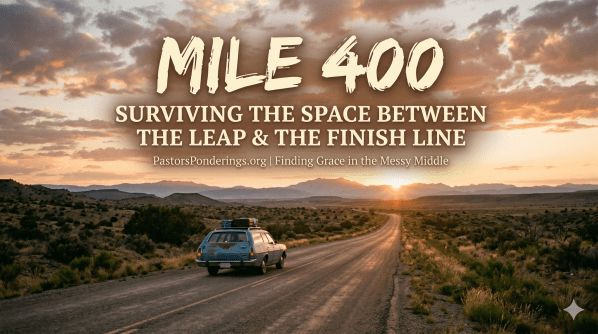
But the middle? The middle is mile 400 of an 800-mile road trip. The coffee is lukewarm, the scenery has blurred into a monotonous gray, and the silence in the car is no longer peaceful—it’s just heavy. The beginning simply requires a leap of faith, and the finish line just asks for a final sprint. But the middle requires grit. It demands relentless endurance and a stubborn refusal to quit when the excitement fades.

This “middle space” isn’t just about road trips, though. It creeps into every significant aspect of our daily lives and our spiritual walks. It’s month three of trying to build a new habit, where the initial motivation is completely gone but the life-changing results haven’t shown up yet. It’s the second year of launching a ministry or a business, where the launch-day applause has faded and you are left staring at the unglamorous, daily grind. We feel it in the hard, sanctifying work of marriage or parenting when the honeymoon phase is a distant memory, but the deep, quiet comfort of a fifty-year anniversary is still decades away.

And we certainly feel it in our faith. It’s that agonizing silence between praying a desperate, tear-soaked prayer and actually seeing God’s hand move in our lives.

It is right here, in this messy middle, where the enemy of our souls loves to pull up a chair and plant seeds of doubt. The middle is incredibly vulnerable. Without the hype of the start or the reward of the finish, our minds start to wander. This is the exact spot where we start asking dangerous, anxiety-ridden questions. We wonder if we actually heard God correctly, or if we just made the whole thing up in our heads. We start agonizing over whether taking that leap of faith was a massive mistake, and we question if it’s even worth it to keep putting one foot in front of the other.

If you are feeling the heavy, unglamorous weight of the middle today, I want you to know that your exhaustion is entirely valid. Feeling tired here doesn’t mean your faith is broken, and it certainly doesn’t mean you’ve taken a wrong turn or that God has abandoned you. It simply means you are in the crucible of endurance—the exact place where your spiritual muscle is built.

In our spiritual lives, the middle is often where we do the most growing, but let’s be honest—it’s also where we do the most groaning. Think about the Israelites for a second. The parting of the Red Sea was a miraculous, thrilling beginning, and the Promised Land was a glorious finish line. But the wilderness? That was a long, dusty, frustrating middle.

Maybe you’re in a “middle” season right now. You’re praying for a breakthrough in your health, your family, your career, or your peace of mind. You know God is faithful, but frankly, you’re just really tired of sitting in the waiting room.

Here is the encouragement I want to leave you with today: God does some of His most profound, beautiful work in the messy middle. The waiting isn’t a waste; it’s a workshop. He is actively shaping your character, deepening your reliance on His strength, and preparing your heart to carry the weight of the blessing that’s coming.

When the middle gets overwhelming, remember that you don’t have to have it all figured out. You just have to stay tethered to the One who holds it all together. Take a deep breath today. He hasn’t forgotten you, and He isn’t finished yet. I hope that you find encouragement in this truth today!

Before you close this tab and step back into your day, I’d love for you to grapple with these two questions:

  1. Where in your life are you currently rushing the process instead of trusting the Maker?
  2. If you viewed your current waiting season as a “workshop” rather than a “delay,” how would that change the way you walk through it today?

Something more to ponder today.
-Grace & Peace
Pastor Scott.

The Sacred Art of Being Right Here

(and avoiding the trappings of this fast-paced life)

You’re probably busy right now.

Maybe you’re reading this on your phone while waiting in line at the grocery store.

Or maybe you’ve got a dozen tabs open on your browser, and this is just one of them.

We live a lot of our lives on the way to somewhere else.

The next meeting.

The next weekend.

The next phase of life.

“Once the kids are finally in school…”
“Once I get through this busy season at work…”
“Once things just settle down…”

We have a tendency to treat the present moment like it’s a waiting room.

Just a beige, sterile lobby we have to sit in until the real thing happens. Until our name is called.

But here’s the thing.

When you read through the ancient stories of Jesus, you notice something striking.

He never seems to be in a hurry.

He’s constantly walking from one town to another, sure. He has places to go.

But he is always, always getting interrupted.

By a woman reaching out in a crowded street.

By a blind man calling out from the dusty side of the road.

By people lowering their friend through a roof right in the middle of his teaching.

And for Jesus, the interruption isn’t a distraction from the work.

The interruption is the work.

He understood something that we so often forget in our hyper-connected, deeply exhausted world.

The divine isn’t just found at the destination.

It’s found in the dust of the journey.

What if we’re missing the profound because we’re too focused on waiting for the spectacular?

We look for God in the earthquake, the wind, and the fire. We look for Him in the grand milestones and the mountaintop experiences.

But God is remarkably comfortable in the ordinary.

In the quiet whisper.

In the breaking of bread around a messy table.

In the face of the person sitting across from you right now.

Grace isn’t something you have to sprint to catch up with.

It’s the air you’re already breathing.

So, take a breath.

Look around.

You don’t have to be anywhere else, or anyone else, to encounter the holy today.

It’s right here.


Three Questions to Ponder:

  1. Where in your life are you currently treating the present moment like a waiting room for the future?
  2. If you truly believed the mundane ground you are standing on right now is holy, what would change about how you move through your day today?
  3. Who or what is “interrupting” you lately, and how might God be gently inviting you to see that very interruption as the actual work you are called to?

Grace & Peace,
-Pastor Scott.

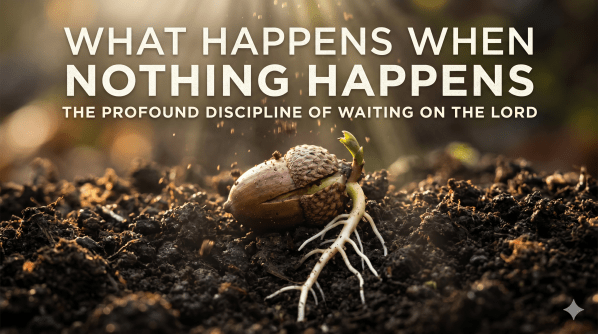
What Happens When Nothing Happens

We hate waiting.

We just do.

We have apps to skip the line. We have shipping that gets it to our front door by tomorrow morning. We want the answer, the fix, the breakthrough, the clarity, the open door.

And we want it right now.

Because to us, waiting feels like a glitch in the system. We tend to think of waiting as a gap. A void. An empty, useless space between where we are and where we actually want to be.

Like a waiting room. You just sit there. Staring at a five-year-old magazine. Doing absolutely nothing.

But what if spiritual waiting isn’t passive?

What if waiting on the Lord isn’t a delay in your story… what if it’s a crucial chapter of your story?

What if it is the most profoundly active thing you could possibly do?

See, when the scriptures talk about waiting on the Lord, it’s not about twiddling your thumbs. It’s not about spiritual resignation. It’s about tension.

Think of a seed buried deep in the dark, heavy dirt. From the outside, it looks like nothing is happening. It looks abandoned. It feels like the gardener forgot all about it.

But beneath the surface? Everything is happening.

The shell is breaking. Roots are desperately reaching and digging deep into the soil. True, sustainable growth is occurring. You cannot get the massive, unshakeable oak tree without the dark, quiet, excruciatingly slow work of the seed in the dirt.

It’s in the waiting that our false idols are slowly stripped away. It’s in the waiting that we realize we aren’t actually in control. (And man, we love pretending we are in control, don’t we?) It’s in the waiting that our faith stops being a neat little transaction with the Divine—”I do this for you, God, so you give me that”—and starts becoming a real, breathing relationship.

We finally discover that God isn’t a vending machine. He is a presence.

And sometimes, the greatest, most profound gift He can possibly give us is the uncomfortable silence that forces us to stop talking, stop rushing, and start listening for His heartbeat.

The discipline of waiting isn’t about ignoring reality; it’s about anchoring yourself so deeply in the goodness of God that the rushing world around you loses its grip on your soul. It’s active trust. It’s rebellious hope.

So, if you find yourself in the waiting room right now—frustrated, tired, wondering if God lost your file—I want to invite you to stop trying to escape the wait, and start leaning into it.

Because the soil is doing its work.

As you go about your week, I want to leave you with three questions to chew on. Let these sit with you. Ponder them:

1. In your moments of profound discouragement: When you’re exhausted and ready to throw in the towel, what if this divine delay isn’t a punishment, but a deliberate setup to build a deeper, more resilient reliance on His strength rather than your own?

2. In your season of endless searching: When you are desperately looking for the next right answer, are you willing to sit in the uncomfortable, quiet mystery of “I don’t know yet” and trust that God’s presence is enough for today?

3. In your messy time of transition: In that terrifying, beautiful space between what was and what will be, how can you actively tend to the soil of your soul today, instead of just frantically rushing toward tomorrow?

Something more to ponder today.

-Grace & Peace,
Pastor Scott.

The Danger of Comfort and the Need to Lean In.

Picture a classroom.

Maybe you’re in seventh grade. Maybe you’re in a crowded seminary lecture hall. The teacher is talking. The fluorescent lights are buzzing. And you are… somewhere else.

You’re doodling in the margins of your notebook. You’re thinking about lunch. You’re staring out the window, watching the clouds drift by. The words washing over you are just noise. It’s a comfortable, predictable, safe drone.

And then. It happens.

The teacher says your name.

What happens to your body in that exact fraction of a second? Your spine stiffens. Your eyes snap to the front of the room. You literally, physically, shift your weight.

You lean in.

Because suddenly, the lecture isn’t abstract anymore. It isn’t just noise. It’s highly personal, and it demands your immediate attention.

That comfortable drone? That slow, subtle lulling to sleep? That’s exactly what happens to us in ministry.

You’ve been doing this for a while. You know how the meetings run. You know which songs get the congregation moving, which sermon structures get the nods, how to balance the budget, and how to keep the machine humming.

The machine is safe. The machine is predictable. And let’s be honest: the machine is incredibly comfortable.

But here’s the thing about the machine. It doesn’t have a pulse.

We start out in ministry completely leaned in. We are wide awake to the calling. But over time, the wear and tear of the job takes its toll. People are messy. People are unpredictable. People will break your heart, and they will exhaust you, and they will ask questions you don’t have the answers to.

So, what do we do?

We build structures. We retreat to our offices. We dive into the thick theology books. We spend hours tweaking the graphics for the new sermon series. We step back into the spaces we are used to, the spaces where we are the experts, where we are insulated and in control.

Because leaning out is easy. Leaning back is safe.

But out there in the mess, our name is being called.

God is speaking through the unraveling marriage in your congregation. He is speaking through the doubting young adult sitting in the back row. He is calling your name through the marginalized family in your neighborhood who just needs someone to show up.

When we retreat to the comfortable spaces, we stop hearing our name. We start managing instead of ministering. We start preserving instead of pioneering.

Think about the life of Jesus. He didn’t spend a lot of time in the comfortable, predictable spaces. He didn’t build a machine and manage it from a corner office.

John 1:14 says, “The Word became flesh and made his dwelling among us.” He didn’t shout instructions from the safety of the heavens. He moved into the neighborhood. He got dirt under his fingernails. He crashed dinner parties with the wrong kind of people (Mark 2:15).

And he was constantly calling names. He didn’t just wave at Zacchaeus in the tree; he stopped, called him by name, and invited himself into the mess of a despised tax collector’s home (Luke 19:5). He saw Mary weeping at the tomb, blinded by her grief, and the thing that finally broke through the noise wasn’t a theological explanation. It was him, simply saying her name: “Mary” (John 20:16).

He leaned in. And he asks us to do the same.

The heart of ministry isn’t found in the green room. It isn’t found in the flawless, down-to-the-minute execution of a Sunday morning service.

It’s found in the living room. It’s found in the hospital waiting area. It’s found in the quiet, desperate, heavy moments where all you have to offer is your presence.

When we get comfortable, we miss the miracle. We miss the moment the lights finally come on in someone’s eyes. We miss the raw, beautiful redemption of a shattered life being put back together. We miss the very heartbeat of the Divine.

So, here is the invitation.

Listen closely. Through the hum of the church machinery, your name is being called.

How will you respond?


Questions to Consider:

  • Where are your “safe spaces”? What are the tasks, rooms, or routines you retreat to when the messy reality of people becomes too overwhelming?
  • Who is currently “calling your name”? Is there a specific person or situation in your church or community that you have been actively avoiding because it requires you to step out of your comfort zone?
  • When was the last time you felt the “jolt”? Think back to a recent moment in ministry where you were suddenly, acutely aware that God was using you in a raw, unscripted way. How can you posture yourself to experience that more often?
  • Are you managing a machine, or ministering to a movement? If you stripped away the lights, the budget, and the Sunday morning production, what would be left of your ministry?

Step out of the office. Leave the safety of the well-worn path.

Will it be hard? Yes. Will it break your heart? Almost certainly.

But hear your name. Shift your weight. Lean in.

The Grace Expert & The Eight Year Secret.

The news about Philip Yancey is the kind of thing that makes you set your coffee down and just stare out the window for a while.

If you’ve spent any time in the “thinking” corners of the church, Yancey has probably been a companion of yours. His books—What’s So Amazing About Grace? and The Jesus I Never Knew—weren’t just bestsellers; they were lifelines. He was the guy who gave us permission to admit that faith is often a mess of doubt and shadow. He made grace feel like something sturdy enough to hold our weight.

And now, we’re processing this: an eight-year affair. With a married woman. All while he was the face of modern Christian grace, writing the books and speaking at the conferences. He came forward himself, stepped down, and admitted he had “disqualified” himself.

It’s a gut-punch. Not because we’re naive enough to think Christian leaders don’t fail—we know better by now—but because of the specific nature of this failure. It forces a terrifying question: How does someone spend nearly a decade describing the heart of God while their own heart is miles away?

The Art of the Split Life

History is littered with this kind of thing. King David wrote the most beautiful poetry in the Bible while his hands were literally stained with the blood of a man he had murdered to cover an affair. Peter preached the gospel after denying he even knew Jesus.

But Yancey’s situation feels like a very modern, very quiet tragedy. Eight years isn’t a “moment of weakness” or a one-time lapse in judgment. It’s thousands of small, daily choices to live a double life. It’s a sustained effort to keep the “Public Grace Expert” and the “Private Transgressor” from ever meeting in the same room.

It makes you wonder about the words he wrote during those eight years. Were they hollow? Or were they something more tragic—a cry for help from a man who knew the truth of grace but felt he had drifted too far out to actually touch it?

The Myth of Compartmentalization

We like to think we can keep our lives in separate boxes. We tell ourselves, “This secret part of me doesn’t affect my work for God.” But the soul doesn’t work that way. When we live in contradiction, something begins to atrophie.

In church circles, we talk about accountability and integrity so much that the words have lost their teeth. We’ve turned accountability into a polite “how are you doing?” over lunch. But real integrity isn’t about being perfect; it’s about alignment. It’s making sure the person people see on the stage is the same person sitting alone in a hotel room.

When that alignment snaps, we start performing. We use the right “Christianese,” we hit the right emotional notes in our prayers, and we learn how to fake the glow of a spiritual life that has actually gone cold on the inside.

The Quiet Creep of Atrophy

Spiritual decay doesn’t usually happen overnight. It’s a slow, subtle erosion.

  • It starts when you’re “too busy” for your own soul because you’re doing “the Lord’s work.”
  • It grows when you justify a small compromise because, hey, look at all the good you’re doing.
  • It solidifies when you realize you’re good at pretending—and that everyone believes the act.

Eventually, you aren’t living a faith; you’re managing a brand. You become a professional at describing a God you no longer talk to in private. That is the real danger of ministry: you can become so familiar with the language of God that you lose the fear of Him.

Where Does This Leave Us?

The “good” news—if we can call it that—is that Yancey chose to stop the clock. He chose to step into the light, however late, and own the wreckage. That is an act of integrity, even if it’s the final, painful act of a career.

But his story should be a mirror for the rest of us. It’s a warning not to wait for the “big fall.” It’s a call to look at the gaps in our own lives—the places where we are pretending, the secrets we’re guarding, and the ways we’ve let our public persona outpace our private character.

Grace is big enough for Philip Yancey. It’s big enough for the woman involved. And it’s big enough for us. But grace is never an excuse to stay in the dark; it’s the power that allows us to finally come clean.

Let’s stop posing and start being honest. Because a broken person who is honest is much more useful to God than a “godly” person who is lying.

Grace, Peace & Accountability
-Pastor Scott.

The Threshold of 2026: What if we stopped “Fixing”?

We’re standing on it again. That invisible line.

One second it’s 11:59 p.m. on December 31, 2025, and the next, we’ve crossed over into 2026. We act like the air changes, don’t we? Like the molecules of the universe suddenly rearranged themselves because a calendar page turned.

We call them “Resolutions.” But if you look at that word—resolution—it’s about finding a solution. It implies that you, as you are right now, are a problem to be solved. A leak to be plugged. A glitch in the system that needs a software update.

But what if 2026 isn’t about “fixing” the old you?

What if the “New Year” isn’t a demand for a better version of yourself, but an invitation to finally meet the real one?
I’ve met so many people in my life, and I don’t want to sound judgmental, but I can automatically tell when someone is simply putting on a mask and living a fake life for others to see. Sometimes people do this to impress others, while some pretend instead of live a real life because they fear what people might think if they ACTUALLY ‘let their hair down’.

But what would happen in 2026 if we all just stopped pretending, and started living our lives with authenticity without fear of judgement?

The Rhythm of the New

In the Hebrew scriptures, there’s this beautiful, recurring idea that God is “doing a new thing.” But “new” in the biblical sense isn’t usually about replacement. It’s about renewal. It’s like a tree in winter. It looks dead. It looks stagnant. But deep in the soil, in the dark, silent places where no one is taking selfies or posting updates, something is shifting.

The tree isn’t trying to be a different tree in the spring. It’s just becoming more of what it already is.

So, as we stare down the barrel of 2026, I have some questions. Not the “How much weight do you want to lose?” kind of questions. The other kind. The kind that sit in the pit of your stomach:

  • What are you carrying into this year that isn’t actually yours to carry? Is it a parent’s expectation? A former version of yourself that you outgrew three years ago? A shame that has already been forgiven but you keep in your pocket like a lucky charm?
  • What would happen if you stopped trying to “arrive”? We spend so much energy trying to get somewhere else. To the next job, the next relationship, the next tax bracket. But what if the Divine is actually in the here? What if the burning bush is right in your backyard, but you’re too busy looking at a map of a different forest?
  • Where is the “New” already happening? Look at your life. Not the big, flashy stuff. Look at the small, quiet pulses of grace. The friend who actually listens. The way the light hits the floor at 4:00 p.m. The fact that you’re still breathing.

The Sacred Middle

2026 will have its share of mess. We know this. There will be moments of stress, anxiety, problems – and much more. There will be moments where you feel like you’re failing at everything. I don’t want to dismiss that these kinds of events will most likely happen to us all in 2026.

But the Gospel—the “Good News”—isn’t that life becomes a straight line of success. It’s that even in the mess, even in the “not-yet-resolved” parts of our lives, there is a Presence. A “With-ness.”

Jesus didn’t say, “I have come so that you might have a perfectly organized life and a 401k.” He said he came so we might have Life. Abundant, vibrant, messy, holy, complicated Life. Emmanuel = God – with us. God connected to us. God in relationship with us every. step. of. the. way. (full stop, no flimsy/flip-flopping decisions – He’s all-in with your life! He’s fully invested in YOU!)

A Pondering for the Road

As you step across that threshold into 2026, maybe skip the “To-Do” list for a minute. Try a “To-Be” list.

  • To be… present.
  • To be… kind to yourself when you stumble.
  • To be… open to the idea that God likes you exactly as you are, even as He invites you into who you are becoming.

The calendar is turning tomorrow at 11:59pm.
The sun will rise. And the Spirit is already there, whispering, “Let’s see what we can make of this together.”

Grace and Peace to you in 2026.
-Pastor Scott.

The Unnoticed Goodness

Thanksgiving has a way of slowing us down just enough to notice what’s been happening all along—the overlooked kindnesses, the small mercies, the quiet faithfulness that rarely makes headlines. It’s the season when we finally pause long enough to see the fingerprints of God on the ordinary. I mean, His presence is everywhere!

But here’s what’s been hitting me lately: some of the most powerful moments of goodness are the ones no one else ever sees.
No platform.
No applause.
No credit.
Just a quiet decision to do the right thing because it’s right.

Maybe it was the way you let someone go ahead of you in line, even though you were late.
Maybe it was the word of encouragement you sent that you thought was “no big deal.”
Maybe it was the prayer you prayed for someone who will never know your name.

Thanksgiving reminds us that gratitude isn’t just something we feel—it’s something we live. And when we live it quietly, faithfully, consistently… those moments echo. They ripple out further than we realize.

Scripture puts it simply:
“And let us not grow weary of doing good, for in due season we will reap, if we do not give up” (Galatians 6:9).

Doing good when someone is watching is easy.
Doing good when no one sees—that’s where character is formed.
And often, those hidden acts are the ones God uses to shape someone’s story in ways we’ll never fully know this side of heaven.

You may think you’re just holding a door, paying for someone’s coffee, giving a quiet offering, sending a text, praying a prayer.
But perhaps the person on the receiving end was standing right on the edge—and your small act of unseen kindness pulled them back.

This Thanksgiving, maybe the most meaningful gratitude isn’t found around the table but in the unnoticed corners of everyday life… where God is shaping the world through ordinary people doing ordinary good.

Not for applause.
Not for credit.
But for the quiet joy of reflecting Christ.

Three Questions for the Soul

  1. If God is the only one who notices the good I do this week, is that enough for me?
  2. Whose story could be changed by one small, unseen act of kindness from me today?
  3. Do I want to be known as grateful—or do I want to be grateful in a way that genuinely changes the way I live?

May your Thanksgiving be filled not just with gratitude spoken, but gratitude practiced—quietly, faithfully, joyfully.

Grace & Peace,
-Pastor Scott.

Cast It ALL (Psalm 55:22)

Hey there, beautiful souls, Pastor Scott here, sorry it’s been a minute.
I have a few minutes today and I’ve been reading this verse today just meditating on it and perhaps you’re sometimes like me with what seems to be the weight of the world on your shoulders. This verse has gives me hope, and I think it will do the same for you.

Today, let’s lean ponder this verse full of promise hope and assurance because it’s something that resonates with me and with the kind of truth that can shift the air around us all. Lets dig into that verse. It’s Psalm 55:22.

It says, “Cast your cares on the Lord, and he will sustain you; he will never let the righteous be shaken.
Let that sink in for a second. “Cast your cares.” Not toss them lightly like you’re skipping stones on a lake, but “cast” them—like a fisherman throwing a net, like you’re heaving something heavy into the arms of someone stronger. There’s weight to this word. There’s intention here. There’s a letting go that feels like both surrender and strength. Life, right? It’s heavy sometimes. You’ve got bills stacking up, relationships fraying or just plain falling apart, dreams that feel like they’re slipping through your fingers. Maybe you’re carrying grief that’s too big for words, or anxiety that wakes you up at 3 a.m. with a racing heart. And here’s David, the poet-king, the guy who’s been betrayed, chased, and undone, whispering to us across centuries: “Cast it. Give it to God. He’s got you.” What’s wild about this verse is that it’s not just a command—it’s a promise. God doesn’t just say, “Hand it over.” He says, “I’ll sustain you.” That word, “sustain”—it’s not about a quick fix or a pat on the back. It’s about being held up, carried, nourished, like a plant getting just the right amount of water and light to keep growing.

It’s God saying, “I see the weight you’re carrying, and I’m not going anywhere. I’ll hold you steady.” And then there’s that last bit: “He will never let the righteous be shaken.” Never. Not when the diagnosis comes, not when the job falls through, not when the world feels like it’s spinning out of control. The righteous—those who are chasing after God’s heart, who are trying, stumbling, and getting back up—aren’t promised a life without storms. But they’re promised a God who keeps them anchored through it all.

So, what’s the invitation here? It’s to stop clutching. To stop white-knuckling your worries like they’re yours to solve alone. What if you took that thing—the one that’s been keeping you up at night—and you just… let it go? Not because you’re giving up, but because you’re giving it “over”. You’re trusting that the God who made the stars, who knows every crack in your heart, is big enough to handle it. This isn’t about pretending everything’s fine. David, the guy who wrote this psalm, was in the middle of betrayal and chaos when he penned these words. He wasn’t floating on a cloud of good vibes. He was raw, real, and probably a little scared. But he knew something we often forget: God’s not afraid of our mess. He’s not asking us to clean it up before we come to Him. He’s saying, “Bring it. All of it. The fear, the doubt, the anger, the questions. I can take it.”

What would it look like to cast your cares today? Maybe it’s a prayer whispered in the car on your way to work. Maybe it’s writing down that thing you’re afraid to name and leaving it on the page, an offering of trust. Maybe it’s just sitting still for a minute and saying, “God, I don’t know how to let this go, but I’m trying.”

There’s freedom on the other side of casting. There’s a lightness, a steadiness, a knowing that you’re not alone. Because the God who sustains you? He’s not just powerful—He’s personal. He’s close. He’s got you, right here, right now, in the middle of whatever you’re facing. So, let’s ponder this together, friends. What’s the weight you’re carrying? What’s the care you need to cast? And what might happen if you trusted—really trusted—that God’s got you, that He’ll sustain you, that He won’t let you be shaken?

Questions to Chew On Today:

1. What’s one care you’re holding onto right now that feels too heavy to carry alone? What would it look like to cast it onto God?

2. When you hear “He will sustain you,” what does that stir in you?
Do you believe God can hold you up, even in the messiest parts of your life? Why or why not?

3. What’s one small step you can take today to let go of control and trust God with your worries?

4. How might your life feel different if you truly believed you wouldn’t be shaken, no matter what comes?

Keep pondering, keep casting, keep trusting.
You’re not alone in this.
-Grace and peace, Pastor Scott

Rooted and Resilient

So, Jeremiah 17:7-8. Let’s just sit with it for a minute, shall we?

But blessed is the one who trusts in the Lord, whose confidence is in him. They will be like a tree planted by the water that sends out its roots by the stream. It does not fear when heat comes; its leaves are always green. It has no worries in a year of drought nor ceases to yield fruit.”

You know, there’s something in us, isn’t there? This innate desire to be, well, unshakeable. To be that person who can weather any storm. To not just survive, but to thrive, even when everything around us feels like it’s drying up.

And here’s Jeremiah, pointing us to it. He’s not talking about some magic formula or a special incantation. He’s talking about trust. Simple, profound trust.

Think about that tree. Not just any tree, but a tree planted by the water. It’s not just getting a sprinkle every now and then; it’s rooted in the source. Its roots, they’re not just scratching the surface; they’re digging deep, reaching out, finding that constant flow.

And because of that deep connection, what happens?

“It does not fear when heat comes.”

That’s a big one, isn’t it? The heat comes for all of us. The pressure, the stress, the unexpected curveballs. The moments where you feel like you’re just wilting. But this tree? It doesn’t fear. Its leaves are always green. Think about that. Even when the world around it is parched, this tree is vibrant. It’s alive.

“It has no worries in a year of drought.”

Drought. We know drought. The times when everything feels scarce, when inspiration dries up, when relationships feel strained, when the bank account looks a little thin. Those long stretches where you just wonder if anything good will ever come again. But this tree? No worries. Because its roots are still doing their thing, silently, consistently, drawing from that underground source.

“Nor ceases to yield fruit.”

This is the kicker, right? Not only does it survive, not only does it stay green, but it continues to produce. Even in the lean times, it’s still giving. It’s still contributing. It’s still being what it was made to be.

So, what does this mean for us?

It’s an invitation, really. An invitation to examine where our roots are going. Are we trying to draw life from superficial things? From approval? From endless striving? From the fleeting highs of immediate gratification? Because those things, they dry up. They just do.

Or are we willing to dig deeper? To send our roots down into something more substantial? Into trust. Into a quiet, consistent confidence in the divine, in the very source of life itself.

It’s not about avoiding the heat or the drought. They’re going to come. But it’s about how we’re rooted in them. It’s about cultivating that deep, unwavering connection that allows us to not just endure, but to flourish. To stay green. To keep yielding fruit, even when the world around us is screaming for us to wilt.

So, where are your roots going today? Just something to ponder. Something to sit with. Maybe even something to dig into.
Grace & Peace,
-Pastor Scott.

Liminal Space – A Refilling of Grace.

Hey there, friend.
Let’s talk about liminal spaces. You know, those weird, in-between places where you’re not quite *here* anymore but not fully *there* yet either? Doorways, thresholds, moments where the veil between you and the divine feels so thin it’s like you could reach out and touch it. The Celts called these “thin places,” spots where heaven and earth brush up against each other, where you can almost hear the heartbeat of God. And I’m not just talking about physical places—though those are real too, like a quiet beach at dawn or that one pew in your church that just *feels* holy. I’m talking about those moments in life when you’re caught in transition, suspended, waiting, and something sacred sneaks in. Think about Moses at the burning bush in Exodus 3. He’s just out there, tending sheep, minding his own business, when *bam*—a bush is on fire but not burning up. God says, “Take off your sandals, for the place where you are standing is holy ground” (Exodus 3:5). That patch of desert wasn’t holy because of the dirt or the shrubbery. It was holy because God showed up in the in-between, in the ordinary, and Moses was paying attention. He stepped into a liminal space, a threshold where the eternal crashed into the everyday.

Or how about Jesus in the Garden of Gethsemane (Matthew 26:36-46)? He’s in this gut-wrenching moment, not quite at the cross but no longer just teaching and healing. He’s in the middle, sweating blood, wrestling with what’s coming. It’s a thin place, where his humanity and divinity are laid bare, where he’s crying out to God and the air feels electric with the weight of what’s about to happen.

Have you ever been in a moment like that?
Where you’re stuck between what was and what’s next, and God feels so close it’s almost too much? Liminal spaces aren’t always comfortable. They’re often disorienting, like standing in a doorway not sure if you’re coming or going. Think about the Israelites wandering in the wilderness for 40 years (Exodus 16-17). They’d left Egypt, but the Promised Land was still a dream. They were in-between, grumbling, doubting, yet God kept showing up—manna in the morning, water from a rock. Those desert years were a thin place, where they learned to trust, to lean into the mystery of a God who meets you in the messy middle. So here’s a question for you:

Where are the liminal spaces in your life right now?
Are you in a season of waiting—maybe for a job, a relationship, a diagnosis, or just some clarity? What if those in-between moments aren’t just empty gaps but holy ground, places where God is waiting to meet you? I mean, think about it: when you’re stuck in transition, when you don’t have all the answers, don’t you find yourself a little more open, a little more raw, a little more ready to hear that still, small voice? And here’s another thing to chew on: What if liminal spaces aren’t just about you finding God, but God finding you?

In Psalm 139:7-10, David says, “Where can I go from your Spirit? Where can I flee from your presence? If I go up to the heavens, you are there; if I make my bed in the depths, you are there.” There’s no in-between place where God isn’t already waiting. That jobless season, that heartbreak, that moment when you’re staring at the ceiling at 3 a.m.—those are thresholds, thin places where the divine is whispering, “I’m here.” So, what’s it look like to lean into these spaces? Maybe it’s pausing in the middle of your chaos to breathe and say, “God, show me where you are in this.” Maybe it’s noticing the ordinary moments—a sunrise, a conversation, a quiet walk—and asking, “Is this holy ground?” What if you stopped rushing through the in-between to get to the “next thing” and instead let yourself linger, let yourself listen?

Here’s one more question to sit with: What’s keeping you from seeing the thin places in your life?
Is it fear? Distraction? The need to have it all figured out? What if you let go of that for a moment and just stood still, like Moses, sandals off, ready for God to show up? Liminal spaces are everywhere, friend. They’re the thresholds, the waiting rooms, the moments when you feel a little lost but a lot alive. They’re where God loves to show up, where the ordinary becomes extraordinary. So, where’s your thin place today? And what might happen if you stepped into it, heart open, ready to meet the One who’s already there?

Keep your eyes open.
Holy ground is closer than you think.

Grace & Peace,
-Pastor Scott.

Blog at WordPress.com.

Up ↑