As I sit here looking at the calendar, I realize we are standing right on the threshold of Palm Sunday. It’s hard to believe we are already nearing the end of our Lenten journey, isn’t it?
Whenever this time of year rolls around, I find myself thinking deeply about the stark contrast of the days ahead. Palm Sunday is a day of high energy. We love the waving of the palm branches, the upbeat hymns, and the shouts of “Hosanna!” It feels like a long-awaited victory parade. But as we prepare our hearts for this coming Sunday, I want to invite you to look a little closer at the man riding in on the donkey.
The crowds that day were thrilled. They were throwing their cloaks on the road and cheering for a conquering king. Luke 19:37-38 paints the picture perfectly: “The whole crowd of disciples began joyfully to praise God in loud voices for all the miracles they had seen: ‘Blessed is the king who comes in the name of the Lord! Peace in heaven and glory in the highest!’”
They wanted a political savior. They wanted someone to kick out the Romans and make their lives easier. But Jesus wasn’t riding into Jerusalem to make them comfortable; He was riding in to save their souls. Just a few verses later, as He approaches the city and hears the cheers, Jesus actually begins to weep over Jerusalem. He knew that the very same voices shouting “Hosanna” on Sunday would be shouting “Crucify Him” by Friday.
This brings a profound thought to mind from C.S. Lewis. In his classic The Chronicles of Narnia, Mr. Beaver famously describes Aslan—the Christ figure of the story—by saying:
“Safe? … Who said anything about safe? ‘Course he isn’t safe. But he’s good. He’s the King, I tell you.”
The crowds on Palm Sunday wanted a “safe” king—a tame lion who would do their bidding and fit neatly into their worldly agendas. But Jesus is not a tame lion. The path He was walking didn’t lead to an earthly throne; it led straight to the agonizing wood of the cross. Lewis reminds us that following Christ isn’t about God improving our current circumstances; it’s about a total, reverent surrender of our very lives.
Here is my challenge to you this week:
Do not rush the journey. It is so tempting for us, in our modern, fast-paced world, to show up for the parade on Palm Sunday, check out for the week, and then show up again for the empty tomb on Easter morning. We love the triumph, but we shrink back from the tragedy.
This Holy Week, I challenge you to sit in the uncomfortable, quiet reverence of the season:
Pause and reflect: Spend time reading through the events of Maundy Thursday.
Sit in the shadows: Allow yourself to feel the heavy, somber reality of Good Friday.
Embrace the silence: Recognize the profound stillness of Holy Saturday.
You cannot fully appreciate the blinding, glorious light of Resurrection Sunday until you have spent time contemplating the deep darkness of Friday. Let’s not reduce Jesus to a tame lion this week. Let’s approach the cross with awe, repentance, and a quiet, contemplative reverence for the sheer magnitude of what it cost to save us.
Hey, beautiful souls, welcome to Pastor’s Ponderings! I’m Pastor Scott, your fellow traveler on this winding, sacred road we call faith. Today, I’m inviting you to grab a coffee (or tea, if you’re one of those people), find a quiet corner, and dive into something that’s been stirring my heart: what it means to be Easter people. Not just folks who celebrate Easter with lilies and chocolate bunnies, but people who live like the tomb is empty, like love wins, like the world’s been turned upside down. Let’s ponder this together—what does it look like to live the resurrection in a world that’s messy, broken, and yet so achingly beautiful?
The Scene: A Mountain, a Miracle, and Some Doubts
Picture this: Matthew 28:16-20. The disciples are trudging up a mountain in Galilee. They’re exhausted, grieving, and probably a bit confused. Jesus, their friend and teacher, was crucified, dead, gone. And now? He’s standing there—alive, radiant, impossible. The text says, “They worshiped him; but some doubted.”
Can we just pause and appreciate how human that is? They’re staring at a man who was dead, now alive, and some of them are thinking, “Is this for real?” I love that. It’s so us. We want to believe in resurrection, in hope, in God showing up, but part of us whispers, “Really? In this world? With these headlines?”
And here’s what gets me: Jesus doesn’t scold them for doubting. He doesn’t say, “Get it together!” Instead, He steps right into their messy faith and says, “All authority in heaven and on earth has been given to me. Go and make disciples of all nations, baptizing them, teaching them, and don’t forget—I’m with you always, to the very end of the age.”
That’s the heartbeat of Easter. That’s the call to be Easter people. So, let’s unpack it with some big, soul-stirring questions about what this means for us today.
Authority That Sets Us Free
When Jesus says, “All authority in heaven and on earth has been given to me,” what’s He talking about? We hear “authority” and picture a king on a throne or a CEO barking orders. But Jesus’ authority isn’t like that. It’s not about control or domination. It’s the authority of a love that’s stronger than death.
This is the guy who faced betrayal, torture, and a cross, then walked out of the tomb saying, “I’m still here.” His power doesn’t force anyone to do anything—it invites us into a story where death doesn’t get the last word. Love does.
So, here’s a question: What would it look like to trust that kind of authority in your life? Not the world’s version of power—money, status, control—but the kind that sets people free? Who in your world needs to hear that there’s a love bigger than their pain, fear, or shame? Maybe it’s a coworker drowning in stress or a neighbor who’s lost hope. Being an Easter person means carrying that kind of authority—not to lord it over anyone, but to say, “There’s a way through this, and it’s love.”
Making Disciples, Building Connections
Next, let’s talk about this “go and make disciples” part. It can sound churchy, like a mission for people with clipboards and evangelistic checklists. But what if it’s not that at all? What if making disciples is about inviting people to become fully human, the way God dreamed us to be?
Baptizing, teaching, obeying—it’s not about signing people up for Team Jesus. It’s about walking with them into a life where we love like Jesus, forgive like Jesus, and show up for each other like Jesus. Easter people don’t just recruit; we connect. We share coffee, stories, tears. We say, “You don’t have to do this alone—come sit at this messy, holy table.”
Here’s another question: Who’s someone you could invite into that kind of journey? Not to fix them or convert them, but to say, “Let’s figure out what it means to be human together”? The resurrection isn’t just about getting to heaven someday—it’s about heaven crashing into earth now, through us, through relationships, through community. Who’s your one person you could reach out to this week?
The Promise That Changes Everything
And then there’s this promise that hits me every time: “Surely I am with you always, to the very end of the age.” Always. Not just when you’re feeling spiritual or when you’ve got your act together. Jesus is with you when you’re nervous about sharing your faith, when you fumble your words, when you’re not even sure you believe it yourself.
Easter people live with the awareness that the risen Jesus is here. In the coffee shop, in the awkward conversation, in the quiet moments when you’re wondering if any of this matters. What would change if you really believed He’s with you? Right now, as you’re reading this, as you’re driving to work, as you’re thinking about that one person you could invite into this story? How would that shift the way you live, love, and show up?
The Risk and the Call
Being an Easter person feels like a risk, doesn’t it? It’s stepping into a world that screams “death wins” and saying, “No, love does.” It’s trusting a different kind of authority, walking with people toward life, and knowing we’re not alone. But isn’t that what Easter’s about? The tomb is empty. Jesus is alive. And He’s calling us to live like it.
So, here’s my invitation to you: Think about one person. Someone who’s searching, hurting, or curious. What would it look like to invite them into this resurrection life? Not to sell them something or preach at them, but to offer a taste of the hope, love, and presence that Easter brings. Maybe it’s a text: “Hey, wanna grab coffee?” Maybe it’s a kind word or a listening ear. Maybe it’s just saying, “I’m figuring this faith thing out too—wanna come along?”
And here’s the big question: What’s stopping you? Is it fear? Doubt? The lie that you’re not qualified? Because Easter people aren’t perfect. We’re just people who’ve seen the empty tomb and can’t keep it to ourselves.
Let’s Live Like the Tomb Is Empty
Thanks for joining me on this pondering journey. If this stirred something in you, share it with a friend, drop me a note, or take a moment to pray for that one person you’re thinking of. I’m Pastor Scott, and I’m rooting for you, praying for you, believing that you’re Easter people in a world that needs you.
Keep pondering, keep loving, and keep living like the tomb is empty.
Hey friends, welcome back to Pastor’s Ponderings. I’m Pastor Scott, and today I’m sitting down with my coffee, my Bible, and a heart full of wonder about Easter. It’s the season of resurrection, of new life, of something breaking through—and I want to invite you into that mystery with me. Easter’s not just a day on the calendar or a story we dust off once a year. It’s an invitation. A dare. A question: What if the things we thought were dead aren’t finished at all? Let’s ponder this together.
I was walking through my neighborhood last night just before a thunderstorm, and spring is waking up all around me. Trees budding (lots of pollen), flowers poking through the dirt. And there, in a neighbor’s yard (the one that always has a perfect lawn and a perfect garden – I’m so envious), was this one tulip—bright red, standing tall like it was shouting, “I’m alive!” It stopped me in my tracks. Because isn’t that Easter? Something refusing to stay buried. Something insisting that life gets the last word.
Let’s go to the story. Picture it: early morning, the air cool and heavy with dew. The women—Mary Magdalene, maybe another Mary—are walking to the tomb. Their steps are slow, their hearts weighed down with grief. They’re carrying spices to anoint a body. Jesus’ body. The one they loved, the one they followed, the one they thought would change everything. Now it’s over. Done. Finished.
Or so they think.
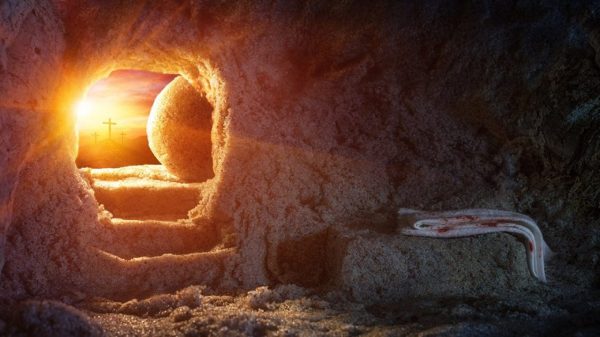
Then they get there, and—boom—the stone’s rolled away. The tomb’s empty. An angel’s sitting there, casual as you please, saying, “He’s not here. He’s risen.” Can you imagine Mary’s face? Confusion, shock, maybe a flicker of hope she’s afraid to let herself feel. Because that’s not how death works. That’s not how the story was supposed to end.
Or was it?
Here’s what grabs me about Easter: It’s not just about what happened that morning. It’s about what it means for us today. Easter says the worst thing is never the last thing. Betrayal? Not the final word. Pain? Not the end of the chapter. Even death? Nope. There’s something more. There’s a rising.
I wonder where you feel that in your life right now. Where are you standing at a tomb, holding onto something you think is gone? A dream that fizzled out? A relationship that’s fractured? A hope you’ve buried? Easter’s whispering to you, “It’s not over. Look for the life.”
Let’s slow down for a second, because resurrection is a big word. We toss it around at church, but what does it really mean? Sure, it’s about Jesus rising from the dead—absolutely, that’s the heartbeat of our faith. But it’s also about what that does to *us*. To you and me. To the world we’re stumbling through.
Resurrection says that God’s not done. Not with you, not with your story, not with the mess. It says there’s always a next. A new chapter. A second chance. And here’s the thing: it doesn’t always look like you expect. Sometimes resurrection is loud—an empty tomb, angels singing, the whole shebang. But sometimes it’s quiet. It’s the friend who texts you just when you need it. It’s the courage to try again after you’ve failed. It’s the moment you forgive when you thought you’d hold that grudge forever.
Resurrection’s sneaky like that. It shows up in the dirt of life. In the ordinary. In the places we least expect. Because that’s where God loves to work, isn’t it? In the cracks. In the mess. In the moments we’d written off.
So let’s get real. I know life doesn’t always feel like a resurrection party. Sometimes it feels like you’re stuck at the tomb, clutching those spices, staring at what’s lost. I’ve been there. We all have. But here’s what I’m learning: Easter invites us to move. Those women at the tomb didn’t just stand there, gaping at the empty space. They ran. They told people. They became part of the story.
And that’s the question Easter asks us: Are you going to stay at the tomb, holding onto what *was*? Or are you going to step into what *could be*? Are you going to look for the places where life’s breaking through—and then join in?
Maybe it’s a conversation you need to have, even if it scares you. Maybe it’s a dream you’ve shelved that’s tugging at your heart again. Maybe it’s just getting up tomorrow and choosing to love a little more, forgive a little deeper, hope a little braver. That’s resurrection. That’s Easter alive in you.
Here’s my challenge as we sit with this Easter season: Look for it. Look for the resurrection all around you. Not just in the big, flashy moments, but in the small ones. Where’s love refusing to quit? Where’s hope pushing up like that tulip through the dirt? Where’s life saying, “I’m not done yet”?
And then—here’s the part that changes everything—*be* the resurrection. Easter’s not just something that happened 2,000 years ago. It’s happening now. In your choices. In your courage. In the way you show up. You get to roll stones away for someone else. You get to carry the news that life wins. You get to live like the tomb is empty—because it is.
One last thought before I let you go. In John’s Gospel, Jesus says, “I am the resurrection and the life.” Not “I’ll give you resurrection later.” Not “I’ll show you life someday.” But *I am*. Right now. Right here. In the middle of your doubts, your fears, your questions—resurrection is already humming. It’s already alive. And you’re invited to step into it.
So this Easter, don’t just read the story. Live it. Run from the tomb. Tell the world with your life. Be the rising. Because the story’s not over—and neither are you.
Thanks for pondering with me, friends. If this stirs something in you, share it with someone. Let’s keep asking the big questions together. Until next time, keep seeking, keep hoping, and keep rising. Grace, Peace & Tulips, -Pastor Scott.
Hey friends! I’ve been mulling this topic over today. I don’t want to write a devotional thought that scares you, nor do I want to depress you. Recently, while scrolling on TikTok, I came across this profile that uses AI to generate what certain celebrities who died before their time would look like today. As I watched these clips, I was both sad and happy at the same time. Thanks to the use of artificial intelligence, this content creator brought some of my childhood celebrities back to life.
So, let’s talk this thing called death—this inevitability, the thing we don’t bring up at dinner parties, the one we tiptoe around like it’s the awkward uncle who overstays his welcome. It’s the shadow in the corner, the thing we’re told to fear, to fight, to outrun. But what if we’ve been looking at it all wrong? What if death isn’t the end of the story, but a doorway? What if it’s not a period in a sentence, but a comma?
I mean, think about it. We live in a world obsessed with keeping death at arm’s length—anti-aging creams, kale smoothies, that extra mile on the treadmill—like we can negotiate with it, bribe it to look the other way. And yet, it’s coming for all of us. You, me, the barista who just spelled your name wrong on the cup. Death doesn’t discriminate. It’s sometimes been called the great equalizer. But here’s the wild, beautiful twist: what if it’s not something to dread? What if it’s something to lean into? Not in some morbid way, but rather an embrace of the comma, the next chapter, the acknowledgement that even though we don’t fully know yet, our lives are actually created to be eternal.
See, there’s this ancient story—maybe you’ve heard it—about a guy named Jesus. He’s walking around, healing people, feeding crowds, flipping tables, and then he says something outrageous: “I am the resurrection and the life.” Not I’ll give you resurrection, not someday you’ll get life—he says I am it. Right here, right now. And then, just to prove it, he walks straight into death—nails, cross, tomb, the whole brutal mess—and comes out the other side. Alive. Breathing. New.
What’s that about? It’s about a promise. A promise that death doesn’t get the last word. A promise that whatever’s on the other side isn’t darkness or nothingness, but something so alive, so vibrant, it makes everything we’ve ever known look like a shadow. Heaven, sure—call it that if you want—but it’s not just harps and clouds. It’s a reality where everything broken gets mended, where every tear gets wiped away, where you and I step into the fullness of who we were always meant to be.
And here’s the thing: that promise isn’t just for later. It’s for now. Because if resurrection is real—if Jesus meant what he said—then death isn’t a monster under the bed. It’s a transition. A shedding. Like a seed cracking open in the dirt, letting go of what it was so it can become something more. You don’t have to be afraid of that. You don’t have to clench your fists and grit your teeth. You can open your hands. You can breathe.
I think about my own life sometimes—those moments when I’ve felt death brush close. A loved one gone too soon, a diagnosis that stopped me cold, or just the quiet ache of knowing this body won’t last forever. And yeah, it stings. It’s heavy. But then I hear that voice again: “I am the resurrection and the life.” And I wonder—what if this isn’t the end? What if it’s the beginning of something so big, so good, I can’t even wrap my head around it?
So, what if we stopped running from death and started trusting the One who beat it? What if we lived like people who know the tomb is empty? Because it is. It’s empty. And that changes everything. Death isn’t the thief we thought it was—it’s the usher, leading us into a room we’ve been homesick for our whole lives.
You don’t have to fear it. You don’t have to outsmart it. You just have to trust that the story’s not over. That there’s a resurrection waiting. That heaven isn’t a far-off dream—it’s the heartbeat of everything true, pulling us closer every day. And when the time comes, when we step through that doorway, we’ll see it: the light, the love, the life that never ends.
So, here’s my question for you today: What would it look like to live unafraid? To wake up tomorrow and say, “Death, you don’t own me—I’m already on the other side”? Because you are. We all are. The promise is real. The tomb is empty. And the best is yet to come.
Let’s talk about something we don’t often talk about directly: death. It seems macabre or taboo. It’s one of those things that hangs around the edges of our lives, a constant hum we try to tune out. We get so good at avoiding it, at pushing it away, that when it crashes into our world – the phone call, the diagnosis, the sudden absence – it can feel like a cosmic gut punch.
And in those moments, the questions come flooding in. What now? Where did they go? Is this… is this really it?
It’s okay to ask those questions. It’s okay to wrestle with them. In fact, I think it’s essential. Because honestly, a faith that doesn’t grapple with death, a faith that tries to bypass the very real pain and mystery of it all, isn’t really a faith at all. It’s just a nice idea, a comforting story we tell ourselves.
But Christianity, at its core, is about something much more disruptive, much more real than that. It’s about resurrection.
Now, I know what you’re thinking. “Resurrection? Scott, come on.” And I get it. It sounds… well, it sounds like a Sunday school answer (where the answer is always “Jesus”). But what if, just what if, it’s not just a tidy theological point? What if it’s the key to understanding everything?
Think about a seed. You plant it in the ground. It dies. It decomposes. It looks like it’s gone. Finished. But then, something incredible happens. A sprout emerges. New life. From what looked like death.
That’s the rhythm of the universe. Death and rebirth. Winter and spring. The ebb and flow of the tide. It’s woven into the fabric of everything. And it’s woven into us.
We’re so afraid of endings. We cling to what we know, to what’s familiar. But what if endings aren’t really endings at all? What if they’re transitions? Gateways? The edge of something beautiful we can’t even imagine? It’s beyond our current vision, beyond our current field of reality.
Jesus talked about this. He talked about losing your life to find it. He talked about a grain of wheat falling to the ground and dying so that it could bring forth much fruit. He wasn’t just talking about himself. He was talking about the fundamental nature of reality.
So, when we face death – our own or the death of someone we love – it’s okay to grieve. It’s okay to feel the pain. It’s okay to rage against the unfairness of it all. Grief is not the absence of faith. It’s the honest expression of love. It’s visceral, it’s raw, it’s the authentic expression of loss.
But even in the midst of that grief, we can hold onto this hope, this wild, audacious hope, that death is not the final word. (Thank God!) That what looks like the end is actually the beginning. That what seems lost is actually found, transformed, made new. We just can’t see it yet. It’s just beyond our reach. Beyond the “veil” – “So we fix our eyes not on what is seen, but on what is unseen, since what is seen is temporary, but what is unseen is eternal.” (2 Corinthians 4:18)
This isn’t about escaping the reality of death. It’s about facing it head-on, with courage and with hope. It’s about trusting that even in the darkest valley, even in the face of the ultimate unknown, there is still light. There is still life. There is still love. This should be encouraging to us all. We don’t have to fear this unknown variable, or be paralyzed by this interruption of life. It’s okay to talk about it. It’s okay to tackle this topic with the assurance that God is still present and His sovereignty has authority over both life and what we call death. New life is resurrection…we are just on the edge of it peering into something we have yet to understand.
And that, my friends, is a story worth believing in. Grace and Peace, -Pastor Scott.
Dear fellow Ponderers…
I have been dragging my feet in writing this for some time.
Not because I didn’t want to write this edition to Pastorsponderings, but rather because I want to be careful in how I broach this conversation. I do not wish to offend and upset you – the reader. Some will no doubt become offended anyway, and I have come to terms with the fact that I will not always make everyone happy – that’s a fool’s errand anyway.
Perhaps in light of this Holy Week that we are all entering into we might also reflect on the Passover feast that Jesus participated in with His disciples…what we now call “The Last Supper”.
Thus, I write this with the utmost sensitivity and respect.
Is Communion Considered Taboo in our Army?
Within The Salvation Army, even the conversation of the Lord’s Table/Supper/Communion has become a taboo topic. It is almost as if we are forbidden to talk about it, let alone partake in this ceremony. Some have postulated that despite not participating in this ceremony, we have created our own sacred ceremonies in place of it, thus making the argument that we are non-sacramental in practice null and void.
I fear that failure to discuss such topics within our Army can lead to a polarization of our theological perspective, and variants of our doctrine might splinter and break off (as in some locations, it already has).
Some within our Army would treat the topic of communion with deep disdain to the point that the practice of it is almost treated as an organizational sin. It is my estimation that too much focus on such a topic in this light is a waste of time and not conducive to unity within our Army. There should be more open dialogue on this topic as I believe there should be on the topic of baptism. -Someone will inevitably lambaste me for that, but that would just prove my point that we treat such innocent conversations on the topic as complete taboo and even sinful to even mention, which is ludicrous.
Is Communion Misunderstood In The Universal Church?
In Luke 22 it is recorded the celebration of Passover that Jesus and His disciples were partaking of. This has now been dubbed “the Last Supper”, where Jesus knew that the time had come for Him to fulfill the final act of Salvation in His false trial, torture, and death by crucifixion. Thus, Jesus reclines with His disciples and takes in these final private moments with those He is closest with:
14 When the hour came, Jesus and his apostles reclined at the table.15 And he said to them, “I have eagerly desired to eat this Passover with you before I suffer.16 For I tell you, I will not eat it again until it finds fulfillment in the kingdom of God.”
17 After taking the cup, he gave thanks and said, “Take this and divide it among you.18 For I tell you I will not drink again from the fruit of the vine until the kingdom of God comes.”
19 And he took bread, gave thanks and broke it, and gave it to them, saying, “This is my body given for you; do this in remembrance of me.” (Luke 22:14-19)
Could it be that over the centuries the emphasis (or fixation) upon the bread and wine have been misplaced? Didn’t Jesus preach in parable and often teach as Rabbis of His day taught? With questions and metaphor? When Jesus spoke of doing “this” in remembrance of me, is it not possible that it wasn’t just the bread and wine He was talking about, but rather the entire dinner together, the fellowship and unity of disciples? Is it possible that instead of coming together just to contemplate the bread and the wine, the whole ceremony of remembrance is just as vital? Coupled with the remembrance, the unifying love of Christ that binds it all together is the common denominator. So much so, that when the disciples gathered in another upper room together in perfect unity, they encountered the second blessing an the day of Pentecost? (Acts 2:1-31)
Perhaps, it is in the very practice of gathering in unity and prayer that we find the proper practice of Communion to be viable and appropriate – even commanded by Christ Himself. After all, didn’t Jesus also pray for unity of the believers when we said, “that they may all be one, just as you, Father, are in me, and I in you, that they also may be in us, so that the world may believe that you have sent me.” (John 17:21) Dear Salvation Army,
Let me ask you a question: When are our Soldiers unified with the love of Christ?
When is it that we remember Jesus as our Savior and source of resurrection power?
Would you suggest that it is when we gather in times of confession, of worship, of fellowship? When does the mission of Christ within our Army become the most galvanized and evident in the body of believers?
Is there a time for ceremony and formal recognition? Of course!
What do those intentionally consecrated moments look like?
Could it be that Communion has been vilified in our Army? (Perhaps that is too strong a word)…
Is it possible that what Communion truly is – is the coming together of His disciples in fellowship and unity instead of mere ceremony? Can we do this over a meal together?
Perhaps instead on the over emphasis of the elements we have lost sight of the One who broke the bread and poured the wine?
What do YOU think?
Post your comments below and let’s continue this pondering together.
*Disclaimer: The views expressed here are of the author’s views and do not necessarily reflect the views of The Salvation Army. Reader desecration is advised. *
I always have fond memories of the Easter season.
Growing up in the church, I don’t recall a time when I didn’t go to church. Many times I sat through that dreaded (at least in the eyes of a child) 3 hours of the cross Good Friday service. I also remember not being all that fond of early Sun-rise services either. Waking up at the crack of dawn, even before the rooster would even begin to crow…the lights would twinkle in windows down the street as some rustled about in the early dawn. Then we would hustle to a public outdoor service of some kind where the cold wind would always bite at my nose and send me to shivering later. But there was always the reward of the warm glow of the Sunrise when it crested the mountain at the Eastern horizon. Perhaps, in some way, that is why Easter sun-rise service has always been special to me. I would shiver in the cold morning air UNTIL the Sun began to shine and cast its warming rays upon us once more. It would remind me of the state I was in before knowing Christ – that cold and lonely place. It was a place devoid of the Son, filled with selfishness and hurt…but when Christ’s love broke into my life and I accepted His forgiveness and grace – I could feel the warmth of His love. It almost felt as I was wrapped in His warm embrace, and all was right with the world again.
Perhaps, as I reminisce of my many visits to those cold mornings of Easter Sunday, where we would sing “Up from the grave He arose“, I too find myself being resurrected again. I too identify with the empty tomb, for God’s glory has warmly shone into my life. And when the glow of the rising Sun appears again, I see the hope of eternity once more in its rising. No, not in the Sun itself, but in the Son-rise, a Messiah conquering death, a Savior delivering me once more from my sin-sick heart.
“Death cannot keep his prey— Jesus, my Savior! He tore the bars away— Jesus my Lord!
Up from the grave He arose, With a mighty triumph o’er His foes He arose a Victor from the dark domain, And He lives forever with His saints to reign. He arose! He arose! Hallelujah! Christ arose!
Something more to Ponder.
What are you Easter memories? Comment below and let the conversation continue!
Monday after Easter, and the Easter dress is on the floor in the laundry room, as are the Easter suits and carelessly tossed ties and shoes. Easter is over. The Celebration party had its curtain call. Everyone went home. So…what now?
What impact does the Resurrection have on us the day after? The week after? The month after? Understandably we can say “Well there’s always next year…” or “I go to church every Sunday anyway.” These are all valid points, but what kind of impact does Christ’s resurrection have on you and me in our daily lives?
All too often we want to put Jesus back.
We put Him back into those boxes for next year.
We put Him back on the hanger as we hang up that Easter dress or suit.
We close our Bibles to that story until next year rolls back around.
We put Jesus back into our preconceived, compartmentalized places.
But should we put it all back like that?
Is there a trace of Him in our work places, social events, friendships, relationships, families? Or does He get put away just like the seasonal stuff in our closets?
I have to wonder what the answer is even for me sometimes.
I can accept a risen Savior, but what does it mean in my habits, and in my faith walk and my desire to become more and more like Him? How does this Resurrected Christ fit into my overly complicated life? Am I secretly compartmentalizing Jesus? Am I packing Him away for another year? Am I checking that season off on my calendar and moving on without Him there?
What a tragedy it would be for any of us to progress past the cross and the empty tomb without it affecting the entirety of who we are as His creation! Essentially when we put Him back on the shelf, in the box, on a hanger – we are selectively accepting who He is and who He can be in our lives. We are, subconsciously putting limits on the Almighty…we are also putting limits on our own spiritual growth.
A New Creation:
A friend of mine on Facebook posted this comment that sparked my heart and ignited some intrinsic truth deep within me. Have you ever had one of those “A-ha” moments? Where the light bulb flickers on, and it’s bright and it shines on truth. Perhaps this will spark something within you too in terms of re-framing who Jesus is, which will undoubtedly make us second guess putting Jesus back…here it is:
“One could suggest that the ‘tetelestai’ (it is finished) saying refers not to atonement but to creation; it is the creation that is completed on the cross. On the cross, the true human is created, creation is now complete.” (Cameron Horsburgh/Michael Hardin)
-Mind. Blown. –
How can you ever go back to putting Jesus on the shelf?
How can you not have a life changing event take place in your heart when you consider ALL of creation is now complete in this Messiah atonement? That we can’t put God in a box and only bring Him out once a year in light of creation becoming complete in Him. There’s nowhere else to move besides forward in our relationship to the One who has made EVERYTHING complete!
It’s like buying a new suit, wearing it only one time just to put it on a hanger and stare at it while wearing the same old dingy ripped up, dirty outfit you’ve always worn. It just doesn’t make any sense. So…why do we do this sometimes with Jesus?
Unwrapping It.
Take Jesus off the shelf.
Throw the old outfit away – you have a new suit to wear!
Throw away the old title for yourself – “Sinner”
Because you’ve been saved by this amazing grace found only in Jesus, and you’ve been given a new title – “Child of God.”
You can’t compartmentalize Jesus.
You can’t “seasonalize” Him either.
He can’t be contained.
He wants to transform you!
He has already completed creation – which can include YOU!
“Here I am! I stand at the door and knock. If anyone hears my voice and opens the door, I will come in and eat with that person, and they with me.” Revelation 3:20
May you find an ever present Christ with you today!
May our hearts be compelled to live for Him and reside with Him every moment of every day! May we experience this new creation every time we utter His name on our breath.
May this transformation of the new, complete creation be in us EVERY day.
Something more to Ponder today.
To God be the glory!
(Another fitting article for today from Steve Simms entitled: “Why Put Jesus In A Box?” check it out too!)
…And then it came to pass
that my heart was rent and broken,
turmoil spilled the spoken word
with nail and sword they killed my Lord.
The veil was torn
redemption born
the Lamb was made to bleed.
For He stepped in
relieved my sin
and we are free indeed.
—
As the cost explodes the night
no grave can hold Eternal’s light
For we’ve been bought –
from blind to sight
The God-man, love’s true might.
And here we are – a second chance
from sin’s cold grasp to love’s first glance
the choice is ours, redemption’s call
His blood can cleanse and heal us all.
…His love WILL heal and cleanse us all.
I keep thinking about Mary encountering Jesus in the garden post-death.
Imagine it with me if you can:
She is going there to properly take care of his dead body.
She is going there to shed a few more tears in private.
She is going there to say goodbye.
Her heart is as heavy as a led balloon.
She just can’t wake up from this nightmare.
Rising early that morning, a night wrought with bad dreams and sleeplessness, she heads directly to the grave.
Call it a moment to convince herself that He’s really gone.
Call it a part of the mourning process.
Rounding the last turn in the overgrown garden she comes upon a sight that she cannot quite explain.
Reason fails her and she is pauses a step to take in the scene attempting to comprehend it all – His grave is open. Picking up the pace, she closes in on the tomb and enters all in one quick motion. The place where they had laid Jesus is empty, it is vacant. Had the authorities changed their minds? What happened to the body of her teacher, her rabbi?
Mary runs back and gets the disciples who, upon hearing this troubling news, run to the tomb to check it out for themselves.
Fresh tears begin to well up in her eyes as a lump forms in her throat as this all takes place.
Where is Jesus?
Why had they done this?
Could they not have left Him be, allowing this one ounce of dignity?
Stepping back out of the tomb, the early sun begins to crest the horizon and spills effortlessly out upon the garden igniting it in hues of orange and red. Mary doesn’t know what to do. She is dumb-founded. Mary peers again into the tomb to make sure she has seen it correctly, as grief can often cloud the ruffled edges of judgment and understanding. Then…something catches her eye – two angelic forms standing beside the place where dead-Jesus had been laid. They speak to her. “Woman, why are you crying?” they ask…as if the meaning of death and loss meant nothing. But Mary swallows back tears and replies “They have taken away my Lord and I don’t know where they have put Him.” Uttering this very statement is like releasing the floodgates in a dam and her resolve breaks and so does her heart.
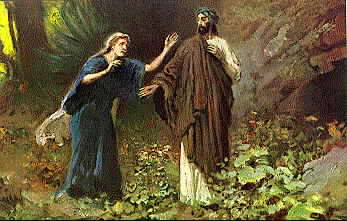
Suddenly, a shadow passes between her and the fire branded sunrise. It is the silhouette of a man. It MUST be the gardener coming to tend to the property before the hot sun engulfs and wilts the plants. It must be someone who knows something about where Jesus has be taken. Once again, the question is asked of her, this time by the man standing silhouetted in front of her, “Woman, why are you crying? Who are you looking for?” Again Mary sniffles and forces out a tired, bitter response amidst her flowing tears “Sir, if you have carried him away, tell me where you have put him, and I will get him.”
She is at the end of her strength.
She is beyond heart-sick.
At the very least this can be done – recovering Jesus’ body.
Then, something remarkable happens – the dead speaks.
The man before her says one word that brings water to a desert.
This one word means more than the content of thousands of words meticulously strewn together in a book.
He speaks this one word and the storms of mourning cease.
He speaks this one word and shattered pieces of her heart become whole again.
“MARY.”
In her weakest state she recognizes just who He is.
In her tear-blurred eyes and flood of grieving heart, she finds renewed strength in His presence.
She calls out to Him by His respected title – ““Rabboni!” (which means “Teacher”).
Mary is overwhelmed with joy.
She is filled with relief.
The sun, now in its fuller light shines upon the son of God in all of His resurrected glory.
He is alive!
_____________________________________________________________________________________
I keep coming back to this story because often we too keep going to back to the empty tombs in our lives.
We keep coming up with the wrong conclusions.
Doubt casts its shadow upon our faith and it weighs heavily on us.
Doubt blurs our resolve and shakes our foundations of belief.
We stoop down into that tomb time and time again and we forget that we do not serve a dead-savior, but a risen one.
We need to look up and see Him.
We need to recognize our teacher.
We need to find Him once more for ourselves.
He wipes away our tears and longs for us to cry out to Him.
Will you?
Something more to ponder today.
To God be the glory!








 Pastor's Ponderings