
Don’t Lose Heart.

Hey there, you beautiful soul. Let’s just pause for a second, wherever you are—sipping coffee, folding laundry, or maybe stealing a quiet moment in the car. I want us to lean into something together, something ancient yet still alive, something that feels like the still, small voice of the Divine. We’re going to dig into a few verses from 2 Corinthians 4:16-18, and I promise, they’re like a tiny spark that can light up the whole room of your heart. Here they are:

“Therefore, we do not lose heart. Though outwardly we are wasting away, yet inwardly we are being renewed day by day. For our light and momentary troubles are achieving for us an eternal glory that far outweighs them all. So we fix our eyes not on what is seen, but on what is unseen, since what is seen is temporary, but what is unseen is eternal.”

Wow. Just… wow. Can you feel or sense the substance of those two verses? The tenderness? Paul, this guy who’s been through shipwrecks and prisons and all sorts of chaos, starts with this bold, gentle nudge: Don’t lose heart. It’s like he’s sitting across from you at a coffee shop, looking you in the eyes, saying, “I know it’s hard. I know you’re tired. But don’t give up.”

What does that stir in you? Because, let’s be real—sometimes life feels like it’s fraying at the edges. Maybe your body’s aching, or your heart’s carrying a grief that’s too heavy to name. Maybe it’s just the slow grind of the everyday, where you’re juggling bills and schedules and a million little worries. Paul sees that. He’s not pretending it’s all fine. He says, Outwardly, we’re wasting away. That’s honest, isn’t it? Things break down. Bodies age. Plans unravel.

But then—oh, then—he flips the script. Inwardly, we’re being renewed day by day. Isn’t that wild? It’s like there’s this quiet, steady work happening inside you, even when you can’t see it. Like a seed splitting open under the soil, or the first hint of dawn before the sun even crests the horizon. Renewal. Not a one-time fireworks show, but a daily, almost invisible unfolding. What if that’s true? What if, right now, in the middle of whatever you’re carrying, something new is being born in you?

And then Paul goes deeper. He calls our troubles light and momentary. Now, I don’t know about you, but sometimes my troubles feel like boulders, not feathers. Momentary? Some of you are thinking, “Paul, this pain has been my companion for years.” So what’s he doing here? I don’t think he’s dismissing our struggles. I think he’s inviting us to zoom out, to see the bigger canvas. These troubles, as real as they are, aren’t the whole story. They’re weaving something—something Paul calls an eternal glory.

Glory. That word’s got some heft, doesn’t it? In the Bible, it’s this sense of radiance, of divine weight, of something so real it makes everything else feel like a shadow. Your pain, your questions, your long nights—they’re not wasted. They’re part of this mysterious process, shaping something eternal, something that far outweighs the heaviness you’re carrying. Can you imagine that? That the stuff you’re walking through is somehow contributing to a beauty that’s bigger than you can grasp?

And here’s where Paul gets really mischievous: So we fix our eyes not on what is seen, but on what is unseen. Okay, Paul, how do you see the unseen? It’s like he Ascendant, right? It’s this cosmic paradox, this invitation to shift your gaze. The seen—the doctor’s report, the bank account, the broken relationship—that’s real, but it’s temporary. The unseen—the love that holds you, the hope that flickers, the divine presence that’s closer than your breath—that’s eternal. It’s like one of those optical illusions where you see a vase, but then you blink, and it’s two faces. Paul’s saying, “Blink. Look again. See the eternal.”

So, how do we do this? How do we train our hearts to notice the unseen? Maybe it’s as simple as starting your day with a breath and a question: What’s renewing in me today? Maybe it’s naming one thing you’re grateful for, even if it’s just the warmth of your coffee mug. Maybe it’s sitting in silence for a minute, letting yourself feel connected to something bigger. These aren’t grand gestures. They’re small, daily practices that tune your soul to the frequency of the eternal.

Here’s the thing: this isn’t about ignoring the pain or slapping a smiley face sticker on your struggles. Feel it all—the ache, the fear, the questions. But don’t let that be the only story. There’s another story, an unseen one, where renewal is happening, where glory is being forged, where the eternal is breaking through.

So, my friend, wherever you are today—whether you’re standing tall or barely holding on—don’t lose heart. Fix your eyes on the unseen. Trust that something beautiful, something eternal, is unfolding. And here’s an open-ended invitation: What’s one tiny way you can practice seeing the unseen today? Maybe it’s a moment of gratitude, a kind word to someone, or just a deep breath where you whisper, “I’m not alone.” What’s stirring in you? Let it simmer. Let it lead you somewhere new.

Grace and peace, always.
-Pastor Scott.

When Sunday School Answers Fall Short…

by Pastor Scott

You ever get tired of the neat, tidy answers? You know the ones I’m talking about—those churchy, Sunday School responses that get tossed out like a life preserver when life’s questions feel more like a tsunami. “God’s got a plan.” “Just trust and obey.” “It’ll all work out in the end.” They’re not wrong, necessarily. But sometimes, they feel like Band-Aids on a broken bone. Life’s complicated, messy, and raw. And sometimes, the harder we try to wrap it up in a neat little bow, the more it unravels.

I’m sitting here, sipping my coffee, staring out the window at a world that doesn’t always make sense. Maybe you’re there too. Maybe you’ve asked, Why did this happen? Why him/her? Why now? Maybe you’ve prayed until your knees ached, and the heavens stayed silent. Or maybe you’ve watched someone you love wrestle with pain so deep it makes your chest hurt just to think about it. And when you bring those questions to church, you get… a platitude. A verse quoted like it’s a magic wand. A smile that says, “Don’t dig too deep.

But what if the digging is the point? What if the wrestling is where we meet God? What if, within that tension, real faith, even in the unknown, gets galvanized?

Let’s talk about Jacob for a second. You know the story—Genesis 32. He’s alone by the Jabbok River, and he ends up in this all-night wrestling match with a mysterious figure. Some say it’s God, some say an angel, but whoever it is, Jacob’s not letting go. He’s got questions. He’s got baggage. He’s got a past he’s running from and a future he’s terrified of. And in the struggle, he gets a limp—and a new name. Israel. “One who strives with God.”

Isn’t that something? God doesn’t smite Jacob for wrestling. He doesn’t hand him a scroll with all the answers. He meets him in the fight. And Jacob walks away changed, but not fixed. He’s still got the limp.

What if that’s us? What if the limp is part of the deal? What if the questions—the ones that keep you up at night, the ones that make you wonder if you’re even doing this faith thing right—are the very place where God shows up?

I’m so tired of pretending we’ve got it all figured out. I’m tired of hearing, “Just read Romans 8:28, and you’ll be fine.” Don’t get me wrong—that verse is gold. “And we know that in all things God works for the good of those who love him, who have been called according to his purpose.” It’s true. But it’s not a vending machine promise. It doesn’t mean every tragedy comes with a PowerPoint explaining why. Sometimes, we’re left with the tension. The mystery. The ache.

And that’s okay.

Think about Job. The guy loses everything—his kids, his wealth, his health. His friends show up with their Sunday School answers, basically saying, “You must’ve sinned, brah. Repent, and it’ll all be fine.” Job’s like, No, I didn’t do anything to deserve this. And he demands an audience with God. He’s bold. He’s raw. He’s not afraid to say, This doesn’t make sense, and I’m not okay with it.

When God finally speaks, does He give Job a flow chart of why bad things happen? Nope. He shows up in a whirlwind and says, Were you there when I laid the earth’s foundation? It’s not an answer—it’s a perspective shift. God’s like, I’m bigger than your questions, but I’m still here with you. And somehow, that’s enough for Job. Not because he gets it, but because he trusts.

So, here’s the challenging, hard question for us today: Can we trust God when the answers don’t come? Can we sit in the tension of I don’t know and still believe He’s good? Can we let go of the need to have it all figured out and just… wrestle?

I also think about Jesus in Gethsemane. He’s sweating blood, begging for another way. “Father, if you are willing, take this cup from me.” (Luke 22:42). Even Jesus, the Son of God, had a moment where the plan didn’t feel okay. But then He says, “Yet not my will, but yours be done.” That’s not a Sunday School answer. That’s surrender in the face of the unknown. That’s trust when the road ahead looks like a cross.

So, what about you? What’s the question you’re wrestling with? The one you’re afraid to say out loud because it feels too big, too messy, too unspiritual? What if you brought it to God—not for an answer, but for a fight? What if you said, I’m not letting go until you bless me—not with clarity, but with presence?

Here’s what I’m learning: Faith isn’t about having all the answers. (I used to think it was, but it certainly isn’t) It’s about trusting God in the questions. It’s about showing up to the mat, night after night, even when you’re tired, even when you’re limping. Because God’s not afraid of your struggle. He’s not offended by your doubt. He’s there, in the dark, ready to wrestle.

So, let’s stop pretending we’ve got it all together – because we don’t. Let’s stop handing out churchy clichés like they’re the cure for everything. Let’s be honest about the hard stuff—the grief, the fear, the why that echoes in our souls. And let’s trust that God is big enough to handle it. That He’s good enough to hold us, even when we don’t understand.

As it says in Psalm 23:4, “Even though I walk through the darkest valley, I will fear no evil, for you are with me.” Not because I get it. Not because it all makes sense. But because He’s with me.

So, keep wrestling, my friend. Keep asking. Keep limping. And trust that the God who meets you in the struggle is the same God who carries you through.

What’s the question you’re afraid to ask? And what would it look like to bring it to God—not for an answer, but for Him?
-Grace & Peace,
Pastor Scott

Discovering Your Calling – One Path or Many?

By Pastor Scott


Hello, friends. Welcome to Pastor’s Ponderings, a space where we sit together, hearts open, and wonder about the big questions. No need for tidy answers or neat conclusions—just a willingness to lean into the mystery of God. Today, I’m pondering something that keeps so many of us awake at night: calling. What does it mean to discover your calling? Is there one singular path God has laid out for you, like a cosmic GPS blinking “You Are Here”? Or is life something wider, messier, more… alive? Let’s explore this together, through the lens of Scripture and the quiet whispers of the Spirit.

The other day, I was walking through the park, watching leaves spiral down from the trees, each one dancing in its own chaotic, beautiful way. I wondered, Does every leaf have a calling? To land in just the right spot? Or is the falling itself the point? We humans, we crave the one thing—the one job, the one mission, the one purpose that makes sense of our existence. We want to know we’re on the right path.

But when I open Scripture, it’s like God gently chuckles at our need for a straight line. Take Jeremiah 1:5, where God says, “Before I formed you in the womb, I knew you; before you were born, I set you apart; I appointed you as a prophet to the nations.” That’s specific, isn’t it? Jeremiah’s got a clear calling: prophet, nations, go. But then I think about Moses. He starts as a prince in Egypt, becomes a fugitive, then spends decades as a shepherd before God shows up in a burning bush and says, “Now you’re going to lead my people out of slavery.” Was Moses’ calling always to be a liberator? What about those 40 years tending sheep? Were they a detour, or were they part of the calling?

This is where it gets interesting. We love the idea of a singular calling because it feels safe. “Tell me the one thing I’m supposed to do, God, and I’ll do it.” But Scripture doesn’t always play along. Consider Paul. He’s a tentmaker, a Pharisee, a persecutor of Christians, and then—bam—blinded on the road to Damascus, he becomes an apostle to the Gentiles. But even then, his life isn’t just one thing. He’s preaching, writing letters, making tents to pay the bills, surviving shipwrecks, sitting in prisons. Was his calling just “apostle”? Or was it the whole messy, beautiful tapestry of his life?

Ecclesiastes 3:1 offers a clue: “There is a time for everything, and a season for every activity under the heavens.” A season. Not a single moment, not a single job, but seasons. Planting, uprooting, weeping, laughing, building, tearing down. What if your calling isn’t one thing, but a rhythm? A dance through seasons, where God is weaving something bigger than you can see?

Maybe the question isn’t “What’s my calling?” but “Who am I becoming?” When Jesus calls the disciples in Matthew 4:19, he doesn’t hand them a five-year plan. He simply says, “Follow me, and I will make you fishers of men.” Follow me. Not “Here’s the map.” Not “Here’s the job description.” Just… follow. Trust. Walk.

That’s scary, isn’t it? We want certainty. We want to know we’re not wasting our lives. But what if the wasting is the point? What if the detours, the failures, the seasons of not-knowing are where God is shaping us? Psalm 139:16 says, “Your eyes saw my unformed body; all the days ordained for me were written in your book before one of them came to be.” All the days. Not just the shiny ones where you feel like you’re “living your purpose.” Every day. The days you’re changing diapers, the days you’re stuck in a cubicle, the days you’re crying because you don’t know what’s next. God’s writing something in all of them.

Here’s where I’m landing, friends: I don’t think Scripture points us to one singular calling. It points us to a Caller. To a God who says, “Walk with me. Trust me. Let me shape you through every season, every stumble, every joy.” Your calling isn’t a destination; it’s a relationship. It’s showing up, day after day, saying, “Here I am, God. What’s next?”

And maybe that’s freeing. Maybe it means you don’t have to have it all figured out. Maybe the barista pouring coffee with love, the accountant crunching numbers with integrity, the artist creating beauty in obscurity—they’re all living their calling, right now, because they’re doing it with God.

So, what’s stirring in you? Are you chasing the one big thing? Or are you starting to see the beauty in the seasons, in the mess, in the not-knowing? I’d love to hear your thoughts—drop a comment or send me a message. This is a journey we’re on together.

Let’s close with a prayer: God, you are here. In every season, in every question, you are writing our story. Help us trust you. Help us follow. Amen.

Thanks for pondering with me, friends. Until next time, keep wondering, keep walking, keep trusting.
Grace & Peace,
-Pastor Scott.


If this topic has been meaningful to you, would you let me know by dropping a comment below? I would love to hear from you!

Forgiveness and Reconciliation: Why Is It So Hard?

-Pastor Scott

Hey there, you beautiful, messy, wandering souls. Welcome to Faith Ponderings, where we don’t just ask the big questions—we lean into them, poke at them, let them breathe. I’m Pastor Scott, your fellow traveler, your co-wonderer, your let’s-get-curious-about-the-hard-stuff companion. No quick fixes here, no bumper-sticker theology. Just us, the Spirit, and a whole lot of holy mystery.

Today, we’re diving into something that’s both a knife to the heart and a balm to the soul: forgiveness. And not just forgiveness, but reconciliation—that next step, that harder step, where you try to rebuild something after it’s been shattered. Why is it so hard? Like, so damn hard? Why does it feel like you’re climbing a mountain with no summit, lugging a backpack stuffed with rocks labeled “hurt,” “betrayal,” and “they don’t even get it”?

Grab a coffee, a journal, or just a quiet corner of your soul. Let’s sit with this. Let’s wrestle. Let’s see where the Spirit takes us.


The Gritty Beauty of Forgiveness

You ever notice how we love the idea of forgiveness? It sounds so good on paper. “Forgive and forget.” “Let it go.” Cue the Disney soundtrack, right? But then you try it, and it’s like… whoa. This isn’t a Hallmark card. This is gritty. This is raw. This is you staring at the person who hurt you—or maybe just their ghost in your memory—and your heart screams, “I can’t. I won’t. They don’t deserve it.”

And here’s the thing: that feeling? It’s real. It’s human. It’s not wrong to feel it. Forgiveness isn’t a transaction, like paying a bill or checking a box. It’s a journey. A process. A tearing-open of your soul to say, “I’m not gonna let this wound define me anymore.” It’s a gift you give yourself, with God’s help, to set your heart free.

But reconciliation? Oh, that’s another beast. That’s saying, “Not only am I letting go of this pain, but I’m gonna try to rebuild something with you. Something new. Something fragile.” And that’s where it gets messy. Because while forgiveness is yours to give, reconciliation takes two.


What Does Scripture Say?

Let’s go to the Bible, because it doesn’t shy away from this mess. In Matthew 18:21-22, Peter—good ol’ Peter, always asking what we’re thinking—comes to Jesus and says, “Lord, how many times should I forgive my brother or sister who sins against me? Up to seven times?” Seven! Peter’s feeling generous. That’s a lot of forgiveness. But Jesus? He blows it up. “Not seven times, but seventy-seven times.” Or in some translations, seventy times seven. Jesus is saying, “Peter, stop counting. Forgiveness isn’t a math problem. It’s a way of being.”

But here’s what gets me: Jesus doesn’t say, “And then reconcile every time.” Forgiveness is one thing—you release the debt, you let go of the grudge. Reconciliation, though? That’s a bridge you build together. It takes trust, rebuilt brick by brick. It takes the other person showing up, owning their stuff, saying, “I see the hurt I caused.” And sometimes… they don’t. Sometimes they can’t. Sometimes they won’t.

So what do you do then? Do you keep forgiving, seventy-seven times, while they keep swinging? Or is there a point where you say, “I forgive you, but I can’t walk with you anymore”? That’s the tension. That’s where we sit, in the ache, asking, “God, what now?”


Joseph’s Story: A Slow, Cautious Dance

Let’s look at Joseph in Genesis 45. This guy’s brothers sold him into slavery. Slavery. Years of betrayal, pain, abandonment. And yet, when he’s standing there, powerful in Egypt, and his brothers show up, he doesn’t just forgive them—he weeps, he embraces them, he reconciles. But it wasn’t instant. It took years. It took his brothers showing some remorse, some change. And even then, Joseph tested them. He didn’t fling open the door and say, “All good!” He watched. He waited. He protected his heart.

I wonder… is that what reconciliation looks like? A slow, cautious dance? A willingness to hope, but not a blindness to reality? Because we love the story of the prodigal son in Luke 15:11-32—the father running out, arms wide, party planned. It’s beautiful. But what if the son came back and said, “I’m not sorry, I just need more cash”? Would the father still throw the party? Or would he say, “I love you, I forgive you, but we’re not there yet”?


The Tension of Reconciliation

This is why it’s so hard. Forgiveness is yours to give—it’s a gift you offer, even if the other person never receives it. But reconciliation? That’s a bridge you build together. And sometimes, the other side isn’t ready to meet you halfway. Sometimes, they’re not safe to build with. Maybe they’re still wielding the same weapons that hurt you. Maybe they’ll never say sorry. And that’s where we need wisdom. That’s where we need prayer, community, maybe even a good therapist to help us sort through the wreckage.

Some of us are carrying wounds from people who will never apologize. A parent who failed you. A friend who betrayed you. A spouse who broke your trust. And the church—oh, the church—sometimes tells us, “Just forgive! Move on! Be the bigger person!” But what if being the bigger person means saying, “I forgive you, but I need boundaries”? What if it means loving from a distance? Is that less holy? Or is that just… human?

Psalm 147:3 says, “He heals the brokenhearted and binds up their wounds.” I love that. God’s not standing there saying, “Hurry up and forgive so I can love you.” He’s binding up your wounds. He’s healing your broken heart. And maybe forgiveness is part of that healing—not for them, but for you. To set you free. To say, “This hurt doesn’t get to own me anymore.”


Forgiveness vs. Reconciliation: A Holy Distinction

Here’s where I’m landing, friends. Forgiveness is a gift you give yourself, with God’s help, to let go of the poison. It’s saying, “I’m not gonna let this grudge eat me alive.” It’s a solo act, a sacred release. Reconciliation, though? That’s a mutual project. It’s a bridge you build, but only when it’s safe, only when there’s shared work. Sometimes, reconciliation means restoring a relationship to what it was. Other times, it means building something new—something different, something that honors the truth of what happened.

And God? He’s in both. He’s in the letting go and the rebuilding. He’s in the tears and the boundaries. He’s in the “I forgive you” and the “I can’t trust you right now.” He’s writing a story of healing, even when it’s messy.


Where Are You in This?

So, where are you in this? What’s stirring in your heart? Are you stuck on forgiving someone, wrestling with that seventy-seven times thing? Or are you wondering if reconciliation is even possible—or safe? Maybe you’re carrying guilt because you can’t reconcile, and you’re wondering if that makes you a bad Christian. Can I just say… you’re not alone. This is hard. It’s supposed to be hard. It’s holy work, but it’s not instant. It’s a journey.

Here’s a challenge: Take a moment to reflect. Journal it out, pray it through, or just sit in the quiet. Ask yourself:

  • What hurt am I carrying that I need to release?
  • Is there a relationship where reconciliation is possible, or do I need boundaries instead?
  • How is God inviting me to heal, right here, right now?

And if you’re feeling stuck, share your ponderings. Drop a comment, send me a message, or talk it out with someone you trust. We’re in this together.


A Closing Prayer

Let’s close with a breath. Inhale… exhale… God, you see the hurts we carry. You see the walls we’ve built, the bridges we’re scared to cross. Heal us. Guide us. Show us how to forgive, how to love, how to be whole. Amen.

Thanks for being here, you beautiful souls. This is Faith Ponderings, and I’m Pastor Scott. Keep asking, keep wrestling, keep trusting. Peace to you.


What’s stirring in you? Share your thoughts in the comments below. Let’s keep pondering together.

Heaven and Hell – Places, States, or Something More?

By Pastor Scott


Hello, friends. Welcome to Pastor’s Ponderings, this is a quiet space where we can sit together, hearts open, and wrestle with the big questions—the ones that possibly stir our souls and keep us up at night. Today, we’re diving into something that’s both familiar and mysterious, something we’ve heard about since we were kids, something that’s been painted in vivid colors and whispered in hushed tones: heaven and hell. I don’t know about you, but I’ve always been interested in this particular topic. Like, where do we go when we die? What happens next? So, today we’re exploring Heaven and Hell.

Yeah, those two.

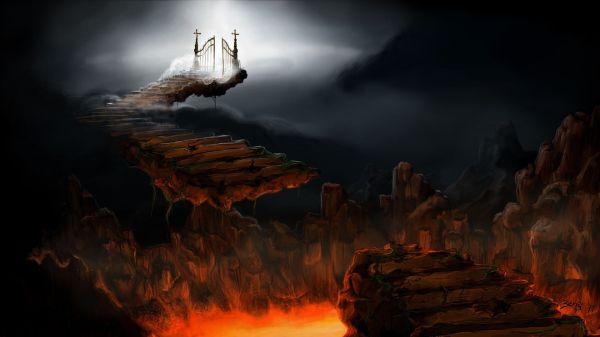
We grow up with these ideas, don’t we? Heaven, this perfect place—clouds and angels, streets of gold, a celestial city where everything is right. And hell, the opposite—fire, brimstone, eternal torment. Good people go up, bad people go down. It’s clear, right? Like a cosmic sorting system, neatly dividing the saved from the damned.

Except… is it? (is it really that straightforward? Is it really that simple?)

Because when you start digging into Scripture, it gets kinda messy. It gets complicated. It’s not always so black-and-white, up-or-down. Let’s start with hell. The word itself carries so much weight, scares people, but what does it actually mean? In the Old Testament, we find Sheol. And Sheol isn’t always this fiery pit of torment we imagine. It’s more like… the grave. The place of the dead. A shadowy, murky realm where everyone goes—righteous or not. Psalm 139:8 says, “If I make my bed in Sheol, you are there.” God is there, in the depths. That’s not exactly the hell we picture, is it?

Then we get to the New Testament, and things get even more layered. There’s Gehenna, a word Jesus uses. Interestingly, Gehenna was a real place—a garbage dump outside Jerusalem where fires burned constantly, a place of decay and destruction. When Jesus talks about Gehenna in places like Matthew 5:29, it’s vivid, visceral. But is He describing a literal place of eternal punishment? Or is He using this image to point to something deeper—maybe the consequences of living a life turned away from God?

And then there’s Hades, which feels more like the Greek underworld, and Tartarus, mentioned in 2 Peter 2:4 as a place for fallen angels. So, we’ve got all these different words—Sheol, Gehenna, Hades, Tartarus—all translated as “hell” in our English Bibles. Each carries its own nuance, its own imagery. It’s like Scripture is less interested in giving us a clear map of the afterlife and more interested in inviting us to ponder the weight of our choices.

Now, let’s talk about heaven. We often imagine it as a place way up there, far from the mess of this world. But Scripture doesn’t always describe it that way. Jesus talks about the “kingdom of God” or the “kingdom of heaven,” and in Luke 17:21, He says it’s “within you” or “among you.” Not a distant destination, but something breaking into the present, something you can taste now. In Revelation 21, we get this breathtaking vision of a new heaven and a new earth, where God dwells with humanity, wiping away every tear. It’s not about escaping to some ethereal realm—it’s about heaven coming down, transforming this world.

And then there’s Paul, who in 2 Corinthians 12:2 talks about being “caught up to the third heaven.” The third heaven? What does that even mean? Is it a literal place? A spiritual experience? A metaphor for closeness to God? The early Jewish worldview often spoke of multiple heavens—layers of divine reality. It’s like Scripture is saying, “This is bigger than you can grasp. Lean into the mystery.”

You see what I’m getting at? Heaven and hell aren’t as simple as we often make them out to be. They’re not just places on a cosmic map, neatly labeled “reward” and “punishment.” And that brings us to the deeper question: What’s it all about?

We often frame heaven and hell as God’s cosmic courtroom—follow the rules, get the golden ticket; break them, face eternal consequences. But is God really just a judge, handing out eternal sentences based on our performance? Or is there something more going on? Because Jesus talks a lot about judgment, yes. But He also talks about forgiveness. About grace. About a love that never gives up. In Luke 15, the father in the parable of the prodigal son doesn’t wait for his wayward child to grovel—he runs to him, arms wide open. That’s the heart of God.

What if heaven and hell aren’t so much about where we go, but about how we are? What if they’re about the state of our hearts, the direction of our lives, the choices we make in this very moment?

Let’s ponder this. What if hell is separation? Separation from God, from others, from our true selves. What if it’s the natural consequence of choosing a life disconnected from love, compassion, and life itself? In Matthew 25, Jesus describes those who ignore the hungry, the stranger, the prisoner as being sent to “eternal punishment.” But the word there for punishment, kolasis, can also mean correction or pruning. What if even God’s judgment is about restoration, not destruction? What if hell is less about eternal torment and more about the pain of living apart from the Source of all life?

And heaven—what if it’s connection? Connection with God, with others, with the fullness of who we were created to be. In John 10:10, Jesus says, “I have come that they may have life, and have it to the full.” That’s heaven—not just a future hope, but a present reality. A life saturated with love, overflowing with grace, radiating hope. Revelation 22 paints a picture of a river of life, a tree of healing for the nations. That’s not a far-off dream—it’s something we’re invited to participate in now.

Maybe, just maybe, heaven and hell aren’t only places we go after we die. Maybe they’re realities we experience here and now. Maybe we’re creating heaven or hell with every breath we take, with every choice we make, with every relationship we cultivate or neglect. When we choose love, when we forgive, when we seek justice, we’re bringing heaven to earth. When we choose selfishness, apathy, or hatred, we’re building walls of separation—our own little hells.

This isn’t to say there’s no afterlife, no ultimate fulfillment of God’s promises. Scripture points to a future where God makes all things new. But it’s also saying that eternity starts now. The choices we make today ripple into forever.

It’s a mystery, of course. We’re talking about things beyond our full comprehension. And that’s okay. Maybe instead of obsessing over the fire and brimstone or the clouds and harps, we can focus on this: God is love (1 John 4:8). And God is always, always, always reaching out to us, inviting us into a life of love, a life of connection, a life that is… truly life.

So, what’s stirring in you? How do you imagine heaven and hell? Where do you see glimpses of connection or separation in your own life? Drop a comment or send me a message—I’d love to hear your ponderings. We’re in this together, wrestling, wondering, trusting.

Let’s close with a prayer: God, you are love, and you are always calling us closer. Help us choose connection over separation, love over indifference, life over death. Guide us into your kingdom, here and now, and forever. Amen.

Thanks for pondering with me, friends. Until next time, keep questioning, keep seeking, keep trusting.
Grace & Peace,
-Pastor Scott.

Wrestling with Evil – Where Is God in the Darkness?

By Pastor Scott


Hello, friends. Welcome back to Pastor’s Ponderings, where we sit together, hearts wide open, and wrestle with the questions that weigh heavy on our souls. Today, we’re going there. We’re talking about evil. That word. It’s a heavy one, isn’t it? The one we whisper about, the one we try to explain away, the one that creeps into our dreams and floods our newsfeeds.

Evil is everywhere, isn’t it? We see it on the grand scale—wars tearing nations apart, natural disasters swallowing communities whole. But we also feel it in the quiet, personal moments—the child battling cancer, the family shattered by violence, the weight of injustice that presses down on the oppressed. And in those moments, the question rises, sharp and unyielding: Where is God in all of this?

It’s the question that’s been asked for millennia. The one that makes people walk away from faith, the one that keeps theologians up at night, the one that, if we’re honest, makes all of us wonder. If God is all-powerful and all-loving, how can there be so much evil in the world?

We try to make sense of it, don’t we? We reach for explanations. Free will, for instance—God gave us the choice to love or to hate, to create or to destroy. And that makes sense, up to a point. It explains why humans hurt each other. But then you think about a tsunami, a pandemic, an earthquake. What choice did the victims have? Where does free will fit when the ground itself seems to turn against us?

Then there’s the idea of a greater plan, some cosmic tapestry where all this suffering somehow fits, somehow leads to a greater good. But does that really satisfy? Does it comfort the mother who’s lost her child? Does it bring justice to the oppressed? Or does it feel like a hollow promise, a way to gloss over the pain?

And what about our images of God? Is God the one who allows evil, standing back and watching it all unfold? Or is God somehow in it—suffering with us, weeping with us, groaning alongside creation? Romans 8:22 says, “We know that the whole creation has been groaning as in the pains of childbirth.” Creation itself is in pain, and yet, in verse 26, we’re told the Spirit “intercedes for us through wordless groans.” God is groaning too. Not distant, not detached, but right here, in the mess.

Here’s what keeps circling back to me: we want a God who fixes it. A God who steps in, banishes the darkness, and makes everything right. We want the superhero God, the one who snaps His fingers and wipes out evil. But what if God doesn’t work that way? What if God’s power isn’t the power over, but the power within?

What if, instead of erasing evil, God’s power is the power to transform it? To redeem it? To take even the darkest, most broken moments and weave them into something new, something beautiful, something… hopeful? Think of the cross. The ultimate symbol of evil—torture, injustice, death—and yet, through it, God brings resurrection, redemption, life. John 16:33 has Jesus saying, “In this world you will have trouble. But take heart! I have overcome the world.” Not by removing trouble, but by overcoming it, by working through it.

It’s a mystery, I know. A mystery that defies easy answers. And maybe that’s the point. Maybe the goal isn’t to solve the problem of evil, but to enter it. To be present to the pain, to lament with those who lament, to work for justice in a world that so desperately needs it. Lamentations 3:19-23 reminds us that even in the bitterness of suffering, God’s mercies are new every morning. There’s a light that shines, even in the darkest places.

That light—it flickers in the eyes of those who fight for good, who work for peace, who love in the face of hate. It glows in the hands that rebuild after disaster, in the voices that speak out against oppression, in the hearts that refuse to give up. And maybe, just maybe, that light is God. Not a God who removes all suffering, but a God who walks through it with us, who empowers us to be agents of healing and hope in a broken world.

Isaiah 43:1 says, “Do not fear, for I have redeemed you; I have summoned you by name; you are mine.” Even in the valley of the shadow of death, God is with us (Psalm 23:4). Not fixing, not erasing, but with. And that presence, that nearness, changes everything.

So, where does this leave us? Wrestling, I think. Wrestling with the questions, the tears, the doubts. But maybe, in the wrestling, we find a God who is closer than we ever imagined. A God who doesn’t stand above the pain, but enters it. A God who doesn’t promise a world without evil, but a world where evil doesn’t have the final word.

What’s stirring in you? How do you wrestle with the reality of evil? Where do you see that flickering light of hope? Drop a comment or send me a message—I’d love to hear your thoughts. We’re in this together, pondering, questioning, trusting.

Let’s close with a prayer:
“God, you are in the darkness and the light, in the questions and the pain. Walk with us. Show us your light. Empower us to be your hands and feet in a broken world. Amen.”

Thanks for pondering with me, friends. Until next time, keep wrestling, keep hoping, keep trusting. Peace be with you.


Good Friday: Death & The Great Unraveling.

Also check out my Good Friday episode on Spotify & Apple Podcasts:

Hey, friends. It’s Good Friday. The air feels heavy, doesn’t it? Like the world is holding its breath, caught in the tension of a moment that’s both brutal and beautiful. Today, we’re sitting with the cross, with death, with the great unraveling of everything we thought we knew. And I’m not gonna lie—it’s messy. But it’s also where the real stuff happens.

Let’s start here: Good Friday isn’t just a day on the calendar. It’s a collision. It’s God stepping into the chaos of human brokenness, staring death in the face, and saying, “You don’t get the last word.” But before we rush to the resurrection, let’s pause. Let’s feel the weight of this moment. Because something profound happens when everything falls apart.

Think about it. Jesus on the cross—arms stretched wide, body broken, crying out, “My God, my God, why have you forsaken me?” This isn’t just a historical event; it’s a mirror. It’s the moment where every ounce of human pain, every betrayal, every fear of abandonment, every question about whether God is even there—it all gets absorbed into the heart of God. The cross is where the threads of our tidy little lives start to unravel, and we’re left with the raw, unfiltered truth: death is real. Suffering is real. And yet, love is more real.

But here’s the thing: we don’t like unraveling, do we? We want to keep it together. We want our plans to work, our faith to be neat, our lives to make sense. Good Friday says, “Nope. Not today.” It’s the day that forces us to look at the places where we’re clinging too tightly, where we’re avoiding the pain, where we’re pretending we’ve got it all figured out. It’s the day that whispers, “Let it go. Let it fall apart. Because that’s where the new thing begins.”

I’m thinking about my own life as I write this. There’s this moment a few years back—maybe you’ve got one too—where everything I thought I knew about God, about myself, about what “success” looks like, just… crumbled. I was sitting in my office, staring at a stack of sermon notes that felt hollow, and I realized I was terrified of letting go. Terrified of admitting I didn’t have the answers. But in that unraveling, in that death of my need to control, something broke open. I started to see God in the mess, in the questions, in the silence.

Good Friday is like that. It’s the death of our illusions. It’s the moment where we’re invited to stop running from the pain and just sit with it. Because here’s the wild, upside-down truth: the cross shows us that death isn’t the end. It’s the doorway. It’s the place where God says, “I’m here. In the worst of it. I’m here.”

So, let’s get real for a second. What’s unraveling in your life right now? What’s the thing you’re holding onto so tightly that your knuckles are white? Maybe it’s a relationship that’s fraying, a dream that’s dying, a version of yourself you’re afraid to let go of. What if Good Friday is an invitation to stop fighting the unraveling and trust that something new is being woven in the wreckage?

Here are a few questions to chew on as you sit with this day:

  • What’s the “death” you’re afraid of facing in your life right now? Is it a literal loss, a change, or maybe the death of an old way of thinking?
  • Where do you see God in the unraveling moments of your story? Can you look back and spot the threads of grace in the mess?
  • What would it look like to trust that love gets the last word, even when everything feels like it’s falling apart? How might that change the way you move through this day, this season?

Friends, Good Friday isn’t the end of the story, but it’s a crucial part. It’s the part where we learn that God doesn’t shy away from the dark. God enters it. God transforms it. So today, let’s not rush past the cross. Let’s stand here, in the shadow of death, and let the great unraveling do its work. Because on the other side? There’s life. More life than we can imagine.

With you in the mess,
Pastor Scott

What’s unraveling for you today? Drop a comment below or just sit with these questions in your heart. Let’s hold space for the holy work of Good Friday together.

The Unfolding Meal – A Reflection on Feet, Bread, and the Great Yes

As I sit with the scene of the Last Supper, I find myself drawn into a moment so rich, so layered with meaning, that it feels like a tapestry woven with threads of humility, sacrifice, and love. This was no ordinary meal. It was Passover, a time when the Jewish people gathered to remember—to taste and see the story of their liberation from slavery, to let the bitter herbs and unleavened bread stir their souls. The air was thick with history, with hope, with the promise of God’s faithfulness. And there, in an upper room, Jesus and his disciples sat together, sharing this sacred meal.

Can you picture it? The flickering lamplight, the low hum of conversation, the weight of expectation. The disciples had walked with Jesus, seen his miracles, heard his teachings. They must have wondered what was next. A bold move against the Roman oppressors? The unveiling of a new kingdom? Their hearts were likely racing with possibility.

But then, Jesus does something utterly unexpected. He rises from the table, removes his outer robe, ties a towel around his waist, and kneels with a basin of water. One by one, he begins to wash their feet.

Pause for a moment and let that image settle in your heart. Foot washing was the work of servants, a gritty, humbling task reserved for the lowest in society. Yet here is Jesus—their teacher, their Lord, the one they dared to call Messiah—kneeling before them, tending to their dusty, calloused feet. The room must have grown quiet, the air heavy with astonishment. Peter’s protest echoes what many of us might feel: “No, Lord, not my feet. This isn’t right.” We cling to our hierarchies, our sense of who should serve and who should be served. But Jesus, in this tender, radical act, dismantles those assumptions. He shows us a different kind of power—one that kneels, that serves, that loves without counting the cost.

“Do you understand what I have done for you?” he asks. “If I, your Lord and Teacher, have washed your feet, you also should wash one another’s feet. I have set you an example.” This isn’t just about feet, is it? It’s about a posture of the heart. It’s about seeing the dignity in every person, no matter how worn or weary their journey. It’s about meeting others in their vulnerability, their mess, their humanity—and serving them there.

As the meal continues, the ordinary becomes extraordinary. Jesus takes bread, breaks it, and says, “This is my body, given for you. Do this in remembrance of me.” He lifts a cup of wine: “This is the new covenant in my blood.” Simple elements—bread and wine—become symbols of a love so profound it would soon be poured out on a cross. This act of remembrance isn’t just a backward glance at history. It’s an invitation to participate, to let this love shape us, to let it break us open and make us whole.

What strikes me most is the intimacy of this moment. Jesus knows what lies ahead—the betrayal, the suffering, the weight of the cross. Yet he chooses this meal, this shared table, to reveal the heart of his mission. He’s saying, “This is who I am. This is what love looks like. Even when the world feels like it’s crumbling, this is the way.” It’s a love that gets down low, that breaks itself open, that says a resounding “yes” to humanity, even in its brokenness.

As I reflect on this unfolding meal, I find myself asking: Where is the sacred hiding in the ordinary moments of my life? Where am I being called to kneel, to serve, to wash the dusty feet of those around me? It might be in the small acts—a listening ear, a shared meal, a moment of grace extended to someone who feels unworthy. It might be in the courage to love without expecting anything in return.

The bread, the wine, the water on weary feet—they point us to a love that transforms. They invite us to remember, not just a meal long ago, but a way of being that can change how we move through the world. So, as you ponder this scene, consider: Where are the dusty feet in your life? How might you embody this humble, sacrificial love? And how can you say your own “yes” to the call to serve, to remember, to love?

Thank you for joining me in these reflections. May we carry this sacred meal with us, letting it shape our hearts and our hands as we walk this journey together.
Grace & Shalom,
-Pastor Scott

The Seeds You Can’t Outrun

Galatians 6:7 at Pastors Ponderings

Hey there, friends. Welcome back to Pastors Ponderings. It’s Pastor Scott here, and today we’re digging into a single verse that’s been rattling around in my head like a loose stone: Galatians 6:7. Paul’s words hit hard and stick deep: “Do not be deceived: God cannot be mocked. A man reaps what he sows.” That’s it. Short, sharp, and straight to the gut. Ready to wrestle with it? Let’s go.

Picture Paul writing this to the Galatians—folks he cared about, folks he sometimes wanted to shake a little. He’s not mincing words here. Reaps what he sows. It’s got that earthy, farmer’s wisdom to it—like something your grandpa might’ve muttered while tossing seed into the ground. But don’t let the simplicity fool you. This isn’t about crops. It’s about us. Our lives. The seeds we’re scattering every single day, whether we’re paying attention or not.

Take a moment. What are you sowing? Not in the big, shiny moments you’d post online, but in the quiet ones nobody sees. The way you snap at the cashier when you’re rushed. The bitter thoughts you let fester like weeds. The grudges you nurture as if they’re prize roses. That’s seed, friends. And Paul’s warning us: don’t kid yourself. God’s not buying the act. What you plant comes back to you.

It’s a little unnerving, right? Your life’s this garden, and you’re holding the shovel. No pointing fingers at the soil or the weather or the neighbor’s dog digging up your rows. You reap what you sow. It’s on you.

But here’s where it shifts. Paul’s not just playing the heavy here—he’s not out to shame us. This isn’t about guilt trips. It’s about power. Real power. If you reap what you sow, then you’ve got a hand in what grows. You’re not just drifting through life, waiting for the next thing to happen. You’re the gardener. You get to choose.

So, what’s growing in your patch? Seriously—stop reading for a sec if you need to, grab a coffee, and sit with that question. Are you sowing bitterness? Fear? That sneaky cynicism that feels like armor but leaves you empty? Or are you planting something different—kindness, courage, hope—even when it feels risky or foolish? Because here’s the truth: the harvest doesn’t lie. It’s coming. And it’s got your name on it.

Paul’s writing to a church here—a messy, real group of people stumbling through faith together. He’s saying, don’t buy the lie that you can plant thorns and pick roses. You can’t mock God like that—not because He’s keeping score, but because that’s how the world works. It’s stitched into the universe. Gravity pulls. Seeds sprout. Actions ripple.

But flip that coin: every good thing you sow—every time you choose love over spite, grace over payback—it’s not lost. It’s seed. And it’s going to push through the dirt and turn into something wild and beautiful, something you can’t even picture yet.

Here’s the challenge: What are you sowing today? Not tomorrow, not when life’s all neat and tidy—right now. Galatians 6:7 isn’t a threat—it’s a wake-up call. It’s Paul grabbing us by the shoulders, saying, “You’ve got this crazy, sacred shot to shape what’s coming. Don’t miss it.”

And here’s the hope: You’re not out there alone. The God who set this whole reaping-and-sowing thing in motion? He’s right there with you. He’s the sun warming the ground, the rain soaking it through, the force that cracks the seeds open and pulls them toward the light. You sow, and He grows. That’s the quiet promise humming beneath this verse.

Galatians 6:7 is a mirror. A dare. A whisper that says your life matters—every seed you plant matters. So maybe today, you and I, we pick up the shovel. We sow something brave. Something true. And we trust the harvest is on its way. What do you say? Let’s see what breaks through the soil.

Keep digging, keep planting, keep chasing the mystery. I’ll see you back here next time.
Grace, Peace & Dirt under the nails

— Pastor Scott

Palm Sunday- Donkeys or Warhorses?

Happy Monday, my friends! I hope each of you had a good weekend. Today, we edge ever closer to Easter, and I wanted to dig into what will happen on Palm Sunday. So, let’s dive into this wild, beautiful, interesting story from Luke 19:28-44 that always evokes questions.

Picture it with me: Jesus is heading into Jerusalem, and the air crackled and hummed, thick with a restless energy that felt like a living thing—wild, untamed, sparking with possibility.

He’s not rolling in with a warhorse or a chariot—no, he’s on a donkey, a borrowed one at that. This isn’t the entrance of a conqueror, at least not in the way we’d expect. It’s quieter, humbler, but don’t let that fool you—it’s loaded with meaning, dripping with intention.

So, he tells his disciples, “Go get me that colt.” They’re confused, probably—Jesus isn’t exactly known for spelling things out in neon lights. But they go, they find it, and here he comes, riding down the Mount of Olives. The crowd’s losing it—coats on the ground, palm branches waving, shouts of “Hosanna!” bouncing off the stones. It’s a party, a parade, a moment where hope feels so close you could touch it. They’re quoting the Psalms, calling him the King who comes in the name of the Lord. Peace in heaven, glory in the highest—it’s cosmic, it’s earthy, it’s everything all at once.

But then, zoom in. Jesus isn’t grinning ear to ear. He’s not waving like a politician soaking up the applause. He’s weeping. Weeping! The guy they’re cheering for, the one they’re pinning their dreams on, is crying as he looks at Jerusalem. Why? Because he sees what’s coming. He sees the city that’s about to miss the point, miss the moment, miss him. “If you’d only known what would bring you peace,” he says, “but now it’s hidden from your eyes.” Hidden. That word hangs there, heavy, haunting. Days of siege are coming, he says—enemies, barricades, destruction—because they didn’t recognize the time of God’s visitation. The time when God showed up, right there, on a donkey.

Now, let’s pause. What’s this about? Is this just a sad history lesson, a first-century postcard of a city that didn’t get it? Or is it something more, something that’s still humming under the surface of our lives? Because here’s the thing: Jesus isn’t just crying over Jerusalem back then—he’s crying over every Jerusalem since. Every place, every heart, every moment where we miss what’s right in front of us. Where we trade peace for power, love for control, presence for distraction.

Think about it. The crowd wanted a king to fix their problems—kick out the Romans, restore the glory days. They wanted fireworks and fanfare. But Jesus rides in on a donkey, not a stallion. He’s offering a different kind of kingdom, one that doesn’t shout but whispers, one that doesn’t crush but lifts. And they miss it. They miss the visitation because it didn’t look like what they expected.

So, here’s the question pulsing through this story: What are we missing? What’s God riding into our lives on, right now, that we’re too busy waving our own branches to see? Maybe it’s not the loud, obvious thing we’re waiting for—maybe it’s quieter, smaller, more borrowed-donkey than royal-steed. Maybe peace isn’t in the next big win or the perfect fix, but in the tears, the humility, the willingness to ride into the mess instead of around it.

And those tears of Jesus—they’re not just pity. They’re love. Love that sees what could be, what should be, and mourns what isn’t yet. But they’re also hope. Because even as he weeps, he keeps going. He doesn’t turn the donkey around. He rides into Jerusalem anyway—into the cheers, into the chaos, into the cross. He doesn’t give up on them. He doesn’t give up on us.

So, today, let’s ponder this. Let it get under your skin a little bit. Let it settle down deep.
Let’s ask: (and I always seem to be asking where something is lol, it’s just in my nature)
Where’s the donkey in my story? Where’s the peace I’m missing because I’m looking for a warhorse? And what if—just what if—God’s visitation is already here, waiting for me to stop shouting long enough to see it? Because the one who wept over Jerusalem is still weeping, still riding, still whispering: “Peace. Peace. I’m here.”

Grace & Peace,
-Pastor Scott.

Blog at WordPress.com.

Up ↑