“I Can See Clearly Now: Removing the Cultural Blinders.”

Have you ever wondered how much of what you believe is shaped by the culture around you? How much it is shaped by your childhood, your Sunday School class, that old church lady or man who frowned every time you laughed during a church service? How often do we confuse what we’ve absorbed from our past and surroundings with what God is truly saying? It’s like wearing sunglasses indoors. Everything looks a little darker, and you don’t even realize it until someone asks, “Why are you still wearing those?”

We all wear cultural blinders. They shape how we see God, how we see others, and even how we see ourselves. These blinders aren’t always bad; they’re just there. They’re the stories we’ve been told, the assumptions we’ve never questioned, and the unspoken rules we’ve learned to follow. But what if some of those stories, assumptions, and rules are keeping us from seeing clearly? Why aren’t we asking the right questions? Or even asking questions at all? Why do we just assume that we already know?

The Problem with Cultural Blindness

One of the biggest dangers of cultural blinders is that they limit our vision. Jesus talked about this all the time. Remember when he said, “You have heard it said… but I tell you…” (Matthew 5)? He was challenging the cultural scripts people had internalized—the ones that said, “Love your neighbor and hate your enemy” or “An eye for an eye.”

Jesus wasn’t just tweaking the rules; he was flipping the entire script. He was saying, “The way you’ve been taught to see the world isn’t the way God sees it.” And if we’re honest, we need that same challenge today. Could it be that there’s a script that we’ve blindly accepted that might need to be flipped?

The Filters We Don’t See

Think about the stories our culture tells about success. Bigger, better, faster, more. It’s a narrative that’s so pervasive we barely notice it. And yet, Jesus comes along and says, “Blessed are the poor in spirit… blessed are the meek… blessed are those who hunger and thirst for righteousness” (Matthew 5:3-6). He’s inviting us to see success in a completely different way.

Or consider how we’re taught to categorize people. Who’s in, who’s out. Who’s worthy of our time and attention. And then Jesus tells a story about a Samaritan—someone the cultural script labeled as an enemy—and makes him the hero (Luke 10:25-37). Jesus is constantly disrupting our categories, asking us to see people as God sees them. It’s dangerous. It’s counter-cultural. It’s amazing.

Removing the Blinders

So, how do we begin to remove these blinders? It starts with humility. We have to admit that we don’t see the whole picture. As Paul writes, “For now we see only a reflection as in a mirror; then we shall see face to face” (1 Corinthians 13:12). Part of growing in our faith is acknowledging that our vision is incomplete and asking God to help us see more clearly. It can be scary to admit this. It’s daunting to accept change in our preconceived notion of “having it all worked out.” So what needs to change? What is still blinding you from fully seeing?

Here are three practices to help:

  1. Question Your Assumptions Start by asking, “Why do I think this way?” Whether it’s about God, relationships, or the world around you, take the time to examine your beliefs. Are they rooted in Scripture, or are they shaped by cultural norms? Philippians 2:12 reminds that we should “work out our salvation with fear and trembling.” When we begin to question our assumptions we begin to remove the sunglasses that has prevented us from properly seeing.
  2. Listen to Other Voices Sometimes we need to step outside our echo chambers. Read books, listen to sermons, or have conversations with people who see the world differently. It’s amazing how much we can learn when we’re willing to listen. But be brave when you listen. Don’t just embrace the comfortable. Or the things that already speak to your accepted understanding of Church, Others and the Divine. Be prepared to dig deeper and as you listen begin to ask the hard questions.
  3. Ask God for Fresh Eyes Make it a habit to pray, “God, help me see what you see.” This simple prayer can open your heart to new perspectives and reveal the blind spots you didn’t even know you had.

The Freedom of Clear Vision

When we remove the cultural blinders, we start to see the world the way God intended. We see people as made in his image, without bias and rooted understanding. We see success as faithfulness, not achievement. We see love as the highest calling. And most importantly, we see God not as a reflection of our culture, but as the Creator who’s constantly inviting us into something deeper, truer, and more beautiful.

So maybe it’s time to take off the sunglasses. To step into the light. To let God show us what we’ve been missing all along. Because when we see clearly, everything changes.

Grace and Peace.
-Pastorsponderings.

Discovering Grace in Everyday.

Life has this way of pulling us in a thousand directions at once, doesn’t it? There’s the constant hum of obligations, deadlines, and distractions—a never-ending playlist of demands. And in the midst of it all, we can start to feel like we’re losing the plot, like we’re just moving through the motions. I call it “getting lost in the sauce”…

But here’s the thing: even in the chaos, there’s grace.

Grace is not about striving harder or being perfect. It’s about discovering that God is present in every moment—the messy, the mundane, the miraculous. The sacred is right here, in the very fabric of your ordinary day. It’s both ordinary and mysterious all at the same time.

Think about how Jesus lived. He walked dusty roads. He shared meals with fishermen and tax collectors. He paused to notice people—a woman at a well, a man in a tree, children running toward Him. He didn’t rush through life; He moved with intention, always present, always open to the beauty and possibility in the moment.

And maybe that’s the invitation for us. To slow down. To breathe deeply. To notice.

One of my favorite fiction authors, Brandon Sanderson once said, “Enjoy memories, yes, but don’t be a slave to who you wish you once had been. Those memories aren’t alive. You are.”

So my fellow ponderers, notice the laughter of a friend. The warmth of sunlight breaking through your window. The kindness of a stranger. The joy of a child’s giggle. These aren’t just random moments; they’re whispers of grace, reminders that you’re not alone in this. And that you are alive. What a gift this is!

Scripture reminds us, “The Lord is close to the brokenhearted and saves those who are crushed in spirit” (Psalm 34:18).

Close. Not far off, not out of reach. Close.

What if we lived as though that were true? What if we embraced the idea that God is not only with us in the big, life-altering moments but also in the small, overlooked ones? I call those small things microblessings. They are often overlooked and taken for granted. But God is present within all of it, and with you.

So today, let’s practice looking for the sacred in the ordinary. Let’s believe that grace is woven into the very fabric of our lives, waiting to be noticed, waiting to be embraced. Take notice. Look around you. Breathe deep the blessings and grace of God. It’s there for you to receive.

You are loved. You are held. And you are walking in grace—even now.

Peace to you.

-Pastorsponderings

Taste and See: The Beauty of Trusting in God.

There’s something magnetic about the way the psalms draw us in, isn’t there? They’re raw, human, unpolished. They take us to the very core of the human experience—joy, pain, fear, gratitude. Today, let’s pause with Psalm 34:

“I sought the Lord, and he answered me; he delivered me from all my fears. Those who look to him are radiant; their faces are never covered with shame. … Taste and see that the Lord is good; blessed is the one who takes refuge in him.”

Did you catch that? Fear and radiance, shame and goodness—all intertwined. The psalmist isn’t merely saying, “Believe this.” He’s inviting us to experience it, to live it, to feel it deep in our bones.

“I sought the Lord, and he answered me.”

Seeking is active. It’s not passive waiting; it’s stepping into the mystery, bringing our messy, tangled fears before God. When you seek, you’re opening your heart to the possibility that maybe—just maybe—there’s a love big enough to hold you, even in your darkest moments.

And then? Freedom. Deliverance. The kind of peace that makes fear lose its grip.

“Those who look to him are radiant.”

Radiance—it’s not about physical beauty or perfection. It’s about what happens when you live with the weight of shame lifted off your shoulders. It’s the glow of someone who knows they’re deeply loved, fully seen, and completely accepted.

Have you ever noticed how light seems to pour out of people who’ve encountered that kind of love? Their joy isn’t tethered to circumstances; it flows from something deeper, more unshakable.

“Taste and see that the Lord is good.”

This isn’t a theoretical proposition. It’s an invitation to dive in. To taste. To see. To engage all your senses. The psalmist is saying, “Try it. Take the leap. Experience God’s goodness for yourself.”

Think about tasting—really tasting—a piece of ripe fruit. You don’t analyze it from a distance. You bite into it. The sweetness floods your mouth. It’s immediate. Real. That’s the kind of encounter with God the psalmist is talking about.

So, what’s the invitation here?

It’s not to have all the answers. (we certainly don’t) It’s not to tidy up your life or figure out your theology. (it’s still a work in progress) It’s simply to come. To seek. To look. To taste. To take refuge in a God who is good—always good—even when life feels anything but.

What would it look like for you to bring your fears to God today? To trust that he meets you right there, not with condemnation, but with deliverance?

What if you leaned into his goodness—not as a concept, but as a reality you can taste and see and know?

Let’s live this day tasting, seeing, trusting. Because when we do, radiance isn’t just a possibility; it becomes the very rhythm of our lives.

Grace and peace.

The Prodigal Within: Confronting the Parts of Myself I’d Rather Not See

We all know the story of the prodigal son – that wayward child who demanded his inheritance, squandered it in wild living, and finally came crawling back home to his father’s embrace. The scripture literally says, “when he came to his senses” (Luke 15:17, NIV) It’s a beautiful tale of redemption, one we’ve heard countless times from pulpits and Sunday school classes…and maybe an old flannel-graph or two. But lately, I’ve been wrestling with an uncomfortable truth: the prodigal son isn’t just a character in a parable. He lives within me. There. I’ve said it. (Phew, what a relief).

You see, I’ve spent years pointing fingers at others’ shortcomings while expertly avoiding the mirror. I’ve sat in church pews, Bible balanced perfectly on my lap, nodding along to sermons about transformation while carefully tucking away the parts of myself that needed transforming most. I’ve become a master at seeing the speck in my brother’s eye while ignoring the plank in my own. Can you relate? I sure hope you can. Because I think this shadow-self, this prodigal lives within us all.

But God, in His persistent grace, hasn’t let me stay comfortable in my spiritual blindness. He’s been gently, yet firmly, turning my gaze inward, inviting me to examine those shadowy corners of my heart I’ve worked so hard to ignore. This isn’t just another devotional about self-improvement or a three-step guide to better Christian living. This is my raw, honest journey of confronting the prodigal within – the parts of myself I’d rather pretend don’t exist.

Let me start by confessing something that makes me deeply uncomfortable: I am a master of selective Christianity. I’ve perfected the art of highlighting the verses that make me feel good while skillfully dodging the ones that challenge my comfortable patterns. For years, I’ve chosen to focus on God’s promises of prosperity while conveniently overlooking His calls to die to self. I’ve championed grace for others in public while harboring private judgments that would make the Pharisees proud.

This journey began years ago, on an ordinary Wednesday evening, during what should have been a routine small group meeting. We were discussing the Beatitudes – familiar territory, I thought. But when someone asked, “What does it really mean to be poor in spirit?” I opened my mouth to give my usual polished answer and suddenly stopped short. In that moment, the Holy Spirit held up a mirror, and for the first time, I truly saw myself. Have you had that mirror experience too?

In that moment, I saw the pride masquerading as spiritual wisdom. I saw the selfishness dressed up in religious duty. I saw the fear hiding behind my confident exterior. Like the prodigal son, I hadn’t physically left my Father’s house, but my heart had wandered far from home. I was living in a far country of my own making, feeding on the husks of religious performance while starving for genuine transformation.

This isn’t a story about wallowing in guilt or shame. Rather, it’s about the extraordinary discovery that the same Father who runs to meet the physically prodigal son also races toward those of us who’ve wandered within the walls of the church. It’s about finding that true repentance begins not with outward actions, but with the courage to face ourselves honestly before God.

How honest are we about this prodigal within? When the Holy Spirit lifts that mirror before us what do we see and what do we intentionally ignore?

Confronting our Prodigal Self
When we confront instead of flee, true growth begins to take root within us. Only when we begin to accept that which we have long ignored will we truly experience freedom from the slavery of self. It’s liberating. You should try it sometime…there I go again judging you when I still have work to do.

Something more to ponder today.
Questions to consider:
1) What is preventing you right now from confronting your prodigal self (your shadow-self)?
2) What is the Holy Spirit saying to you?
3) How can you intentionally accept God’s honest, yet loving assessment of you?
Being vulnerable before God is hard. What can you do to set aside five minutes today to just sit before that mirror? Don’t flinch, just sit and listen. He desires to clothe you and throw a party for his child who was once lost but is now found.
(Repeat again tomorrow).

When Faith Flickers – Finding God in the Shadows of Doubt.

After the death of a loved one, I felt lost. The prayers we had all prayed seemed to have been for nothing. I felt as if God were distant from me, and if I’m being honest, I was angry at Him for not answering my prayers when I needed Him most. I resented Him, and I felt my faith fading away. It wasn’t gone entirely, but I found myself questioning the rhythms and routines of my faith journey. Had I grown too comfortable? Is there more to faith than this? Am I doing it all wrong?

I have discovered that faith, like most things, can wane from time to time. I do not think it’s wrong to express moments of doubt. Because doubt, like shadows, can often cast its long amorphous tendrils over the spaces once illuminated by trust and assurance…but the light is still there.

Time, you see, though a human construct, can separate us from that path, and we begin to forget. What do we forget, you may ask? We forget the fulfillment of God’s promises. We lose sight of the many times we felt His presence with us, and instead we only recall the times when our prayers seemed to go unanswered. Time has a way of allowing those shadows to grow in us. And then our grip is loosened, and our resolve erodes. Often times when this happens, we berate ourselves because we lack faith. Inwardly we cower at the thought that others might discover our shortcomings. Why are we afraid to be vulnerable around other Christ-followers? Do we not realize that they struggle with their faith and doubt too? We often fail to acknowledge that they are also imperfect and just as vulnerable. And yet, oftentimes, our first inclination is to worry about what others might think of our struggles instead of sharing them. Could it be that when we share, we commiserate and encourage others? Instead of sharing, our first instinct is to hide and pretend to be something we are not – perfect. Here’s a confession for you: I am so tired of pretending to be perfect. I despise the masks that we force ourselves to wear. I hate the Christianese jargon that we spout when all of it is shallow and signifies nothing but words that fail to penetrate our hearts.

Can I be real for just a second? I fear that 90% of our offerings to God (worship services, the words we say, catch phrases and platitudes) are performed for the benefit of others and not God…and the flickering flame of our faith continues to dim, and we wonder why.

When Faith Flickers – Ask the Hard Questions.

I think it’s safe to say that God is not threatened by our questions; instead, He invites them as pathways to deeper faith and understanding. When we ask the tough questions it creates authenticity and, believe it or not, it deepens our relationship with Him. We no longer have to placate or utter words that have become routine and ritualistic. Instead, we begin to actually battle with the tangible problems of life. Many times, we tend to avoid the hard questions because they could cause doubt; but in reality, asking the tough questions brings perspective, and in so doing, our faith becomes resilient having been forged in deeper roots.

Don’t Be Afraid of Authenticity.

So throw off the mask, the false pretenses, the Christianese jargon, the constant worry about what others might think because you aren’t acting or dressing the part of what Church is “supposed” to look like. Here’s a newsflash – You are the church. It’s you. It’s been you all this time. God wants YOU to be real and honest with Him about your faith. He doesn’t need any more empty talk that placates but is void of action and credibility. It’s okay to doubt. It’s okay to ask the hard questions, especially when faith begins to flicker. It may seem that the shadows are growing darker around you, but embrace the path that you’re currently on. There’s something to be learned from it all. And when you begin to tackle the daunting, the seemingly insurmountable, and you face the thing you fear the most – you will discover God has never left you. He’s right there with you.

When your faith flickers, and the shadows of doubt may seem overwhelming, but remember that God is not distant or disinterested. He is present in your questions, your fears, and your struggles. Doubt doesn’t disqualify you from His love; it invites you into deeper dependence on Him.

God’s light shines brightest in the darkest moments, guiding you through uncertainty with His truth and grace. Like a steady flame, His faithfulness remains unwavering, even when your faith feels weak. Lean into Him, trusting that He will meet you in the shadows, rekindle your hope, and lead you into a deeper, more resilient faith.

When you walk with God, even flickering faith becomes the foundation for a stronger, enduring trust in His unchanging character and promises.

-Something more to ponder today.

Pentecost – A Sincere Fire…

I love researching the origins of things.
One of my favorite docu-shows is ‘Mysteries At The Museum’ where they tell stories and uncover some mysterious tale from long ago that I never knew existed. I think my love for television shows like this has to do with knowledge and better understanding the world around me. There is this hunger for understanding who I am as a human being and that of this creation around me. I would imagine in some way you are the same as me in this search for truth and understanding.

No photo description available.


I recently came across the etymology of the word “Sincerely”. What’s funny is I know the origin story, but I liked the erroneous version of its origin better. I think I like it because I think it speaks to me on a spiritual level, and carries with it a deep connection of awe and wonder for me.

The story goes like this:
In the Middle Ages, painters would use wax to conceal blemishes in their artwork. It was a technique to cover up these mistakes so that the painter would not have to start over and could sell these paintings to potential buyers. No one would know what was under the surface of the wax, nor would they notice unless they were to carefully analyze the surface of the canvas.

Zest It Cold Wax Painting Medium Review - Jackson's Art Blog


Thus, when a painter would paint their masterpieces they would sign their paintings with ‘Sincerely’ at the bottom in order for the buyer to understand that the artist had created this masterpiece “without blemish”, or without the use of cover up wax. This was a guarantee of honesty, vulnerability and transparency…

Regardless if the origin of the word “Sincerely” didn’t come from these painters and artists, I find the context here to be absolutely stunning and profound. Painters did indeed use wax to cover up blemishes on their canvas and many times without owners ever knowing that they made a mistake.

This is how the Lord has whispered into my heart this week as I approached Pentecost this year. For the first time in fifteen years I am no longer an ordained minister. For the first time in my career as a pastor, I have found a sense of emptiness that had been occupied by busyness and it was all my own doing. There were times that I covered over mistakes on my canvas. Times where I could fool everyone else of my sincerity and yet there I was waxing over the obvious blemishes without ever acknowledging them to anyone, let alone God.

This isn’t some sort of deep confession of moral failure, this is an admission of pride and arrogance. I was the painter covering things up and feigning my innocence. And through it all God wanted and still wants my sincerity.

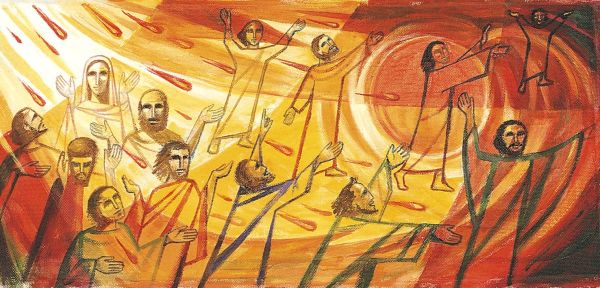
Many of us approach Pentecost, the day where God’s holy presence literally fell upon those in that upper room with a certain amount of wax covering our canvas. We cover up the mistakes and pretend that God doesn’t see them. Perhaps deep down we know that He does, but as long as we keep fooling everyone else, all is well. But you see that isn’t the way things work with God. He wants us blemishes and all. He desires our vulnerability and our honesty. He wants for us to admit to Him that we haven’t got it all worked out yet. That’s okay. He wants us to stop pretending to be some thing we are not. God longs for us to just take the wax off of our canvas’ and SINCERELY come before Him with contrition and reverence.

So let me ask you today, how sincere is your relationship with God?
How honest are you being with your walk of holiness? How much are you truly striving to live like Jesus every day? I know that there is so much to unpack here. I know that perhaps you will have to do some soul searching. Don’t wait to do it by saying “I’ll get around to it”. Don’t hesitate to come before the Father spiritually naked and without wax. He sees us completely and already knows. So if we truly want to experience Pentecost today in our lives, we MUST be sincere in our minds, hearts and lives.

The Way of Love | Episcopal Church of the Good Shepherd, Federal Way


Something more to ponder on this day of Pentecost.
God Bless you today!

https://pastorsponderings.org/2013/11/22/catching-fire-at-pentecost/

Finding What We Seek…

“One thing I ask from the LORD, this only do I seek: that I may dwell in the house of the LORD all the days of my life, to gaze on the beauty of the LORD and to seek him in his temple.” -Psalm 27:4

There is the old testament story about a woman named Hannah.
Hannah did not have any children of her own and she desperately wanted a child. So after one of the Jewish celebrations, Hannah goes to the temple and fervently prays to God to give her a child. She prays and weeps and is in deep anguish over this heartfelt need to be a mother. As she is praying and weeping, the priest Eli sees Hannah there, and he thinks she is drunk because her lips are moving but no words are coming out. So Eli goes and confronts her and even tells her to throw away her wine.

Imagine that for a second, this woman is crying out to God in one of her lowest moments and she can’t even catch a break without having Eli confront her in judgement. Hannah doesn’t lash out though, she just tells the priest why she is there and that she is not drunk. Hannah outlines her heartache and even says “I am very discouraged and I am pouring out my heart to the Lord.” (NLT translation).
The priest responds by saying, “May the God of Israel grant you the request that you asked of Him.”

Scriptures then tell us that Hannah goes home and is at peace and starts eating AGAIN. Let’s stop for a minute and recognize that in Hannah’s distress she had stopped eating and was so discouraged in her heart.

Have you ever been there?
Have you ever been so heavily burdened that you lose all appetite and thoughts of self-care?

One such moment comes to my mind in my life. My Wife had just tragically lost her mother in a horrible accident and for the next couple of days in the midst of our mourning we couldn’t eat and we barely slept. It was gut wrenching sadness and heartbreaking pain. Scripture tells us that there is a time for everything (Ecclesiastes 3)…and in our lives, most of us have experienced those times of mourning. I believe Hannah felt a certain kind of mourning in her life as well and that is why we are made to understand in 1 Samuel 1:9-28 that Hannah was not eating…or probably sleeping. Her heart was so heavy and burdened with this deep longing and sadness for a child.

In the Seeking – We Find.
Hannah sought out God in this dark moment of her life.
She knelt before God and didn’t care if anyone else was watching, and as she poured out her heart to God, and He was there listening.

Praying for Women to Hunger for God · TWR Women Of Hope


It had nothing to do with a priest answering Hannah’s pleas…although Eli certainly did that. There wasn’t some sort of mystical words that Eli spoke that eased her heart. Rather, it was Hannah’s faith in the God that she prayed to that allowed her to find peace again. There was a certainty that filled that place where her mourning had been. Faith blossomed while her mourning decayed and faded away.

There is a truth of us in this.
David certainly found it when he wrote this:
One thing I ask from the LORD, this only do I seek: that I may dwell in the house of the LORD all the days of my life, to gaze on the beauty of the LORD and to seek him in his temple.” -Psalm 27:4

When we seek first the Kingdom of God and His righteousness, ALL these things will be given to us (Matthew 6:33). But it starts with our seeking.
Are we willing to search God and know Him? To truly know Him?! Not know of Him. Or about Him. But to truly KNOW Him?

What does it look like in our modern day to “dwell in the house of the Lord all the days of my life”? Let me give you a hint: it’s not just about going to church, but that’s a great start. It is about allowing God to dwell in your life every moment of every day. To literally breathe Him in and out in your actions, thoughts and words. So much so that your old self-induced life fades away to be replaced with a self-less holy one that reflects Christ completely.

Then, when we are heavy burdened, when we face daunting days of uncertainty (that can seem be insurmountable at times) we can seek God. We can know Him, and we can get up from our places of prayer and be rejuvenated in life by His spiritual nourishment, provision and love.

Questions to Ponder today:
What is currently weighing on your heart?
Have you prayed about these things to God?
These prayers can be spoken out loud or silently. They can be written down or thought in your mind as you go about your day. But one thing that truly helps is that you verbalize your burdens to the Lord. Even though He already knows them, speak them to Him.
Lastly do you trust that God is not only listening to your prayers, but that He is in your life and is a participant in it?

May we find what we seek today…and may we be seeking God as well purposely strive to dwell in the House of the Lord forever.

-Amen.

Something more for us to ponder today.
To God be the glory.

Look What I Discovered Today…(Amazing Grace on the Wind)

For the past two weeks I make the morning and late afternoon drive between Prattville Alabama and Selma. It is a forty six minute drive each way. The scenery will beat any urban bumper to bumper drive hands down. There are rolling pastures of green all splendidly infused with waving deep purple wild violets. They bend and bow in the wind as if in a southern Alabama greeting long lost to the world.

Driving down this two lane highway, where the speed limit is 55 miles an hour, but the raging trucks blow black billowing smoke from their diesel engines as they speed by at 75…I am unperturbed because I am attempting not to miss a single detail of this pastural marvel.

To the right there is a deep shadowy canopy of trees, all purposefully planted years and years ago as cows lazily graze beneath them. There is a bountiful buffet of grass and their bellies attest to this fact as they chew on their cud. I see all of this as I speed by at 60 miles an hour.

Further on down the next curve in the road are workers in blue coveralls and up with the sun as they attempt to raise the frames of a barn. Their labors will soon provide roof and shade to tractors and the large green harvester parked near by. There is a slow steady rhythm to their movements as they languish underneath the heavy beams, ensuring they fall into place only to hoist up another one…on and on down the line.

Lastly I reach the next hill top on the country road and find myself before a bronze historic placard. The placard prominently announces the entrance to an old country church. A United Methodist Church by the name of Ivy Creek. Its name matches the long, majestic driveway curtained on each side by trees and ivy. The old iconic white washed walls with steepled bell-tower top marks years of use and if you were to listen very carefully one can still hear the old church bell, long since removed, calling mournfully for its ancient parishioners and the ghosts of church services of yesteryear.

Perhaps many of the old oaks that line the dust gravel path contain within their own rings a time stamped record of the numerous times “amazing grace” has wafted on the wind and embedded each note and each refrain sung into the porous grains…,embedded so deeply in fact, that the sap running down on the outside of the bark could joyously proclaim the occasional “Hallelujah” to the wind as it passes by.


The sun, golden and new in the morning sky, kisses the side of the old chapel as if God himself has declared that “it is good.” And deep inside of me there is this longing to be caught up in one of those sun rays, golden and resplendent, fresh and new…I want to hear God whisper “it is good“…of me.
I breathe this simple moment in, as I stand all alone at this entrance to this church with its shadow lingering over me. This little glimpse of paradise has been grasped at for just a moment…I am filled with a deep sense of love and warmth in this new day.

And then I get back into my car all the while whispering “Amazing Grace” to the wind.

The Problem With Submission…

“Submit yourselves, then, to God. Resist the devil, and he will flee from you. Come near to God and he will come near to you.” -James 4:7-8

I have a tough time with one word in this passage.
It has nothing to do with God, faith or salvation…it has everything to do with how this word is used in the world, sometimes maliciously, in order to put people in their place.

What is the word?

“Submit”.

I don’t do well with submission.
Honestly, it makes me feel like a prisoner having to obey the warden. (Images of Shawshank Redemption come to mind)…

Perhaps it is because I have personally witnessed that word being used and abused.
Perhaps it is because I struggle with my own need for freedom.
Regardless of the why, there is still the issue with the how…how do I submit…and the ‘who’ – who am I to submit to?

For some of us it is the trust involved in such an act.
Questions like, “what if my trust is betrayed”, and “can I really trust them”?
Many time it isn’t even about submitting to God, but rather authority figures in our own lives; Bosses, business advisors, managers, family members…etc. Then, when we have been burned by submitting to a faulty human-led system, we transplant this disappointment and disillusionment upon God…as if He too is imperfect and will let us down.

I too have struggled with this notion, meanwhile transplanting my own mortal experience upon an immortal God. But have I short changed God when I’ve done this? Do I still struggle with these trust issues? Can I fully submit to God in spite of my past hurts and the numerous failed dumpster fires of attempted human submission?

Maybe I’m overthinking this…have you ever done that?
I’ve counted all of the variables, outcomes, pros and cons way before ever taking a step. My 1st Grade Teacher’s voice keeps ringing in my ear as she said, “look before you leap.” But maybe in this case, it’s the other way round?! Perhaps I just have to go for it and place my all before God when I do.

In James 4:7-8, perhaps it’s more about coming near to God than it is about submitting to Him…because wouldn’t we naturally do that anyway when we really, really know someone? After all, didn’t God come close to us first when He sent Jesus into this messed up world? He met us more than halfway as He hung on a cross for our sins.

You see, I know all of the theological implications of such an act. I know Jesus intellectually, but are there still times when my heart does not know Him…when I’m not near to God, in fact, I couldn’t be further from Him? Have you ever felt like that? We have all of the head knowledge, but when it really comes down to it, there’s a heart issue that still needs working out.

If you’re anything like me, perhaps you’re still trying to reconcile what submission looks like with God. I’ve been on this journey for quite some time, and I feel that the Holy Spirit has led me this far, I’m going to have trust Him in the things I have yet to figure out. He hasn’t given up on me, and I’m positive He certainly hasn’t given up on you either. Perhaps it’s not so much submission that He’s after, but rather a closer relationship with us. After all, doesn’t submission come from a place of trust? I cannot submit to something I don’t trust, and I cannot trust if I don’t come close enough to God.

The trouble with submission is we aren’t close enough to a God who desires a relationship with us…and I’m still working through this. I don’t have a Mary Poppins answer for you, just a notion and a nudge to deepen your relationship with the Almighty…we just might discover that is what was needed all along.

-Something more to ponder today.

Fear the Walking Faith…It’s a journey!

He replied, “Because you have so little faith. Truly I tell you, if you have faith as small as a mustard seed, you can say to this mountain, ‘Move from here to there,’ and it will move. Nothing will be impossible for you.” Matthew 17:20

Oh how our faith can waver sometimes.
It seems that the gusting of a slight breeze of discord or worry can shake our quivering feet of faith.

Have you ever come to a moment of realization that your faith is not as deep as you once thought it was? We all encounter times, while on this journey, where the feel as though we have entered into the desert and we are found lacking in our resolve and fortitude. This journey will take us into places that require us to dig a little deeper and to endure the dry and thirsty places – where we find ourselves questioning everything and reaching further for God…who seems to have gone silent.

Have you been to this place?

I remember when I first learned to swim.
My parents would take me into the deeper part of the waters where my feet couldn’t touch and then let go of me, and as they let go of me they step back out of my reach. I remember there was a momentary panic. The saving hands were no longer on me and I found myself struggling to keep my head above the waters. I remember having to reach out my arms while kicking my feet so that I could reach the safety again. As I did this, without realizing, I began to swim by myself for the first time.

My intentions were not to swim. My intention was to reach the safe arms of my parents who were just out of reach.

There is growth within the tension and fear.
Growth that can only take place when we are left to our own devices.
Growth that can only transpire within the turmoil and desert places of our faith journey.

It is as if God steps back from us, and we are faced with the seemingly terrifying notion that we must step into the deep alone. The truth is that we are most certainly not alone, but rather there is growth that is only found in desert. And so we step out, unsure of ourselves…unsure if we can reach those safe arms of Christ again.

Remember Peter on the waters before Jesus?
He is asked to step out into a turbulent, uncertain space.
Peter takes a couple of steps, loses sight of the arms of Christ and begins to sink.
He takes his eyes off of Jesus.
He considers the impossibilities of such a journey.
He must have recalled his inability to do this feat, and as the doubt sinks in so does Peter.

We often chastise Peter for his lack of faith.
We often sermonize this passage to implicate the lack of resolve that ‘the Rock’ had…
But where were the other disciples?
Do we read about their steps of faith on the waters? No.
They were still in the boat watching it all go down.

We have to get out of our boats.
We will encounter dry and thirsty times in our faith journey.
It will feel as if we are all alone out in the wilderness, but we are not alone.
God steps back and watches us within the tension of deeper waters.
And it is within those deeper spaces that we grow.
It is through perseverance that our character and the very image of Christ becomes clearer in us.

Some have turned back and returned to the safe places.
Some have given up because they have felt abandoned.
Others have persevered and they have grown.
The Lord desires all of us to deepen our faith, and so these times of dryness should be seen as opportunities to grow up into this amazing faith.

Being like Jesus isn’t easy.
It takes determination and desire on our part.
Are you prepared to allow God to deepen your faith?
Is it your desire to get off of spiritual baby formula and begin to feast on more sustainable spiritual nourishment?

Take that next step…don’t be afraid, He’s got you, and He isn’t far from you right now!

Something more to ponder today.

Blog at WordPress.com.

Up ↑