
By Pastor Scott
Hello, friends. Welcome to Pastor’s Ponderings, this is a quiet space where we can sit together, hearts open, and wrestle with the big questions—the ones that possibly stir our souls and keep us up at night. Today, we’re diving into something that’s both familiar and mysterious, something we’ve heard about since we were kids, something that’s been painted in vivid colors and whispered in hushed tones: heaven and hell. I don’t know about you, but I’ve always been interested in this particular topic. Like, where do we go when we die? What happens next? So, today we’re exploring Heaven and Hell.
Yeah, those two.
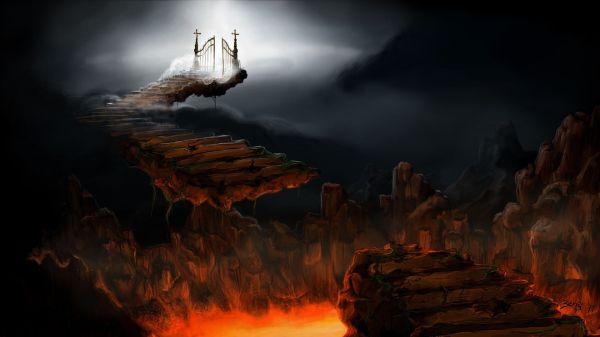
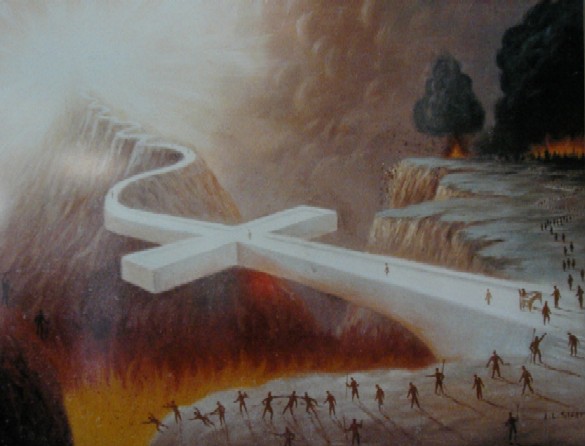
We grow up with these ideas, don’t we? Heaven, this perfect place—clouds and angels, streets of gold, a celestial city where everything is right. And hell, the opposite—fire, brimstone, eternal torment. Good people go up, bad people go down. It’s clear, right? Like a cosmic sorting system, neatly dividing the saved from the damned.
Except… is it? (is it really that straightforward? Is it really that simple?)
Because when you start digging into Scripture, it gets kinda messy. It gets complicated. It’s not always so black-and-white, up-or-down. Let’s start with hell. The word itself carries so much weight, scares people, but what does it actually mean? In the Old Testament, we find Sheol. And Sheol isn’t always this fiery pit of torment we imagine. It’s more like… the grave. The place of the dead. A shadowy, murky realm where everyone goes—righteous or not. Psalm 139:8 says, “If I make my bed in Sheol, you are there.” God is there, in the depths. That’s not exactly the hell we picture, is it?
Then we get to the New Testament, and things get even more layered. There’s Gehenna, a word Jesus uses. Interestingly, Gehenna was a real place—a garbage dump outside Jerusalem where fires burned constantly, a place of decay and destruction. When Jesus talks about Gehenna in places like Matthew 5:29, it’s vivid, visceral. But is He describing a literal place of eternal punishment? Or is He using this image to point to something deeper—maybe the consequences of living a life turned away from God?
And then there’s Hades, which feels more like the Greek underworld, and Tartarus, mentioned in 2 Peter 2:4 as a place for fallen angels. So, we’ve got all these different words—Sheol, Gehenna, Hades, Tartarus—all translated as “hell” in our English Bibles. Each carries its own nuance, its own imagery. It’s like Scripture is less interested in giving us a clear map of the afterlife and more interested in inviting us to ponder the weight of our choices.
Now, let’s talk about heaven. We often imagine it as a place way up there, far from the mess of this world. But Scripture doesn’t always describe it that way. Jesus talks about the “kingdom of God” or the “kingdom of heaven,” and in Luke 17:21, He says it’s “within you” or “among you.” Not a distant destination, but something breaking into the present, something you can taste now. In Revelation 21, we get this breathtaking vision of a new heaven and a new earth, where God dwells with humanity, wiping away every tear. It’s not about escaping to some ethereal realm—it’s about heaven coming down, transforming this world.
And then there’s Paul, who in 2 Corinthians 12:2 talks about being “caught up to the third heaven.” The third heaven? What does that even mean? Is it a literal place? A spiritual experience? A metaphor for closeness to God? The early Jewish worldview often spoke of multiple heavens—layers of divine reality. It’s like Scripture is saying, “This is bigger than you can grasp. Lean into the mystery.”
You see what I’m getting at? Heaven and hell aren’t as simple as we often make them out to be. They’re not just places on a cosmic map, neatly labeled “reward” and “punishment.” And that brings us to the deeper question: What’s it all about?
We often frame heaven and hell as God’s cosmic courtroom—follow the rules, get the golden ticket; break them, face eternal consequences. But is God really just a judge, handing out eternal sentences based on our performance? Or is there something more going on? Because Jesus talks a lot about judgment, yes. But He also talks about forgiveness. About grace. About a love that never gives up. In Luke 15, the father in the parable of the prodigal son doesn’t wait for his wayward child to grovel—he runs to him, arms wide open. That’s the heart of God.
What if heaven and hell aren’t so much about where we go, but about how we are? What if they’re about the state of our hearts, the direction of our lives, the choices we make in this very moment?
Let’s ponder this. What if hell is separation? Separation from God, from others, from our true selves. What if it’s the natural consequence of choosing a life disconnected from love, compassion, and life itself? In Matthew 25, Jesus describes those who ignore the hungry, the stranger, the prisoner as being sent to “eternal punishment.” But the word there for punishment, kolasis, can also mean correction or pruning. What if even God’s judgment is about restoration, not destruction? What if hell is less about eternal torment and more about the pain of living apart from the Source of all life?
And heaven—what if it’s connection? Connection with God, with others, with the fullness of who we were created to be. In John 10:10, Jesus says, “I have come that they may have life, and have it to the full.” That’s heaven—not just a future hope, but a present reality. A life saturated with love, overflowing with grace, radiating hope. Revelation 22 paints a picture of a river of life, a tree of healing for the nations. That’s not a far-off dream—it’s something we’re invited to participate in now.
Maybe, just maybe, heaven and hell aren’t only places we go after we die. Maybe they’re realities we experience here and now. Maybe we’re creating heaven or hell with every breath we take, with every choice we make, with every relationship we cultivate or neglect. When we choose love, when we forgive, when we seek justice, we’re bringing heaven to earth. When we choose selfishness, apathy, or hatred, we’re building walls of separation—our own little hells.
This isn’t to say there’s no afterlife, no ultimate fulfillment of God’s promises. Scripture points to a future where God makes all things new. But it’s also saying that eternity starts now. The choices we make today ripple into forever.
It’s a mystery, of course. We’re talking about things beyond our full comprehension. And that’s okay. Maybe instead of obsessing over the fire and brimstone or the clouds and harps, we can focus on this: God is love (1 John 4:8). And God is always, always, always reaching out to us, inviting us into a life of love, a life of connection, a life that is… truly life.
So, what’s stirring in you? How do you imagine heaven and hell? Where do you see glimpses of connection or separation in your own life? Drop a comment or send me a message—I’d love to hear your ponderings. We’re in this together, wrestling, wondering, trusting.
Let’s close with a prayer: God, you are love, and you are always calling us closer. Help us choose connection over separation, love over indifference, life over death. Guide us into your kingdom, here and now, and forever. Amen.
Thanks for pondering with me, friends. Until next time, keep questioning, keep seeking, keep trusting.
Grace & Peace,
-Pastor Scott.



















 Pastor's Ponderings