The Grace Expert & The Eight Year Secret.

The news about Philip Yancey is the kind of thing that makes you set your coffee down and just stare out the window for a while.

If you’ve spent any time in the “thinking” corners of the church, Yancey has probably been a companion of yours. His books—What’s So Amazing About Grace? and The Jesus I Never Knew—weren’t just bestsellers; they were lifelines. He was the guy who gave us permission to admit that faith is often a mess of doubt and shadow. He made grace feel like something sturdy enough to hold our weight.

And now, we’re processing this: an eight-year affair. With a married woman. All while he was the face of modern Christian grace, writing the books and speaking at the conferences. He came forward himself, stepped down, and admitted he had “disqualified” himself.

It’s a gut-punch. Not because we’re naive enough to think Christian leaders don’t fail—we know better by now—but because of the specific nature of this failure. It forces a terrifying question: How does someone spend nearly a decade describing the heart of God while their own heart is miles away?

The Art of the Split Life

History is littered with this kind of thing. King David wrote the most beautiful poetry in the Bible while his hands were literally stained with the blood of a man he had murdered to cover an affair. Peter preached the gospel after denying he even knew Jesus.

But Yancey’s situation feels like a very modern, very quiet tragedy. Eight years isn’t a “moment of weakness” or a one-time lapse in judgment. It’s thousands of small, daily choices to live a double life. It’s a sustained effort to keep the “Public Grace Expert” and the “Private Transgressor” from ever meeting in the same room.

It makes you wonder about the words he wrote during those eight years. Were they hollow? Or were they something more tragic—a cry for help from a man who knew the truth of grace but felt he had drifted too far out to actually touch it?

The Myth of Compartmentalization

We like to think we can keep our lives in separate boxes. We tell ourselves, “This secret part of me doesn’t affect my work for God.” But the soul doesn’t work that way. When we live in contradiction, something begins to atrophie.

In church circles, we talk about accountability and integrity so much that the words have lost their teeth. We’ve turned accountability into a polite “how are you doing?” over lunch. But real integrity isn’t about being perfect; it’s about alignment. It’s making sure the person people see on the stage is the same person sitting alone in a hotel room.

When that alignment snaps, we start performing. We use the right “Christianese,” we hit the right emotional notes in our prayers, and we learn how to fake the glow of a spiritual life that has actually gone cold on the inside.

The Quiet Creep of Atrophy

Spiritual decay doesn’t usually happen overnight. It’s a slow, subtle erosion.

  • It starts when you’re “too busy” for your own soul because you’re doing “the Lord’s work.”
  • It grows when you justify a small compromise because, hey, look at all the good you’re doing.
  • It solidifies when you realize you’re good at pretending—and that everyone believes the act.

Eventually, you aren’t living a faith; you’re managing a brand. You become a professional at describing a God you no longer talk to in private. That is the real danger of ministry: you can become so familiar with the language of God that you lose the fear of Him.

Where Does This Leave Us?

The “good” news—if we can call it that—is that Yancey chose to stop the clock. He chose to step into the light, however late, and own the wreckage. That is an act of integrity, even if it’s the final, painful act of a career.

But his story should be a mirror for the rest of us. It’s a warning not to wait for the “big fall.” It’s a call to look at the gaps in our own lives—the places where we are pretending, the secrets we’re guarding, and the ways we’ve let our public persona outpace our private character.

Grace is big enough for Philip Yancey. It’s big enough for the woman involved. And it’s big enough for us. But grace is never an excuse to stay in the dark; it’s the power that allows us to finally come clean.

Let’s stop posing and start being honest. Because a broken person who is honest is much more useful to God than a “godly” person who is lying.

Grace, Peace & Accountability
-Pastor Scott.

The Threshold of 2026: What if we stopped “Fixing”?

We’re standing on it again. That invisible line.

One second it’s 11:59 p.m. on December 31, 2025, and the next, we’ve crossed over into 2026. We act like the air changes, don’t we? Like the molecules of the universe suddenly rearranged themselves because a calendar page turned.

We call them “Resolutions.” But if you look at that word—resolution—it’s about finding a solution. It implies that you, as you are right now, are a problem to be solved. A leak to be plugged. A glitch in the system that needs a software update.

But what if 2026 isn’t about “fixing” the old you?

What if the “New Year” isn’t a demand for a better version of yourself, but an invitation to finally meet the real one?
I’ve met so many people in my life, and I don’t want to sound judgmental, but I can automatically tell when someone is simply putting on a mask and living a fake life for others to see. Sometimes people do this to impress others, while some pretend instead of live a real life because they fear what people might think if they ACTUALLY ‘let their hair down’.

But what would happen in 2026 if we all just stopped pretending, and started living our lives with authenticity without fear of judgement?

The Rhythm of the New

In the Hebrew scriptures, there’s this beautiful, recurring idea that God is “doing a new thing.” But “new” in the biblical sense isn’t usually about replacement. It’s about renewal. It’s like a tree in winter. It looks dead. It looks stagnant. But deep in the soil, in the dark, silent places where no one is taking selfies or posting updates, something is shifting.

The tree isn’t trying to be a different tree in the spring. It’s just becoming more of what it already is.

So, as we stare down the barrel of 2026, I have some questions. Not the “How much weight do you want to lose?” kind of questions. The other kind. The kind that sit in the pit of your stomach:

  • What are you carrying into this year that isn’t actually yours to carry? Is it a parent’s expectation? A former version of yourself that you outgrew three years ago? A shame that has already been forgiven but you keep in your pocket like a lucky charm?
  • What would happen if you stopped trying to “arrive”? We spend so much energy trying to get somewhere else. To the next job, the next relationship, the next tax bracket. But what if the Divine is actually in the here? What if the burning bush is right in your backyard, but you’re too busy looking at a map of a different forest?
  • Where is the “New” already happening? Look at your life. Not the big, flashy stuff. Look at the small, quiet pulses of grace. The friend who actually listens. The way the light hits the floor at 4:00 p.m. The fact that you’re still breathing.

The Sacred Middle

2026 will have its share of mess. We know this. There will be moments of stress, anxiety, problems – and much more. There will be moments where you feel like you’re failing at everything. I don’t want to dismiss that these kinds of events will most likely happen to us all in 2026.

But the Gospel—the “Good News”—isn’t that life becomes a straight line of success. It’s that even in the mess, even in the “not-yet-resolved” parts of our lives, there is a Presence. A “With-ness.”

Jesus didn’t say, “I have come so that you might have a perfectly organized life and a 401k.” He said he came so we might have Life. Abundant, vibrant, messy, holy, complicated Life. Emmanuel = God – with us. God connected to us. God in relationship with us every. step. of. the. way. (full stop, no flimsy/flip-flopping decisions – He’s all-in with your life! He’s fully invested in YOU!)

A Pondering for the Road

As you step across that threshold into 2026, maybe skip the “To-Do” list for a minute. Try a “To-Be” list.

  • To be… present.
  • To be… kind to yourself when you stumble.
  • To be… open to the idea that God likes you exactly as you are, even as He invites you into who you are becoming.

The calendar is turning tomorrow at 11:59pm.
The sun will rise. And the Spirit is already there, whispering, “Let’s see what we can make of this together.”

Grace and Peace to you in 2026.
-Pastor Scott.

The Offering Plate is Half Empty – Now What?

Hey.
It’s Sunday morning.
The worship band just landed on that last sustained chord, the one that makes everyone feel like the roof lifted off for a second and maybe goosebumps have appeared on your arms.
But now, here comes the part nobody asked for on the original tour bus of Christianity: the offering.
The ushers start their slow walk down the aisle.
Baskets. Plates. Little velvet bags on sticks (Our church has the boxes in the back and we give afterwards).
Whatever your tradition calls it, it shows up like clockwork.
And lately, maybe you’ve noticed—like I have—that the plates (or in our case the Offering Box) looks…lighter.
Not dramatically empty, not yet, but definitely not overflowing.
Half empty, maybe even a little less than half.
And here’s the thing: nobody says it out loud, but everybody feels it. The pastor (me, in this case) feels it when the finance report lands in my email inbox before our next board meeting.

The treasurer feels it when the mortgage and other bills are due.
The single mom feels it when she drops in a twenty and wonders if it’s enough.
The guy in the back row feels it when he pretends to check his phone so he can let the plate pass by without anyone noticing.

So let’s just talk about it.

No announcements.
No guilt slides.
No Malachi proof-texts dropped like grenades.
Just us.

The offering plate is half empty—now what?

First, can we admit that tithing can feel like the last surviving relic of rule-based religion?
Ten percent.
The word itself sounds like it was invented by an accountant who moonlights as a Puritan right?!
And somewhere along the way we turned a wild, ancient practice of trust into a spiritual report card.

You didn’t hit 10%?
F minus in faith, see me after class.
No wonder there’s resistance.
No wonder there’s guilt.
No wonder some of us just… pass the plate. I’ve been on both sides of this.
I’ve been the broke twenty-something who genuinely had $11 in the bank and felt like a failure when the plate came.
I’ve been the pastor who stood up front and said “God loves a cheerful giver” while secretly scanning the room to see who looked cheerful and who just looked constipated.

Here’s what I’m learning—slowly, painfully, wonderfully: The goal was never to fill the plate.
The goal was to free the heart.

In the Old Testament, people brought crops, animals, oil, flour—stuff they actually lived on.
Handing it over was a way of saying out loud, “I can’t make the sun come up tomorrow, but You can.
Here’s my trust, in grain form.


Jesus sits down opposite the treasury one day and watches the river of coins clinking in.
Rich people tossing in heavy bags—impressive, loud, tax-deductible.
Then a widow drops in two tiny coins worth almost nothing.
And Jesus loses His mind (in a good way).
He calls His disciples over like He just saw the Grand Canyon of faith.
“She put in more than all the rest.” Not because the budget was suddenly balanced.
But because her heart was suddenly free.

If I’m honest – that story wrecks me, because I want my giving to be about freedom, not fear.
I don’t want to give because I’m afraid God will take something if I don’t.
I don’t want to give because I’m afraid the church lights will go out.
I don’t want to give because I’m afraid of what people think when the plate passes by my row (or I pass by the box in the back).

I want to give because I’m stunned again that everything I have is borrowed anyway.
I want to give because I walked into this building carrying wounds and walked out carrying hope, and somebody paid for that hope.
I want to give the way I want my kids to see their dad give—eyes wide open, grinning, no arm-twisting required.

So if the plate is half empty right now, maybe it’s not a crisis.
Maybe it’s just an invitation.
An invitation to ask better questions than “Am I hitting 10%?”

Questions like:
What would it look like to move from guilt to gratitude?
From obligation to overflow?
From resistance to release?

Start anywhere.
Five bucks. Fifty. Five hundred. Zero.
Just make it honest.
Make it a moment where you look up—literally or figuratively—and say,
This is me trusting You with what feels impossible to let go of.

Because here’s the secret nobody tells you in stewardship season: the plate is not a tax.
It’s a testimony. Every coin, every crumpled bill, every direct deposit, or online payment is a little postcard that says,
“I was afraid, but I did it anyway.”
“I was broke, but I’m not broken.”
“I thought I needed this more than God did… turns out I was wrong.”

So yeah.

The offering plate is half empty.
Maybe that just means there’s room for something new to be poured in.

Your move.

-Grace and peace,
Pastor Scott

View Post(opens in a new tab)

Peace, Power, and Purpose: A Devotional Thought on John 20:19-23

Hey, friends, let’s jump into something personal and real today.
Picture it with me: the disciples are huddled together, doors locked, hearts pounding. They’re scared out of their minds. Jesus, their leader, their friend, was just crucified. The weight of loss and fear is crushing them. And then—KA-BLAM—Jesus shows up. Right there in the room. John 20:19-23 tells us this moment isn’t just a cool resurrection story; it’s a game-changer for how we live as followers of Jesus.

Let’s unpack it and let the Holy Spirit mess with us a bit.

The Scene: Peace in the Chaos
It’s evening, the first day of the week, and the disciples are hiding. The Jewish leaders are out for blood, and these guys are next on the list. Then Jesus appears—risen, alive, real. His first words? “Peace be with you.” Man, stop and feel that. These guys are freaking out, and Jesus doesn’t lecture them or shame them for their fear. He speaks peace. Twice, actually (v. 19, 21). Why? Because He knows their hearts are a mess, and He’s the only one who can calm the storm inside them. Isn’t that us? We lock ourselves behind doors of fear—fear of failure, fear of what people think, fear of the future. And Jesus steps into our mess with the same words: “Peace be with you.” Not a fluffy, feel-good peace, but a deep, soul-anchoring peace that says, “I’m here, and I’ve overcome death itself.” Are you letting His peace rule your heart, or are you still bolting the door, trying to control the chaos?

The Mission: Sent Like Jesus
Then Jesus drops a bombshell: “As the Father has sent me, I am sending you” (v. 21). Think about that. The Father sent Jesus to live a sinless life, to love the broken, to confront hypocrisy, to die for sinners, and to rise in victory. And now Jesus says, “That’s your mission too.” This isn’t a suggestion. It’s a divine commissioning. You and I are sent into the world with the same purpose Jesus had—to show people the Father’s love and bring them into His kingdom. But let’s get real: are we living like we’re sent? Or are we just cozying up in our Christian bubbles, playing it safe? Jesus didn’t stay safe. He went to the cross. He loved the unlovable. He spoke truth even when it cost Him. What’s holding you back from living sent? Is it comfort? Fear of rejection? Or have you just forgotten the weight of what Jesus is calling you to?

The Power: The Holy Spirit
Jesus doesn’t just send them; He equips them. He breathes on them and says, “Receive the Holy Spirit” (v. 22). This is huge. The same Spirit that raised Jesus from the dead is now given to the disciples—and to us. This isn’t just a nice gift; it’s the power to live out the mission. It’s the Spirit who convicts, transforms, and emb emboldens us to forgive sins and proclaim truth (v. 23). But here’s where it gets uncomfortable. Are we actually relying on the Holy Spirit? Or are we trying to do this Christian life in our own strength? I’ve been there—planning, striving, hustling to make ministry happen, only to realize I’m running on empty because I’ve ignored the Spirit’s power. I have to tell you, that’s really convicting and personal. I tried to be a super pastor – the best or the best. Yet, God operates from our weakness and humility. Why do we constantly get it wrong? Why are do equate performance with success? Probably because that’s the world’s standard, but not God’s. When was the last time you paused and asked the Holy Spirit to fill you, guide you, or give you boldness to share Jesus with someone?

The Challenge: Forgive and Proclaim
Verse 23 is a head-scratcher: “If you forgive anyone’s sins, their sins are forgiven; if you do not forgive them, they are not forgiven.” This isn’t about playing God; it’s about the authority Jesus gives His followers to proclaim forgiveness through the gospel. When we share the good news, we’re offering people the chance to be forgiven and reconciled to God. But if we stay silent, we’re withholding that opportunity. That’s heavy, right? Your words, your life, your witness—they carry eternal weight. So, what are you doing with that authority? Are you proclaiming forgiveness to a world that’s desperate for it? Or are you holding back because you’re afraid of how it’ll land? Who in your life needs to hear about the forgiveness Jesus offers? What’s stopping you from telling them?

Ponder This, Friends
This passage isn’t just a cool story about Jesus showing up. It’s a call to live differently. Jesus steps into our fear with peace, sends us with purpose, empowers us with His Spirit, and entrusts us with the message of forgiveness. But here’s the thing: this isn’t just for the disciples 2,000 years ago.

This is for you. Right now. Today. So, let me ask you a few questions to chew on:
– Where are you locking the door on Jesus, trying to keep fear or control in charge?
– What does it look like for you to live “sent” in your everyday life—at work, at home, in your community?
– Are you relying on the Holy Spirit’s power, or are you running on your own fumes?
– Who in your life needs to hear about the forgiveness Jesus offers, and what’s stopping you from sharing it?

Friends, let’s not just read this passage and move on. Let’s let it wreck us, change us, and push us to live boldly for Jesus. He’s alive. He’s with us. And He’s sending us out with His peace and power. Let’s go.
Grace & Peace,
-Pastor Scott

The Fleeting Vapor of Life.

Hey friends, today I am pondering how much vapor our lives contain.
The bible says our life is but vapor (James 4:14) – quick, fleeting, temporary – poof, and it’s gone.

So, I’m sitting here in the quiet, my heart a little heavier than usual today. I lost a friend recently—a mentor, a guide, someone who poured wisdom and laughter into my life like a river that never seemed to run dry. And yet, here we are, standing at the edge of that river, staring into the stillness where their presence used to ripple. Death has a way of doing that, doesn’t it? It stops us in our tracks, takes the breath out of our lungs momentarily, makes us look up from our calendars and coffee cups, and whispers, This life? It’s fragile. It’s fleeting. It’s a vapor.

James, that no-nonsense brother of Jesus, put it like this: “What is your life? You are a mist that appears for a little while and then vanishes” (James 4:14, NIV). A mist. A puff of breath on a cold morning. Here one moment, gone the next. It’s not morbid to linger on this—it’s honest. It’s the kind of truth that shakes us awake, that begs us to ask:

What are we doing with this one, wild, temporary life?

When I learned yesterday that one of my mentors and friends passed, it felt like the ground shifted beneath me. Maybe you’ve been there too—when someone you love or admire slips beyond the veil, and you’re left holding questions bigger than your heart can carry. Why so soon? What comes next? And what does it all mean for the days we’ve got left? I want to lean into those questions together for just a few moments, because I think, in some way, they’re holy.
They’re the kind of questions that pull us closer to the mystery of God, to the heartbeat of eternity.

The Fragility of Now

Let’s start here: life is breakable. It’s delicate, like a clay jar holding something sacred. Paul, that wild-eyed apostle, called us “jars of clay” to show that the treasure inside us—God’s light, God’s love—is carried in something that can crack, chip, shatter (2 Corinthians 4:7). My friend’s death reminds me of that today. One moment, they were here—laughing, teaching, encouraging, challenging me to be better. Next, they were gone, and I’m left holding the pieces, wondering how something so vibrant could be so temporary.

But isn’t that the beauty of it? The fragility is what makes it precious. Every hug, every shared story, every quiet moment of prayer—it’s all a gift because it won’t last forever. The writer of Ecclesiastes gets it: “There is a time for everything, and a season for every activity under the heavens: a time to be born and a time to die” (Ecclesiastes 3:1-2, NIV). This life is a season, a chapter, a melody that rises and falls. And when someone we love steps out of this song, it doesn’t mean the music stops—it just changes key.

The Afterlife: A Door, Not a Wall

So what happens when the mist fades? When the jar breaks? When the melody shifts? That’s where the questions about the afterlife come in, and oh, they’re big questions. But here’s the thing: death isn’t a wall. It’s a door. Jesus said, “I am the resurrection and the life. The one who believes in me will live, even though they die” (John 11:25, NIV). That’s not just a comforting platitude; it’s a promise that whatever lies beyond this life, it’s held in the hands of a God who loves us fiercely.

What’s on the other side? The Bible gives us glimpses, not blueprints. Streets of gold, a new heaven and new earth, a place where “God will wipe every tear from their eyes” (Revelation 21:4, NIV). But it’s less about the details and more about the One who’s waiting there. My friend, my mentor, my Grandparents, my Aunt Joy —they’re not gone, not really. They’ve stepped through the door into a reality more real than this one, where the love and laughter we shared here are just a shadow of what’s to come. It’s not some fairytale story, but rather a hope, a reality, an eternal promise.

The afterlife isn’t about escaping this world; it’s about this world being caught up in something bigger, something eternal. It’s about God saying, “I’m not done with you yet.” When I think of my friend and others who have recently made that transition, I imagine them laughing in a place where the colors are brighter, the joy is deeper, and the love is unending.
And that gives me hope.

Living the Temporary with Eternity in Mind

But what about us, the ones still here, breathing in this fleeting vapor? How do we live in a world where jars break and mists vanish? We live awake. We live open. We live like every moment is a chance to love, to forgive, to create something beautiful. Jesus told us to “seek first his kingdom and his righteousness” (Matthew 6:33, NIV), which isn’t about ignoring this life but about infusing it with eternal weight. Every act of kindness, every prayer whispered in the dark, every time we choose love over fear—it’s all building something that outlasts the mist.

My friend’s life was like that. He didn’t just exist; he poured himself out. He listened well and pointed me (and others) toward a Jesus in a way that made me want to run toward Him. His sudden death doesn’t erase that—it amplifies it. It reminds me to live in a way that echoes into eternity, to hold loosely to the things that fade and cling tightly to the things that last.

So here’s my invitation to you, friends: let’s live like we’re made of mist.
Let’s love like we’re made of eternity. Let’s hold the people we love a little closer, forgive a little quicker, and chase the God who holds both this life and the next. Because this vapor? It’s fleeting.
But the One who breathes it into being?
He’s forever.

“The life appeared; we have seen it and testify to it, and we proclaim to you the eternal life, which was with the Father and has appeared to us” (1 John 1:2, NIV).

Let’s proclaim it with our lives, every fragile, beautiful moment of them.

With you in the journey,
Pastor Scott

Dear Pastors, The Miracle IS the Mess.

Hey Pastor,

You’re sitting there, sipping that coffee that’s gone cold, staring at the sermon notes that refuse to come together, aren’t you? The weight of the world—or at least the weight of your congregation’s expectations—sits heavy on your shoulders. You’re supposed to have answers. You’re supposed to be the steady one, the one who points to the divine when everyone else is lost in the chaos. But what if the chaos is the point? What if the mess is where the miracle lives?

Let’s pause for a second and breathe. Because I know you’re tired. I know you’re carrying the stories of the single mom who can’t make rent, the teenager who’s cutting again, the elder who’s questioning everything they’ve ever believed. And you’re carrying your own stuff too—the doubts that creep in at 2 a.m., the fear that you’re not enough, the nagging sense that maybe you’re just faking it.

But what if that’s exactly where God shows up? Not in the polished sermon, not in the perfectly executed service, but in the raw, unfiltered mess of it all?

Think about it. The Bible isn’t a tidy book. It’s a wild, untamed collection of stories about people who screw up, fall apart, and somehow, in the middle of their mess, find themselves stumbling into grace. Abraham lies about his wife. Moses kills a guy. David—oh, David—makes a royal mess of things. And yet, these are the people God uses. These are the ones who carry the story forward.

What if your church’s budget crisis, your personal doubts, or that one parishioner who keeps emailing you at midnight are not distractions from the holy but invitations into it? What if the divine is woven into the frayed edges of your life, not waiting for you to clean it up first?

I’m not saying it’s easy. It’s not. It’s brutal sometimes. You’re out there, week after week, trying to speak hope into a world that feels like it’s unraveling. You’re preaching resurrection while you’re still grieving your own losses. But here’s the thing: the resurrection didn’t happen in a sterile, airbrushed tomb. It happened in the dark, in the dirt, in the place where nobody thought life could break through.

So, Pastor, what if you stopped trying to fix the mess? What if, instead of chasing the perfect sermon or the flawless leadership moment, you leaned into the cracks? What if you let yourself feel the weight of the doubts, the fears, the failures—not to wallow, but to find the sacred there?

Because I believe this: God is in the mess. God is in the tears you cry when nobody’s watching. God is in the awkward silence when you don’t have the answer. God is in the church board meeting that goes off the rails, in the youth group kid who keeps asking why, in the moment you look in the mirror and wonder if you’re cut out for this.

The miracle isn’t that you get it all together. The miracle is that God meets you in the middle of it.

So here’s my invitation to you today: take a risk. Preach that sermon that’s a little too raw. Have that conversation with the person you’ve been avoiding. Admit to your congregation that you don’t have all the answers. Let the mess be holy. Because when you do, you might just find that the Spirit is moving in ways you never expected—through the cracks, through the chaos, through you.

What if the mess is the canvas where God paints the most beautiful stories? What if your imperfections are the very place where grace breaks through?

Keep going, Pastor. You’re not alone. The miracle is already happening—right there in the mess.

With you in the wild, untamed journey,
Grace & Peace,
Pastor Scott

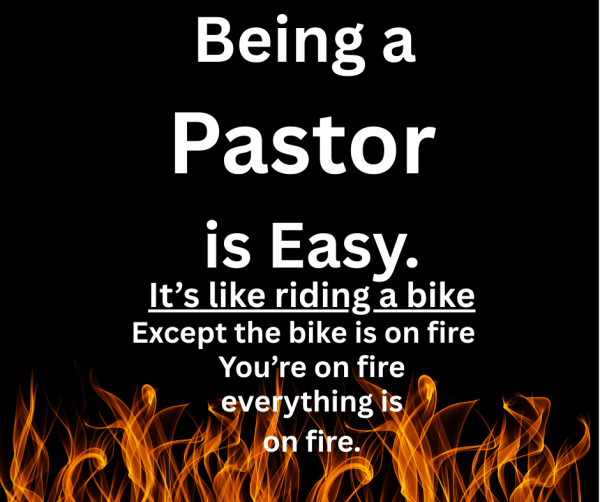
Holy Crap, This is Hard: A Pastor’s Take on the Mess

Okay, friends, let’s be real. Ministry. It’s beautiful. It’s inspiring. It’s… sometimes brutally, gut-wrenchingly hard. Like, harder than trying to explain the Book of Revelation to your five-year-old nephew while he’s hopped up on Mountain Dew and birthday cake. We’re talking sleepless nights, tough conversations, the weight of the world on your shoulders kind of hard. And if you’re a pastor, you know what I’m talking about.

So, what do we do with all that? How do we navigate the messy, complicated, sometimes heartbreaking realities of leading a community? Because let’s be honest, pretending everything’s sunshine and rainbows isn’t going to cut it. We’ve all seen that. It doesn’t work. It actually makes things worse.

Here’s the thing I’ve learned (and I’m still learning, by the way, this is a lifelong gig): It’s okay to not be okay. Seriously. You’re not a robot. You’re a human. You have doubts. You have fears. You have moments where you just want to throw in the towel and move to a secluded cabin in Montana and raise goats and maybe a miniature donkey. (Anyone else have that fantasy?)

And that’s perfectly normal. In fact, I’d argue it’s essential. Because when we’re honest about our struggles, when we acknowledge the pain, that’s when we open ourselves up to something bigger than ourselves. That’s when we create space for grace.

Think about it. The stories that resonate with us, the stories that stick with us, they’re not the ones where everything is perfect. They’re the stories where people wrestle with the hard stuff. They’re the stories where people face their fears, their doubts, their brokenness, and somehow, through it all, find a way to keep going.

That’s the kind of community I want to be a part of. A community where it’s okay to say, “I’m struggling.” A community where we can be real with each other, where we can share our burdens, where we can support each other through the tough times.

Now, I’m not saying it’s easy. Dealing with hard things is, well, hard. But here are a few things I’ve found helpful:

  • Find your tribe: Connect with other pastors, mentors, friends, people who get it. You need people you can be honest with, people who will listen without judgment, people who will remind you that you’re not alone.
  • Take care of yourself: This sounds basic, but it’s crucial. Get enough sleep. Eat healthy food. Move your body. Do things that bring you joy. Seriously, schedule it in. It’s not selfish; it’s essential.
  • Embrace the questions: Doubt is not the enemy of faith. In fact, I think it can be a catalyst for growth. Don’t be afraid to ask the hard questions. Don’t be afraid to wrestle with the mysteries. That’s where the real transformation happens.
  • Remember the bigger story: Sometimes, when we’re in the thick of it, it’s hard to see the bigger picture. But remember, there’s a story unfolding, a story of hope, a story of redemption, a story that’s bigger than our individual struggles. And we’re all a part of it.

So, yeah, ministry is hard. Life is hard.
But we’re not in this alone.
We’re in this together.
And maybe, just maybe, in the midst of the mess, we’ll discover something beautiful, something profound, something truly holy. And that, my friends, I believe is so worth it!

Grace & Peace,
-Pastor Scott.

The Fraying Threads of Friendship: Why It’s So Hard to Keep Friends as We Age

By Pastor Scott

You ever notice how friendships start to feel like old sweaters? They’re cozy, familiar, but over time, they get stretched out, a little threadbare, maybe even lost in the back of the closet. You don’t mean for it to happen. Life just… happens. And suddenly, you’re standing there, wondering where all your people went.

I’ve been chewing on this a lot lately, mostly because I got hit with a question that stopped me dead in my tracks. I was doing this pastoral survey—you know, one of those “reflect on your life and ministry” deals that’s supposed to make you feel wise and connected. It asked, “Do you have two friends you could call in the middle of the night if you were in a crisis?” Simple, right? Two names. Just two.

I sat there, cursor hovering over the page, and I couldn’t answer it. Not honestly. I mean, I’ve got people. I’ve got my wife, my kids, my congregation, folks I laugh with at church potlucks. But two friends I could call at 2 a.m., no hesitation, no doubt they’d pick up? I didn’t know if I had that. And that realization? It felt like a punch to the gut.

Here’s the thing: I don’t think I’m alone in this. The older we get, the harder it is to maintain friendships. When you’re young, it’s easy. You’re thrown together in school, sports, youth group. You bond over pizza runs and late-night talks about dreams that feel like they’re just around the corner. But then life creeps in—jobs, mortgages, kids, doctor’s appointments, and suddenly, you’re not just juggling time; you’re wrestling it to the ground.

And let’s be real: as a pastor, it’s even trickier. You’re everyone’s friend, but nobody’s friend, you know? You’re there for the crises, the weddings, the funerals, but when it’s your turn to need someone, you hesitate. You don’t want to burden anybody. You’re supposed to be the strong one, the one with the answers. Plus, there’s that weird dynamic where you’re not sure if people are your friend because they like you or because you’re Pastor Scott.

But it’s not just a pastor thing. I’ve talked to enough people—carpenters, teachers, stay-at-home moms—to know this is a human thing. As we age, our worlds get smaller. We move away. We get busy. We get hurt. Maybe a friend betrayed you, or maybe you just drifted apart, and now it feels awkward to reach out. Like, what do you even say? “Hey, remember me? We used to grab coffee ten years ago. Wanna pick up where we left off?”

And then there’s the vulnerability piece. Friendship—real, deep friendship—requires you to show up as you are. No mask, no filter. That’s scary when you’re 20, but when you’re pushing 40, 50, 60? It’s terrifying. You’ve got baggage now. You’ve got scars. You’re not sure if you can trust someone to hold all that without dropping it.

So, what do we do? Do we just shrug and say, “That’s life,” and keep trudging along, lonely but pretending we’re fine? Or do we fight for it? Because I think friendship is worth fighting for. It’s not just nice to have; it’s holy. Jesus didn’t do life alone—he had his twelve, his inner three. He ate with them, laughed with them, cried with them. If the Son of God needed friends, who are we to think we can go it solo?

I’m trying to figure this out myself, and I don’t have all the answers. But here’s what I’m learning:

  1. Start small. You don’t need a squad of ten. One friend, one real connection, can change everything. Text someone you’ve been meaning to reconnect with. Say, “Hey, I miss you. Can we grab a burger?” It might feel awkward, but awkward is better than empty.
  2. Be honest. If you’re struggling, say it. I’m preaching to myself here, because I’m terrible at this. But the few times I’ve let my guard down and admitted, “I’m lonely,” it’s opened doors I didn’t expect. People want to show up; they just need to know you need them.
  3. Make time. I know, I know—time is the one thing we never have enough of. But friendship doesn’t survive on leftovers. Schedule it. Put it on the calendar. Treat it like it matters, because it does.
  4. Lean into grace. Not every friendship is meant to last forever. Some people are in your life for a season, and that’s okay. Let them go with love, and keep your heart open for who’s next.

I’m still wrestling with that survey question. I’ve started reaching out to a couple of old friends, and it’s been messy and beautiful and humbling. I don’t know if they’d pick up at 2 a.m. yet, but I’m hoping we’re getting there. And I’m praying for the courage to keep showing up, to keep risking the vulnerability, to keep believing that God’s got people for me—and for you.

Because here’s the truth: we weren’t made to do this alone. We were made for late-night calls, for belly laughs, for someone to sit with us in the dark and say, “I’m here.” And if we’re willing to fight for it, I think we can find our way back to each other.

So, tell me—how’s it going for you? Got your two people? Or are you, like me, staring at the question, wondering where to start? Let’s figure it out together.
Grace & Peace,

Pastor Scott


Let’s Talk About Death and Empty Tombs

Listen to this episode on Spotify (click the link)

Hey friends! I’ve been mulling this topic over today. I don’t want to write a devotional thought that scares you, nor do I want to depress you. Recently, while scrolling on TikTok, I came across this profile that uses AI to generate what certain celebrities who died before their time would look like today. As I watched these clips, I was both sad and happy at the same time. Thanks to the use of artificial intelligence, this content creator brought some of my childhood celebrities back to life.

So, let’s talk this thing called death—this inevitability, the thing we don’t bring up at dinner parties, the one we tiptoe around like it’s the awkward uncle who overstays his welcome. It’s the shadow in the corner, the thing we’re told to fear, to fight, to outrun. But what if we’ve been looking at it all wrong? What if death isn’t the end of the story, but a doorway? What if it’s not a period in a sentence, but a comma?

I mean, think about it. We live in a world obsessed with keeping death at arm’s length—anti-aging creams, kale smoothies, that extra mile on the treadmill—like we can negotiate with it, bribe it to look the other way. And yet, it’s coming for all of us. You, me, the barista who just spelled your name wrong on the cup. Death doesn’t discriminate. It’s sometimes been called the great equalizer. But here’s the wild, beautiful twist: what if it’s not something to dread? What if it’s something to lean into? Not in some morbid way, but rather an embrace of the comma, the next chapter, the acknowledgement that even though we don’t fully know yet, our lives are actually created to be eternal.

See, there’s this ancient story—maybe you’ve heard it—about a guy named Jesus. He’s walking around, healing people, feeding crowds, flipping tables, and then he says something outrageous: “I am the resurrection and the life.” Not I’ll give you resurrection, not someday you’ll get life—he says I am it. Right here, right now. And then, just to prove it, he walks straight into death—nails, cross, tomb, the whole brutal mess—and comes out the other side. Alive. Breathing. New.

What’s that about? It’s about a promise. A promise that death doesn’t get the last word. A promise that whatever’s on the other side isn’t darkness or nothingness, but something so alive, so vibrant, it makes everything we’ve ever known look like a shadow. Heaven, sure—call it that if you want—but it’s not just harps and clouds. It’s a reality where everything broken gets mended, where every tear gets wiped away, where you and I step into the fullness of who we were always meant to be.

And here’s the thing: that promise isn’t just for later. It’s for now. Because if resurrection is real—if Jesus meant what he said—then death isn’t a monster under the bed. It’s a transition. A shedding. Like a seed cracking open in the dirt, letting go of what it was so it can become something more. You don’t have to be afraid of that. You don’t have to clench your fists and grit your teeth. You can open your hands. You can breathe.

I think about my own life sometimes—those moments when I’ve felt death brush close. A loved one gone too soon, a diagnosis that stopped me cold, or just the quiet ache of knowing this body won’t last forever. And yeah, it stings. It’s heavy. But then I hear that voice again: “I am the resurrection and the life.” And I wonder—what if this isn’t the end? What if it’s the beginning of something so big, so good, I can’t even wrap my head around it?

So, what if we stopped running from death and started trusting the One who beat it? What if we lived like people who know the tomb is empty? Because it is. It’s empty. And that changes everything. Death isn’t the thief we thought it was—it’s the usher, leading us into a room we’ve been homesick for our whole lives.

You don’t have to fear it. You don’t have to outsmart it. You just have to trust that the story’s not over. That there’s a resurrection waiting. That heaven isn’t a far-off dream—it’s the heartbeat of everything true, pulling us closer every day. And when the time comes, when we step through that doorway, we’ll see it: the light, the love, the life that never ends.

So, here’s my question for you today: What would it look like to live unafraid? To wake up tomorrow and say, “Death, you don’t own me—I’m already on the other side”? Because you are. We all are. The promise is real. The tomb is empty. And the best is yet to come.

Whispers to the Infinite: Unlocking the Dance of Prayer

(Check out the Spotify Audio Version of this Pondering Here)

Hey friends, you ever think about how wild it is that we get to talk to God? Like, the Creator of everything — spinning galaxies and the whispering winds, the One who dreamed up the taste of rain and the sound of laughter—that God leans in close and says, “Yeah, tell me what’s on your mind.” It’s not a monologue, you know? It’s not us shouting into the void, hoping the echo comes back with a nod. It’s a conversation. A back-and-forth. A dance of words and silence.

I mean, think about it—communication is this holy thread woven into everything. The way a sunrise speaks without saying a thing, the way a friend’s eyes can tell you they’re hurting before their mouth catches up. And prayer? Prayer’s like that. It’s not just words strung together, all polished and proper. It’s the raw stuff—your fears, your dreams, the ache you can’t name. It’s you showing up, messy and real, and God meeting you there, not with a clipboard and a checklist, but with a heartbeat that says, “I’m listening.”

Jesus, he got this. He’d slip away to the hills, not to perform some religious script, but to breathe, to talk, to listen. He’d say things like, “Ask, and it’ll be given. Seek, and you’ll find.” Not because it’s a vending machine deal—insert prayer, get prize—but because it’s about relationship. It’s about trust. It’s about daring to open your mouth and let the honest stuff spill out, knowing the One on the other end isn’t rolling His eyes or tapping His foot.

So what if we tried that today? What if we stopped treating prayer like a memo to the boss and started seeing it as a late-night chat with the best friend who never sleeps? What if we said, “God, here’s what’s heavy, here’s what’s beautiful, here’s where I’m stuck,” and then—here’s the kicker—we paused? We let the silence sit. We listened for that still, small voice that doesn’t always sound like we expect.

Because communication with God isn’t about getting it right. It’s about showing up. It’s about letting the words—or the lack of them—carry you closer to the One who’s been speaking your name since before you took your first breath. What would happen if we leaned into that? If we let prayer be less about saying the perfect thing and more about being fully, wildly, wonderfully heard?

Blog at WordPress.com.

Up ↑