
Hello friends, and welcome back to the blog.
As we journey through Holy Week together, we land on a day with a rather unusual name: Maundy Thursday. If you’ve ever wondered where the word “Maundy” comes from, it’s actually derived from the Latin word mandatum, which means “command.” It refers to the new commandment Jesus gave His disciples on this very night: “Love one another. As I have loved you, so you must love one another” (John 13:34).
But before Jesus ever spoke those words, He gave the disciples—and us—a living, breathing, shocking demonstration of exactly what that kind of love looks like.
If you have a few minutes today, I want to invite you to step into the Upper Room with me. I want us to look at two powerful moments from that evening: the washing of the feet, and the breaking of the bread. Because when we put them side by side, they paint the most beautiful picture of our Savior’s heart.
The Shock of the Basin
Imagine the scene. It’s the Passover feast. Jesus and His closest friends are gathered in a private room. In the ancient Middle East, walking in sandals on unpaved, dusty, animal-trodden roads meant your feet got utterly filthy. It was customary for a servant to wash the guests’ feet as they arrived.
But there was no servant in the Upper Room. And none of the disciples volunteered for the job.
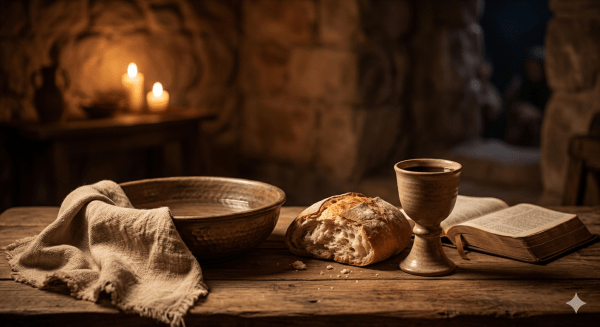
So, in the middle of the meal, Jesus stands up. He takes off His outer clothing, wraps a rough linen towel around His waist, pours water into a basin, and kneels down.
Can you imagine the pin-drop silence in that room? The Creator of the universe, the Messiah, on His knees, washing the grime from the calloused feet of fishermen, tax collectors, and even the man who was about to betray Him. Peter, in classic Peter fashion, tries to put a stop to it: “You shall never wash my feet!” It just felt too wrong, too backward. Kings don’t wash the feet of peasants.
But Jesus was showing them a different kind of kingdom. He was physically acting out the very nature of the Gospel: God coming down, taking the posture of a servant, to cleanse us from the dirt we could never wash off ourselves.
The Bread and the “Remembrance”
With the towel put away and the basin set aside, Jesus returns to the table. And here is where He transitions from the water to the wine.
He takes a loaf of bread, gives thanks, breaks it, and hands it out to those same men whose feet He just washed. He says, “This is my body given for you; do this in remembrance of me” (Luke 22:19). Then He takes the cup, explaining that it represents His blood, poured out for the forgiveness of sins.
We say those words so often in church—“do this in remembrance of me”—that sometimes they can lose their weight. We often think Jesus was just setting up a church ritual for us to follow. And while Communion is a beautiful, sacred sacrament, I think Jesus was asking for something even deeper.
How the Basin Explains the Bread
Why did Jesus wash their feet right before breaking the bread? Because the basin explains the bread.
The foot washing was the prequel to the cross. By kneeling with the towel, Jesus was saying, “Pay attention. What I am doing for your feet tonight, I am about to do for your souls tomorrow.”
When Jesus says, “Do this in remembrance of me,” He isn’t just saying, “Eat this bread and drink this juice so you don’t forget my name.” He is saying, “Remember the basin. Remember the towel. Remember how my body was broken and my blood was poured out to serve you and save you. Now, live your life in that exact same way.”
To “remember” Jesus at the Communion table is to embrace His servant heart. We remember His sacrifice by becoming living sacrifices ourselves. We remember the bread He broke for us by breaking our own pride to serve others. When we forgive an offense, when we show radical hospitality, when we stoop down to help someone who can offer us nothing in return—we are remembering Him. We are passing the bread, and we are picking up the towel.
A Word of Encouragement
Friends, as you step into the heavy, holy reality of Good Friday and the joyous triumph of Easter Sunday, I want to encourage you to linger in the Upper Room for just a moment today.
Before you go out and try to serve the world, let Jesus wash your feet. Let Him love you. Let Him cleanse the guilt, the shame, and the spiritual dust you’ve picked up along the road this week. You don’t have to clean yourself up before you come to His table; He is the one who does the washing.
Accept His profound, humble, beautiful love today. Take the bread. Drink the cup. And then, fueled by His incredible grace, let’s go out and find some feet to wash.
Grace and peace to you this Holy Week,
-Pastor Scott.
 Pastor's Ponderings