We’re officially deep into that “middle” space. The holiday glitter has long since been vacuumed up. The New Year’s resolutions? They’re likely sitting in a drawer or in that “Christmas” closet under the stairs or attic somewhere, right next to that “extra” button you saved but will never actually sew onto your coat.
Maybe you woke up today feeling a little…ordinary.
A little dusty.
A little “I forgot to buy milk and now my cereal is just a bowl of crunchy sadness.”
And we’ve been told, haven’t we?
We’ve been told that the Divine lives in the spectacular. In the mountaintop experiences. In the moments where the music swells, the lights dim, and everything feels “perfect.” We often go out and try to capture that kind of “feeling” over and over again. Sometimes we have bought into the lie that this is the only place or only moment(s) that God shows up.
But what if that’s not the whole story?
What if the Spirit isn’t waiting for you to get your act together?
What if the Creator of the stars and the galaxies is just as interested in your Tuesday morning commute as He is in a cathedral service where everything is on point and the music is studio quality?
Think about it.
The ancient Hebrews had this word: Ruach.
It means breath. It means wind. It means spirit.
It’s the thing that animates everything.
And you’re doing it right now.
(Go ahead. Take a breath. I’ll wait.)
See?
You didn’t have to earn that breath.
You didn’t have to fill out a form or prove you were “holy enough” today to deserve that oxygen. You didn’t have to perform well enough to receive a nod and an approval for that last inhalation of O2 – no, it’s a gift.
It was just… given.
Gift. Grace. Flow.
There is a rhythm to this life, it’s the cadence beneath the noise of your notifications and your “to-do” lists. And that hum, that cadence is saying one thing over and over:
You are here. You are seen. You are loved.
Not the “future, improved version” of you.
Not the you that finally loses the ten pounds or finally masters that sourdough starter (I see you, friend on facebook).
This you. The one with the mismatched socks and the slightly-too-full inbox.
So today, if things feel a bit messy?
If you drop your toast face-down or the dog barks right when you start your Zoom call?
Smile.
Maybe even laugh.
Because the Light isn’t waiting for the cracks to be fixed. The Light is specifically designed to shine through the cracks.
The mess isn’t an obstacle to the sacred.
The mess is the sacred.
May you find the wonder in the mundane today.
May you realize that your very existence is an act of worship.
And may you know, deep in your bones, that you are exactly where you need to be.
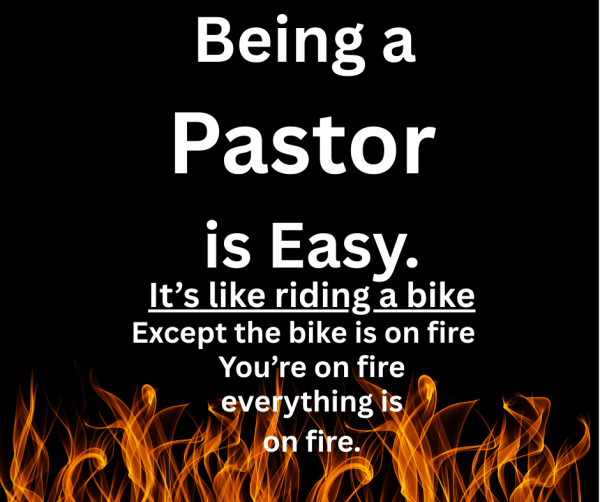
Okay, friends, let’s be real. Ministry. It’s beautiful. It’s inspiring. It’s… sometimes brutally, gut-wrenchingly hard. Like, harder than trying to explain the Book of Revelation to your five-year-old nephew while he’s hopped up on Mountain Dew and birthday cake. We’re talking sleepless nights, tough conversations, the weight of the world on your shoulders kind of hard. And if you’re a pastor, you know what I’m talking about.
So, what do we do with all that? How do we navigate the messy, complicated, sometimes heartbreaking realities of leading a community? Because let’s be honest, pretending everything’s sunshine and rainbows isn’t going to cut it. We’ve all seen that. It doesn’t work. It actually makes things worse.
Here’s the thing I’ve learned (and I’m still learning, by the way, this is a lifelong gig): It’s okay to not be okay. Seriously. You’re not a robot. You’re a human. You have doubts. You have fears. You have moments where you just want to throw in the towel and move to a secluded cabin in Montana and raise goats and maybe a miniature donkey. (Anyone else have that fantasy?)
And that’s perfectly normal. In fact, I’d argue it’s essential. Because when we’re honest about our struggles, when we acknowledge the pain, that’s when we open ourselves up to something bigger than ourselves. That’s when we create space for grace.
Think about it. The stories that resonate with us, the stories that stick with us, they’re not the ones where everything is perfect. They’re the stories where people wrestle with the hard stuff. They’re the stories where people face their fears, their doubts, their brokenness, and somehow, through it all, find a way to keep going.
That’s the kind of community I want to be a part of. A community where it’s okay to say, “I’m struggling.” A community where we can be real with each other, where we can share our burdens, where we can support each other through the tough times.
Now, I’m not saying it’s easy. Dealing with hard things is, well, hard. But here are a few things I’ve found helpful:
Find your tribe: Connect with other pastors, mentors, friends, people who get it. You need people you can be honest with, people who will listen without judgment, people who will remind you that you’re not alone.
Take care of yourself: This sounds basic, but it’s crucial. Get enough sleep. Eat healthy food. Move your body. Do things that bring you joy. Seriously, schedule it in. It’s not selfish; it’s essential.
Embrace the questions: Doubt is not the enemy of faith. In fact, I think it can be a catalyst for growth. Don’t be afraid to ask the hard questions. Don’t be afraid to wrestle with the mysteries. That’s where the real transformation happens.
Remember the bigger story: Sometimes, when we’re in the thick of it, it’s hard to see the bigger picture. But remember, there’s a story unfolding, a story of hope, a story of redemption, a story that’s bigger than our individual struggles. And we’re all a part of it.
So, yeah, ministry is hard. Life is hard. But we’re not in this alone. We’re in this together. And maybe, just maybe, in the midst of the mess, we’ll discover something beautiful, something profound, something truly holy. And that, my friends, I believe is so worth it!
Hey there, friends, happy Monday! In just a few days it will be May, and May is Mental Health Awareness Month. So, I thought it would be helpful to write about this topic today. Mental health can, unfortunately be a taboo topic often tiptoed or whispered about in church hallways or avoided altogether because it feels too raw, too messy, too…unspiritual. But what if I told you that mental health is as much a part of our sacred journey as prayer, worship, or loving our neighbor? What if the struggles we face in our minds are not a sign of weakness but an invitation to deeper grace?
A while back, I sat down with a colleague at work (I work for a Mental Health non-profit), we’ll call her Lisa (that’s not her real name), a counselor who’s spent years walking alongside folks wrestling with anxiety, depression, and everything in between. I wanted to know: Why is it so hard for us, especially in the church, to talk about mental health? Why do we slap a stigma on it like it’s something to be ashamed of? And what would it look like for us to tear that stigma down, brick by brick, and build something new in its place?
Lisa leaned back in her chair, her eyes soft but piercing, and said something that stuck with me: “Scott, we’ve got this unspoken rule in a lot of churches. It’s like, if you’re struggling mentally, you’re somehow failing at faith. Like your depression means you don’t trust God enough or your anxiety is a lack of surrender. But that’s not how it works. That’s not how any of this works.”
And I felt that. Deep in my gut. Because I’ve seen it. I’ve seen the way we sidestep conversations about mental health in our congregations. I’ve seen the way people hide their pain because they’re afraid of being judged, of being told to “just pray harder” or “give it to God.” I’ve seen it in my own life, too. There was a season when I was carrying so much—pastoring a church, raising kids, trying to be a good husband—and I felt like I was drowning. I didn’t have the language for it then, but looking back, I was wrestling with anxiety. And you know what? I didn’t tell a soul. Not because I didn’t want help, but because I was terrified of what people would think. A pastor with anxiety? Come on, Scott, pull it together.
But here’s the thing: God didn’t create us to hide. From Him, from each other, from ourselves. Genesis tells us we were made in God’s image, fearfully and wonderfully crafted, every part of us—our hearts, our minds, our messy, beautiful, complicated souls. And when our minds hurt, when our thoughts spiral, when the weight of the world feels like too much, that’s not a betrayal of God’s design. It’s part of being human in a broken world.
Lisa put it this way: “Mental health struggles are like any other kind of pain. If you break your leg, you don’t sit there and pray for the bone to magically heal while refusing to see a doctor. You get a cast, you do the physical therapy, you let people help you. Why should it be any different with our mental health? Therapy, medication, support groups—these aren’t signs of failure. They’re tools. They’re gifts.”
That hit me hard. Gifts. What if we started seeing mental health care as a gift? Not just for the person struggling, but for the whole community? Because when one of us is hurting, we’re all hurting. And when one of us finds healing, we’re all lifted up. That’s the body of Christ, right? We carry each other’s burdens. We celebrate each other’s victories. We don’t leave anyone behind.
So, let’s talk about the stigma. Where does it come from? I think part of it is fear. We’re afraid of what we don’t understand. Mental health can feel like this big, mysterious thing, and it’s easier to push it away than to lean in and listen. Part of it is history, too. For a long time, the church hasn’t known what to do with mental health. We’ve leaned on spiritual answers for everything, and while I believe with all my heart that God is our ultimate healer, I also believe He gave us brains to create medicine, hearts to offer compassion, and communities to hold each other up.
And let’s be honest: sometimes it’s pride. We want to look like we’ve got it all together. We want to be the strong ones, the faithful ones, the ones who never waver. But you know what’s stronger than pretending you’re fine? Being honest. Saying, “I’m not okay right now.” That takes courage. That takes faith. That’s the kind of vulnerability Jesus modeled when He wept in the garden, when He cried out on the cross. If the Son of God can be honest about His pain, why can’t we?
So, what do we do? How do we start breaking the silence? I don’t have all the answers, but I’ve got a few ideas, and I’d love to hear yours. First, let’s talk about it. Like, really talk about it. In our sermons, in our small groups, in our coffee shops and living rooms. Let’s normalize conversations about mental health the way we normalize conversations about physical health. Let’s share our stories—not to compare pain, but to remind each other we’re not alone.
Second, let’s educate ourselves. Pastors, I’m looking at us. We don’t have to be therapists, but we can learn enough to recognize when someone’s struggling and point them toward help. We can partner with counselors, host workshops, create spaces where people feel safe to say, “I need support.” And we can preach about mental health with the same compassion we bring to any other part of the human experience.
Third, let’s be the church. The real church. The one that shows up with casseroles and prayers and listening ears. The one that doesn’t judge or fix, but just sits with people in the mess. The one that says, “You are enough, just as you are, and God loves you right here, right now.”
I think about Jesus a lot when I ponder this stuff. Jesus, who met people where they were. The woman at the well, carrying her shame. The man possessed by demons, crying out in torment. The disciples, scared and doubting. Jesus didn’t turn them away. He didn’t tell them to get their act together first. He saw them, loved them, and offered them a way forward. That’s our model. That’s our call.
So, friends, here’s my invitation to you: Let’s be a community that breaks the stigma. Let’s be a place where people can say, “I’m struggling,” and hear, “I’m here with you.” Let’s be a church that doesn’t just talk about grace but lives it, especially when it comes to mental health. Because the God who knit us together, who knows every thought before we think it, is not ashamed of us. Not ever.
What do you think? What’s one step you could take to start this conversation in your own life or community? Drop a comment below or shoot me an email—I’d love to keep this going. Until then, keep pondering, keep praying, and keep showing up for each other. We’re in this together.
We all know the drill: “Forgive and forget.” Easier said than done, right? Forgiveness. It’s one of those words that gets thrown around a lot, but honestly, what does it even mean?
To me, forgiveness isn’t about pretending something hurtful never happened. It’s not about condoning bad behavior or letting people off the hook for their actions. Forgiveness, at its core, is about un-muscling your soul.
Think about it. When someone hurts us, it’s like they’ve thrown a punch. We clench our fists, tense our shoulders, and hold onto that anger. We build a fortress around our hearts, convinced that holding onto that pain somehow gives us power. But here’s the thing: holding onto anger is exhausting. It’s like constantly carrying a heavy weight around with you. It drains your energy, steals your joy, and keeps you stuck in the past.
Forgiveness isn’t about letting the other person off the hook. It’s about setting yourself free. It’s about choosing to release the grip of that anger, that resentment, that bitterness. It’s about choosing to stop letting the past dictate your present.
Now, I know what you’re thinking: “But Scott, what about justice? What about accountability?”
Justice is important. Accountability is important. But forgiveness doesn’t negate those things. They can exist side-by-side. Forgiveness is about your inner healing. It’s about choosing to break the chains of the past and step into a life of freedom and peace.
Forgiveness isn’t always easy. Sometimes it feels impossible. But I believe that true freedom comes when we choose to un-muscle our souls, to release the grip of the past, and to step into a life of love and grace.
What do you think? What does forgiveness mean to you? I’d love to hear your thoughts.





 Pastor's Ponderings