A Thanksgiving Devotional: Forgiveness, Reconciliation, and the Courage to Try Again

Every Thanksgiving, we talk about gratitude—giving thanks for blessings, family, food, and the goodness of God. But sometimes the things we’re most thankful for are the things God heals inside us: old wounds, buried regrets, lingering anger, unresolved relationships.

And strangely enough, a lesson in forgiveness shows up in Home Alone through the quiet, misunderstood character known as Old Man Marley. (Do you remember him?)

We first see him through Kevin’s fearful eyes—pale, silent, distant, dragging a shovel across the snowy sidewalk. But later, sitting together on a church pew, Marley finally opens up. He confesses that he hasn’t spoken to his son in years because of a painful argument. Pride sat heavy between them. Fear kept him from trying again. Regret made him feel paralyzed. And the saddest part? He watches his granddaughter sing in the choir but doesn’t go near her… because reconciliation feels impossible. It’s a like lesson for all of us and the baggage of anger, resentment and unforgiveness that many of use lug around with us. Some call it just a ‘chip on the shoulder’ but it’s more of an abscess on the heart which prevents any forward momentum because we’re anchored to this burden that could potentially be lifted if we were to just expose it and release it.

Maybe you’ve been there.
Maybe Thanksgiving brings you around people you love but don’t know how to talk to anymore, and so you’ve quit trying.
Maybe the table is set, but something unsaid still sits between you and someone else, and the weight of that baggage keeps nagging at your heart.
Maybe gratitude is hard this year because bitterness is louder than the quiet thanks, or maybe it’s overlooked altogether because of this mountain of hurt piled up at the door of your heart.

Scripture doesn’t ignore this ache. It speaks into it with both truth and tenderness. I want to explore this for just a moment. And I hope you’re still reading this:

1. Forgiveness Is God’s Invitation to Freedom

Bear with each other and forgive one another… Forgive as the Lord forgave you.
Colossians 3:13

Forgiveness isn’t excusing what happened. It’s not pretending the pain didn’t matter.
Forgiveness is choosing not to let the wound have the last word. If we do, it will just continue to fester in our souls and make us even more bitter in life.

When Marley admitted, “I’m afraid to call my son,” it wasn’t the conflict that trapped him—it was the fear of taking the first step. Forgiveness begins when we decide, “I won’t let fear freeze me anymore.” It takes real guts to be the one to initiate the forgiving. Most are reluctant to even entertain the notion because all-to-often pride gets the better of us.

2. Reconciliation Requires Courage, Not Certainty

If it is possible, as far as it depends on you, live at peace with everyone.
Romans 12:18

God doesn’t say reconciliation will always be easy. Or fast. Or neat. Or even possible – there’s a big “if” hanging out in this verse. Sometimes the other person isn’t ready. Sometimes the relationship may never look the same.

But as far as it depends on youyou can initiate peace.
You can send a text. Make a call. Offer a prayer. Turn toward the possibility instead of away from it.

Back to Home Alone and this scene for just another moment:
Kevin tells Marley, “You should call him.” It’s a simple, childlike nudge toward hope. Isn’t it interesting that children have the tendency to hitting the heart of the matter? If we grown-ups would just become wise like kids again. (Somewhere I hear Jesus scolding His disciples for trying to shoo off a bunch of kids from talking to Him.) Simplistic faith usually has the direct approach to life, while we ‘adults’ tend to overcomplicate every avoidance and insult. Why can’t we become child-like in our faith again? What’s stopping us?

3. Thanksgiving Isn’t Complete Without Grace

Blessed are the peacemakers, for they will be called children of God.
Matthew 5:9

At the end of Home Alone, there’s a brief moment easily missed unless you’re watching for it:

Marley stands outside with his son—talking, laughing, embracing. His granddaughter runs into his arms.
The family he thought he lost… restored. The snow falls. The world is quiet.
Forgiveness has opened a door he thought was locked forever.

That’s what grace does.
It rebuilds.
It reopens.
It releases both the wounded and the one who caused the wound.


A Thanksgiving Reflection

Here’s a quick reflection for each of us to consider.
This Thanksgiving, before the turkey hits the table, maybe take a moment to ask:

  • Is there someone I need to forgive, even if only in my heart for now?
  • Is there someone I need to reach out to, as far as it depends on me?
  • Is fear keeping me from trying, when grace is inviting me forward?

God specializes in resurrection—not just of souls, but of relationships.
Even the frozen, silent ones. Even the ones we think are beyond repair.

And who knows?
Like Old Man Marley, this might be the year something long-broken finally comes home.
Give this some serious though friends. Don’t live a life of bitterness when grace and even peace are possible for you right here and now. Find the courage and reach out.

Prayer:
Lord, as we give thanks this season, soften our hearts where they’ve grown hardened. Give us courage where fear has settled in. Help us forgive as You have forgiven us, and guide us toward peace where reconciliation is possible. Amen.

Forgiveness and Reconciliation: Why Is It So Hard?

-Pastor Scott

Hey there, you beautiful, messy, wandering souls. Welcome to Faith Ponderings, where we don’t just ask the big questions—we lean into them, poke at them, let them breathe. I’m Pastor Scott, your fellow traveler, your co-wonderer, your let’s-get-curious-about-the-hard-stuff companion. No quick fixes here, no bumper-sticker theology. Just us, the Spirit, and a whole lot of holy mystery.

Today, we’re diving into something that’s both a knife to the heart and a balm to the soul: forgiveness. And not just forgiveness, but reconciliation—that next step, that harder step, where you try to rebuild something after it’s been shattered. Why is it so hard? Like, so damn hard? Why does it feel like you’re climbing a mountain with no summit, lugging a backpack stuffed with rocks labeled “hurt,” “betrayal,” and “they don’t even get it”?

Grab a coffee, a journal, or just a quiet corner of your soul. Let’s sit with this. Let’s wrestle. Let’s see where the Spirit takes us.


The Gritty Beauty of Forgiveness

You ever notice how we love the idea of forgiveness? It sounds so good on paper. “Forgive and forget.” “Let it go.” Cue the Disney soundtrack, right? But then you try it, and it’s like… whoa. This isn’t a Hallmark card. This is gritty. This is raw. This is you staring at the person who hurt you—or maybe just their ghost in your memory—and your heart screams, “I can’t. I won’t. They don’t deserve it.”

And here’s the thing: that feeling? It’s real. It’s human. It’s not wrong to feel it. Forgiveness isn’t a transaction, like paying a bill or checking a box. It’s a journey. A process. A tearing-open of your soul to say, “I’m not gonna let this wound define me anymore.” It’s a gift you give yourself, with God’s help, to set your heart free.

But reconciliation? Oh, that’s another beast. That’s saying, “Not only am I letting go of this pain, but I’m gonna try to rebuild something with you. Something new. Something fragile.” And that’s where it gets messy. Because while forgiveness is yours to give, reconciliation takes two.


What Does Scripture Say?

Let’s go to the Bible, because it doesn’t shy away from this mess. In Matthew 18:21-22, Peter—good ol’ Peter, always asking what we’re thinking—comes to Jesus and says, “Lord, how many times should I forgive my brother or sister who sins against me? Up to seven times?” Seven! Peter’s feeling generous. That’s a lot of forgiveness. But Jesus? He blows it up. “Not seven times, but seventy-seven times.” Or in some translations, seventy times seven. Jesus is saying, “Peter, stop counting. Forgiveness isn’t a math problem. It’s a way of being.”

But here’s what gets me: Jesus doesn’t say, “And then reconcile every time.” Forgiveness is one thing—you release the debt, you let go of the grudge. Reconciliation, though? That’s a bridge you build together. It takes trust, rebuilt brick by brick. It takes the other person showing up, owning their stuff, saying, “I see the hurt I caused.” And sometimes… they don’t. Sometimes they can’t. Sometimes they won’t.

So what do you do then? Do you keep forgiving, seventy-seven times, while they keep swinging? Or is there a point where you say, “I forgive you, but I can’t walk with you anymore”? That’s the tension. That’s where we sit, in the ache, asking, “God, what now?”


Joseph’s Story: A Slow, Cautious Dance

Let’s look at Joseph in Genesis 45. This guy’s brothers sold him into slavery. Slavery. Years of betrayal, pain, abandonment. And yet, when he’s standing there, powerful in Egypt, and his brothers show up, he doesn’t just forgive them—he weeps, he embraces them, he reconciles. But it wasn’t instant. It took years. It took his brothers showing some remorse, some change. And even then, Joseph tested them. He didn’t fling open the door and say, “All good!” He watched. He waited. He protected his heart.

I wonder… is that what reconciliation looks like? A slow, cautious dance? A willingness to hope, but not a blindness to reality? Because we love the story of the prodigal son in Luke 15:11-32—the father running out, arms wide, party planned. It’s beautiful. But what if the son came back and said, “I’m not sorry, I just need more cash”? Would the father still throw the party? Or would he say, “I love you, I forgive you, but we’re not there yet”?


The Tension of Reconciliation

This is why it’s so hard. Forgiveness is yours to give—it’s a gift you offer, even if the other person never receives it. But reconciliation? That’s a bridge you build together. And sometimes, the other side isn’t ready to meet you halfway. Sometimes, they’re not safe to build with. Maybe they’re still wielding the same weapons that hurt you. Maybe they’ll never say sorry. And that’s where we need wisdom. That’s where we need prayer, community, maybe even a good therapist to help us sort through the wreckage.

Some of us are carrying wounds from people who will never apologize. A parent who failed you. A friend who betrayed you. A spouse who broke your trust. And the church—oh, the church—sometimes tells us, “Just forgive! Move on! Be the bigger person!” But what if being the bigger person means saying, “I forgive you, but I need boundaries”? What if it means loving from a distance? Is that less holy? Or is that just… human?

Psalm 147:3 says, “He heals the brokenhearted and binds up their wounds.” I love that. God’s not standing there saying, “Hurry up and forgive so I can love you.” He’s binding up your wounds. He’s healing your broken heart. And maybe forgiveness is part of that healing—not for them, but for you. To set you free. To say, “This hurt doesn’t get to own me anymore.”


Forgiveness vs. Reconciliation: A Holy Distinction

Here’s where I’m landing, friends. Forgiveness is a gift you give yourself, with God’s help, to let go of the poison. It’s saying, “I’m not gonna let this grudge eat me alive.” It’s a solo act, a sacred release. Reconciliation, though? That’s a mutual project. It’s a bridge you build, but only when it’s safe, only when there’s shared work. Sometimes, reconciliation means restoring a relationship to what it was. Other times, it means building something new—something different, something that honors the truth of what happened.

And God? He’s in both. He’s in the letting go and the rebuilding. He’s in the tears and the boundaries. He’s in the “I forgive you” and the “I can’t trust you right now.” He’s writing a story of healing, even when it’s messy.


Where Are You in This?

So, where are you in this? What’s stirring in your heart? Are you stuck on forgiving someone, wrestling with that seventy-seven times thing? Or are you wondering if reconciliation is even possible—or safe? Maybe you’re carrying guilt because you can’t reconcile, and you’re wondering if that makes you a bad Christian. Can I just say… you’re not alone. This is hard. It’s supposed to be hard. It’s holy work, but it’s not instant. It’s a journey.

Here’s a challenge: Take a moment to reflect. Journal it out, pray it through, or just sit in the quiet. Ask yourself:

  • What hurt am I carrying that I need to release?
  • Is there a relationship where reconciliation is possible, or do I need boundaries instead?
  • How is God inviting me to heal, right here, right now?

And if you’re feeling stuck, share your ponderings. Drop a comment, send me a message, or talk it out with someone you trust. We’re in this together.


A Closing Prayer

Let’s close with a breath. Inhale… exhale… God, you see the hurts we carry. You see the walls we’ve built, the bridges we’re scared to cross. Heal us. Guide us. Show us how to forgive, how to love, how to be whole. Amen.

Thanks for being here, you beautiful souls. This is Faith Ponderings, and I’m Pastor Scott. Keep asking, keep wrestling, keep trusting. Peace to you.


What’s stirring in you? Share your thoughts in the comments below. Let’s keep pondering together.

Dear Salvation Army, Mending Fences…

Dear Salvation Army, reconciliation is a beautiful thing.
We seek it for our soldiers, we preach it from our pulpits, but do we truly live it?
I have heard it said that we as people are quick to expect forgiveness when we have been wronged, but what about when we have performed the misstep, what then?  How quickly do we respond to the hurt with the seeking of forgiveness and reconciliation?  It can be likened to the parable that Jesus told about the unforgiving servant who had just received forgiveness for a huge debt that he owed.  You would think that he would go home with great relief and treat others the same way he had just been graciously treated, but instead he returned the favor by harshly treating someone who was in his debt.  (Matthew 18:21-35)

My fellow Salvationists, we can be so good at distributing grace to the stranger, but to those within our ranks, at times that grace is missing.  One might say that because we operate within an authoritarian leadership model, one has come to expect harsh treatment amongst the ranks…let me ask you is this how Christ led his disciples?  Of course not!  Let me clear the air, there is no excuse for leaders who lord their power over those they have been given authority over.  Eventually they will receive the same kind of treatment that they have doled out.  Please do not misunderstand what I am saying and take it to mean that I am directing this conversation solely on Divisional and territorial leaders, as a matter of fact, dear Corps Officers, you ought to be very mindful of the power you have been given in your current appointments too!  How you treat your soldiers ought to be the way that you desire to be treated as well!

Let us prick this very vein of conversation today in order to arrive at a very important destination – Reconciliation!
I have heard some very sad tales of officers and soldiers leaving our ranks because they felt that they were no longer welcome and/or specific people, who had an ounce of power made then feel powerless and useless.  Perhaps I should interject here and compare our attrition rates with those awful circumstances mentioned above and wonder aloud if we are not self-destructing because a minority of people were given power and they horribly misused it?

Proverbs 13:10 says, “Where there is strife, there is pride, but wisdom is found in those who take advice.”  Perhaps some of us need exactly that today.  I am most certainly not the one who ought to give it, for I am just as imperfect as the next soldier…but I do feel led to offer just three helps upon the road to reconciliation today that I feel our Army should consider.

Instead of paving over the pain and pretending those hurts are not there…
Instead of turning our backs on those who have left our ranks for any number of reasons…
Instead of ostracizing, criticizing, and gossiping…

Here are three very simple suggestions for ALL of the Soldiers in our Army both high in rank to the adherent considering soldiership.

1 Admit to the wrongs
“When pride comes, then comes disgrace, but with humility comes wisdom.” -Proverbs 11:2
Are we so haughty in our hearts that we are above admission of guilt and wrong-doing?
Do we fear that we will lose credibility and our place of power amongst the ranks if we admit our missteps?
Could it be that in order for us to truly move forward as an army and in our mission, we have to humble ourselves so that He might lift us up?  (James 4:10)  This “humbling” includes owning our failures both corporately and individually.  If we wish to seek failure and loss of mission, then keep sweeping the sin and guilt under the rug as we think no one will ever notice.  But if we wish to experience fulfillment of mission and victory over sin, then we have to admit our sins and failures before God.  Yes, admit the wrongs, but don’t remain or live there, for to do so will lead to certain disillusionment and disgrace.  We merely stop there to own our failures…but remember He will lift us up when we discard pride and put on humility.

2 Atone for the Wrongs 
I firmly believe that one of the cruxes of our army today is the willingness to forgive the shortcomings of prospective believers and new believers than it is to forgive the shortcomings of “the saints”.  We treat soldiers who have fallen more harshly than we would ever treat a stranger…why?  Because they should have known better?  Are we not still susceptible to the lures of temptation and sin even if we don on our uniforms?  Galatians 6:1 says, “Brothers and sisters, if someone is caught in a sin, you who live by the Spirit should restore that person gently.”  Did you catch that last part?  It says “GENTLY”.  All too often we are more harsh with fellow soldiers and officers, so much so that we have driven some away from our ranks, and they will never set foot in a corps ever again because of the pain we have caused them.  How do we atone for such a thing?  How does the Army move past these wrongs?  The true authoritarian, devoid of faith, would simply relocate that officer (if it was an officer involved)…they move them to a less desirable appointment or far away from the blight that was caused…but is that really what a Holiness movement ought to do, assuming we still carry that mantel and title within our hearts as a mission?

I am not naming any specific situation, I am simply pointing out what a true authoritarian model of leadership would do.  Within this strict sense of this model, true authoritarian leaders are to never be questioned or opposed because to do so would unravel the very fabric of the organization’s identity.  This model can often be on display from the corps setting all the way to IHQ.  This is not to say that all leaders portray this model, but perhaps because of it, there have been times that wrongs were done and then swept mercilessly under rugs in the attempt to forget and not to forgive.  If we as Christ-followers wish to travel the path of reconciliation, we have to own up to our wrong doings and stop sweeping.  The truest form of bravery, sincerity and grace is found in making peace when you were the one who once sought war; To attempt to mend the broken that you once broke.  The bigger man or woman, the truest leader amongst us is one who admits and makes the attempt to atone for wrongs done to others especially those amongst (or formerly amongst) our own ranks.

3 Seek Reconciliation:

“Therefore, if you are offering your gift at the altar and there remember that your brother or sister has something against you, leave your gift there in front of the altar. First go and be reconciled to them; then come and offer your gift.”  -Matthew 5:23-24

“Blessed are the peacemakers, for they will be called children of God.” -Matthew 5:9

Reconciliation doesn’t just happen once, it happens as often as there are wrongs to be righted.  I recall a time when I harbored anger towards a person in my corps and on Sunday morning I had to preach while that person was in the congregation.  I remember how my words felt like heavy weights that I could not lift, let alone speak.  How can I be sincere with my fellow soldiers if I had not sought to mend that which was truly broken in my heart and in that particular relationship at the time?  Was I at fault?  Absolutely, and it took every ounce of my courage to swallow my own pride and need to be right and make every effort to fix that relationship, only then would we be able to move on.  Once that was accomplished, it was like a large exhale had been released within our corps.

Dear fellow Soldiers, perhaps the reason your corps or your spiritual journey has been halted is because there is reconciliation that needs to take place.  Swallow your pride and seek it out, stop holding your breath of guilt and shame…exhale it in relief as you seek to mend the broken.  The hardest place to do this is with your fellow soldiers and officers with whom you hold animosity, pain and perhaps shame.  Holiness is dead if we are not able to offer grace towards one another.  Holiness is dead if we cannot admit, atone and reconcile both as individual travelers and as fellow sojourners.

Something more for the Army to ponder today.
To God be the glory!

Dear Salvation Army, Is Your Mercy Seat Broken?

Recently in our corps something happened.
No, it wasn’t another rousing chorus of “O Boundless Salvation”.  It wasn’t another meal around the table, although those are rather nice.
Instead, there in the sanctuary of our corps, in the place where lives are changed and hearts transformed by the power of the Holy Spirit, in that very room…something was damaged – The Mercy Seat.

It happened because some corps kids were playing through out the building…scratch that.  It happened because not “some” kids, but MY kids happened to be playing in the corps building (Why is it always the Officer’s Kids?  Really??).   They ended up in the sanctuary.  Perhaps the lure of the microphones and musical instruments were too much.  Regardless of how they ended up there, they were there.  In the process of scaling the mercy seat, my eldest’s foot got caught on the lip of the seat and tripped.  As he tripped, the mercy seat came with him.  He tipped it over completely, and with it the top was pried off.

Upon inspection of the mercy seat, I quickly realized that it was not going to go back together without a little help from a hammer and some new nails.  Currently, repairs are underway.

It’s a Metaphor…mercy seat2
It dawned on me last night while laying in bed, and it all began with a broken mercy seat.  Perhaps in our corps we have lost what the mercy seat used to represent.  Perhaps, it is broken today and in need of repairs.

Question: Is your mercy seat broken?
I don’t mean physically, but emotionally, tangibly, spiritually, is it still intact?
Does your corps still call people to penitence, repentance and reconciliation?
Or have we gotten away from holding each other accountable for fear of offending others?  I don’t mean “accountability” in the sense of judgmental attitudes and condescending “I’m better than you” behavior, I mean is that standard and call to the mercy seat still available to all who would seek it?  Is there an invitation to it?
mercy seat
My Fear:
I fear that we as an Army have gotten away from it in some places.  If your corps still introduces people to Christ through the mercy seat, I applaud you.  The mercy seat in and of itself isn’t magical.  It isn’t really even about how nice it looks or how old it might be in your building.  What matters is the emphasis of repentance, reconciliation, and holiness.  The mercy seat could represent more than just that piece of furniture in our chapels…but do we emphasize it anymore?  There are times when I wonder if, in the next ten years, will it still be a part of our Army’s identity?  Will we have discarded it as some ancient Army relic of times gone by?

Is your Mercy Seat Broken? Mom 1
Perhaps it has gathered dust from lack of use.
Perhaps it needs some revitalization and fixing today.
Perhaps, in order to revive this Army, we ought to seek it out…but more importantly we ought to seek out the power behind our faith.

I believe the Holy Spirit isn’t finished with us yet.
I believe that He longs for us to linger upon that mercy seat as we reconcile ourselves to Him once more.
I believe that in order for us to possibly regain our passion and fire for the world, we have to go back to it and start once more upon our knees.

I fear that if we do not repair these broken mercy seats, our Army will soon follow that same fate as well.

-Something more for our Army world to ponder today.
To God be The Glory!

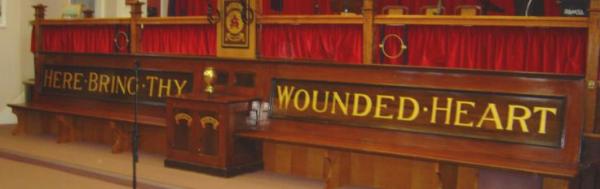
(Cover image: Mercy Seat at Exeter Temple, UK)

“Ambassadors of Reconciliation”

Image

“We are therefore Christ’s ambassadors, as though God were making his appeal through us. We implore you on Christ’s behalf: Be reconciled to God.” -2 Corinthians 5:20

One of my favorite words in the English language is “Reconciliation”.  The etymology of the word reconcile comes from the Latin “reconcilare” which means “to bring together again”.  

When Jesus came into this world and identified with humanity as the God-man He sought to bring together again the original creation of man with God the Father.  Did you catch that?  At one time, in our original state, we were together with God.  He would walk with Adam and Eve.  He would fellowship with them in the garden of Eden.  He actually, physically, walked WITH them.  

But.

Because of original sin, which entered the picture, we became separated from God.  Think of it like a great big, messy divorce…except we were the offending party and God the Father did nothing to deserve our infidelity.  How it must have wrecked His heart to find us unfaithful to Him.  To find out we (Adam and Eve) deliberately and consciously disobeyed Him.  But we all know this story don’t we?  We understand the consequences of the fall of man…don’t we? 

Yes Jesus came. 

He came to set things right with us.  

He came to Reconcile us (back again) into the Father’s arms.  

Think about that for a moment.  Isn’t that beautiful?  Doesn’t that evoke in you some sort of longing to physically be embraced by God the Father as you enter into the wedding feast?  Jesus came to restore us.  He came for the whosoever…those who would actually come seeking Him.  

But, wait…there’s more. 

When we face the God-man, Jesus Christ, for who He is and what He came to do, we make a vital decision.  We, who have then become Christ-followers, we choose to become like Him in our daily living.  A part of this “becoming” is to pick up where Jesus left off.  We follow in the footsteps of the Rabbi, but in so doing we shuck off our old identities and adopt (not just imitate, but become) Christ in  our everything!  

Taking it a step further, we are to be Christ’s ambassadors to the world relaying the vital message of reconciliation to the whosoever. There is a misnomer though that I think we buy into once in a while – “Reconciliation is only for the sinner”.  This is simply not true.  Though we have become like Christ in every way, shape or form (or so we think thus far) we are still in need of THAT reconciliation daily!  

The Hebrew words associated to the word “Ambassador” are: “tsir” or “melits” and “malak”.  Essentially they mean “an interpreter” or “a messenger”.  

When we think of Ambassadors today we think of politicians from certain countries whose job it is to broker peace and trade agreements with other countries.  But we as Christ-followers are also called to be ambassadors of reconciliation to the sinner and the saint.  Taking it a step further being an Ambassador also implies that we are to literally breathe Christ’s message into other people by our words and more importantly by our actions.  

How can we provide clear interpretation of God and that of His love to those around us if we have not fully adopted and reconciled ourselves to His love as well?  If this reconciled life is not within us then we cannot breathe this into other people’s lives.  So as an Ambassador it has to begin with You…and it has to begin with me.  

It first must become personal…daily, even moment by moment breathing Christ’s holiness and likeness into our own hearts and minds through the power of the Holy Spirit. (Philippians 4:8).    

Prayer: 

Dear Lord, let it begin with me.  Breathe on me breath of God, allow me to be reconciled to You daily.  Help me to see that I am called to be your messenger to others, even other saints.  Help me to be the best Ambassador for you that I can be.  May it be my lifelong passion which begins moment by moment with you.  In Your Holy name I pray these things, -Amen.  

Lost and Found

Image


2 Corinthians 5:20-21 (NIV)
20 We are therefore Christ’s ambassadors, as though God were making his appeal through us. We implore you on Christ’s behalf: Be reconciled to God. 21 God made him who had no sin to be sin for us, so that in him we might become the righteousness of God.

A sister never gave up hope in finding her long lost brother.  She spent two decades searching for him.  They had been separated and adopted out and records were sketchy at best in terms of locating his adoptive parents.  She had almost given up until her searching paid off…Her brother was found!  After twenty years of searching, she found him and a tale of reconciliation could finally be told.  It would be hard to describe the emotions in that room when she finally glanced at him as he entered…how the tears must have flowed freely as images of her brother as a child swam in her head.  The tearful reunion after such a vacuum of time, lost time had separated them. 

Stories like these happen all of the time.  What a day of celebration when families get reconnected after so many years!  It is certainly a joyful time I would imagine.  I’ve never actually been to one of those reunions; I’ve never been separated from my family for more than a few weeks at best.  But you almost don’t have to, in order to imagine the overwhelming joy and happiness that is poured about that lost, now found soul. 

So it is within the Kingdom of Heaven.  Christ has searched for us, has extended Himself to the very cross to that we might be reconciled with our rightful family!  All of heaven rejoices when we are at last reconciled to the Father through Jesus His son and the shedding of His blood for us.  What a wonderful tale of reunion is told every time a soul who was lost is now found again!  Like the sister in the story, Christ never stops searching for us and He wants us to be found! 

Are you in need of being found today?  Do you know someone who is still lost in this world?  Christ is searching, and wants so desperately to reconcile the lost back again to the Father! 

-Just a thought!   

Blog at WordPress.com.

Up ↑