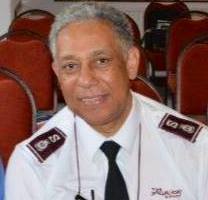
Perspectives Day 3 – Featuring Commissioner Clive Adams “Do Something!”


It spurred William Wilberforce, subsequent to his conversion, to dedicate the rest of his life to the abolition of slavery in the eighteenth century.

It was the command that William Booth gave his son, Bramwell, upon seeing homeless men huddled under a London bridge in the latter part of the nineteenth century.

It inspired Bob Geldof to organise Live Aid in 1985 after watching a BBC documentary on the famine in Ethiopia the previous year.

In 2007, it drove Michael Smith, sickened by the violence and destruction he witnessed daily as a policeman, to start Word 4 Weapons which, to date, has seen 10, 000 weapons handed in to collecting bins supplied by The Salvation Army.

The compulsion to ‘do something’ springs from the very heart of God – He, who…

has told you… what is good…

has told you what he wants from you:

to do what is right to other people,

love being kind to others,

and live humbly, obeying your God

(Micah 6:8 New Century Version)

God’s word is filled with such injunctions for us to reject indifference and inaction as responses to need. From Abraham’s intervention in Lot’s troubles when he could have been enjoying the land, through the prophets’ clear proclamation of a God less interested in creeds than in deeds – of mercy and justice, to Jesus, moved with compassion into action, and on into the Church Age, where, from its earliest beginnings, we see the Church appointing leaders especially to ‘do something’. A continuous line of grace being communicated through actions, throughout humankind’s history we see the hand of God ‘doing something’.

Doing something in the face of need should be as natural to the disciple of Jesus as participating in prayer, fellowship, worship and witness. Those first disciples would have recalled their own perplexity the day they stood alongside their master at the end of a long day of ministry, worrying about the hungry needs of thousands (John 6:5-13). Their perplexity arose from the size of the problem – it seemed insurmountable – and the Master’s clear expectation that they should do something about it – it seemed impossible. They learnt that day that, if they did what they could, gave what they had and obeyed as instructed, Jesus would bless their efforts, abundantly!

Children of the Central North Division have been inspirational in grasping this strong correlation between discipleship and doing something. Taken on a discipling course, they soon made the connection between their discipleship and doing something for people in need. The result is the amazing Change4Change project they have started to help trafficked children in Malawi.

                     [Donate to their Change4Change page here]

The Children’s Ministries Unit at THQ recently hosted these fine Salvationist young people when they enjoyed a trip to London, which included a visit to my office. What a joy to meet such enthusiasm! We were able to rejoice over the phenomenal amount of money they have raised already.

These young people have not let the enormity of the problem intimidate them. They’ve done something about it which will make a difference. Thereby, they join a long line – a line which starts at the Throne of Mercy and reaches across the ages and all around the world as people understanding the heart of a just and merciful God go out and do something. All of those referenced – Wilberforce, Booth, Geldof, Smith and these intrepid Salvationist young people – faced challenges too large for them to tackle, but, undaunted, they did tackle them, overcame them and made a difference. They were not overwhelmed, they did something!

There’s more than enough need to go around. Which begs the question: What can you do?

Image Check out Commissioner Adam’s blog site: http://insight.salvationarmy.org.uk/do-something  

ImageThis is so relevant yet today!  Do something!  


Perspectives Day 2 – Featuring Stephen Court (Major) “Semantics Antics”

Image

“SEMANTICS ANTICS”
(Stephen Court)

Words have power. Yes, this truth is usually used in the context of either speaking life instead of death (see James on the tongue) or of the prophetic (see the creation account of God speaking things into being).


But it also goes for semantics – the meanings of words.


When we use certain words we imply and apply certain meanings. When these words enter the general vocabulary they shape the meaning of the things they describe. Words have power.


We (The Salvation Army) have been using some words and terms far too carelessly. Here are some examples:


lay (as in ‘lay people’ and ‘laity’): this refers to people who are not ordained and otherwise qualified to participate in Christian service. It is carelessly applied to everyone who is not an officer. This is poor theology and terrible history. Despite the spiritual inferiority complex-induced mistake of the late 1970s and the ‘ordination’ of officers, there is not some mystical abracadabra ‘ordination’ that accompanies commissioning. All of our generals and the vast majority of our commissioners (in all of history) have not been ‘ordained’ in the mistaken sense that the relatively recent commissioning exercise has appended. By the loose use of the term ‘lay’ that means Booth, Railton, Booth-Tucker, Higgins, Carpenter, Orsborn, Kitching, Coutts, Wickberg, Wiseman, Brown, Wahlstrom, Burrows, Tillsley, Rader, Gowans, Larsson, Clifton, Bond, and Knaggs were/are ALL ‘LAY PEOPLE’. The term is ridiculous in a Salvationist context. There are no ‘lay people’ in The Salvation Army. There are converts, recruits, soldiers, and officers. That’s it.


Words have power.


clergy: Official SA websites (AUE, USE, C+B, among others) as well as influential sites (e.g. wikipedia) define or equate officers as and with clergy. This is evil. Officers are not clergy. Officers are soldiers who have given up secular employment and covenanted to make themselves exclusively available temporally and geographically for the salvation war in vocational leadership. ‘Clergy’ by definition requires ordination.   Watch the end of the faulty reasoning:

If ‘officer’ equals ‘clergy’; and,


‘Clergy’ requires ‘ordination’ (which it does by definition); then,


All the generals (but our current one) and most of the commissioners were not/are not officers.


By using words like ‘clergy’ and ‘laity’ we are reinforcing the unbiblical clergy/laity split, one of the key strategies of the devil against the people of God.


Words have power.


pastor: These are the four New Testament ‘offices’ Paul outlines in Ephesians 4: apostle, prophet, evangelist, and teacher/shepherd. The last – teacher/shepherd – includes a word that is translated only once in the whole New Testament as ‘pastor’ but clearly means ‘shepherd’.[i]


Those covenantally involved in vocational Christian leadership – our leaders – are called corps or commanding officers, divisional commanders, territorial commanders, and general. They are not formally called evangelist, apostle, prophet, shepherd/teacher even though many fill one or more of these roles. To pick one out of the hat (with the increasingly rare exception of ‘evangelist’ as in ‘territorial evangelist’, the chosen term is always ‘pastor’) is to call hockey hall of famer Wayne Gretzky a penalty killer. Now, Penalty Killer Wayne Gretzky certainly was efficient in killing penalties but to limit his impact on the ice to penalty killing is ridiculous.


Why then do officers (and lots who attend meetings) call officers ‘pastors’? Excellent question, no good answer to which is available, but some explanation is possible:

A. we have an inferiority complex when compared to churches;

B. we have an identity crisis in which we don’t know that we are not a church (see below);

C. we are catering to a church subculture instead of fighting to rescue lost people from hell;

D. we are overwhelmingly influenced by non-Salvationist Christian content (books, conferences, TV, radio, podcasts, blogs, etc.).


Remember, words have power. What are the effects of officers being called ‘pastor’?


i. we sabotage our mission because, among the people we are trying to rescue from heading to hell, ‘pastor’ generally has negative connotations. So we inaccurately identify with something that is unpopular in trying to reach the people with whom it is unpopular. Ridiculous.


ii. we change what it means to be an officer from some heroic combination of apostle/prophet/evangelist/teacher\shepherd leading troops in a salvation war to some bad-breathed, shellac-haired, touchy-feely stereotype aiming to keep the pews warm.


iii. we limit Holy Spirit, who actually works through all FOUR offices, not just a distorted half of the teacher/shepherd one.


Only church people seem attached to terms like ‘pastor’.


Could it be that we use a term like ‘pastor’ because we want church people to attend our meetings and don’t really care about people who are lost?


Words have power.


church: For centuries we have understood the ‘Church’ to be a place where the gospel is preached and the sacraments are administered. However, The Salvation Army is a revolutionary movement of covenanted warriors exercising holy passion to win the world for Jesus.


Based on these definitions, is your corps a church?


No. (unless you are surreptitiously passing around bread and grape juice and splashing your people with water)


So, by definition, your corps is not a church. Why call it one?[ii] Why identify with something that is manifestly unpopular with the people who are headed to hell that we are trying so hard to reach with the Gospel? Why sabotage your local mission and the mission of our global movement? Your corps is not a church despite what someone stuck on a sign or put in a magazine or said from the microphone.


Words have power.


service: This one is hilarious. Just this Sunday afternoon a salvationist took a phone call at the hall. The person had been calling, apparently, for the last hour but our explain, “we’ve been in service for the last hour and a half… we were in service… we were in service…”


Well, this person was evidently LOOKING for some service and it made absolutely NO SENSE to him that The Salvation Army had been ‘in service’ and yet had neglected to pick up the phone to SERVE him! Now, our friend had been taught that what had just happened was a religious ceremony (that is the definition of her use of the term ‘service’). But to the people going to hell, ‘service’ means service – the act of being served – and we’d not been serving them.


So, for the record, The Salvation Army does not hold ‘services’. We have what are called ‘meetings’. Check out your history. We have holiness MEETINGs and salvation MEETINGS and soldiers MEETINGS and all kinds of meetings. But we don’t ‘have services’. As the sign on the way OUT of one garrison said, ‘The service begins when the meeting ends’. Let’s keep our serving in VERB form, please.


Words have power.


Do you get it? The words you use affect what we are. When you use terms like ‘church’ and ‘pastor’ and ‘service’ and ‘clergy’ and ‘lay’ you are watering down The Salvation Army and compromising the testimony of salvationists and insulting soldiers and limiting Holy Spirit and sabotaging our mission and hindering our effectiveness. Stop it, please.


Don’t even get me started on ‘members’, ‘ministry boards’, ‘sanctuaries’…

  Endnotes

[i] 1. ‘Pastor’. For some reason, people like this term. In KJV it comes up once – Jeremiah 17:16 (NIV renders it ‘shepherd’); in NIV ‘pastor’ turns up once – Ephesians 4:11.


But the word in Ephesians 4:11 is ‘poimen’ and it actually appears 18 times in the New Testament, 17 times being translated ‘shepherd’. So it seems like ‘pastor’ is a biblically rare synonym for the much more popularly used term ‘shepherd’.


Since ‘shepherd’ actually means something, apart from being a synonym, and since ‘shepherd’ lacks the negative connotative accretions of ‘pastor’ in today’s society, it makes much more strategic and biblical sense to use that term instead of ‘pastor’.


This says nothing of the replacement of CO with ‘pastor’ (‘pastor’ is not nearly synonymous with CO and so is an even worse replacement for CO than it is for shepherd).


So, let’s agree that ‘pastor’, being unbiblical and unpopular, is a term we should avoid.


[ii] ‘church’. The Bride of Christ? Metaphor. Flock? Metaphor. Building, temple, body? All metaphor. But the Army of God? The Salvation Army? We’re not a metaphor. We’re not a comparison to something that we aren’t. We’re an army. ‘Church’ carries negative connotations throughout the West. The large majority of populations in developed countries vote with their feet that ‘church’ is irrelevant and unimportant and marginalised. Why on earth would we rush to pretend to be a ‘church’ when it is, a. not accurate, and b. not effective? Why on earth would we forfeit our God-given, biblical identity as an Army? (possibly because we got the ‘prophetic trumps relevant’ principle backwards and we have a spiritual inferiority complex).

Catch Major Stephen Court’s Blog Writings at – http://www.armybarmyblog.blogspot.com/

 

Sermon Podcast: “Two”


“Two”
Luke 10:38-42 (NIV)
38 As Jesus and his disciples were on their way, he came to a village where a woman named Martha opened her home to him.
39 She had a sister called Mary, who sat at the Lord’s feet listening to what he said.
40 But Martha was distracted by all the preparations that had to be made. She came to him and asked, “Lord, don’t you care that my sister has left me to do the work by myself? Tell her to help me!” 41 “Martha, Martha,” the Lord answered, “you are worried and upset about many things,
42 but only one thing is needed. Mary has chosen what is better, and it will not be taken away from her.”

Do we open up___ our houses__ to Jesus? (v.38)

Are we willing to sit______at His feet?
(v.39)

What are our Distractions and Demands______________?
(v.40)
There are two choices.
What is the “one”______thing that is needed for us? (v.42)
Prayer:
Dear Lord I long to sit at Your feet. I long to listen to Your words and do what You would have me do. Teach me to prioritize my life. Teach me to understand how worry can be so crippling to my spirit this day. Teach me how to revel and worship at Your feet. –Amen.


The Salvation Army…A Holiness for Failures.

Image

Okay, I admit my title is a little inflammatory…hang with me, I’ll get to the point.  Here’s what I mean: The Salvation Army ministers to many who come from hard-living lifestyles.  Admittedly many souls who come to us for help are victims of these lifestyles.  How we minister to them begins with the old catch phrase/slogan “Soup, soap, salvation”.  We long to fill their stomachs, clean them up and get their lives back on track before we can minister to their hearts.  Perhaps it doesn’t have to be specifically in that chronological order either, our ministry opportunities could come simultaneously.  But the core of our ministry stems upon a demographic of those who are marginalized, poor and/or destitute…and the failures – there I said it.   

The “Failure” –
We live in a numbers oriented ministry driven world where, from an outside point of view only having 20 or 40 in a service on Sunday seems to indicate a dying church when compared to mega churches and large community churches that boast well over a 1,000 members.  I’m not knocking these churches, nor am I jealous and want to become them…but there are quite a few who join the ranks of the army who look at these churches and then look at our corps attendance on Sundays and feel as if we’ve failed and/or are dying.  It’s a failure of a different sort, a failure of perspective.  This failure of perspective comes when we buy into the lie that numbers in the pews are the only source or indicator of a ministry’s effectiveness.   Successful ministry begins and ends at personal relationships.  Do we spend quality time one on one with those with whom we minister with and to?  This is the true evidence of genuine discipleship.  Not that it can’t happen in other ministries where you can possibly get lost in the crowd, but can you hide in a corps that boasts 40 members?

Image


 Are we caring for the complete person?  Is there follow-up and attention to the real sources of crucial personal issues in their lives? The Salvation Army isn’t like other churches because it isn’t just a church, it’s a movement and a triage location to the lost, hurting, marginalized and the failures.  

Operating within a Holiness For Failures: 
Fellow spiritual freedom fighters we aren’t strictly in the business of merely facilitating “goods” to those in need.  We have a broader, greater mission to fulfill.  It may indeed begin with the services of goods in order to meet the physical needs, but it mustn’t end there!  That is only the beginning.   We must be willing able to help usher those we serve in our community into the very throne room of heaven in order for them to have the opportunity to meet and know Christ Jesus.  Providing “goods” and services gets us in the door but if we are a mission of holiness for failures (myself included) then we must do more than a box of food, a place to sleep and a warm meal…we must display and convey Jesus!  

Jesus came for the Failures and the Lost! 

Image


Jesus came for the whosoever, and those He picked to serve in His mission were not the best of the best.  They were tough men and women.  Many were from hard living lifestyles and many did not have the best of educations.  If Jesus had operated within modern day success oriented means He would have gone to the synagogues and recruited the most educated.  He would have filled the temples to the brim and He would have had an active prosperous ministry that would have afforded Himself many properties and riches…yet this wasn’t His mission.  He came to the rejects, the prostitutes, the outcasts, the uneducated, the lame and the sick, the dead and all we failures.  Not failures by occupational standards or in friendships (not all anyway) but by a salvation standard.  “For all have sinned (failed) and fallen short of the glory of God.”   (Romans 3:23)  He operated within a holiness for failures system.  This isn’t to mean that Holiness is or was a failure, but rather He went to the sinner, He lived among to poor, He cared for the outcasts and brought the power of redemption to those who would hear and seek.  Even selecting His disciples He showed evidence that He would use anyone who was willing to follow and willing to receive His holiness and success at the cost of even death.  

From point ‘a’ to point ‘b’ 

How are we bringing people from point ‘a’ (a life of sin and shame) to point ‘b’ (a life of salvation, redemption and holiness)?  What are we concerned with more?  Numerical success or the success of holistic ministry and spiritual life altering opportunities?  Are we looking over the fences at other ministries that do not embody what our movement is all about? We are many parts of the body of Christ and with that being said other ministries out there operate for different reasons.  Jesus brought hope to a world of failures, how are we emulating Him in our Corps and in our various ministries in our communities?  

Perhaps you’re hung up on the word “failure” today because of its negative connotations.  Jesus came you and for me because we needed Him!  Still today many are lost in their failures, blinded by habitual sins and shame…be a light to them not by your power but by His Holy Presence.  Help to usher His holiness to those who need Him most!  Perhaps we must stop looking over the fences, stop comparing ourselves and get back to work.  The upside – when we allow Christ to work within us as well as those we minister to He will turn us from Failures into His Holy Success stories.

 “Go for souls, and go for the worst!” 

-Just another thought to Ponder.


“Perspectives” Day 5 – Featuring Timothy McPherson “Vulnerable”

Image

Vulnerable

I’m an introvert. I once saw this Internet meme and thought it was hilarious and aptly described me:

Image

I do not like exposing myself to too much scrutiny, examination, and prominence. It’s a protective measure. I don’t like getting hurt emotionally.

Those who know me and have seen me voice my opinions on Social Media would beg to differ. I tend to be quite “vocal” in my online presence; more so than I would have ever had the courage to do so in public. I have no scientific data to support my claim, but sometimes I feel the Internet, and especially Social Media, makes extroverts of introverts. It’s almost like a buffer zone for me. I am able to think, process, and then articulate my thoughts and feelings regarding various topics.

If you know me outside of Social Media, you might tend to view me as very reserved. This sometimes has gotten interpreted as being stuck up. While I was at our College for Officer Training (seminary) my now-wife was advised not to get to know me because I was too intellectual and too theological for her. I am very grateful that she did not heed that advice!

That being said, I love to preach. I love to teach. Standing up before a crowd or being part of a discussion group brings out what little extroversion I possess. However, since I am an introvert, releasing all of that mental muscle to expose myself before a group of people always leaves me exhausted afterwards. I retreat, find a book, or go to sleep.


The Problem

Enter the plight of the introverted clergy. We can get very lonely.

Perhaps a common misconception is that introverts don’t want friends. This is not true in the least. For myself:  I do want friends. Sometimes it’s a desperate longing. Then the inner battle of introversion begins:  being vulnerable versus not being lonely. It can be a bitter struggle. Often times, I feel surrounded by a group of strangers who are watching my every move and hoping for a misstep.

Image

In my case, my self-defense became too bitter and overran my life. I had no one (other than my wife) with whom I could express my fears, frustrations, joys, sorrows, accomplishments (or the lack thereof). I hated it. However, I was not willing to open myself up to the possibility that friendship is possible with others. My marriage suffered. My ministry suffered. I was a living hypocrite talking about loving my neighbor when I had the hardest time doing it myself. I began to look at myself repugnantly. I hated who I had become and began to hate myself.

My walls of defense had kept me safe for a little while, but in the end, they crumbled and collapsed on top of me. I was a mess.


The Hard Lesson

I realized (very slowly) that I needed to change. I began to open myself up to others. It was an arduous task. Protecting my own insecurity had led to my downfall. There were other factors mixed in that made things extremely difficult, but I at least could control my friendships. Finally, I decided to open up.

That has helped me out extremely. Trust is hard for me to give out. I had been hurt too often in the past, but then I realized that the benefits of trusting people far outweigh the hurts that I might otherwise receive from those who would betray my trust. I am by no means out of the woods and I need to continually improve myself. One of the most difficult things for me to do is to make friends in my own community. Being an officer in The Salvation Army tends to be isolating. There seems to be an unspoken rule that fraternizing is not allowed. However, I believe that actually goes against God’s command to love each other as we love him.

Being vulnerable to others is a discipline that I am still learning. I hope someday to be proficient at it. I will always be an introvert, but I don’t have to be a lonely one.


Easter Sermon Podcast “Death is Dead” (Peeling back the labels) -Brainerd Lakes Corps The Salvation Army


itunes pic

Please find the link to the podcast here  – 

http://scottstrissel.podomatic.com/entry/2014-04-20T11_12_49-07_00

Podcasts are also available for download via iTunes/Podcasts/Brainerdcorps

Jesus said to her, “I am the resurrection and the life. The one who believes in me will live, even though they die; and whoever lives by believing in me will never die. Do you believe this?” (John 11:25, 26 NIV)

John 20:1-9 (NIV) 
1 Early on the first day of the week, while it was still dark, Mary Magdalene went to the tomb and saw that the stone had been removed from the entrance. 
2 So she came running to Simon Peter and the other disciple, the one Jesus loved, and said, “They have taken the Lord out of the tomb, and we don’t know where they have put him!” 
3 So Peter and the other disciple started for the tomb. 
4 Both were running, but the other disciple outran Peter and reached the tomb first. 5 He bent over and looked in at the strips of linen lying there but did not go in. 6 Then Simon Peter, who was behind him, arrived and went into the tomb. He saw the strips of linen lying there, 
7 as well as the burial cloth that had been around Jesus’ head. The cloth was folded up by itself, separate from the linen. 
8 Finally the other disciple, who had reached the tomb first, also went inside. He saw and believed. 9 (They still did not understand from Scripture that Jesus had to rise from the dead.)

Jesus said to her, “I am the resurrection and the life. The one who believes in me will live, even though they die; and whoever lives by believing in me will never die. Do you believe this?” (John 11:25, 26 NIV)

John 20:1-9 (NIV) 
1 Early on the first day of the week, while it was still dark, Mary Magdalene went to the tomb and saw that the stone had been removed from the entrance. 
2 So she came running to Simon Peter and the other disciple, the one Jesus loved, and said, “They have taken the Lord out of the tomb, and we don’t know where they have put him!” 
3 So Peter and the other disciple started for the tomb. 
4 Both were running, but the other disciple outran Peter and reached the tomb first. 5 He bent over and looked in at the strips of linen lying there but did not go in. 6 Then Simon Peter, who was behind him, arrived and went into the tomb. He saw the strips of linen lying there, 
7 as well as the burial cloth that had been around Jesus’ head. The cloth was folded up by itself, separate from the linen. 
8 Finally the other disciple, who had reached the tomb first, also went inside. He saw and believed. 9 (They still did not understand from Scripture that Jesus had to rise from the dead.)

Palm Sunday Sermon Podcast – Brainerd Lakes Salvation Army

palmsunday

“Complete Submission”

Here’s the sermon podcast link, also it is available to download from iTunes/Podcast/brainerdcorps

http://scottstrissel.podomatic.com/entry/2014-04-19T18_27_39-07_00

“Complete Submission”
(Mark 11:1-11)
1) When Jesus S________us He has a P______.

• He knows the o_________before we

g___ there!
• Do we s_________in the way?
• Or do we f__________ go even if we don’t have all of the information?

2) He will give us the w_______s to

s________. He G___________us!

3) When we S________ to Christ’s W______

for our lives, He can take His R___________

place as K__________of K_____________!


Why The Salvation Army isn’t for everybody, but it is for everyone!

Image

It was founded as an outreach, a mission, a cause.  

The mobile Army wasn’t created to be another church but rather a fighting force equipped to fight sin and its stranglehold on humanity.  Its members were to fight side by side for the purpose of relieving human suffering while administering the annocuational cure which is Christ to the dying soul.  Life replacing death.  

Humility walks in close step to the sounds of marching feet in an Army of spiritual combatants.  Without this vital component, one might have the temptation to become self-righteous and prideful.   But this fight, if total commitment is the goal and holiness is the aim, offers little time for selfish desires and ambitions.  

Thus, The Salvation Army is not for everybody.  Within its ranks there are few benefits of receiving human praise and awards of personal prestige.  Payment for services as Officers, Soldiers and Lay persons are minimal at best and carry with it responsibilities of a full-time commitment.  If one were searching for a higher paying position which afforded more luxury and freedom The Salvation Army certainly would not be for everybody in search of these physical comforts.  If the mission is at the forefront, which is also an extension of the Great Commission, such desires for personal acclaim and earthly wealth is diminish over time.  Don’t get me wrong, however, these temptations will still occasionally occur, but if Holiness and humility are present as tools for utilization in a Soldier’s armor then that soldier can withstand this assault with the power of the Lord.  

…but it (The Salvation Army) is for everyone!

 In recent years struggles have arisen.  Lifestyle questions have been raised.  Accusations (even at times correct) have been made.  Yet if the mission is still intact, and the purpose for which The Salvation Army was established is still sought after, then the true love of Christ will shine and be seen by all who are seeking love and acceptance.  

Christ came for the whosoever, and as we continue our fight against sin and its stranglehold on humanity we must not lose our identities as first Children of God and secondly Soldiers of the Army.  When we can look at others through the lens of love as Christ first loved us, we then can see both sinner and saint still very much in need of hope and grace.  The sinner and the saint do not need more condemnation and warfare of the spiritual kind flung at them as if they are the opposing enemy.  “For our struggle is not against flesh and blood, but against the rulers, against the authorities, against the powers of this dark world and against the spiritual forces of evil in the heavenly realms.” Ephesians 6:12.  

If we are an Army marching ever forward we must consider what it means to truly “march forward” while engaging the REAL enemy of this world that seeks to envelope the hapless victims in sin, hopelessness, and death.  

I don’t mean to sound harsh, but in warfare, even in this spiritual fight, we need Soldiers and Officers who are willing to engage the enemy for the sake of others and with the power of the Holy Spirit…we do not need more sidelines cheerleaders, pretenders, or the “half-committed”.  It’s either all or nothing.  

The Lord doesn’t want a part-time commitment or what is MOST convenient for us.  He wants from us a full surrender, and in our full surrender we may be lead to do some revolutionary things in our time.  It may be uncomfortable.  It may stretch us.  But extending God’s love, hope and grace to our communities and fields of service will mean life or death to ones in which we invest our time, talents and treasures.


Image

-Just a thought.  

Perspectives – Day 3 Featuring Stephen Court “The Salvo Way: In Defence of The Salvation Army System”

Image

The Salvo Way: In Defence of The Salvation Army System

by Major Stephen Court

It’s not trendy. And for those who grew up with it or are quite familiar with it, the Army system, with its unique vocabulary and peculiar traditions, might even been regarded as defunct.

Corps Sergeant-Majors? Recruiting Sergeants? Quarter Masters? I mean, come on!

But our discipleship and leader training system, from junior soldiers through corps cadets, into senior soldier training and local officership and corps council, complete with orders and regulations, followed by options in candidateship and officer training, works.

Part of the problem is that we’ve forgotten what we are. As Major Harold Hill explains, in “Four Anchors From The Stern” (http://www.armybarmy.com/JAC/article2-64.html):

The Army’s own history, the history and doctrine of the church, the pattern of sociology, the Word of Scripture, all testify against any great need to be “a church”. Our own history provides us with a clear precedent for retaining our identity without resorting to denominationalism; the history and doctrine of the church provide an ecclesiological and theological base, the sociology of religious movements provides a rationale, and Scripture provides a mandate.

We are not a social agency only. We are not a church. We are not a denomination. We are an order.

And we have orders and regulations, not suggestions and recommendations.

‘Obedience to properly constituted authority is the foundation of all moral excellence’ (Catherine Booth). That is fine in regard to ethics. But Florence Booth takes it further when she testifies:

Looking back over 44 years of officership, it seems to me impossible to speak too highly of the value and importance of Salvation Army discipline… I realised very clearly that if all leaders had a truer idea, a stricter ideal, of obedience to rules and regulations, a much greater advance would be made throughout the Army world. (cited in A Field For Exploits, 2012)

This isn’t popular today. But the issue is not that obedience to Orders and Regulations has been tried and found wanting but found ‘irrelevant’ and ‘obsolete’ (and maybe a little too ‘hard’?) and not tried.

Our desperation for success has sometimes led us far astray from Salvationism. You can possibly see for yourself corps in your division more or less imitating the Baptists, Pentecostals, and Anglicans and others (including poor substitutions of ‘church’ for ‘corps’, ‘service’ for ‘meeting’, ‘pastor’ for ‘officer’, ‘offering’ for ‘collection’, ‘committee’ for ‘council’, ‘member’ for ‘soldier’, etc.). The problem is that most of these methods and terms don’t work very well when clothed in Salvationism.

We are not free to make things up on the fly. We’re part of an Army. We’re actually obligated to apply the Army system. If you aren’t applying it, you are compromising The Salvation Army and limiting the pace of advance of the salvation war.

Applying non-salvo methods and programmes with non-salvo doctrines and non-salvo theology in attempts to mimic their success while we play the role pastor and church is doomed to failure.

Strategically, it is mistaken. The significant majority of Canadians have voted with their feet that ‘church’ is irrelevant. Why would we pretend to be a church?

Biblically, it is near-sighted. There are all kinds of biblical metaphors for the people of God – body, temple, vineyard, building, flock, etc. But the Army of God is not a metaphor – it is not compared to something it is not. We are engaged in actual spiritual warfare. Biblically we are on solid ground.

So, to present as a ‘church’ is neither accurate nor effective.

What goes for church goes for its leaders. In NIV ‘pastor’ turns up once – Ephesians 4:11, though the Greek word ‘poimen’ appears 18 times in the New Testament, 17 times being translated ‘shepherd’. ‘Pastor’ is a biblically rare synonym for the much more popular ‘shepherd’, which it makes much more strategic and biblical sense to use instead of the term ‘pastor’, packed as it is with negative connotative accretions today.

…Oh wait, except that shepherd relates to flock – a metaphor, in contrast with Army, in a very real spiritual war against the forces of evil.

So, let’s agree that ‘pastor’, being unbiblical and unpopular, is another term we should avoid.

Let’s stop pretending. Let’s embrace The Salvation Army. Let’s embrace Salvationism, its leadership system and structure (for more detail on this, see http://www.armybarmy.com/JAC/article11-75.html).

We’re not embracing these things out of tradition or loyalty or some desperate insane stubbornness (or stubborn insanity). It’s just that our crucified and resurrected Lord and Savior, Jesus Christ, has lavished His love on us, transforming us from dreary, hopeless ne’er-do-wells slouching to heaven into mighty warriors who live to fight and fight with love,and has commissioned us to this wonder-working, world-winning mission through this divine marvel called, “The Salvation Army… the extremity of an extraordinary imagination made history. The wildest dream of the wildest dreamer materialized” (Evangeline Booth, The World’s Greatest Romance).

—-

Twitter.com/StephenCourt


An Army Engaged in Battle!

Image

I was having a conversation with a person the other day about what I do (I’m a pastor/officer with The Salvation Army).  In the midst of our conversation she told me that recently The Salvation Army was featured on a trivia show.  They were the answer to this question:  What is the only Army in the world that has never fought a battle.  This revelation kind of caught me off guard.  Of course I understood the connotation – a physical battle, but I thought to myself in a very real, practical/spiritual sense how wrong they truly were.  The Salvation Army was formed for just the purpose of engaging an enemy that has ravaged this wretched world since the fall of Adam and Eve.  We are at War!!  The public may not know this, but we are engaged in the front lines of spiritual warfare every day.  Sometimes I fear perhaps even some of our Soldiers and (dare I say) Officers don’t know this.   

We must continue to be an Army that is engaged in this battle daily!  Do falter or to fall is not an option!  Ephesians 6:12 says this:  “For our struggle is not against flesh and blood, but against the rulers, against the authorities, against the powers of this dark world and against the spiritual forces of evil in the heavenly realms. Therefore put on the full armor of God, so that when the day of evil comes, you may be able to stand your ground, and after you have done everything, to stand.

Image

There is a very real spiritual adversary that holds many sinners captive still today.  Many people are bound by all kinds of addictions, perversions and entanglements that they cannot break.  Who can save them?  We alone certainly do not possess the strength, nor the power to free them, but girded with the full armor of God, this Army of Salvation can still be vital and effective!   We never stand alone in the midst of the fray, we carry the banner of Christ with us and the Holy Spirit is our ammunition and power!  

So how must we begin?  We begin on our knees in penitence before the Almighty!  We seek His power, His guidance, and His direction.  Only when we have been thoroughly equipped through our conversations with the Father can we then get up and fight on.  Without these necessary daily, even moment by moment conversations with the Father we will not continue to stand against the father of lies.  

Dear fellow Christ-followers and Soldiers of the Army, we cannot simply wear the uniform and pretend to be engaged, we must actively fight for the salvation of other lost souls in our communities and even in our own homes!  Without active soldiers and officers who are willing to fight and willing to boldly stand up, this cause will surely falter and fail.  We don’t need casual partakers or bench warmers, but we need active participants who will stand in the gap for the hurting, the tired, the poor, the wretched and the lost!  This battle for the lost is not over!  It certainly did not end when our Founders were promoted to glory, nor will it end when we grow old and one day meet Jesus face to face!  But in the here and now, in our small corners of the world, there is still a battle cry to be heard!  There is still a fight to be waged!  There is still lost souls to be saved!  Who will go?  Who will serve?  Who will fight on and answer the cries of the broken and the shattered?  May we all hear the cries, but more importantly, may we all hear God’s calling for us to take our stands and to reach out a helping hand to poor souls still drowning in the depths of sin.  

I’m reminded of this Battle Song: 

#718 in the Red Song Book –

Fight the good fight with all thy might,

Christ is thy strength, and Christ thy right;

Lay hold on life, and it shall be

Thy joy and crown eternally.

Run the straight race through God’s good grace


2.

Run the straight race through God’s good grace,

Lift up thine eyes and seek his face;

Life with its way before us lies,

Christ is the path, and Christ the prize.

Cast care aside, lean on thy guide


3.

Cast care aside, lean on thy guide,

His boundless mercy will provide;

Lean, and the trusting soul shall prove

Christ is thy life, and Christ thy love.

Faint not, nor fear, his arms are near


4.

Faint not, nor fear, his arms are near,

He changeth not, and thou art dear;

Only believe, and thou shalt see

That Christ is all in all to thee.

John Samuel Bewley Monsell (1811-75)


 Image

Blog at WordPress.com.

Up ↑