How Does Grace Work?

Image

It is more than just saying a prayer at dinner time.  It is more than being “gracious” on a sports field after a loss.  Grace is something that can be offered to more than just a friend in need.  Grace is something that can be profoundly life changing when offered to a complete stranger or even an enemy.  

Grace is defined in the spiritual realms as “God’s unmerited favor”.  This means that grace or God’s love and forgiveness is offered to those who don’t even deserve it.  It’s like going to an execution of a known guilty convict, and just before they “flip the switch” the governor calls to say the guilty convict has been pardoned. Image


 It just doesn’t seem to make sense.  Shouldn’t that person pay for their crimes?  That person certainly didn’t deserve anything but punishment, and yet grace was provided without merit.  

God comes through to us in our wretched state.  Jesus was sent to us despite ourselves, despite how undeserved we were.  God knew that in our total depravity we were hopelessly lost and doomed to suffer our sinner’s fate…yet He still sent Christ.  Jesus took upon Himself the sins of all mankind and they were nailed to the cross with Him.  Knowing this brings John 14 into perspective: 

Do not let your hearts be troubled. You believe in God[a]; believe also in me. My Father’s house has many rooms; if that were not so, would I have told you that I am going there to prepare a place for you? And if I go and prepare a place for you, I will come back and take you to be with me that you also may be where I am. You know the way to the place where I am going.”

Thomas said to him, “Lord, we don’t know where you are going, so how can we know the way?”  Jesus answered, I am the way and the truth and the life. No one comes to the Father except through me. If you really know me, you will know[b] my Father as well. From now on, you do know him and have seen him.

Jesus declares to His disciples and to us as well that grace has come into the world.  He also reminds us of the way to the Father is through Him alone.  

Receiving Grace: 

Image
We can receive this grace from God the moment we cry out to Him.  We can not only be forgiven from our wretched sins and shame but we can be washed clean from them.  God’s grace is like that.  It is His desire that no one suffer death because of sin.  Jesus has given us the way to receive His grace – declare Him to be God’s one and only Son!  Ask Him to forgive your sins, and live this new life through Jesus!  http://www.lifeway.com/lwc/files/lwcF_crd_ss_EforESpec_ABCs-of-Salvation_pdf.pdf

To keep on “the way” and living within His grace perhaps begin by reading the words of the gospel of John, or another of the gospels.  Spend time reading a chapter a day, pray for God to guide you as you read His truths, and ask God for direction.  Lastly find a church to call home.  Find a church family to get plugged into and to connect with.  When you have roots such as these in the Christian faith you will grow!  

Giving Grace:


Image
Lastly, I want you consider something.  Here it is: forgive those who have wronged you!  I know, it’s hard to fathom ever forgiving THAT person, but when we forgive as Christ has forgiven us it not only frees other people but it frees us too.  We no longer have to curry these grudges and hurts around with us.  We no longer have to be burdened by pains that happened to us.  Surrendering these hurts and grudges may be the hardest thing we ever do, but trust me, it is worth it.  


Image

God gave us unmerited grace.  We didn’t deserve it, and yet it is offered to us.  Can we learn to forgive as well?  Can we truly learn to love our enemies (Matthew 5:44)?  Grace is real, free, and available.  Accept it and then offer it to others! 

-Just something else to ponder today!  

Prayer: Dear Lord help me to accept Your grace today!  Guide me in Your truths, I want to serve you and love you with every fiber of my being.  Forgive me of my sins.  Help me to accept Your grace and in turn forgive those around me.  Lord I need to be freed of these burdens.  Grant me Your strength and wisdom to love my enemy.  Show me practical way in which I can show love and forgiveness today.  In Your name I pray all of these things.  -Amen.  

Perspectives Day 5.1 “Poetry” – Featuring Commissioner Harry Read “Heart-Talk”

Image

Heart-Talk

If I but give myself to thee, O Lord,
Roll over on to thee my life and way,
Acknowledge heavenly truth within thy word,
Believe thy love is constant every day

Then will I know the peace that trusting brings,
The power that issues freely from thy hand,
The joy which rises from eternal springs,
The quality of life which thou hast planned.

O grant me, Lord, the wisdom to believe
That life is only life when lived in thee;
Grant me the faith to ask and then receive
The promised life which Christ would live in me.

Shine thou through me thy love and righteousness –
A glow of hope in this world’s hopelessness.

Psalm 37: 5.6
‘Trust in him…he will make your righteousness shine like the dawn.’

By Harry Read.
harry read

Perspectives Day 2 – Featuring Stephen Court (Major) “Semantics Antics”

Image

“SEMANTICS ANTICS”
(Stephen Court)

Words have power. Yes, this truth is usually used in the context of either speaking life instead of death (see James on the tongue) or of the prophetic (see the creation account of God speaking things into being).


But it also goes for semantics – the meanings of words.


When we use certain words we imply and apply certain meanings. When these words enter the general vocabulary they shape the meaning of the things they describe. Words have power.


We (The Salvation Army) have been using some words and terms far too carelessly. Here are some examples:


lay (as in ‘lay people’ and ‘laity’): this refers to people who are not ordained and otherwise qualified to participate in Christian service. It is carelessly applied to everyone who is not an officer. This is poor theology and terrible history. Despite the spiritual inferiority complex-induced mistake of the late 1970s and the ‘ordination’ of officers, there is not some mystical abracadabra ‘ordination’ that accompanies commissioning. All of our generals and the vast majority of our commissioners (in all of history) have not been ‘ordained’ in the mistaken sense that the relatively recent commissioning exercise has appended. By the loose use of the term ‘lay’ that means Booth, Railton, Booth-Tucker, Higgins, Carpenter, Orsborn, Kitching, Coutts, Wickberg, Wiseman, Brown, Wahlstrom, Burrows, Tillsley, Rader, Gowans, Larsson, Clifton, Bond, and Knaggs were/are ALL ‘LAY PEOPLE’. The term is ridiculous in a Salvationist context. There are no ‘lay people’ in The Salvation Army. There are converts, recruits, soldiers, and officers. That’s it.


Words have power.


clergy: Official SA websites (AUE, USE, C+B, among others) as well as influential sites (e.g. wikipedia) define or equate officers as and with clergy. This is evil. Officers are not clergy. Officers are soldiers who have given up secular employment and covenanted to make themselves exclusively available temporally and geographically for the salvation war in vocational leadership. ‘Clergy’ by definition requires ordination.   Watch the end of the faulty reasoning:

If ‘officer’ equals ‘clergy’; and,


‘Clergy’ requires ‘ordination’ (which it does by definition); then,


All the generals (but our current one) and most of the commissioners were not/are not officers.


By using words like ‘clergy’ and ‘laity’ we are reinforcing the unbiblical clergy/laity split, one of the key strategies of the devil against the people of God.


Words have power.


pastor: These are the four New Testament ‘offices’ Paul outlines in Ephesians 4: apostle, prophet, evangelist, and teacher/shepherd. The last – teacher/shepherd – includes a word that is translated only once in the whole New Testament as ‘pastor’ but clearly means ‘shepherd’.[i]


Those covenantally involved in vocational Christian leadership – our leaders – are called corps or commanding officers, divisional commanders, territorial commanders, and general. They are not formally called evangelist, apostle, prophet, shepherd/teacher even though many fill one or more of these roles. To pick one out of the hat (with the increasingly rare exception of ‘evangelist’ as in ‘territorial evangelist’, the chosen term is always ‘pastor’) is to call hockey hall of famer Wayne Gretzky a penalty killer. Now, Penalty Killer Wayne Gretzky certainly was efficient in killing penalties but to limit his impact on the ice to penalty killing is ridiculous.


Why then do officers (and lots who attend meetings) call officers ‘pastors’? Excellent question, no good answer to which is available, but some explanation is possible:

A. we have an inferiority complex when compared to churches;

B. we have an identity crisis in which we don’t know that we are not a church (see below);

C. we are catering to a church subculture instead of fighting to rescue lost people from hell;

D. we are overwhelmingly influenced by non-Salvationist Christian content (books, conferences, TV, radio, podcasts, blogs, etc.).


Remember, words have power. What are the effects of officers being called ‘pastor’?


i. we sabotage our mission because, among the people we are trying to rescue from heading to hell, ‘pastor’ generally has negative connotations. So we inaccurately identify with something that is unpopular in trying to reach the people with whom it is unpopular. Ridiculous.


ii. we change what it means to be an officer from some heroic combination of apostle/prophet/evangelist/teacher\shepherd leading troops in a salvation war to some bad-breathed, shellac-haired, touchy-feely stereotype aiming to keep the pews warm.


iii. we limit Holy Spirit, who actually works through all FOUR offices, not just a distorted half of the teacher/shepherd one.


Only church people seem attached to terms like ‘pastor’.


Could it be that we use a term like ‘pastor’ because we want church people to attend our meetings and don’t really care about people who are lost?


Words have power.


church: For centuries we have understood the ‘Church’ to be a place where the gospel is preached and the sacraments are administered. However, The Salvation Army is a revolutionary movement of covenanted warriors exercising holy passion to win the world for Jesus.


Based on these definitions, is your corps a church?


No. (unless you are surreptitiously passing around bread and grape juice and splashing your people with water)


So, by definition, your corps is not a church. Why call it one?[ii] Why identify with something that is manifestly unpopular with the people who are headed to hell that we are trying so hard to reach with the Gospel? Why sabotage your local mission and the mission of our global movement? Your corps is not a church despite what someone stuck on a sign or put in a magazine or said from the microphone.


Words have power.


service: This one is hilarious. Just this Sunday afternoon a salvationist took a phone call at the hall. The person had been calling, apparently, for the last hour but our explain, “we’ve been in service for the last hour and a half… we were in service… we were in service…”


Well, this person was evidently LOOKING for some service and it made absolutely NO SENSE to him that The Salvation Army had been ‘in service’ and yet had neglected to pick up the phone to SERVE him! Now, our friend had been taught that what had just happened was a religious ceremony (that is the definition of her use of the term ‘service’). But to the people going to hell, ‘service’ means service – the act of being served – and we’d not been serving them.


So, for the record, The Salvation Army does not hold ‘services’. We have what are called ‘meetings’. Check out your history. We have holiness MEETINGs and salvation MEETINGS and soldiers MEETINGS and all kinds of meetings. But we don’t ‘have services’. As the sign on the way OUT of one garrison said, ‘The service begins when the meeting ends’. Let’s keep our serving in VERB form, please.


Words have power.


Do you get it? The words you use affect what we are. When you use terms like ‘church’ and ‘pastor’ and ‘service’ and ‘clergy’ and ‘lay’ you are watering down The Salvation Army and compromising the testimony of salvationists and insulting soldiers and limiting Holy Spirit and sabotaging our mission and hindering our effectiveness. Stop it, please.


Don’t even get me started on ‘members’, ‘ministry boards’, ‘sanctuaries’…

  Endnotes

[i] 1. ‘Pastor’. For some reason, people like this term. In KJV it comes up once – Jeremiah 17:16 (NIV renders it ‘shepherd’); in NIV ‘pastor’ turns up once – Ephesians 4:11.


But the word in Ephesians 4:11 is ‘poimen’ and it actually appears 18 times in the New Testament, 17 times being translated ‘shepherd’. So it seems like ‘pastor’ is a biblically rare synonym for the much more popularly used term ‘shepherd’.


Since ‘shepherd’ actually means something, apart from being a synonym, and since ‘shepherd’ lacks the negative connotative accretions of ‘pastor’ in today’s society, it makes much more strategic and biblical sense to use that term instead of ‘pastor’.


This says nothing of the replacement of CO with ‘pastor’ (‘pastor’ is not nearly synonymous with CO and so is an even worse replacement for CO than it is for shepherd).


So, let’s agree that ‘pastor’, being unbiblical and unpopular, is a term we should avoid.


[ii] ‘church’. The Bride of Christ? Metaphor. Flock? Metaphor. Building, temple, body? All metaphor. But the Army of God? The Salvation Army? We’re not a metaphor. We’re not a comparison to something that we aren’t. We’re an army. ‘Church’ carries negative connotations throughout the West. The large majority of populations in developed countries vote with their feet that ‘church’ is irrelevant and unimportant and marginalised. Why on earth would we rush to pretend to be a ‘church’ when it is, a. not accurate, and b. not effective? Why on earth would we forfeit our God-given, biblical identity as an Army? (possibly because we got the ‘prophetic trumps relevant’ principle backwards and we have a spiritual inferiority complex).

Catch Major Stephen Court’s Blog Writings at – http://www.armybarmyblog.blogspot.com/

 

The Salvation Army…A Holiness for Failures.

Image

Okay, I admit my title is a little inflammatory…hang with me, I’ll get to the point.  Here’s what I mean: The Salvation Army ministers to many who come from hard-living lifestyles.  Admittedly many souls who come to us for help are victims of these lifestyles.  How we minister to them begins with the old catch phrase/slogan “Soup, soap, salvation”.  We long to fill their stomachs, clean them up and get their lives back on track before we can minister to their hearts.  Perhaps it doesn’t have to be specifically in that chronological order either, our ministry opportunities could come simultaneously.  But the core of our ministry stems upon a demographic of those who are marginalized, poor and/or destitute…and the failures – there I said it.   

The “Failure” –
We live in a numbers oriented ministry driven world where, from an outside point of view only having 20 or 40 in a service on Sunday seems to indicate a dying church when compared to mega churches and large community churches that boast well over a 1,000 members.  I’m not knocking these churches, nor am I jealous and want to become them…but there are quite a few who join the ranks of the army who look at these churches and then look at our corps attendance on Sundays and feel as if we’ve failed and/or are dying.  It’s a failure of a different sort, a failure of perspective.  This failure of perspective comes when we buy into the lie that numbers in the pews are the only source or indicator of a ministry’s effectiveness.   Successful ministry begins and ends at personal relationships.  Do we spend quality time one on one with those with whom we minister with and to?  This is the true evidence of genuine discipleship.  Not that it can’t happen in other ministries where you can possibly get lost in the crowd, but can you hide in a corps that boasts 40 members?

Image


 Are we caring for the complete person?  Is there follow-up and attention to the real sources of crucial personal issues in their lives? The Salvation Army isn’t like other churches because it isn’t just a church, it’s a movement and a triage location to the lost, hurting, marginalized and the failures.  

Operating within a Holiness For Failures: 
Fellow spiritual freedom fighters we aren’t strictly in the business of merely facilitating “goods” to those in need.  We have a broader, greater mission to fulfill.  It may indeed begin with the services of goods in order to meet the physical needs, but it mustn’t end there!  That is only the beginning.   We must be willing able to help usher those we serve in our community into the very throne room of heaven in order for them to have the opportunity to meet and know Christ Jesus.  Providing “goods” and services gets us in the door but if we are a mission of holiness for failures (myself included) then we must do more than a box of food, a place to sleep and a warm meal…we must display and convey Jesus!  

Jesus came for the Failures and the Lost! 

Image


Jesus came for the whosoever, and those He picked to serve in His mission were not the best of the best.  They were tough men and women.  Many were from hard living lifestyles and many did not have the best of educations.  If Jesus had operated within modern day success oriented means He would have gone to the synagogues and recruited the most educated.  He would have filled the temples to the brim and He would have had an active prosperous ministry that would have afforded Himself many properties and riches…yet this wasn’t His mission.  He came to the rejects, the prostitutes, the outcasts, the uneducated, the lame and the sick, the dead and all we failures.  Not failures by occupational standards or in friendships (not all anyway) but by a salvation standard.  “For all have sinned (failed) and fallen short of the glory of God.”   (Romans 3:23)  He operated within a holiness for failures system.  This isn’t to mean that Holiness is or was a failure, but rather He went to the sinner, He lived among to poor, He cared for the outcasts and brought the power of redemption to those who would hear and seek.  Even selecting His disciples He showed evidence that He would use anyone who was willing to follow and willing to receive His holiness and success at the cost of even death.  

From point ‘a’ to point ‘b’ 

How are we bringing people from point ‘a’ (a life of sin and shame) to point ‘b’ (a life of salvation, redemption and holiness)?  What are we concerned with more?  Numerical success or the success of holistic ministry and spiritual life altering opportunities?  Are we looking over the fences at other ministries that do not embody what our movement is all about? We are many parts of the body of Christ and with that being said other ministries out there operate for different reasons.  Jesus brought hope to a world of failures, how are we emulating Him in our Corps and in our various ministries in our communities?  

Perhaps you’re hung up on the word “failure” today because of its negative connotations.  Jesus came you and for me because we needed Him!  Still today many are lost in their failures, blinded by habitual sins and shame…be a light to them not by your power but by His Holy Presence.  Help to usher His holiness to those who need Him most!  Perhaps we must stop looking over the fences, stop comparing ourselves and get back to work.  The upside – when we allow Christ to work within us as well as those we minister to He will turn us from Failures into His Holy Success stories.

 “Go for souls, and go for the worst!” 

-Just another thought to Ponder.


My Rescue (a poem or sorts)

Image


I cried out “my foot is slipping”
as I clung horrified to the rock.
Deep below my fall would kill
jagged and deadly…deep below.

In panic and pain strength, it waned
I knew I could not go on.
And just when it seemed I would fall
and my body, broken would fail
His hand reached me at last.

Within His grasp, my breath I gasped
My life had faced death’s cold stare
Yet there He stood, Jesus my Lord
and I knew that I was saved!

From death’s fearful grave
to life – rays of light warm my soul.
For He walks beside me all this way
and I know I have been gloriously saved!  

3 Pitfalls of Holy Living

Image

I grew up within the context of a “Holiness Tradition”.  If you have grown up in this too, perhaps you will understand the importance of sanctification.  This is the second blessing – the Holy Spirit’s anointing and subsequent cleansing of the soul.  Holiness is the willful acceptance of the Holy Spirit’s prodding to become who we were intended to be.  It is the act of complete surrender which leads us on the path of reflecting Christ in every fiber of our being.  It is the beginning point of surrendering our old sinful self completely as we long to become complete in the image of Christ – which is our “new creation” image.  

Yet, all too often, when the topic of holiness is discussed there are pitfalls that creep in and threaten to undo or destroy this transformation of the soul.  These pitfalls come in the form of erroneous thoughts or beliefs which can make ones attempt of complete surrender to the Holy Spirit impossible or at the very least extremely difficult.  

I would like to address three major pitfalls of holy living which always seem to cripple and strangle this vital growth process.  I use the term “process” for lack of a better word, though I mean this walk of holiness and complete surrender.  I also find myself using the words “holiness” and “complete surrender” either together or interchangeably only because “complete surrender” is what is required of us when we allow the Holy Spirit to sanctify us through and through.   

These pitfalls seem to be the three most influential concepts hanging around today that can cause the most damage and deter a person from accepting and receiving this second blessing:

Pitfall #1 – Holiness is about Perfection


Image

I cannot count how many times the term “perfection” comes up when discussing “Holiness” with Sunday School classes and Bible study groups.   Holiness and “human perfection” are not synonymous.   When we talk about becoming Holy, we do not all of a sudden become devoid of our imperfections while suddenly becoming perfect in every way physical shape or physical form.  Human perfection is not our goal when we talk about becoming holy.  The pursuit of human perfection is impossible improbable.  We need to recognize that this pitfall of associating human perfection with holiness will only cause us to become frustrated and long for an easier route in the spiritual life.  

Although we recognize that human perfection is not our goal we should also, in the same breath, acknowledge that it does not let us off the hook within the realms of our moral living.  The old scapegoat of “I’m only human” cannot be our excuse when we make mistakes and stumble upon this path of righteousness.  Yes, we will not be humanly perfect, but the Holy Spirit can sanctify us through and through while providing us aid and strength to avoid the trappings of the old life.  

Pitfall #2 – Holiness is all about working harder

Image


Truth be told this pitfall leads to a lot of burnout among Christ-followers.  Some feel as if they must do more for the “glory of God” and when they consider what “do” is, it entails longer hours of sweat and toil.  Don’t misunderstand me here, the Holy life does include many sacrifices and effort, but simply working harder is not the sole pathway to holiness.  

We can dress up in our uniforms and act the part and still not be any closer to being sanctified through and through.  
We miss the point.  Sanctification is the Holy Spirit’s work within those who are earnestly willing to surrender everything from within and without.  No effort unto our own will ever suffice.  No measure of extraneous “works” will earn us holiness.  We must begin with a humble, seeking heart and a willingness to be taught by the Master.  When we are on our knees before Him, longing to be made whole through the Holy Spirit, then and only then may we experience the all consuming power of sanctification.  

The working harder doesn’t come first…it comes second.  This isn’t to say that we maintain our holiness through working harder, but rather it is a response of love and devotion to the One who cleanses us through and through.  All physical appearances for the benefit of others within the realms of our “works” may very well still fall within the old life.  Working harder in the hopes of attaining holiness will only cause frustration, burnout and disillusionment.  Instead worthy pursuits to consider would be – humility, complete surrender, the discipline of prayer & supplication.

Pitfall #3 – Holiness is only available to smarter more capable saints.

Image


Believe it or not many come to the conclusion that holiness is only reserved for the wisest and the smartest of the saints.  Thankfully (in my case and perhaps yours) this is simply not true.  Jesus even told His disciples when they were attempting to shoo off children who were climbing all over Jesus this:  “Let the little children come to me, and do not hinder them, for the kingdom of heaven belongs to such as these.” (Matthew 19:14 NIV)  I recognize the context here but to me this also indicates the child-like faith we need in order to receive the Holy Spirit. 


Image

Here’s a comforting thought: We don’t need to be a scholar to receive the gift of the Holy Spirit and that of Sanctification.  We do not need to have degrees on our walls or wear a specific color of trim on our shoulders to pursue Christ-likeness.  A lot of people have the head-knowledge but when it comes to the heart-knowledge the mettle of sincere intentions and devotion are formally revealed.  This is first a personal matter.  A private conversation with God Himself.  It is a one on one appearance with God in the holy of holies.  He shows up.  He will never forsake us, and His desire for us all is to avoid these pitfalls as we pursue His holiness in our lives.  Yes, Holiness is possible and attainable to all who are willing to surrender fully to Him.  

-Just another some to ponder today.


Image

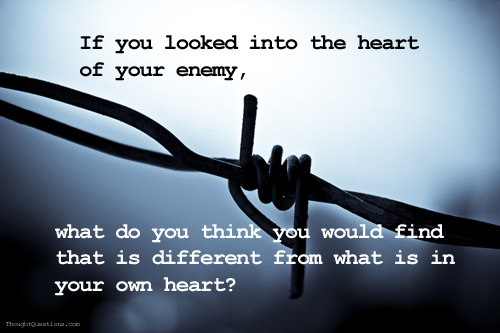
TOUGH QUESTION: Do you REALLY know your Enemy?

Image


Matthew 5:43-45 “You have heard that it was said, ‘YOU SHALL LOVE YOUR NEIGHBOR and hate your enemy.’ 44“But I say to you, love your enemies and pray for those who persecute you, 45so that you may be sons of your Father who is in heaven; for He causes His sun to rise on the evil and the good, and sends rain on the righteous and the unrighteous.…”


Beware of the Relapse

Image

But I am afraid that as the serpent deceived Eve by his cunning, your thoughts will be led astray from a sincere and pure devotion to Christ.”  –2 Corinthians 11:3 

Christ-follower beware!


ImageSalvation 
            is freely available…BUT

It 
can
     be

       Image


We have
this thing
called

Image


Free Will
allows us to 
choose                                                                           It allows us to 
                                                                                       live beneath God’s

Image

                                                                                             Image


                                                                                                    2

Image
Reject His Grace…

Here is 
a
Truth:
A Relapse 

into

Image


is a very
real 
Danger!

It begins in our Hearts 
              &
           Minds.

A Saint (that’s You & Me)
is still 

Image


to the 
trappings

of

Image


Don’t 
be
swept 
away
by it’s lure
and its
sultry voice.


Image

Stand Firm…
                                                                                               Meditate
                                                                                                      on

Image

Do Not
become Prideful
and think for 
one second                                                                         You are
                                                                                         Invulnerable!

Spiritual
Relapse
is very 
real!

so….

Image


Just 
more of                                                       this
                                                                   Pastor’s

Image


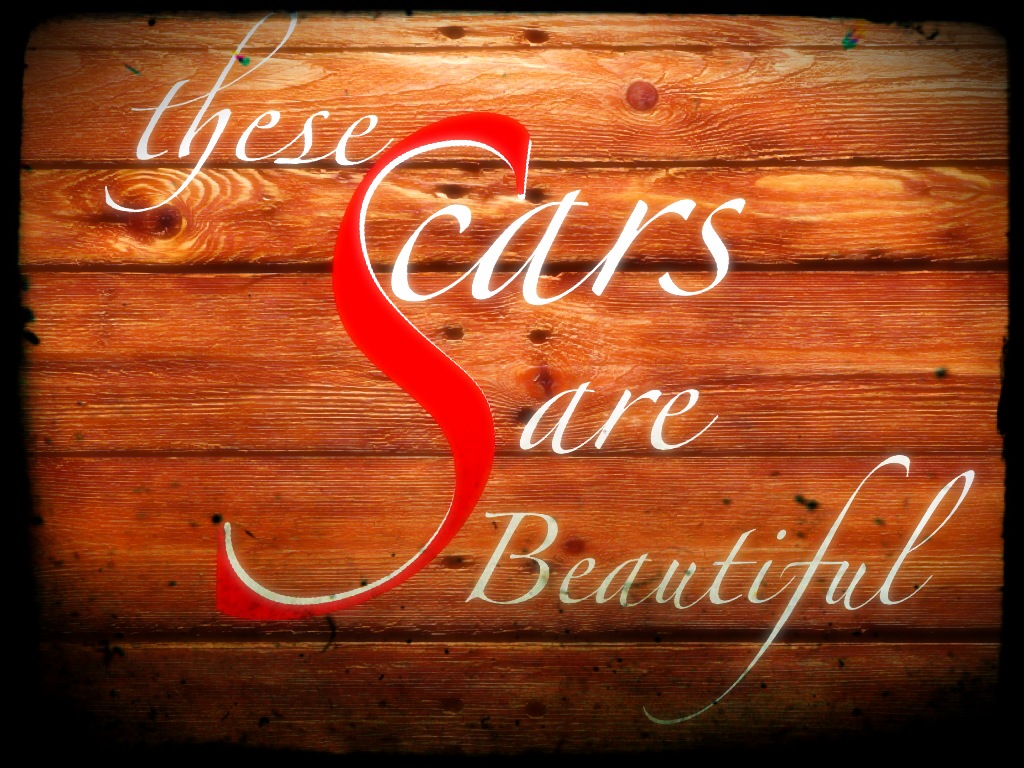
These scars are beautiful!

Image

When I was a young boy I received a bicycle for Christmas, it was blue.  I rode that bike all over the place.  I loved that bike.  There is something freeing about those moments as a young kid riding a bike around town and facing new adventures with that new found freedom.  That freedom took me to the scene of my accident…that sounds more dramatic than it really was.  I fell off of my bike and in the process I gashed my knee open.  The “accident” wasn’t very traumatic or memorable with the exception that there was a lot of blood localized around a cut on my knee.  Upon further review I probably should have had stitches but it was bandaged and wrapped and slowly it healed.  In the healing process it itched, occasionally it burned, but over time it formed into a white lined scar right across my right kneecap.  It is still there to this day, though smaller just as that young boy was so long ago.  

We all have scars.  

Some scars are there to remind us of how foolish or negligent we’ve been in our lives while others were inflicted on us by an outside source.  Regardless of how they were formed they have become part of our identities now.  

Some scars though,  have not marked us on our bodies but rather our hearts and our minds through hurtful experiences inflicted by others around us.  These scars too are long lasting, some we carry with us to this very day and they mark us and are a part of our current identity.  

What kinds of scars do you have?  I would be willing to guess most of us carry with us both types of scars.  We have known the pain of physical afflictions and accidents which have left their marks on us, and we have also known the psychological and harming pain of scars of words slung our way and even the pain of losing a family member to death.  These scars cut us deep and leave their impression on us…sometimes for life.  

Can you recognize the beauty in your scars?   

We have lived.  We have not come through this life (thus far) unscathed.  We have experiences to share with others.  Wisdom to convey.   We have knowledge that we wouldn’t have possessed before earning (or falling victim to) these scars.  

Could I ever relate to a parent in mourning at the loss of their child?  No absolutely not.  I can empathize.  I can weep with them, but I cannot completely understand the heart-wrenching pain involved in that scar.   Although I cannot relate, other parents who have lost children along the way can share their wisdom and understanding during such a time of heart-wrecked agony.  These scars carry with them beauty.  Not because life is lost but because hope can be conveyed.  

I don’t wish to imply any of these scars are lovely when inflicted on us.  They burn.  They hurt…sometimes severely.  Sometimes they maim and disfigure us either physically or emotionally…but there is beauty on the other side of our healing.  There is knowledge and understanding…there is opportunity to relate with others and to help in their healing.  

From our scars to His…

Image
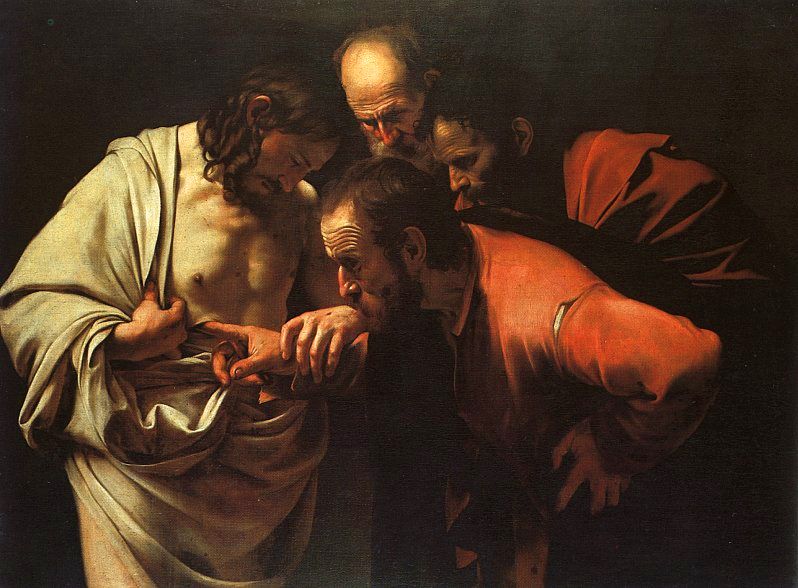
“The Incredulity of Saint Thomas” by Caravaggio

Jesus held out His hands towards Thomas.  We call him “doubting Thomas”…I think we all can relate to him.  Jesus had died.  He had suffered horribly.  His agony had been witnessed, and there was no way to come back from that.  How could the other disciples say Jesus was now alive again?  How could they make Thomas’ soon to be scar in his heart hurt any more?  It was like salt on a fresh wound.  And so He doubted their accounts of a risen teacher.  He vehemently drew the line and was unwilling to cross it until (as if it would ever happen) He physically touched Jesus’ wounded body.  So the scars came to Thomas.  The wounded hands and feet of Jesus suddenly appeared to the disciples in a hide out along with the rest of their Savior.  He stood before them and Thomas had to place his hands into those nail scared hands and a spear pierced side…then He believed.  

Scars are beautiful…

I don’t mean to say that in a masochistic sort of way or idle fascination in pain and maiming, I mean that in relational love and experience.  Thomas placed his inexperienced hands in the nail scarred hands of the Savior and was forever changed.  Jesus knew what it was like to suffer.  Jesus knew what it was like to carry these scars with Him…and His beauty marked the hearts and left a sacred scar on His disciples.  

What was meant to be evil and  damaging in totality had become beautiful and life-giving.  What was meant to destroy and cruelly maim had become healing and salvation to all the world.  These scars are beautiful!  

Do you have scars like these that you can share with the world around you?  These are the scars of experience and understanding.  These are the sacred scars of healing and restoration.  These scars say “I understand and I can relate to what you are going through!”  God doesn’t bring these scars upon us, but He can bring something marvelous out of our trials and experiences.  The damaging things that this life and even Satan himself can throw at us God can turn into victories.  

The scars of a recovering alcoholic who has beaten the odds and stayed sober can lead other alcoholics to find Hope.  The scars of an abused woman who has turned her life around and escaped that wounding lifestyle of physical abuse can bring hope to another woman who is still stuck and imprisoned in that life of hell.  

Do you have scars?  
Can you bring hope?  
Do you have a story to share with one who needs to hear it?  
There is victory in the scars.  
There is hope in the nail scarred hands of a Savior who understands.  

These scars are beautiful!  

Image 

Is Salvation important…to the Church?

Image


Sometimes I think the church is more concerned about competition than it is about people.
It strikes me that many churches spend a lot of money on “church-growth” seminars and guest speakers and even other resources just to increase their Sunday attendances.  I doubt many pastors are like this, but at times there is this perception that the more people a church can attract the more in tithes and offerings they will receive.  

I feel it vital, for we who are church members and fellow sojourners of Christ, to stop the comparisons and the rivalries.  What is the purpose of such folly?  Are we fulfilling the great commission when we look across the street and the other church and covet what they have?  Are we really reaching the lost and hurting in our world when we mock or slam other churches and denominations?  Granted there is a time and place for theological conversations, but our unloving actions have a way of destroying any good we might do.  

Fellow believers in Christ, how vital do you consider the salvation of others to be?  This isn’t a question about how big or small your (our) church is, this is a question about your (our) mission and your (our) priorities.  Sometimes we cloudy the already murky waters of what we do and make excuses for our busy-ness when the #1 priority is to, through the Holy Spirit’s power, help save lost souls.  If what we are doing does in no way impact the potential salvation of the lost then, perhaps, we must once again re-align our priorities.  

I offer you two solutions to assist in the realignment of mission:

 1.  Stop Coveting what you do not have!  

1 Corinthians 12:12 – “Just as a body, though one, has many parts, but all its many parts form one body, so it is with Christ.

We need to get back to work!  Just because another church is having success doing one thing really well, doesn’t mean that we have to stop what we are doing and adopt their mission.  Perhaps they are fulfilling their “part of the body” and we need to put our heads down and stop coveting what they are doing!  Our mission and effective tools, given by the Holy Spirit, might be something completely different than theirs.  We don’t need to have an identity crisis over this, we have to move on and prayerfully and humbly do as He (the Holy Spirit) prompts us to.  We may never look like that mega-church down the street, but was that supposed to be our “model” for Holy Living in the first place?  NO!  Jesus should never be replaced with out covetous longings to be someone else.  He has created us very differently and uniquely!  So with that in mind we need to stop the comparisons and sometimes the jealousy…get on with it!   

2.  Start using what you do have!  

1 Corinthians 12:4-6 – There are different kinds of gifts, but the same Spirit distributes them. There are different kinds of service, but the same Lord. There are different kinds of working, but in all of them and in everyone it is the same God at work.

The Holy Spirit distributes the gifts and dare I say even the passion to fulfill our mission of Salvation to the lost.  So we must be willing to use what He has given us to use.  We must stop with our identity crisis and get on with the full utilization of the spiritual gifts the Holy Spirit wishes us to employ!  He provides what we need, so we have to work within our giftings and abilities!  Every one of us is vital to the body of Christ.  It matter little if we serve in a small church or big church.  The message has to be the same though the gifts might often differ.  

Is Salvation important to you?  

If the answer is “yes” then we need to put aside our jealousy and our frustrations.  We may even have to go before the Father and ask for forgiveness because of our covetous ways.  The church was never intended to be some sort of statistical competitive success drive, but rather a mission of love, compassion and grace who willingly went to the orphans, widows, the poor and hurting and those who were seeking.  We are still that today?  Can we put aside our ridiculous worldly desire for statistical successes and instead focus on the vital nature of the great commission and disciple making?  

Perhaps it’s time for a readjustment of our motives and our missions.  Perhaps it’s time to get back on our knees and allow the Holy Spirit to reignite our wandering hearts.  Perhaps it is time to stop relying on our “church-self help books & seminars” (sometimes they work) and start relying more on the leading of the Holy Spirit in our churches and in our hearts.  There is not some “quick” method to salvation…it begins in relationship, love and fellowship.  So, without further adieu, let’s get on with it!  

Image


Blog at WordPress.com.

Up ↑