

Last year (2016), General Cox set forth an initiative called Journey of Renewal.
This initiative has been created to encourage, grow, and tackle many of the struggles our Army faces today. In some countries in recent years there have been horrific criminal events that have taken place, and in some regards this is the Army’s response as a preventative measure for the present and future.
I am greatly encouraged by this initiative, and see the possibilities of being truly transparent…but please afford me a small measure of cynicism too. I am hopeful, yet I am unsure if this can, or will actually work. (I really, really hope it does!)
I want transparency and accountability for all leadership. 
I believe that this is not only biblical, it is also ethical.
Yet, I am unsure how this will be done from every level, when the accountability of all leadership is not currently in place yet. Sure, there are the yearly reviews and the audits and so on, but how does one thoroughly weigh the performance of Army personnel from afar?
We must tread carefully as we throw the word accountability around, because, as this initiative states, we must have proof with facts and not just rumors. Accusations and rumors can destroy leaders from every level if wrongfully accused, this we must be mindful of. On the same token, our accountability of leadership MUST encompass every level of authority from the top down. We cannot have true accountability until every rank, position and appointment are held to the same level. We cannot sweep things under the rug for one and enforce disciplinary measures for another.
We also should recognize that every level of leadership is fallible and is sometimes subject to making mistakes. A level of grace must be given while these measures of accountability are kept. Without grace, all of us fall short of the glory of God!
Please allow me to quote a portion of this initiative from General Cox:

“Being open and transparent.
The Accountability Movement encourages people to be more open and transparent. Leaders should not ask ‘why do they need to know?’ but rather enable an open, transparent culture of ‘why shouldn’t people be told?’
Salvation Army leaders at all levels should encourage people to think, discuss and debate how the Army can be more effective, efficient and faithful in doing God’s will in our communities.
Mutual respect and truth.
There must be a culture of mutual respect and truth-telling between Army leaders and those under their command. Developing this culture means that if leaders or followers behave badly there must be consequences. The General has made it clear that everyone needs to be held to account – but fairly.
The practice of complaining secretly or writing anonymous letters has to end. A new accountability culture will require effective processes to address the concerns of whistle-blowers – but allegations must be backed up with facts, not rumours.” http://accountability.salvationarmy.org/
I must tell you the portion that I am most wary of: “complaining of secretly or writing anonymous letters has to end…” I understand that there have been many forms of accusation in various places around the Army world, some legitimate while others slanderous and maliciously false. One of the causes of such a practice in our army (letter writing and secretly complaining) is that there is a very real fear of reprisals or punishment for those who would cry foul, and the fear is this punishment will be handed out by leaders in authority. Perhaps an officer has complained about leadership, and so without any investigation, that officer is either directly dealt with or sent to a punishment appointment in the hopes that they will then resign and then the “problem” officer is gone. Our Army is very good at holding our cards tightly to our chest. We are not very good at transparency, although at times we talk a good game…much improvement needs to take place in order to actually be transparent, and I think General Cox is right in talking about this and starting this initiative.
With that being said though, if transparency is to be fully realized there must be a level playing field for all Officers and soldiers (which I really hope this initiative produces). Some people in our Army do not have any way in which they can safely respond to improper use of authority and maltreatment. Where does a soldier go to report the misuse of authority by their Corps Officer? Where does a Corps Officer go to report the misuse of authority by their Divisional Officer? The list goes on. Who will really listen to them and actually take them seriously and look into it? And if something is found, will anything really be done unless it becomes a legal issue?

Please do not misunderstand me, I am not advocating any kind of witch-hunt in our Army by any means, all I am inferring is that everyone who holds a shred of authority from the General on down to the local officer in a corps should be held accountable in the same way. Yes, the level of responsibility is different, but everyone should be striving for the same goal: Christ-likeness and Kingdom building. If another ambition or goal has been improperly submitted, then hold that person accountable and measure the fruit that each produces.
“ new accountability culture will require effective processes to address the concerns of whistle-blowers”
I am very curious to know what “effective processes” actually means?
Dear Salvation Army, if you want to be truly transparent, then these effective processes will be explained in greater detail in the near future. I am encouraged by this initiative “Journey of Renewal”! I see great things taking place if this is followed through with. If we want to see real change and renewal in our Army, we must make the hard decisions; we must confront sin issues and deal with them, but we must also do it with grace and love. We have to take responsibility for our actions from the top down and the bottom up! No one is more important than the next, and if we are leaders, we must be servants first.
Please pray for your leaders, the greater the responsibility of leadership one assumes the more temptation there is, and they face a lot more pressure as well.
May we hold each other accountable for no other purpose than to see lives transformed by the renewing power of the Holy Spirit and to witness the lost being found by a mighty, mighty God!
Something more for the Army world to ponder today!
Tell us what you think! Do you think this new initiative will work? How can we make it work in our community/ministry? How are you already doing “accountability” in your appointment, corps, ministry?
Leave your comments, questions and thoughts below.
Thanks!

Disclaimer: “The thoughts and opinions written here are the writer’s and not necessarily that of The Salvation Army’s, reader discretion is advised.”
 As someone once pointed out everything is spiritual, there should be no compartmentalizing of our various tasks and that of holistic ministry. I know a financial planner in our community who makes a point of praying for every client that comes to visit him. He has even prayed with me there in his office. These prayers that he offers are not pithy cliche prayers either, but one can feel the presence of God while he prays for you and the present circumstances that you are facing. He considers his office not only the place he draws his paycheck from, but a chapel in which he ministers. Perhaps we have not made our officers our chapels of ministry. Perhaps we get so bogged down by what is required of us that we forget to include God in those spaces in order to make them sacred. Everything we do from the most mundane of things to the most important things ought to be considered ministry – not some laborious task to get accomplished.
 When we pray for each segment of our officership and appointment, we will find that our hearts are attuned to the moving of the Holy Spirit. If everything we do is spiritual, then why do not pray in such a way? When we intentionally pray and make this a spiritual discipline we will be better equipped to make the necessary plans that our ministries so desperately need.
  Don’t stumble into your day or week having now idea what you wish to accomplish. Don’t wait until the last minute to pray for our congregation and those you minister to. Keep them in the forefront of what you are doing, after all, the paperwork and reports are all because they are vitally important to you and to God. Do not make haphazard plans at the last minute, throwing things together and hoping they all pan out…do yourself a favor and your soldiers a favor and make intentional, prayerful plans that will form and shape lives for Christ.
 I catch myself doing this, and I recognize my own conviction here:
 emphasis on the “important stuff” that consumes all of your time. I would imagine nearly 99% of us officers are guilty of this at one time or another. Show up and be present. Ask God to give you His eyes to see the needs around you. Spend time drinking coffee (or tea or water) with those who frequent your soup kitchen. Invest yourselves in the lives of people and do not stop with those who wear our uniform and within whom we already know. Step out of your comfort zone and be available to listen, serve and love.
 This step goes hand in hand with #3.
 I cannot stress how important it is for leaders of all positions to listen to those who are actively engaged on the ground in the fight!
 We cannot afford to have polarizing visions when we should all be seeking to remain mission minded and focused. There’s no time for that! Leaders who listen and then lead have a better chance at successfully navigating and accomplishing their objectives in mission! If leaders only dictate from their offices that are tucked away from mission we will fail because administration can only meet mission when it has its ear to the ground and a heart to serve in the capacity of servant-leader. Enough with the old guard of “my way or the highway” brass! Yes be strict on mission-mindedness but compassionate on leading and shepherding! Be a shepherd first and listen!

 I think sometimes what keeps us in our bubbles is the fear of what leadership might do if we try new things that don’t necessarily “look Army”. Is there fear of reprisal and punishment for not maintaining the status quo? Perhaps it’s time to pop the bubble!







 At the other end of the spectrum is the ignoring and tolerance of sin issues in your corps. Be mindful that we are not the judge of our world, but we do hold a high standard for our fellow brothers and sister in Christ who wear this uniform. This almost seems to be in complete conflict with the first point, but it is not. Galatians 6:1 clearly reminds us as it did in Paul’s day – “Brothers and sisters, if someone is caught in a sin, you who live by the Spirit should restore that person gently. But watch yourselves, or you also may be tempted.”
 Officer(s). Yes, they have had training, yes they are leaders, but they cannot lead properly without the core leaders to help them. A shared vision and delegated group will be better equipped to handle opportunities and threats that come to your corps and community. If you don’t currently have core leaders, begin by praying and asking God to reveal potential leaders to you. Prayer is never a last resort, but a constant conversation. Don’t limit your search to just the older members, the younger generations will eventually replace us at some point, so begin to invest in them. Begin to disciple them, and display for them what leadership is all about! Gather one or two influential people with common sense to help you in your corps. Remember, that we are an egalitarian movement – both men and women are equal, so do not limit your leadership search to just men or just women. Without a core group of leaders, the vision and movement will be limited.
 and what we do as a corps, that we begin to have no need for the “outside world”. We stop looking out into our community and we become self-reliant and self-focused. In this danger, what happens when our congregation gets old and dies? Will there be youth to raise up and take our place? Will be just be a group of inbred soldiers? I don’t mean to sound crass, but the reality is, we need to stop being afraid of our communities. We need to stop treating the people outside our buildings as “those people” with a sense of superiority. We must squelch the desire to just remain in our buildings and selfishly focus on “us”. What about the great commission? What are we fighting for if we only fight for ourselves and our traditions and self-interests? If we are all-in and inwardly focused, we will slowly die away…and no one will care when we’re gone.
 This is probably a rare thing, but perhaps not. Perhaps there are some corps that have so many services to the community that worship and all things “Spiritual” are an after thought, and then you come to Sunday and it just becomes a “thing we do”. We focus all of our energies on the outside, on meeting human needs but we seldom meet those needs “in HIS name” anymore. We might as well be just another social service agency or a humanitarian group, because we will have forgotten our first love and the “body” will be just bits and pieces pulled and stretched so thin that it doesn’t resemble Christ any longer.
 vision and goal because “they have been set, and we don’t alter these goals”. Goals should never be so rigid that there is no looking back and re-evaluating what works and what does not work, whether it be in evangelism, discipleship, or corps fellowship growth strategies. Remember what worked 100 years ago, might not necessarily be the best method to use in an ever evolving culture. Not to say we adopt our culture, but we ought to consider what works and what does not work any longer and not be so rigid that we refuse to ever change how we plan and how we enact a strategy in our corps. Rigidity can kill your corps, and stifle any potential growth you might see.
 If you corps does not understand Holiness, and or it is never preached on spoken of, perhaps this might be an indicator of a terminal issue. I am not saying that holiness is the end-all be-all of the corps, but what do you do with Salvation after receiving it? Where does one go after initial sanctification? Does the Holy Spirit still desire to transform us through and through? Does He not want us to be the very reflection of Christ? Yes. There needs to be continual conversation about our surrendered life and how that looks in the real world.
 emulating elders we respect, this is becoming more than who we are now. Walking in the footsteps of saints and in so doing, we too become saints within this great army. If your corps does not have this vital element, closely connected to holiness, you could be facing extinction. Recognize this need, and do something!!
 to be in the bygone days. We can rest comfortably on financial resources and riches we have been given from various places, and never take another risk again…and if we do this, we. will. die. I cannot stress it enough, in order for God to change our Army, we have to become uncomfortable again. We have to take risks and forget what the rules and regulations say. We have to close dead corps, move to places of need without bureaucratic red tape hamstringing us along the way. We have to get out of our pews and put feet to our professed faith. It’s either put up or shut-up. Seriously, we can talk a good game, but if we can’t back it up, then hung it up and quit already. We don’t need fans in the stands not doing the work. We don’t need complainers and criticizers telling it us it can’t be done – because the risk is too great. If we don’t do something, we might as well put our corps on life-support right now. There is a sad trend that is taking place in our corps around the USA, and our corps are not statistically growing anymore. We are not busting out of our corps buildings anymore. Yes, perhaps it’s across the board in all denominations, but could it be that we are so comfortable now that we have stopped ACTUALLY trying to reach our communities? Could this be an entire systemic issue of spiritual laziness? Forgive me if I offend you today, I can’t help but feel alarmed at how swiftly our corps are dying. And I can’t help but wonder what the next 50 years will hold for this movement? If we do nothing, we will not be here in 50 years…not like we have been, not like we should be…and then perhaps, Lord forbid, God raises up someone else to do what we should have been doing.


 Marching On…
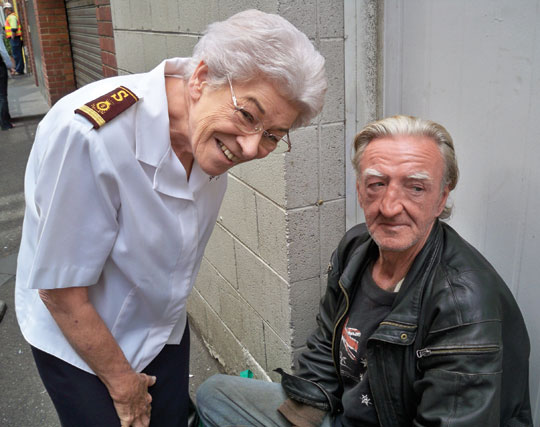
 if you join these ranks as soldiers for any other purpose than to be servants of God and servants of man, then we have joined for all the wrong reasons. The uniform, and all it represents, is a symbolic representation of a sacrificial life. We are taking a stand against sin and death in this world. We are standing with the marginalized. We are pushing to end human slavery in our world. We are striving to end the blight of human trafficking. We are fighting for the homeless, the destitute the helpless, the hurting, the lost. When we put on our uniforms and say we are soldiers, we are saying that our identities are no longer individual, but we are united with Christ to bring His love into some very loveless places of our world. When we say we are soldiers, it means we are saved to serve, and we are saved to save.
 It’s more than just a uniform.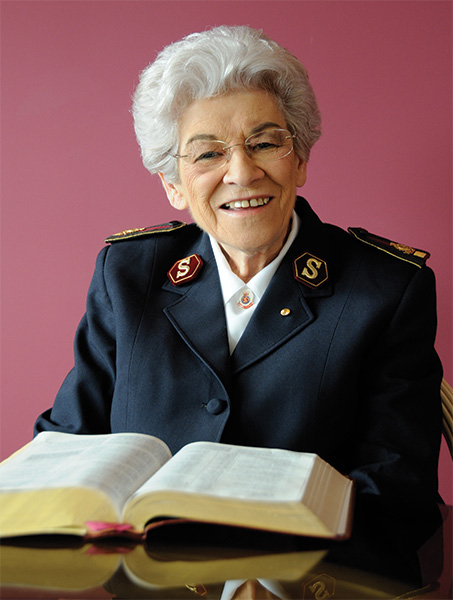
 Pastor's Ponderings