Blog

Joy & Hope…Retrain the Brain.

Image

Two simple words.  Yet all too the often these words fail to connect with humanity.  All too often hate and sorrow are life’s constant companion.  All too often if joy is captured at all it is but a brief glimpse, a blink of the eye…and then it’s gone.

How can we capture and experience true joy and hope?  How can life become so much more potent and alive?  It begins with a climb up a sheer rock face.  Not a real climb mind you, but a journey within one’s thoughts and attitudes.  This climb takes us from where we are to a place above in which we train our minds and prepare our thoughts.  Where we change the thought patterns within our lives and attempt to see life around us as we have never seen it before.

This isn’t some new age philosophy here either.  We aren’t attempting to reach within ourselves, and recognizing our bad habits within our own thoughts.  We face the blatant behaviors and poor choices.  We confront the darkness that resides within our minds.  This is the place where hatred, selfishness, sadness, and greed reside.  Our minds truly are a battle field.  We wage a war that is mostly unseen.  It may sound mystical but in reality where do our actions come from?  -Our thoughts.  Where do those choices come from which hurt others, hurt ourselves and lead us into deeper alleys of sadness?  -Our thoughts.

What would happen, if we could change this pattern of thinking?  What would happen if we could redirect our thinking and what we think on?  What would happen is that we could begin to experience joy and hope not just in mere fragments but in every instance.

So how do we do this?  How do we capture our thoughts and conquer these dark patterns?

1. Seek Guidance:

Understand that we have been created by God and that His fellowship with us can and will change and transform us.  This isn’t some sort of dogma we chant or words we use to line up the masses all straight and uniform in organized religion either.  This is a very personal and intimate relationship that God desires from each of us.  When He sent His one and only Son to die for our sins He made a way for that relationship to be restored once and for all.  So when we confess our dark patterns to Him and accept His Son, Jesus Christ as Lord of our lives we are accepting a better path.

This relationship offers guidance to a better way of living too.  Do you know that followers of Jesus were once called ‘followers of The Way’?  This is truth for us today.  Because Jesus offers us a better way to live.  One that frees us from the bondages of sin and those dark patterns of thinking.

His guidance is available to us and is truly the only way by which we can truly conquer the unhealthy and dark patterns of thinking.  We begin this climb by asking for God’s guidance through prayer and supplication.  But don’t stop with just your words speaking repetitions and utterances…listen.

2. Listening:

Part of the conversation with anyone and even God is not only talking but listening.  This is where instruction and guidance can begin.  We need to prostrate ourselves before God and be available to listen…simply listen.  How else are we to hear from God if we do all of the talking?  Psalm 46:10 says “Be still and know that I am God…” Be still…we are to stop and listen, to be still and hear.  Listening takes patience, silence from distractions and tuning into what God is saying to us.  This act is truly an act of personal worship in a very intimate setting.  It’s not some mystical mumbo jumbo that we do.  You may not audibly hear God speak to you, but within our hearts resides his voice…within our soul He longs to permanently take up reside.  He will speak to us in moments of silence and in moments of deep devotion.  But all too often we are so distracted by the world around us that we hardly tune in to hear what he would say to us.

3. Meditate:

Not in some Eastern philosophy sense, but rather meditate on the very words of God.  By that I mean read His words written for us in the Bible.  Study it.  Read the red letters of Jesus in the synoptic gospels.  Read what Paul instructs the early churches to do.  Understand what James has to say about the tongue in His book.  Study the Bible, don’t approach it as some task or arduous homework assignment either.  Do it out of love and devotion to God and the longing to live a healthier, holier life-style.

4.  Discipline yourself:

Not by flogging yourself or punishing the flesh, by any means…but by being disciplined in your daily routines and attitudes.  Be serious about wanting this joy and hope in your life.  When we seek His guidance and listen to His voice we begin to find peace and understanding.  We begin to want to spend more time with Him.  For some five minutes in prayer is very difficult, but if we discipline ourselves in regards to prayer we will slowly begin to find five minutes isn’t nearly enough time to talk with God.

2 Corinthians 10:5b says, “…we take captive every thought to make it obedient to Christ.” We we can make this climb out of our dark patterns of thought through God’s help, we will begin to understand this verse.  We can truly experience pure joy and hope because we have, through the power of the Holy Spirit, taken captive of every thought.  And we are in turn thinking within the realms of Joy and Hope.

Does this seem far fetched to you?  I hope it doesn’t because God does not want us to reside any longer in the darkness of our minds, but He wants us to surrender every nook and cranny of our body, soul and mind to Him.  When we are or have done so little by little we can begin to experience this joy and hope in every moment of our lives.

Officership: A Calling For a Lifetime?

Image

Some officers have struggled with this.  Some officers haven’t.  I have heard some argue about the lifetime calling while others argue the calling ‘for a season’.  I would like to outline both arguments in this article.  My purpose for this? To help clarify, not further muddy the waters.  To shed light on both contentions and for the reader to draw their own conclusion.

So what is the calling of The Salvation Army officer?  Do we deem it sacred?  Is this calling infallible?  Or do people make mistakes from time to time?

First let’s explore the Officer Covenant:

ImageWhat is a Covenant?

In the Bible covenants were made by God to people.  They were also made by people to God.  And lastly covenants could also be made from one person to another.  A covenant is simply a promise or an agreement, something that could be deemed as binding.

So when one enters into a covenant with God this person is making a promise to do or abstain from something.  With the definition of covenant being given, let’s now explore the two main arguments that are prevalent in our Army today.
Image

Argument #1

The Covenant  an Officer makes to God is for life!

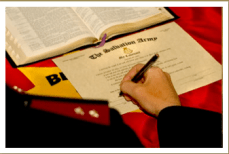
I have heard it said that within this calling, a Salvation Army Officer enters this covenant which is sacred.  What makes it sacred?  Certainly not a simple piece of paper with writing printed upon its surface?  Of course not!  There is, at the end of an Officer’s time at training college, a time of commitment made to God before their peers, the training staff and sometimes the territorial commander.  When the soon to be newly commissioned officer sign this covenant page, they are declaring and affirming their calling to serve the Lord in the capacity of Officership.  What is said about this signing by many, if not most, within leadership that it is a solemn declaration that is for a lifetime.

The argument has sometimes been taken to mean that should an Officer resign later on they have broken their covenant with God.  I have heard stories of Officers who have left the work that were told that they had sinned against God for leaving the work and breaking their ‘Officer’s Covenant’.  The Argument seems valid, yet could be construed as far too legalistic in nature.  Who are we as fallible people to claim that another person has turned their backs on God?

There is a need for accountability and a standard to uphold, however this argument presents a challenge in that how do we uphold this perspective as individuals?  In the legal sense should the terms we use be more clear?  legally speaking what does ‘all my days’ mean?  Is it ‘all my days’ that I’m an Officer?  Or are we to take it to mean ‘all my days’ of life that God has allotted me?

I know this sounds superficial but some could interpret this Officers covenant to mean one of two things.  So is this Covenant we sign for a lifetime or for a season?

Which brings me to the second argument:

Argument #2

The Covenant  an Officer makes to God is for a season!

Some would express that within the Officer Covenant there is adequate enough verbiage to  interpret what we sign as a calling ‘for a time.’  This isn’t generally how most view the covenant, however this is a part of argument #2 and its justification.

Do we truly sign our lives away so to speak and in an instant we no longer have independence in terms of where we will stay and where we will go?  Obviously when one becomes an Officer it isn’t because we are hugely overpaid, nor because we feel inclined to become stylishly dressed in uniform.  It is because we wish to serve the Lord and serve others through the means of Officership within the structure of The Army.

But does this necessarily mean that it is for life?  Obviously Officers don’t view it as some sort of prison sentence and we plod on serving 20 to Life.  But what happens should God call one who is an Officer to something else?  Have they broken their Covenant with God or has God simply used the means of man to adjust that covenant into a newer and different territory?

 Furthermore we shouldn’t presume that the workings of man are necessarily the working or the will of God in every instance.  For in our holiness tradition we are taught that through the continued promptings of the Holy Spirit we look less and less like our old sinful self (old has gone, new has come) and more and more the image of Christ.  In so doing we mature in our faith, could it be that in this maturity some have felt compelled to take a greater leap outside of the Army?  I’m not arguing for all who have left, but some appear to have taken this leap.

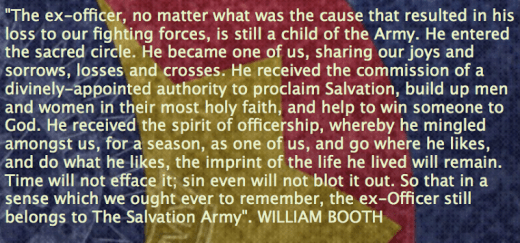
Lastly on this argument looking back at the context of our Founders, William Booth specifically was quite militant in his view of Officership.  Even his own children who had served within its ranks for a time then leaving were considered ‘deserters’ to the cause.  This paints for many this notion that William Booth propelled and enforced our understanding of this Officers Covenant.
Image

Grace, Prayer & Holiness:

One wonders where grace falls within the Army at times.  When some leaders, a minority mind you, have condemned those who have left the work as traitors and sinners.   Grace rises above such lowly expressions.  We too ought to reflect and pray on how we minister to one another within this army.  How we treat one another, while at the same time reminding each other to live holy lives and continued prayer and devotion.

We are in the business of saving souls, but the saving of souls isn’t done solely by uniforms and ranks and officials…it is done first and foremost by the blood of Christ and secondly the workings of the Holy Spirit.  May we ever be diligent in this fight that we do not ostracize those who have, for whatever reason personal or otherwise, left this calling of Officership.  That we continue to live worthy lives before God first and foremost and that we live within that grace instead of condemnation and militant rules and stiff regulations.

Standards are important, leadership is vital, but grace is often the shepherd loving the sheep and gently and allowing growth to take place out of love instead of might and fist.

Home Sweet Home

Image

It’s interesting when you see these hanging in homes.  For most it’s a sentiment that evokes  love, acceptance, peace, somewhere to not only hang your hat but to rest.  These signs are a dime a dozen in tourist shops and craft stores…trust me I’ve been to many of both.  But the real sentiment which is relayed in these wall hangings can be found within our searching can’t it?  We automatically identify places that are not home to us.  Perhaps its in the decor of a place, or in the beds we sleep in, or in the company we find ourselves in.  But in our searching we can identify where home is and where home isn’t.

Similarly this should be the case in our spiritual relationships.  If we are familiar with our Eternal Father in heaven we can quickly identify where He does not reside.  And if we are tempted and go to these places we will continue to feel ‘away from home’ in them.  Isn’t it interesting that the places we call home don’t just make up things or tangible surrounds?  The reasons we call certain places ‘home’ is because of a heart-attachment.  By that I mean we are emotionally, historically, and internally attached to a certain place because ‘this is where I’m from!’.   Do you see the context here?  It’s not four walls of some building that makes a place home, it’s an attachment to us that goes beyond the physical realms.

Similarly in our searching we find ourselves asking ‘big questions’.  Questions like ‘who made me?‘ or ‘Are we alone in the universe?’, ‘is there a God?‘, ‘Can I really believe what the Bible says?‘.  You see we are all searching in some way, shape, or form for home.  Ever since Adam and Eve initially were expelled from the garden of Eden we have been in search of home.  Something within us is missing.  A crucial life component that makes us whole again.

It’s like working so hard on a thousand piece puzzle and coming to the end of it and discovering you are missing one vital piece of the puzzle.  Without that one piece, the puzzle is incomplete.

Intrinsically we are created in God’s image, yet because of this fall into sin, our image of God in us is severely marred…we are missing a piece from within us.  This is what A.W. Tozer said on this subject:

“Before the Lord God made man upon the earth He first prepared for him a world of useful and pleasant things for his sustenance and delight.  In the Genesis account of the creation these are called simply “things.”  They were made for man’s use, but they were meant always to be external to the man and subservient to him.  In the deep heart of man was a shrine where none but God was worthy to come.  Within him was God; without, a thousand gifts which God had showered upon him.  But sin has introduced complications and has made those very gifts of God a potential source of ruin to the soul.  

Our woes began when God was forced out of His central shrine and the things were allowed to enter.  Within the human heart things have taken over.  Men have now by nature no peace within their hearts, for God is crowned there no longer, but there in the moral dusk stubborn and aggressive usurpers fight among themselves for first place on the throne.  

This is not a mere metaphor, but an accurate analysis of our real spiritual trouble.”

Do you see now why we are still in search for home?  As Tozer puts it, the sacred shrine within us that housed God has been replaced with the external things of this world.  We have settled for the creation instead of the Creator.  But sin is an utterly poor replacement for God.  It’s like calling a mildewed and molded shack with no roof ‘Home’…and settling for something far below what God could provide us.

Our search for home is probably the most ancient sentiment and emotional attachment to this now vacant shrine within us.  Everyone in all of creation has now been born with this longing to find home once again.  There is a spiritual ache within us.  And in order to be whole again we, like the prodigal son in Christ’s parable, have to come to our senses and return to Him.  He longs for us to choose Him.  When we consider the ‘slop’ we have put into our lives and within our ‘sacred shrines’ we cannot help but feel ashamed.

Yet Christ provides us this missing piece.  Our image, our relationship can be restored…we can find that peace, perfect peace of Home once more?  It can only be found at the foot of the cross.  May we stop seeking and starting looking to the One who desires to make us whole once again!

Image

  1. Abide with me; fast falls the eventide;
    The darkness deepens; Lord, with me abide;
    When other helpers fail and comforts flee,
    Help of the helpless, oh, abide with me.
  2. Swift to its close ebbs out life’s little day;
    Earth’s joys grow dim, its glories pass away;
    Change and decay in all around I see—
    O Thou who changest not, abide with me.
  3. I need Thy presence every passing hour;
    What but Thy grace can foil the tempter’s pow’r?
    Who, like Thyself, my guide and stay can be?
    Through cloud and sunshine, Lord, abide with me.
  4. I fear no foe, with Thee at hand to bless;
    Ills have no weight, and tears no bitterness;
    Where is death’s sting? Where, grave, thy victory?
    I triumph still, if Thou abide with me.
  5. Hold Thou Thy cross before my closing eyes;
    Shine through the gloom and point me to the skies;
    Heav’n’s morning breaks, and earth’s vain shadows flee;
    In life, in death, O Lord, abide with me.

Prayers before sleeping (poem)

Somewhere in the night
Dreams become elusive
Slipping past the fingers
Lingering only just out of reach.
We tame our tongues
With teas that help us sleep
And yet our minds race
Knocking down reason
Regardless of the seasons
We lay awake on our backs
Staring into the blackened sky.
If it were but a simpler life
Ah, but too simple these idle hands
Would ne’er be truly satisfied
Knowing apart is laying dormant
Would come full circle.
No! But in the darkness
In the creaks and groans
I find the break to pray
Silence beckons these lips
To utter and these ears
To listen…ever seeking
To become more in tune
With His still small voice
Even in such a sleepless night as this.

Blog at WordPress.com.

Up ↑