
The Upper Room Door Buster

Hey friends,
it’s Scott, sitting here in an old office chair, it’s an old faux-leather thing that smells faintly of wood polish and long days or burning the candle at both ends. Outside of my window, there’s an old maple that’s bleeding out its last furious red, each leaf a small, slow-motion fire spiraling down to the ground like it’s trying to write something on the earth before it dies.


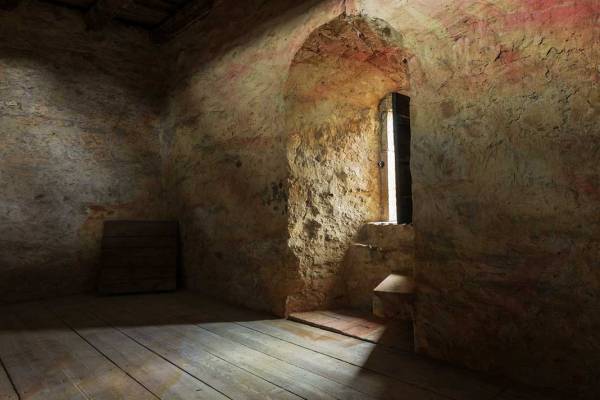
I can’t stop thinking about that upper room (John 20). The air was thick with terror and unshed tears. They too had probably been burning their candles at both ends. The disciples are all bolted in that musty room, breathing shallow, convinced the story just ended in a splatter of blood and a borrowed tomb.

Then the impossible.
He’s there.

Not a ghost.
Not a metaphor.
Flesh.
Breath.
Heartbeat.

And the first word out of the mouth that once called Lazarus out of the dark is the same word He offers them now: Peace.
But watch (watch close), because He doesn’t hide the damage. He lifts the robe, turns those once-ruined hands palm-up, lets the ragged light fall straight through the holes. The resurrection body still carries the crucifixion. The wounds didn’t get airbrushed out in some cosmic Photoshop.

They glow.

And I’m wrecked by this:
Maybe glory isn’t the absence of the scar but the scar set on fire by love.
I have scars that still throb when the weather turns. (Anyone else have old soccer knees and battle scars like me?)

You do too.
Places we were torn open and never quite sewn back the same.
Rooms we keep locked.
Stories we rehearse in the dark like a verdict.

But the Risen One walks straight through those locked doors, breath warm and steady, and says,
“Look. Touch. These are the places the nails went in… and these are the places the world will know it was love that held me there.”

The wounded hands are the ones flipping fish over coals at dawn, feeding men who swore they never knew Him.
The pierced side is the doorway He keeps inviting Thomas to reach into (doubt and all).
So maybe resurrection isn’t erasure.

Maybe it’s the wound transfigured, still telling the truth about Friday while singing the louder song of Sunday.
Maybe the cracks are where the light is planning its jailbreak.

So today, friend, open the fists you’ve been clenching around the shards.

Let Him breathe into the fractures.

Let Him turn the scar into a window.
Because the leaves are falling like grace, and the tree looks dead, but I’ve seen what happens in spring to wood that remembers it was once a cross.
The wounds remain.
The love remains more.
Grace & Peace be with you.
Really.

-Scott

Pouring Out, Lifting Up

(1 Samuel 1–2)

There’s a quiet power in Hannah’s story—one that speaks directly to anyone who has ever carried a burden silently, prayed a prayer desperately, or waited on God faithfully.

Hannah enters the narrative not with triumph but with tears. Year after year she bore the weight of unanswered longing. Yet what sets her apart isn’t simply her suffering, but her response. Scripture tells us that Hannah “stood up” (1 Sam. 1:9). That small, simple phrase marks a turning point. She rose from her place of discouragement and poured out her soul before the Lord with unguarded honesty.

No scripted prayer.
No polished language.
Just a heart laid bare before the God who listens.

And He did listen.

Hannah’s story reminds us that God is not moved by our performance—He is moved by our surrender. What she offered Him in tears, He returned in joy. What she released in prayer, He redeemed in His timing.

Then comes her song in 1 Samuel 2—bold, prophetic, overflowing with praise. Her voice, once choked with grief, becomes a testimony of God’s power to reverse circumstances:
“The Lord raises the poor from the dust… He lifts the needy from the ash heap.”

This is the rhythm of Hannah’s life, and often the rhythm of ours:
What we pour out before God, He is able to lift up in His grace.

For pastors, ministry leaders, and everyday believers, Hannah invites us into three timeless truths:

1. Honest prayer is holy prayer.
God meets us not in the prayers we think He wants, but in the ones that come from the unfiltered places of our hearts.

2. Waiting is not wasted.
Hannah didn’t see God’s silence as God’s absence. She stayed faithful, and God was quietly at work.

3. Worship is our witness.
Hannah’s song isn’t just gratitude—it’s testimony. It points beyond her blessing to the character of God Himself.

Perhaps today you’re carrying something heavy…
a decision, a fear, a disappointment, a prayer that feels unanswered.

Hannah’s story whispers to us:

“Stand up. Come before Him. Pour it out. God still lifts up what is surrendered to Him.”

May we learn from her courage to pray honestly, her faith to trust patiently, and her joy to praise boldly—believing that the God who lifted Hannah’s head is the same God who lifts ours.

Grace & Peace,
-Scott.

When Days Unravel (a poem)

When the day unravels
not in threads but in flames,
and everything I carefully stacked
topples without warning—
I forget how to hold myself together.
I forget how to breathe.

When trouble rises
like dark water creeping at my ankles,
when the walls feel too close
and every light in the room flickers out—
I whisper the smallest prayer,
and trust that You hear even that.

Prayer has never been my lifeboat of last resort.
It has always been the place
where I find myself again.
Where Your presence sits quietly beside me,
filling the gaps of my strength,
turning my trembling into victory,
again and again.

So here I am—
hands open,
releasing everything I was never meant to hold.
Letting the hurt escape on the exhale,
knowing You already understand
every sharp edge of my heart.

And tomorrow—
that wild, mysterious tomorrow—
belongs to You.
I’ll step into it
with trust as my footing,
and You leading me home.

-SStrissel 10/29/25

Cast It ALL (Psalm 55:22)

Hey there, beautiful souls, Pastor Scott here, sorry it’s been a minute.
I have a few minutes today and I’ve been reading this verse today just meditating on it and perhaps you’re sometimes like me with what seems to be the weight of the world on your shoulders. This verse has gives me hope, and I think it will do the same for you.

Today, let’s lean ponder this verse full of promise hope and assurance because it’s something that resonates with me and with the kind of truth that can shift the air around us all. Lets dig into that verse. It’s Psalm 55:22.

It says, “Cast your cares on the Lord, and he will sustain you; he will never let the righteous be shaken.
Let that sink in for a second. “Cast your cares.” Not toss them lightly like you’re skipping stones on a lake, but “cast” them—like a fisherman throwing a net, like you’re heaving something heavy into the arms of someone stronger. There’s weight to this word. There’s intention here. There’s a letting go that feels like both surrender and strength. Life, right? It’s heavy sometimes. You’ve got bills stacking up, relationships fraying or just plain falling apart, dreams that feel like they’re slipping through your fingers. Maybe you’re carrying grief that’s too big for words, or anxiety that wakes you up at 3 a.m. with a racing heart. And here’s David, the poet-king, the guy who’s been betrayed, chased, and undone, whispering to us across centuries: “Cast it. Give it to God. He’s got you.” What’s wild about this verse is that it’s not just a command—it’s a promise. God doesn’t just say, “Hand it over.” He says, “I’ll sustain you.” That word, “sustain”—it’s not about a quick fix or a pat on the back. It’s about being held up, carried, nourished, like a plant getting just the right amount of water and light to keep growing.

It’s God saying, “I see the weight you’re carrying, and I’m not going anywhere. I’ll hold you steady.” And then there’s that last bit: “He will never let the righteous be shaken.” Never. Not when the diagnosis comes, not when the job falls through, not when the world feels like it’s spinning out of control. The righteous—those who are chasing after God’s heart, who are trying, stumbling, and getting back up—aren’t promised a life without storms. But they’re promised a God who keeps them anchored through it all.

So, what’s the invitation here? It’s to stop clutching. To stop white-knuckling your worries like they’re yours to solve alone. What if you took that thing—the one that’s been keeping you up at night—and you just… let it go? Not because you’re giving up, but because you’re giving it “over”. You’re trusting that the God who made the stars, who knows every crack in your heart, is big enough to handle it. This isn’t about pretending everything’s fine. David, the guy who wrote this psalm, was in the middle of betrayal and chaos when he penned these words. He wasn’t floating on a cloud of good vibes. He was raw, real, and probably a little scared. But he knew something we often forget: God’s not afraid of our mess. He’s not asking us to clean it up before we come to Him. He’s saying, “Bring it. All of it. The fear, the doubt, the anger, the questions. I can take it.”

What would it look like to cast your cares today? Maybe it’s a prayer whispered in the car on your way to work. Maybe it’s writing down that thing you’re afraid to name and leaving it on the page, an offering of trust. Maybe it’s just sitting still for a minute and saying, “God, I don’t know how to let this go, but I’m trying.”

There’s freedom on the other side of casting. There’s a lightness, a steadiness, a knowing that you’re not alone. Because the God who sustains you? He’s not just powerful—He’s personal. He’s close. He’s got you, right here, right now, in the middle of whatever you’re facing. So, let’s ponder this together, friends. What’s the weight you’re carrying? What’s the care you need to cast? And what might happen if you trusted—really trusted—that God’s got you, that He’ll sustain you, that He won’t let you be shaken?

Questions to Chew On Today:

1. What’s one care you’re holding onto right now that feels too heavy to carry alone? What would it look like to cast it onto God?

2. When you hear “He will sustain you,” what does that stir in you?
Do you believe God can hold you up, even in the messiest parts of your life? Why or why not?

3. What’s one small step you can take today to let go of control and trust God with your worries?

4. How might your life feel different if you truly believed you wouldn’t be shaken, no matter what comes?

Keep pondering, keep casting, keep trusting.
You’re not alone in this.
-Grace and peace, Pastor Scott

One Last Cup

In the tender cradle of this morning,
we sit, you and I,
cupping the warmth of coffee mugs
as though they hold the pulse of the world.

Each sip is a quiet vow, a slow dance of steam curling upward,
weaving itself into the soft threads of dawn.
The sunlight spills, hesitant, through the window,
its golden tendrils catching dust motes in a fragile, glowing suspension—
a moment so delicate, it aches.

I want to gather this stillness,
press it between the pages of my heart like a flower too tender to bloom twice.
Your eyes meet mine, and the clink of our mugs is a language only we speak—
a hymn to the nectar that warms our throats, the divine quiet that wraps us whole.

The house holds its breath, the little monsters still lost in dreams,
their chaos tethered to sleep’s gentle leash.
This pot of coffee, dark and endless, is ours to drain,
each sip a rebellion against time’s relentless march.

But soon—too soon— the world will stir,
and we will don our armor once more,
stepping into the fray of grown-up things,
the weight of days that demand our courage.

Yet for now, my love, let us linger in this sacred pause.
One last cup, one last moment where silence is enough,
where you and I are enough.

Rooted and Resilient

So, Jeremiah 17:7-8. Let’s just sit with it for a minute, shall we?

But blessed is the one who trusts in the Lord, whose confidence is in him. They will be like a tree planted by the water that sends out its roots by the stream. It does not fear when heat comes; its leaves are always green. It has no worries in a year of drought nor ceases to yield fruit.”

You know, there’s something in us, isn’t there? This innate desire to be, well, unshakeable. To be that person who can weather any storm. To not just survive, but to thrive, even when everything around us feels like it’s drying up.

And here’s Jeremiah, pointing us to it. He’s not talking about some magic formula or a special incantation. He’s talking about trust. Simple, profound trust.

Think about that tree. Not just any tree, but a tree planted by the water. It’s not just getting a sprinkle every now and then; it’s rooted in the source. Its roots, they’re not just scratching the surface; they’re digging deep, reaching out, finding that constant flow.

And because of that deep connection, what happens?

“It does not fear when heat comes.”

That’s a big one, isn’t it? The heat comes for all of us. The pressure, the stress, the unexpected curveballs. The moments where you feel like you’re just wilting. But this tree? It doesn’t fear. Its leaves are always green. Think about that. Even when the world around it is parched, this tree is vibrant. It’s alive.

“It has no worries in a year of drought.”

Drought. We know drought. The times when everything feels scarce, when inspiration dries up, when relationships feel strained, when the bank account looks a little thin. Those long stretches where you just wonder if anything good will ever come again. But this tree? No worries. Because its roots are still doing their thing, silently, consistently, drawing from that underground source.

“Nor ceases to yield fruit.”

This is the kicker, right? Not only does it survive, not only does it stay green, but it continues to produce. Even in the lean times, it’s still giving. It’s still contributing. It’s still being what it was made to be.

So, what does this mean for us?

It’s an invitation, really. An invitation to examine where our roots are going. Are we trying to draw life from superficial things? From approval? From endless striving? From the fleeting highs of immediate gratification? Because those things, they dry up. They just do.

Or are we willing to dig deeper? To send our roots down into something more substantial? Into trust. Into a quiet, consistent confidence in the divine, in the very source of life itself.

It’s not about avoiding the heat or the drought. They’re going to come. But it’s about how we’re rooted in them. It’s about cultivating that deep, unwavering connection that allows us to not just endure, but to flourish. To stay green. To keep yielding fruit, even when the world around us is screaming for us to wilt.

So, where are your roots going today? Just something to ponder. Something to sit with. Maybe even something to dig into.
Grace & Peace,
-Pastor Scott.

Liminal Space – A Refilling of Grace.

Hey there, friend.
Let’s talk about liminal spaces. You know, those weird, in-between places where you’re not quite *here* anymore but not fully *there* yet either? Doorways, thresholds, moments where the veil between you and the divine feels so thin it’s like you could reach out and touch it. The Celts called these “thin places,” spots where heaven and earth brush up against each other, where you can almost hear the heartbeat of God. And I’m not just talking about physical places—though those are real too, like a quiet beach at dawn or that one pew in your church that just *feels* holy. I’m talking about those moments in life when you’re caught in transition, suspended, waiting, and something sacred sneaks in. Think about Moses at the burning bush in Exodus 3. He’s just out there, tending sheep, minding his own business, when *bam*—a bush is on fire but not burning up. God says, “Take off your sandals, for the place where you are standing is holy ground” (Exodus 3:5). That patch of desert wasn’t holy because of the dirt or the shrubbery. It was holy because God showed up in the in-between, in the ordinary, and Moses was paying attention. He stepped into a liminal space, a threshold where the eternal crashed into the everyday.

Or how about Jesus in the Garden of Gethsemane (Matthew 26:36-46)? He’s in this gut-wrenching moment, not quite at the cross but no longer just teaching and healing. He’s in the middle, sweating blood, wrestling with what’s coming. It’s a thin place, where his humanity and divinity are laid bare, where he’s crying out to God and the air feels electric with the weight of what’s about to happen.

Have you ever been in a moment like that?
Where you’re stuck between what was and what’s next, and God feels so close it’s almost too much? Liminal spaces aren’t always comfortable. They’re often disorienting, like standing in a doorway not sure if you’re coming or going. Think about the Israelites wandering in the wilderness for 40 years (Exodus 16-17). They’d left Egypt, but the Promised Land was still a dream. They were in-between, grumbling, doubting, yet God kept showing up—manna in the morning, water from a rock. Those desert years were a thin place, where they learned to trust, to lean into the mystery of a God who meets you in the messy middle. So here’s a question for you:

Where are the liminal spaces in your life right now?
Are you in a season of waiting—maybe for a job, a relationship, a diagnosis, or just some clarity? What if those in-between moments aren’t just empty gaps but holy ground, places where God is waiting to meet you? I mean, think about it: when you’re stuck in transition, when you don’t have all the answers, don’t you find yourself a little more open, a little more raw, a little more ready to hear that still, small voice? And here’s another thing to chew on: What if liminal spaces aren’t just about you finding God, but God finding you?

In Psalm 139:7-10, David says, “Where can I go from your Spirit? Where can I flee from your presence? If I go up to the heavens, you are there; if I make my bed in the depths, you are there.” There’s no in-between place where God isn’t already waiting. That jobless season, that heartbreak, that moment when you’re staring at the ceiling at 3 a.m.—those are thresholds, thin places where the divine is whispering, “I’m here.” So, what’s it look like to lean into these spaces? Maybe it’s pausing in the middle of your chaos to breathe and say, “God, show me where you are in this.” Maybe it’s noticing the ordinary moments—a sunrise, a conversation, a quiet walk—and asking, “Is this holy ground?” What if you stopped rushing through the in-between to get to the “next thing” and instead let yourself linger, let yourself listen?

Here’s one more question to sit with: What’s keeping you from seeing the thin places in your life?
Is it fear? Distraction? The need to have it all figured out? What if you let go of that for a moment and just stood still, like Moses, sandals off, ready for God to show up? Liminal spaces are everywhere, friend. They’re the thresholds, the waiting rooms, the moments when you feel a little lost but a lot alive. They’re where God loves to show up, where the ordinary becomes extraordinary. So, where’s your thin place today? And what might happen if you stepped into it, heart open, ready to meet the One who’s already there?

Keep your eyes open.
Holy ground is closer than you think.

Grace & Peace,
-Pastor Scott.

The Risks We Never Take And The Regret We Carry

You ever notice how life has this way of whispering to you, tugging at your soul, daring you to leap? It’s like there’s this quiet voice, this nudge, that says, Go for it. Step out. Try. But then, just as quick, another voice chimes in—louder, safer, more practical: What if you fail? What if it’s a mess? What if you look like a fool? And so, we stay put. We don’t move. We don’t risk. And years later, we’re left wondering: What if I had? This is about the risks we never take and the regret that lingers like a shadow when we refuse to step out in faith. Because here’s the thing: life isn’t meant to be a museum exhibit, preserved behind glass, untouched and unchanging. Life is messy, wild, and alive—it’s meant to be lived, not just survived. And sometimes, living means risking.


The Weight of What Could Have Been

Let’s start with a story. In the Gospel of Matthew, Jesus tells this parable about a man who gives his servants talents—bags of gold, essentially (Matthew 25:14-30). Two of them take the money, invest it, risk it, and double what they were given. But the third? He’s scared. He buries his talent in the ground, keeps it safe, and hands it back unchanged. No loss, but no gain either. And the master? He’s not impressed. He calls this servant “wicked” and “lazy.” Harsh, right? But here’s the kicker: the servant’s biggest failure wasn’t losing the money; it was refusing to risk it at all. That’s us sometimes. We’re handed gifts—talents, dreams, opportunities—and we bury them. Why? Because we’re afraid. Afraid of failure, afraid of rejection, afraid of the unknown. But what if the real failure is never trying? What if the regret we carry isn’t about the things we did and messed up, but the things we never dared to do? C.S. Lewis once wrote, “You are never too old to set another goal or to dream a new dream.

But dreams require risk.
Goals require movement.
And movement requires faith—faith that the God who made you didn’t make you to play it safe, but to step out into the wild, beautiful unknown.


The Pull of the Safe and the Siren of Regret

Think about it: what’s the risk you’re avoiding right now? That conversation you need to have but keep putting off? That career change you dream about but won’t pursue? That idea, that passion, that calling that keeps you up at night but feels too big, too scary, too out there? We tell ourselves we’re being wise, cautious, responsible. But sometimes, caution is just fear dressed up in a suit. The Bible doesn’t exactly endorse a life of playing it safe. In Hebrews 11, we get this roll call of faith—people like Abraham, who left everything to go to a land he didn’t know (Hebrews 11:8). Or Moses, who stood up to Pharaoh, risking everything for a people who didn’t even appreciate him (Hebrews 11:24-27). These weren’t people who buried their talents. They stepped out, trusting that God was in the risk, that God was in the leap.

And here’s the thing: they didn’t have guarantees. Abraham didn’t have a map. Moses didn’t have a five-year plan.
They had faith.
Faith that the God who called them would show up. As the poet Rainer Maria Rilke said, “The future enters into us, in order to transform itself in us, long before it happens.” The future is calling you, but you’ve got to step toward it.


The Regret That Haunts

Now, let’s talk about regret. Regret is the ghost of risks not taken. It’s the ache of what could have been. Studies show that people don’t regret their failures as much as they regret their inactions. Bronnie Ware, a palliative care nurse, wrote in her book The Top Five Regrets of the Dying that one of the most common regrets she heard was this: “I wish I’d had the courage to live a life true to myself, not the life others expected of me.” Yikes! That hits doesn’t it?

Regret is what happens when we let fear win. When we choose safety over faith. When we bury our talents instead of risking them. And the tragedy? We don’t just rob ourselves; we rob the world. Your gifts, your voice, your story—they’re not just for you. They’re for others. For the people who need what only you can give. As Jesus said, “You are the light of the world. A city on a hill cannot be hidden” (Matthew 5:14). But a light that’s buried? It doesn’t shine.


Stepping Out in Faith

So, what do we do? How do we take the risk? How do we step out when our knees are shaking and our palms are sweaty? First, we remember that faith isn’t the absence of fear; it’s the courage to move through it. As Mark Twain put it, “Courage is resistance to fear, mastery of fear—not absence of fear.” Faith is saying, I’m scared, but I’m going anyway.

Second, we trust that God is in the risk. The Psalms tell us, “The Lord is my shepherd; I shall not want. He makes me lie down in green pastures. He leads me beside still waters” (Psalm 23:1-2). But here’s the part we forget: the shepherd also leads us through the valley of the shadow of death. Faith doesn’t mean we avoid the valley; it means we trust the shepherd to guide us through it.Finally, we start small. You don’t have to quit your job and move to Timbuktu tomorrow. Take a step. Write the first page of that book. Have that hard conversation. Sign up for that class. Risk something. Because the alternative—staying stuck, staying safe—leads to a life half-lived. And you were made for more than that.


The Invitation

So here’s the invitation: don’t let regret write your story.
Don’t let fear bury your talents. Step out. Risk. Trust.
The God who made you is the God who calls you, and He’s not calling you to a life of safety but to a life of faith.
As the great theologian Frederick Buechner said, “The place God calls you to is the place where your deep gladness and the world’s deep hunger meet.” But you’ll never find that place if you don’t take the risk.

What’s the risk you need to take today? What’s the leap your soul is begging you to make? Don’t wait for the perfect moment, because perfect moments don’t come. Step out in faith, and let the future unfold. Because the only thing worse than failing is never trying at all.

So, what’s it gonna be? Will you bury your talent, or will you risk it? The choice is yours, but the world is waiting for your light.

Grace & Peace,
Pastor Scott.

Rediscovering Thin Spaces In Our Spiritual Journey.

Hey friends, it’s been a minute since I last wrote.
Summer months are often a mass acceleration of busyness and mundane tasks – and yet, they still need to be done.
Can I admit something to you? Well, it’s not really a secret, but it’s more of an identifiable internal struggle. Here it is: I often get restless and unsettled in life. It’s nothing substantial to a point that I can identify why or what’s causing it, but rather it’s root deep in my soul and I have to perform a spiritual workout to uproot it, and get to the bottom of it all.

I think you can relate in some way.
Life is often like that for all of us, from time to time.
One day things are going great, the next something is gnawing at your soul and you’re not sure just what it is.
You awaken in the middle of the night – sleep disrupted and then you commence the wrestling match with your pillow and blanket, all the while subconsciously you’re in a space of disruption, anxiety and emotional chaos.

There’s a verse the comforts me in these times of disruption. It’s found in James 4:8. It says, “Come close to God and He will come close to you. Wash your hands, you sinners. Clean up your hearts, you who want to follow the sinful ways of the world and God at the same time.

The Thin Spaces
Our world is full of fast-paced, instant gratification. We want responses to our emails, phone calls, text messages NOW, and if a response doesn’t come quickly we get impatient. Could it be that this component of our instant-response culture drives us to transfer this concept onto our relationship with God? Actually, scratch that, it’s not a matter of “could be”, it’s more certain that that – it IS a fact – we expect God to respond as instantly as a text message from a close friend or spouse. But God doesn’t work like that. Yet, despite this unrealistic expectation about God, He shows us in our lives in unexpected ways.

Get this: Thomas Merton once said, “True contemplation is not a psychological trick but a theological grace. It can come to us ONLY as a gift, and not as a result of our own clever use of spiritual techniques.”


God draws near to us in the quiet moments we intentionally create for His presence. That’s what a thin space is all about. When we draw near, with expectation and a heart of worship, God also draws near to us. The problem is you can fake it until you make it with God. No one is that good of an actor. You cannot act the part and expect the same result as one who is approaching the Divine with humility, love, adoration and supplication. It’s not something that can be fabricated or simulated. God knows our hearts, and if we are to commune with Him within these thin spaces, we are to set aside every distraction, every god we have erected (whether knowingly or unknowingly) and come for relationship and nothing else.

The grace of salvation, the grace of Christian wholeness that flowers in silence, dispels this illusion of separation. For when the mind is brought to stillness, and all our strategies of acquisition have dropped, a deeper truth presents itself: we are and have always been one with God.” –Martin Laird

When we constantly kneel before the altar of our hearts and lay bare with honesty our utter need for God in every aspect of our being, we make that thin space even thinner. This is both done through our supplication and humility as well as this undeserved gift of God’s fellowship that He alone can impart. These thin spaces exist not to glorify our holiness or elevate some over others, but for the weak to be nourished and strengthened.

Friends, do these thin spaces exist in your life right now? What needs to be surrendered and sacrificed so that you can draw near to God? Is it your constant screen time? Unhealthy relationships? Unhealthy boundaries? Whatever it is, surrender it today. Lay it down and dedicate some uninterrupted space and time to draw near to the Almighty.

As your meditation becomes deeper it will defend you from the perpetual assaults of the outer world. You will hear the busy hum of that world as a distant exterior melody, and know yourself to be in some sort withdrawn from it. You have set a ring of silence between you and it; and behold! within that silence you are free.” –Evelyn Underhill

Grace & Peace,
-Pastor Scott.

Peace, Power, and Purpose: A Devotional Thought on John 20:19-23

Hey, friends, let’s jump into something personal and real today.
Picture it with me: the disciples are huddled together, doors locked, hearts pounding. They’re scared out of their minds. Jesus, their leader, their friend, was just crucified. The weight of loss and fear is crushing them. And then—KA-BLAM—Jesus shows up. Right there in the room. John 20:19-23 tells us this moment isn’t just a cool resurrection story; it’s a game-changer for how we live as followers of Jesus.

Let’s unpack it and let the Holy Spirit mess with us a bit.

The Scene: Peace in the Chaos
It’s evening, the first day of the week, and the disciples are hiding. The Jewish leaders are out for blood, and these guys are next on the list. Then Jesus appears—risen, alive, real. His first words? “Peace be with you.” Man, stop and feel that. These guys are freaking out, and Jesus doesn’t lecture them or shame them for their fear. He speaks peace. Twice, actually (v. 19, 21). Why? Because He knows their hearts are a mess, and He’s the only one who can calm the storm inside them. Isn’t that us? We lock ourselves behind doors of fear—fear of failure, fear of what people think, fear of the future. And Jesus steps into our mess with the same words: “Peace be with you.” Not a fluffy, feel-good peace, but a deep, soul-anchoring peace that says, “I’m here, and I’ve overcome death itself.” Are you letting His peace rule your heart, or are you still bolting the door, trying to control the chaos?

The Mission: Sent Like Jesus
Then Jesus drops a bombshell: “As the Father has sent me, I am sending you” (v. 21). Think about that. The Father sent Jesus to live a sinless life, to love the broken, to confront hypocrisy, to die for sinners, and to rise in victory. And now Jesus says, “That’s your mission too.” This isn’t a suggestion. It’s a divine commissioning. You and I are sent into the world with the same purpose Jesus had—to show people the Father’s love and bring them into His kingdom. But let’s get real: are we living like we’re sent? Or are we just cozying up in our Christian bubbles, playing it safe? Jesus didn’t stay safe. He went to the cross. He loved the unlovable. He spoke truth even when it cost Him. What’s holding you back from living sent? Is it comfort? Fear of rejection? Or have you just forgotten the weight of what Jesus is calling you to?

The Power: The Holy Spirit
Jesus doesn’t just send them; He equips them. He breathes on them and says, “Receive the Holy Spirit” (v. 22). This is huge. The same Spirit that raised Jesus from the dead is now given to the disciples—and to us. This isn’t just a nice gift; it’s the power to live out the mission. It’s the Spirit who convicts, transforms, and emb emboldens us to forgive sins and proclaim truth (v. 23). But here’s where it gets uncomfortable. Are we actually relying on the Holy Spirit? Or are we trying to do this Christian life in our own strength? I’ve been there—planning, striving, hustling to make ministry happen, only to realize I’m running on empty because I’ve ignored the Spirit’s power. I have to tell you, that’s really convicting and personal. I tried to be a super pastor – the best or the best. Yet, God operates from our weakness and humility. Why do we constantly get it wrong? Why are do equate performance with success? Probably because that’s the world’s standard, but not God’s. When was the last time you paused and asked the Holy Spirit to fill you, guide you, or give you boldness to share Jesus with someone?

The Challenge: Forgive and Proclaim
Verse 23 is a head-scratcher: “If you forgive anyone’s sins, their sins are forgiven; if you do not forgive them, they are not forgiven.” This isn’t about playing God; it’s about the authority Jesus gives His followers to proclaim forgiveness through the gospel. When we share the good news, we’re offering people the chance to be forgiven and reconciled to God. But if we stay silent, we’re withholding that opportunity. That’s heavy, right? Your words, your life, your witness—they carry eternal weight. So, what are you doing with that authority? Are you proclaiming forgiveness to a world that’s desperate for it? Or are you holding back because you’re afraid of how it’ll land? Who in your life needs to hear about the forgiveness Jesus offers? What’s stopping you from telling them?

Ponder This, Friends
This passage isn’t just a cool story about Jesus showing up. It’s a call to live differently. Jesus steps into our fear with peace, sends us with purpose, empowers us with His Spirit, and entrusts us with the message of forgiveness. But here’s the thing: this isn’t just for the disciples 2,000 years ago.

This is for you. Right now. Today. So, let me ask you a few questions to chew on:
– Where are you locking the door on Jesus, trying to keep fear or control in charge?
– What does it look like for you to live “sent” in your everyday life—at work, at home, in your community?
– Are you relying on the Holy Spirit’s power, or are you running on your own fumes?
– Who in your life needs to hear about the forgiveness Jesus offers, and what’s stopping you from sharing it?

Friends, let’s not just read this passage and move on. Let’s let it wreck us, change us, and push us to live boldly for Jesus. He’s alive. He’s with us. And He’s sending us out with His peace and power. Let’s go.
Grace & Peace,
-Pastor Scott

Blog at WordPress.com.

Up ↑