Perspectives – Day 2 Featuring Lt. Jared Collins “Go For The Weirdest”

Photo Feb 01, 10 21 39 AM

“Go For The Weirdest”

            I think the biggest mindset change that has happened in my first year of officership is my inclination towards a certain group of people.  I have spent the majority of my life in middle to upper-middle class corps.  These were places that had full brass bands and a large songster brigade and were late to the game with a praise team because it was too new and didn’t fit with the old way of things.  Essentially, the churches I went to were (what I imagine to be) the quintessential American church. 

And, for the record, there’s nothing wrong with that.  In fact, I loved these corps!  When I envisioned my life as an officer, it was serving at these middle/upper-middle class churches.  And, if I’m completely honest, I was afraid of the corps that didn’t fit that mold.

            Inside these middle/upper-middle class churches were always one or two weird people.  Not just quirky, but people who didn’t fit in with the majority demographic of the church.  Often they were greeted as they should have been and shown a decent amount of courtesy, but I don’t know if they were always a part of the church…if that makes any sense. 

I bet you know the type.  These are the people who raise their hand in Sunday School and everyone shakes their head (inwardly or outwardly) thinking, “Oh great, what are they going to say today?”  Then the Sunday School teacher has to listen for 5 minutes before they can get a word in and try to steer the conversation back to the material because the person just rambled on and on until they were on a completely new and unrelated subject.

            It just happened in my office about thirty minutes ago.  Someone came in and wanted to talk.  I got about a total of four words in as she talked about not having a fridge, the start of WWI, how her husband died overseas but she things it was her husband’s twin brother, her struggle with schizophrenia, being healed over the tv by televangelist, the problems she has with presbyterians, and a whole lot more…for about an hour. 

            And in the midst of her talking, abruptly jumping from topic to topic without segue, I realized something.  All through my journey to fulfill my calling, inside my head was this ideal corps that was a middle/upper-middle class church filled with normal people whose problems were credit card debt and secret, but manageable addictions, and which colleges they want their children to attend.  But here I am in a corps that has more than a few people like this lady who can talk for hours about nothing because all she wants is someone to listen to her.  And. I. Love. It!

            My wife and I were a little concerned when we came here because, at last count, there were 82 Christian churches in a town of 20k people.  I joke with my fellow officers that, when evangelizing, the question isn’t, “Do you know Jesus,” as much as it’s “What church do you attend?”  So we thought that any church growth that happened was probably going to be at the expense of another church.

            But then we started our kids programs and discovered all these trailer parks full of kids (and adults, for that matter) that didn’t go to church anywhere and were desperate to come to our corps because they knew that their friends were going to be there and they’d be accepted and loved.

            Sadly, that last part hasn’t always been the case.  We’ve had people leave because the kids (and a few adults too) don’t live up to that middle/upper-middle class church standard.  They don’t dress the way they’re supposed to.  They don’t sit the way they’re supposed to.  They don’t have the same hygiene habits.  Sometimes they don’t even have shoes on when they show up.  It pains me to see a small group of people driven away because of these new people who don’t fit the mold…but there are 81 other churches that fit the middle/upper-middle class church mold they’re looking for.

            So I’m left with the question: what do I do with these people who don’t fit the mold?  Do I tell them that they have to meet a certain expectation in order to attend?  They have to shower before they come?  They have to wear shoes?  They can’t talk during church?  They can’t raise their hand during Sunday School?

On a side note: Answering yes to those questions above, as many churches do (implicitly or explicitly) is the reason why there are people who believe they don’t belong in church.  It seems obvious but it’s something that we lose sight of. 

I had a guy come up to me after church one day and say quietly and ashamedly, “I don’t belong here.  These are all good people and…well I still smoke.”  And my heart broke because I have failed as a pastor when there are people who think they have to live up to a standard in order to be welcome at my church. 

Right?  I HAVE FAILED AS A PASTOR WHEN THERE ARE PEOPLE WHO THINK THEY HAVE TO LIVE UP TO A STANDARD IN ORDER TO BE WELCOME AT MY CHURCH!

Please!  Come to my church!  You can come in a three piece suit, a dress with big ol’ hat, or a tank top and shorts that haven’t been washed in a month.  And, you know what?  Go ahead and forget to silence your phone.  Ask me questions mid-sermon.  Fall asleep.  Sing too loudly.  Sing off key.  Don’t sing at all.  Just know that you’ve found a place that loves you and wants you to know Jesus.

William and Catherine Booth, founders of The Salvation Army, are listed in a book of 131 Christians You Should Know.  In it, the author writes of William, “He and Catherine became itinerant evangelists in Wales, Cornwall, and the Midlands, Britain’s “burned-over” districts. The Booths preached in naphtha-lit tents on unused burial grounds, in haylofts, in rooms behind a pigeon shop—anywhere to fulfill his famous words, “Go for souls and go for the worst!””1

I like to think that he wasn’t just talking about the worst sinners, but the worst that society has to offer.  May I be so bold as to amend his statement to say, “Go for souls and go for the worst, and the weird, and the smelly, and the rambunctious and the ones no other church wants.”  Because we have failed if we make people feel like they have to live up to a standard in order to be welcome at our church. 

It seems like this is a constant theme in the New Testament.  People come to Jesus and are not the kind of people who seem like they should be in His presence.  Cripples (Mark 2:1-12), beggars (Mark 10:46-52), lepers (Matthew 8:1-4), tax collectors (Luke 19:1-10), unclean women who suffer from bleeding (Luke 8:40-48), children (Matthew 19:13-15) all come to Jesus and all are accepted, loved, healed and transformed by Him (often to the astonishment of those around Him). 

One story like this stands out to me.  Matthew 15:21-28 says, “Jesus went away from there, and withdrew into the district of Tyre and Sidon. And a Canaanite woman from that region came out and began to cry out, saying, “Have mercy on me, Lord, Son of David; my daughter is cruelly demon-possessed.” But He did not answer her a word. And His disciples came and implored Him, saying, “Send her away, because she keeps shouting at us.” But He answered and said, “I was sent only to the lost sheep of the house of Israel.” But she came and began to bow down before Him, saying, “Lord, help me!” And He answered and said, “It is not good to take the children’s bread and throw it to the dogs.” But she said, “Yes, Lord; but even the dogs feed on the crumbs which fall from their masters’ table.” Then Jesus said to her, “O woman, your faith is great; it shall be done for you as you wish.” And her daughter was healed at once.”

This is what it is to encounter Jesus: to know that we don’t live up to the standard of God’s holiness and to seek Him anyways, knowing that He wants to make us holy.  And I fear that, too many times, there are well-meaning people like the disciples who want to send away those who don’t belong.  They don’t believe these people are worthy of God, not realizing that all of us, like the Canaanite woman, are no better than dogs in comparison to Him.  And He still loves her.  And He still loves us.

Do we show that love and acceptance to the modern day equivalent of these outcasts?  Are they welcome in our churches?

I always envisioned my officership to take place in an upper-middle class church, but the longer I’m here, the more I’m impassioned to go for the souls, and go for the worst, the weirdest, the smelliest, the rambunctious and the ones no other churches want.  Because we have failed if we make people feel like they have to live up to a standard in order to be welcome at our church.  He accepts us just as we are.

            SASB#293

Just as I am, without one plea,

But that thy blood was shed for me,

And that thou bid’st me come to thee,

O Lamb of God, I come!

Just as I am, and waiting not

To rid my soul of one dark blot,

To thee whose blood can cleanse each spot,

O Lamb of God, I come!

Just as I am, though tossed about

With many a conflict, many a doubt,

Fightings within and fears without,

O Lamb of God, I come!

Just as I am, poor, wretched, blind;

Sight, riches, healing of the mind,

Yea, all I need in thee to find,

O Lamb of God, I come!

Just as I am, thou wilt receive,

Wilt welcome, pardon, cleanse, relieve,

Because thy promise I believe,

O Lamb of God, I come!

Just as I am, thy love unknown

Has broken every barrier down,

Now to be thine, yea, thine alone,

O Lamb of God, I come! 2

1 131 Galli, M. (2000). 131 Christians everyone should know. Nashville, Tenn.: Broadman & Holman.

2The song book of the Salvation Army (American ed.). (1987). Verona, N.J.: Salvation Army National Headquarters.

Perspectives Day 1 – “My Cloud of Witnesses” by Lt. Sean Wise

Photo Jan 27, 12 33 51 PM

My Cloud of Witnesses
By Lt. Sean Wise


I’ve spent most of my life pretty well sheltered from personal loss.  While I had my fair share of mourning with others who had lost loved ones, I hadn’t dealt with a lot of the passing away of anyone who was close to me.  That all changed within the past five months, in which time I lost not only one close friend, but five Salvation Army officers who had a tremendous impact on my life.

While I did spend some time in mourning over each of them, it wasn’t until the most recent Promotion to Glory that this thought came into my mind – “I don’t want to live in a world without Steve in it.”  What struck me as strange about that thought was that Steve wasn’t any more or less a part of my life than the other four, but for a few reasons, his passing affected me more than the others.

My friends Dorothy, George, Bob, and Irene were all in what’s expected to be the later stages of life and had dealt for many years with several forms of illness.  Steve, however, was in his mid-40s, much closer to my age.  He was one that I considered among the godly men to serve as a father-figure (or at the very least, an image of what a father should be) in the time after my father left me.  Even though I had more long-term connections with the others, perhaps this is why losing Steve took a bigger toll on me, causing me to think more about the quality of people who are leaving this earth to go Home.

So why would I think that I don’t want to live in this world without him?  Or without the rest of them?  It’s ultimately about the quality of people that they were.  All of those friends were mirror images of the love of Christ.  They were my encouragers when others were decidedly naysayers.  They were my mentors as I grew up knowing that I, too, wanted to be an officer, showing me the right kind of person to be for the tremendous calling I was following in.  They were quality people – and (pardon the expression), they were among a dying breed.

I want to clarify that my thought was not that I don’t want to live anymore.  I believe it was a kind of message to my mind that I need to remember the impact they had on my life.  It’s my turn now to live out the example that my friends gave to me.  It’s my turn to be Christ’s love.  It’s my turn to be an encourager.  It’s my turn to be a mentor.  It’s my turn to step up and be quality.  If we all took on that challenge, the world wouldn’t run out of quality people.  There wouldn’t even be fear of a shortage.  There are so many who have gone before us who have exemplified that kind of personality.

It’s impossible for me to think of those who have made it Home already without thinking of Hebrews 12:1-3.  Their example challenges me to live a life more free from sin.  Their encouragement caused me to fix my eyes on Jesus.  Their motivation has driven me to press on in the race set before me.  Their success in this life leads me to not grow weary.

May we all find such encouragement from our own cloud of witnesses.  While we often say that our loss is Heaven’s gain, we can also know that their memory can be our motivation.

Servants of God, well done!

 
eternity2_

Dear Salvation Army – Communion Survey & Results

What I don’t wish to accomplish with this article:
It is not my intention to discuss whether The Salvation Army’s stance of the practice of communion (or lack there of) as soldiers and officers is wrong.  I am not going to debate and criticize, nor is it the goal of this article to sway you one way or the other.  

Instead:
It is, however, the intent of this article to simply (as possible) present the facts, discuss the results of the survey that was conducted and lastly formulate my personal opinion (because hey, it’s my blog).  There will undoubtedly be debate, those who will strongly oppose even discussing this topic, and some who will just shake their heads.   I would ask everyone to enter into this discussion with an open mind, to set aside preconceived notions (where possible) and look at this topic objectively.  It is not my intention to undermine the Army’s leadership and/or doctrinal decisions (please don’t think me a rebel or one who questions authority), but rather to look at this topic from all angles.  

Discussion:

“When the early believers broke bread together they were really expressing their fellowship in a manner that was both down-to-earth and highly significant.  In a simple common meal they celebrated their life together.  And, at the same time, they recalled the life and death of Jesus Christ and recognized his risen presence amongst them.  

What could be more natural?  Jesus had often broken bread with his disciples (John 6:11).  During his last meal with he had used that simple action to explain to them that as food and drink sustained their physical life, so his body broken and his blood shed in death would bring them spiritual life.  And after his resurrection he had revealed himself in the home of Cleopas in that same simple action (Luke 24:30).

The breaking of of bread was, quite simply, the most natural way for the early Christians to celebrate and reinforce their exciting new fellowship with each other in Christ…The Communion service became separated from its roots in the common meal.  The Church began to believe that the ritual had power in itself to convey the grace of God, even to teach that the bread and the wine actually became the body and blood of Christ.  

This kind of thing encouraged the idea of a special priesthood who alone had the right to administer the grace of God through the giving of the cup and the bread to ordinary believers.  

(Battle Orders, Chick Yuill p. 84-85)

It was against this kind of thinking that our Founders reacted.  
“…There must be no baptismal service that can delude anyone into a vain hope of getting to Heaven without being ‘born again’.  There must be no Lord’s Supper ‘administered’ by anybody in such a way as to show anything like a priestly superiority of one over another – every saved person being a ‘priest unto God”…There must never be a sacramental service at the end of a meeting so as to prevent the possibility of inviting sinners to the mercy seat.” (A statement drafted by George Scott Railton and issued by William Booth in 1881) 

What we can then understand Communion to mean within the context of the early Church and through the above quotes is that gradually the Church began to ritualize this sacred moment within fellowship of believers thereby the origin intent of such a intimate moment became blurred or marred within institutional practice.  

Commissioner Philip Needham puts it this way – 
“Perhaps it is not quite accurate to say that the Army ‘discontinued’ the Lord’s Supper.  Let us say, rather, that the sacrament was transported from the high altar…out of the sanctuary and placed back in society.  Could we be so bold as to say that the meal was brought closer to its origins in the Early Church?”  (Philip Needham: Community in Mission) 

Questions to consider: 

discussion
Has the Church (Big C) lost its focus on the importance and relevance of such an intimate fellowship?  Can we practice “Communion” within the context of The Salvation Army if we exercised only the original practice of the Early Church around the dinner table?  Do we lose something when we “throw the baby our with the bathwater” so to speak?  Given the above explanations and quotations have we as an Army completely steered away from the Early Church practice of fellowship in this way?  Lastly, the Church became bogged down with regulations and ritual that it lost the true significance and even corporate practice of what the disciples and Jesus practiced at the supper table…are we in that same danger when we consider sacramental living and that of our regulatory rituals?  Have we stopped preaching holiness and sanctification?

I only ask these questions because when we become organized the danger is we begin to protect things considered sacred when it was never intended to treated as such.  

Survey Results:

survey
Photo Jul 23, 9 21 54 AM

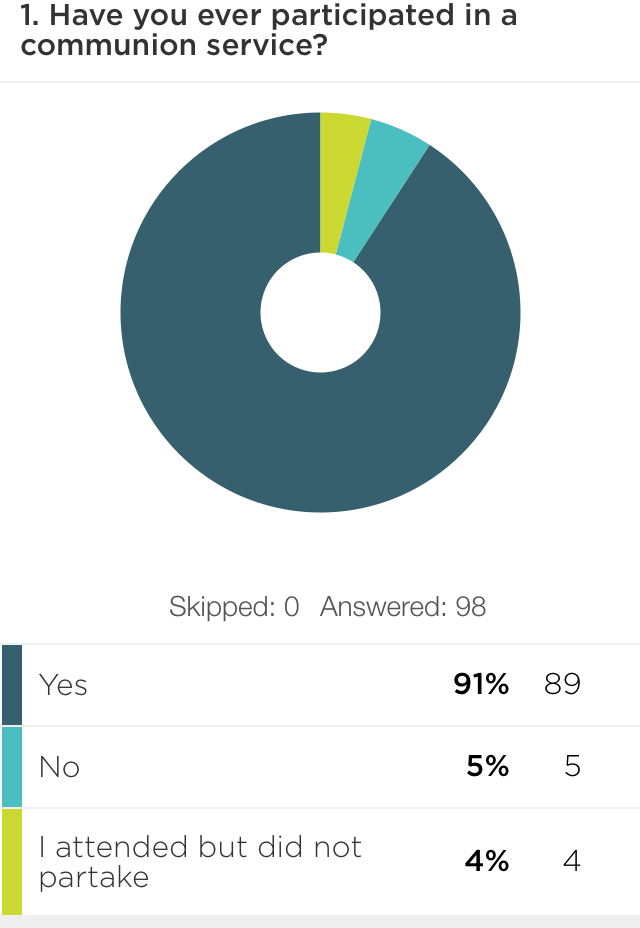
Question #1 “Have you ever participated in a Communion Service?” 


Of those polled 91% said that they have participated in a communion service at some time.  I would venture to guess that most likely these services those participated in were  conducted at a liturgical church some where.   Given this statistic most understand the dynamics of the traditional communion service which involves the bread and wine (or grape juice) depending on the denomination conducting the ceremony.

Question #2:

“Why, in your opinion, does The Salvation Army take such a hard stance against this sacramental practice of the traditional Church? “


Responses: 

“It goes back to William Booth’s thoughts…did not want people to be confused on what is expected to be saved.  His people were basically unchurched.” 


“Not a hard stance, but a practical one.“

“Old fashioned idea about not wanting people to cling to the ritual instead of Christ.  If it’s done right, that won’t be an issue.” 

“Hard? It is a respectful stance, offering a visible argument against disrespectful and superstitious abuses of these ceremonies.“

“I thought initially it was because people thought water baptism and partaking in communion was a means of salvation and the decision was made to stop for that reason!“

“Because of the fear that people will exchange living in Holiness for the sacraments, meaning it doesn’t matter how I live because I partake in communion. Confusing the saving grace of God with ritualistic acts“
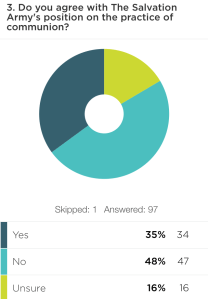
Photo Jul 23, 9 22 03 AM

Question #3

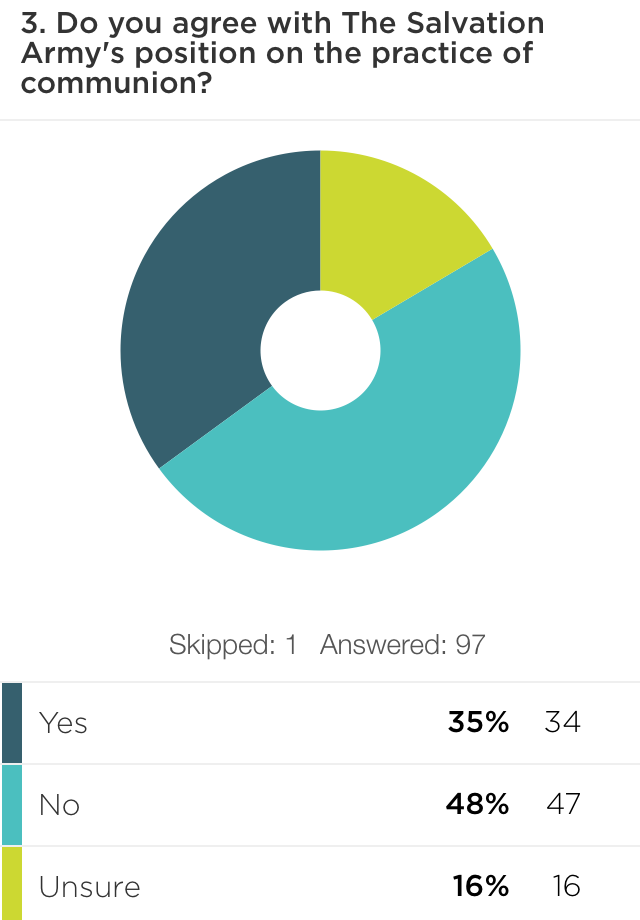
“Do you agree with The Salvation Army’s position on the practice of Communion?” 
35% said ‘Yes’
48% said ‘No’
16% said ‘Unsure’

Something to consider within this question is this: does The Salvation Army and its leaders, including corps officers, take the time to adequately explain this position in formal and informal settings?  


Question #4 

“Are there detractors in participating regularly in communion and if so what are they?” 

Responses: 

“The sacred can become commonplace.”

“Anything can become routine or old hat. If it loses the significance, it should stop. Like Sunday night mtgs, high collars and open airs“

“Like any “ritual”, you run the risk of wearing it out. It becomes more about doing the ritual than what the experience means. That’s unfortunate and potential unavoidable. If we could guarantee deep, sound and continuous teaching the value is increased dramatically.“

“I find practice does nothing for my spiritual life“

” see it still as that which separates those who are worthy to take the sacrament with the unsaved or those who’s hearts aren’t right. I’ve heard it offered far too often like this, but Jesus offered the Seder to everyone at the table. I like Booth’s analogy that we need a bigger table, and it is in our homes.“

“Just as in our stance of zero liturgy, practicing liturgy all the time might cause one to lose meaning because communion become mundane. How should one administer it? Should only corps officers? Should it be wine or grape juice? What type of bread should be used? Could CSM’s administer it? Who is allowed to participate in it? Are soldiers and adherents or also non-believing Salvationists?“

“I think it is easy to substitute the “practice” of the sacraments (a means of grace) with the daily living out of our salvation. The sacraments could become a Salvationist Yom Kippur where you repent once a year for all your sins of last year and all the sins you will commit next year. “His mercies are new every morning” for a reason.“

Question #5

“Are there benefits in participating regularly in Communion and if so what are they?”


Responses: 

“Yes. Taking communion requires a deep examination of your heart, attitudes, and behavior.“

“Old fashioned ideas about not wanting people to cling to the ritual instead of Christ.  If it’s done right, that won’t be the issue.”

“If taken seriously, it can be a moment of personal reflection as to the sacrifice of our Lord. Sitting in the corps hall staring at the mercy seat doesn’t always have the same impact. Also, I tended to view the mercy seat as a place where you came when you were really bad and needed forgiveness. However, participating in communion is a reminder of the grace and forgiveness we are offered, even if we do not have a major sin to confess.“

“It is a nice period of reflection when it occurs.It makes you feel at one with the congregation, but so does the altar call at the penitent form and holiness table.“

“Participating in the sufferings of Christ, partaking of the presence of Christ alongside his bride the church, fellowship at God`s table, confession of sin and receiving forgiveness“

“Reaffirming/ reconnecting with God and your covenant with Him. Prior to becoming soldiers we were Methodists who participated in communion. Nobody thought that taking communion was saving us, it was a time to refocus and remember Jesus’ sacrifice.“

“We know a few soldiers who were raised in a liturgical church who “needed” the sacraments. They were provided for them in a private setting (usually at Easter and Christmas). Their own personal spiritual formation was contingent upon receiving them. Who are we to argue?“

“Feeling of belonging.“

Question 6:
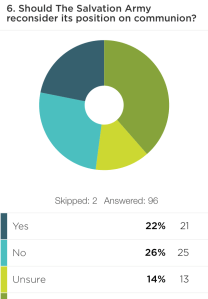
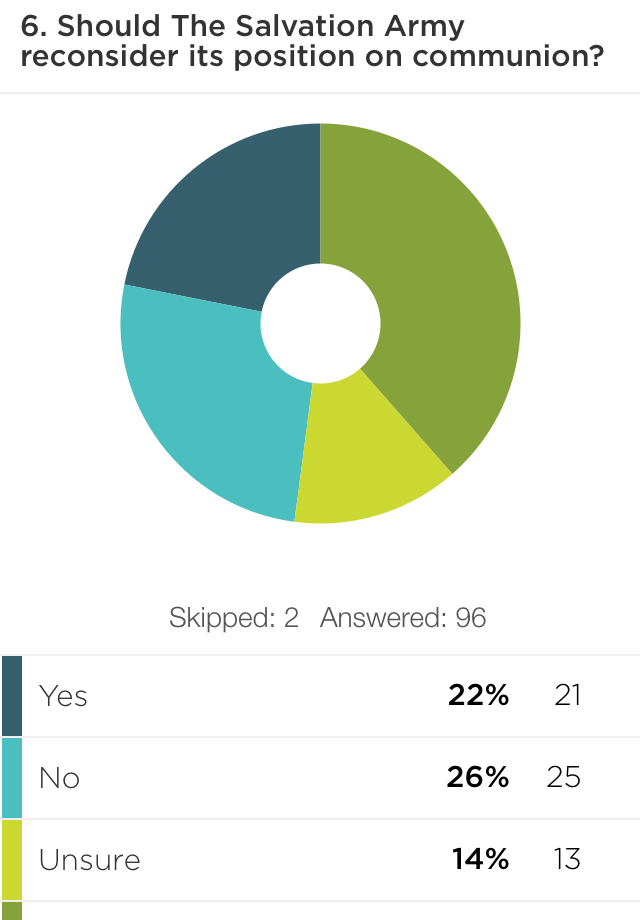
Photo Jul 23, 9 22 11 AM “Should The Salvation Army reconsider its position on Communion?” 

Of those polled –

                        22% said ‘Yes’
                        26% said ‘No’
                        14% said ‘Unsure’

Follow-up question – “If ‘Yes” explain why” (the Dark Green Portion of the graph on left) 

Responses: 
“We are missing out on a beautiful expression of our devotion to Christ.“

“Our original stance for not practicing communion is no longer valid” 

“I hate the prohibition-like attitude towards communion, the mocking from Officers and Soldiers towards those who choose to partake in communion.  I don’t think it should be required but to forbid Officers from administering it is silly – why do we say God can use any space/person/activity to bring Him glory and then put a specific stop to something that does no spiritual harm?” 

“It is okay that the Salvation Army does not practice communion, but we lose something by not understanding the practice.  I think the Salvation Army can continue not practicing, but should be more educated about communion.” 

“I don’t think we need to change our stance, but I do think we need to know it better so we can teach it better.” 

“Don’t threaten discipline due to participating in a SA setting.” 

“As (we) will never be fully recognised in places such as South America, and parts of Europe without use of sacraments in worship.” 

Question #7

Photo Jul 23, 9 22 18 AM

“Are there scriptural references that make the practice of Communion wrong?” 

Of those polled – 

2% said ‘Yes’
79% said ‘No’
8% said ‘Unsure’.

Follow-up question – “If ‘Yes” explain why” (the Dark Green Portion of the graph on right) 

Responses: 
“Wrong is maybe too hard a word.  But the passages describing Communion in the NT (the Synoptic accounts and 1 Corinthians 11 for example) describe something far different from modern communion.  The early Church would not recognize what is being done today.” 

“1 Corinthians 11:23-32 Paul says it’s a communal meal, says any time we eat together as a church we should remember Christ, and Mark 7:1-23 The elders had decreed how to keep scripture and voided it with their traditions, Jesus charged them with deserting the commands of God and He candidly rejected their authority and called it sin.” 

“in 1 Corinthians 11 Communion was addressed but not as wrong.  But that it was being practiced incorrectly.  Paul, therefore, did NOT discontinue the practice, but told the Corinthians how to do it properly.” 

“1 Tim 4:7, Romans 14:17“

“Scriptures like 1 Corinthians 11 make it clear that ‘the Lord’s Supper’ was much more like a “Potluck supper” than the ritualistic emblematic rite that it has become in most churches.  I wouldn’t say that this makes it wrong to do communion, but practice would need to be reviewed.” 

Question # 8
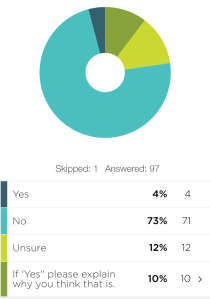
Photo Jul 23, 9 22 31 AM

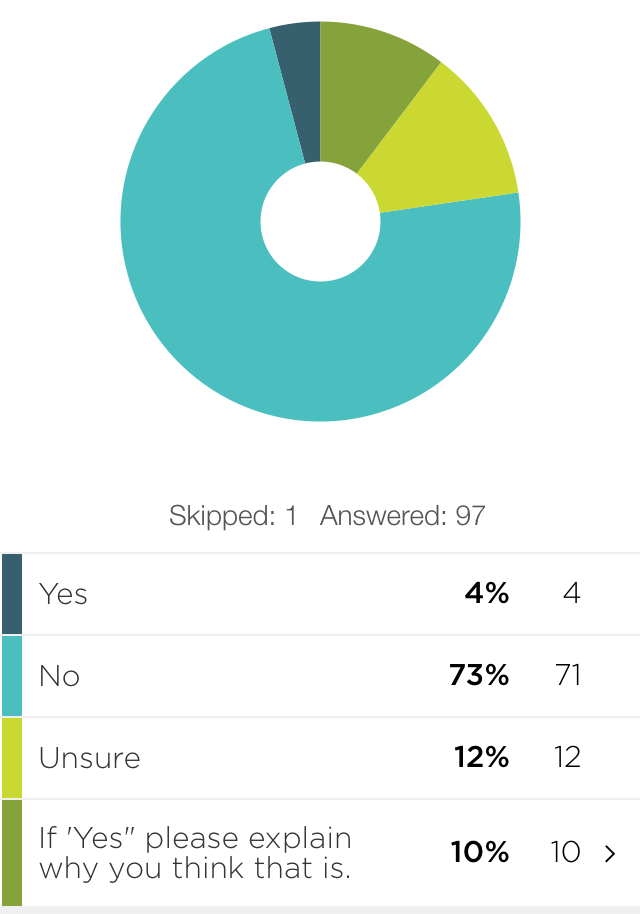
“Does the practice of Communion, in your opinion, detract from the emphasis of the workings of The Holy Spirit?  (Within the realms of The Salvation Army demographic)”


Of those polled – 

4% said ‘Yes’
73% said ‘No’
12% said ‘Unsure’

Follow-up question – “If ‘Yes” explain why” (the Dark Green Portion of the graph on left) 


Responses: 
“Communion can easily become a distraction when the focus of holiness becomes the act, rather than the action of the Holy Spirit and the need for personal holiness.  Holiness is foundational to TSA, and its non-sacramental position says something to the Church, and frees the preacher/teacher to explore the range of holiness.“

“It can.  If we place our trust in ceremony that in and of itself confers grace (that is what a Sacrament is!) then we are excluding the Holy Spirit from being anything more than mechanical.” 

“The majority of Army church members didn’t receive their Christian education from TSA.  So you would create chaos for the sake of being like other churches.”

“It would create two classes of salvationists.  It would devalue those who do not take part.  The Holy Spirit is impeded by deliberate disunity.” 

“How can we speak powerfully about the sacramental life — EVERY moment can be a sacrament and THEN  turn around and say, but we have this special moment too.  It does not make sense and it detracts from part of theology.” 

Question #9
“What did Jesus mean when He said “Do this in remembrance of me”?  (Luke 22:19)

Responses:

“When we share in the bread and wine, we are reminded of the suffering of Christ…which He did willingly for you…and me. I love focusing on the suffering of Christ, while partaking…a strong reminder of His great love for me. Words from the old musical, The Witness, tell us in celebrating communion..”take it and eat it, and when you do do it in love for me.“

“Take time to remember what He went through to bring us salvation.”

“Every time you meet round a table remember me.”

“There are several answers to this depending on your denominational affiliation(s). I grew up Presbyterian, thus we followed the command that Christ gave to his disciples which was to continue on in His fellowship by practicing communion in fellowship with each other. I was also taught that it is a done in remembrance of his sacrifice AND his returning. I continue to believe this today and take communion when I attend church with my parents who are still Presbyterian – it is very sacred to me and has such a deeper meaning now that I am ordained and commissioned into His service. I continue to stand firm, however, that it is not necessary to my walk with Christ nor in seeking holiness.“

“He was celebrating the Passover, which was a full (if ceremonial and symbolic) meal. So it either means “whenever you celebrate Passover remember me” or “whenever you break bread remember me.” By the way, Jesus Christ is only recorded as saying that in Luke, and John doesn’t even record the Last Supper. Kind of strange if it was to become a Sacrament as many modern Christians understand it today.“

“Gathering of believers in fellowship in His name.“

“Sit down and have a meal together. No ritual, just commensality.“


Question #10

“Communion is not necessary for Salvation (this we know) and we should adequately explain this to soldiers and recruits of The Salvation Army, BUT…might we be losing anything in our efforts in avoiding such a practice within our Corps services?  Why or Why not?”

Responses: 

“Yes. In thinking of new people coming into the corps family, many have been raised in a church where communion was shared. Many have indicated they do miss this practice in the Army. I have shared communion with women at Women’s camps and have had many thank me and noted how much they missed this sacrament. (I also had a few critics!)“

“The only thing we would lose is the togetherness but only if it meant the same to everyone.“

“Communion is, in my opinion, the first object lesson sermon. It had little or no significance to the Disciples in the upper room when He instituted it. However, communion has become for some, an important aspect of their Christian life. Not because it bring salvation, but because they feel it helps bring them closer to God. Communion is NOT represented well within The Salvation Army, it is ignored and disregarded as a meaningless ceremony. I don’t think ANYTHING that actively calls us to remember Christ, and His sacrifice are things to be ignored or written-off as meaningless.“

“I think we lose a lot, it is a real act of worship when the motivation is right, it can assist us in drawing closer to God when we are setting our minds on spiritual things.”

“Yes we are, because few officers — not to mention soldiers — understand our position. I have known soldiers who thought they were sinning if they partook! Ridiculous! Our example of emphasizing that which is symbolized above the symbol is sound and, I believe, helpful to the church at large. If we were to ever institute the Sacraments in TSA, it should not be because “Israel wants a king” to be like everybody else, but because we have and teach a thoroughly thought out theology of these ceremonies. And we should NEVER call them Sacraments!”

“not if we explain it in a good way.”

“I’m not sure why TSA is so convinced that most people who practice the sacraments think that they are saved by them. I think what is lost is a tangible reminder of our redemption and a physical act of fellowship with our savior and each other. To think that we are above practices that most other churches engage in seems somewhat arrogant and separatist to me.”

“One of the secondary motivations for being non-sacramental is our Egalitarianism. The resistance toward women giving Communion to men was absolute in 1865 and could easily be that way today. For the sake of unity we dont practice the sacrements. if we did would people get a spiritually fufilling moment sure, but at what cost? isnt it better to be one church too singleminded in advancing the cause of christ that we make this a non-issue. I believe scripture bears out we keep the rememberance of Christ better than anyone who practices communion.“

“No. If we are intentional about teaching/preaching/living sacramental lifestyles, then the simple practice of partaking in communion will not enhance our meetings.”


Concluding Thoughts
MY Thoughts…and You Decide…
In concert with Phil Laeger
(Photograph of Holiness table taken by Debby Hudson/Ft. Lauderdale Corps)
We serve a mighty God! AMEN?!

At times man has imposed ritual upon things and places that was never intended to be.  I do not discount the significance for those who participate in Communion, nor do I criticize the act.  It can be a wondrous and beautiful commemoration of what Christ has done for us.  BUT…there is danger in anything losing its significance if done out of ritual and practice without teaching and instruction. 

Secondly I believe this topic to be quite complex and very personal to many people, hence the varying responses in the survey above.  One person even asked, “why conduct this sort of survey won’t it only cause conflict and division?”  This was never my intention and in fact I believe it only serves to display how unique the body of Christ is and how unique each person’s perspectives and convictions are.   

Lastly, if in fact, the original intent of the ‘Last Supper’ and the early Church’s practice of Communion simply meant breaking bread together and eating food whilst recalling the wondrous sacrifice and salvation through Christ, shouldn’t we get back to that?  If this was the origins which became so deeply entrenched in tradition and ritual shouldn’t we reclaim the origin and not the ritual…and more importantly seek to grow in personal and corporate holiness?  Shouldn’t the Lord’s table then be our tables at home as we teach and instruct our children and families?  Anything can become ritual including wearing our uniforms whilst losing any and all of its significance.  

I have more to say on this topic…but I will conclude here. 

So…what do you think?  

Something more for the Army world to ponder today.  


Disclaimer: This survey represents a small portion of our Army and is in no way representative of everyone. We were able to collect a total of 98 responses from this survey (those who participated) and we thank everyone for your responses. Secondly these are responses from people and soldiers of our army and does not necessarily represent the beliefs and personal views of pastorsponderings.org. Thank you for reading and participating.

Dear Salvation Army – Promotion To Glory & Heaven On Earth

herb
“Promoted To Glory”
Summoned home, the call has sounded,
Bidding a soldier his warfare cease;
And the song of angels resounded,
Welcomes a warrior to eternal peace.
Praise the Lord! from earthly struggles
A comrade has found release.
Death has lost its sting, the grave its victory;
Conflicts and dangers are over;
See him honored in the throne of glory,
Crowned by the hand of Jehovah!

(Herbert Booth, 1890)

We can thank Herbert Booth for this term which we use within our Army today. He coined the above term while writing this song for his mother, Catherine Booth, following her death. What a wonderful tradition that we have within this aspect of “army living”! I have been to many a Promoted to Glory service and have shed many a joyful tear. I would much rather attend a funeral service which evokes the hope and joy of eternity than the deep maudlin, somber experience of the traditional funeral service. But beyond such thoughts on death and its ever presence with us, for certainly it is in our minds that we ever progress to that day, I would rather like to consider life.

Living Out This Promotion Today!
What prevents us from living our glorified promotion while still on earth? I know this sounds rather silly, perhaps to you, but often times I think in our corps we focus on eternity as “being up there” when in fact Jesus himself said; “The kingdom of God doesn’t come by counting the days on the calendar. Nor when someone says, ‘Look here!’ or, ‘There it is!’ And why? Because God’s kingdom is already among you.”

flames
I believe that as God’s Army, we can live out His Kingdom while STILL ALIVE in these earthly vessels. Isn’t that what it’s all about anyway? Aren’t we all commissioned by God to share His hope and His life with those who desperately need life and hope? We are Kingdom builders here on earth. It is a promotion of glory enacted in the here and now! What joy it can be to declare God’s kingdom here on earth a midst a world that is so deeply divided and disillusioned. God’s kingdom, after all, is glorious, holy and illuminated by His presence…are our lives illuminated by His presence here on earth? Here and now?

I recognize that life is never easy. We all face our trials and struggles, but doesn’t God go with us even into those valleys of the shadow of death? Are we ever truly alone? NO! Yes we must honor our fallen comrades and soldiers in our army in the finality of their promotion to glory, yet we need not wait until glory to truly live His kingdom today in our lives! May we live in such a way that others will see His kingdom and marvel at His holiness and long to be consumed by His light in their lives as well.

Let us live out our future promotion to glory TODAY in our living for Christ! Do not squander the opportunities to display His majestic love to others you serve and love. Keep His kingdom ever in your thoughts and in whatever you do, do it for His glory today! We are God’s soldiers living out our future promotion to glory in the here and now!

awake

Dear Salvation Army – Brengle, Holiness and All That Jazz…

“Create in me a clean heart, O God, And renew a steadfast spirit within me.” -Psalm 51:10
holiness
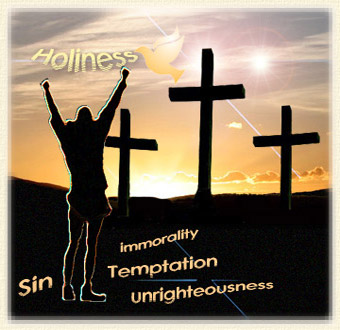
Sometimes one has to wonder where holiness has gone to in our corps. I don’t mean to be harsh but have we forgotten this vital, vital element in our ministry? Isn’t Holiness that which continues to transform the soul into the image of Christ? Doesn’t the work of the Holy Spirit still have the power to transform lives far beyond our wildest human imagination can fathom? Have we grown up so much as an Army that holiness has taken a back seat to service and good works? Dare I say that if that ever becomes the case we will have lost the most vital component of our mission.

For Thy Mission Make ME Holy!
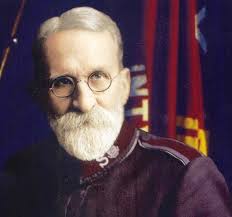
Samuel Logan Brengle has been the most influential writer of The Salvation Army to me on this topic of holiness. Yet we need additional theologians to boldly step forward in our Army to pick up the torch of Brengle. I do not believe that the Holy Spirit is static, nor is His mission for our lives. He transform us because we are imperfectly marred by sin. The Holy Spirit transforms our hearts and lives for the purpose of cleansing us completely. This work might take a lifetime. Many times the transformation and cleansing is dependent upon our willingness to relinquish and surrender that which we have held onto even after initial sanctification.

Questions to ponder for our Army:
HOLINESS-WHAT
How often do you preach on holiness in your corps?
How often do you hear bible studies or sermons on holiness in your corps?
Is holiness and the desire to be like Jesus in every way, shape and form truly something which you personally strive for. I do not wish to imply that doing works will bring us holiness but doing what the Holy Spirit prods us to brings us into an attitude of full surrender.
How full and complete is your surrender?
How willing are you to remain on the altar despite the challenges that come your way?
What still remains in your life that needs surrendering?
What is holding you back?

All That Jazz
Holiness-Bg
The topic of holiness may seem like a very deep theological conversation. Some may even steer clear of it because it just seems too “heady” of a conversation. Our Army is a holiness movement. We believe in the moving of the Holy Spirit. We believe He can make us like Christ through a surrendered life. We believe that it is possible to be holy people of God. Holiness is not physical perfection but it is desiring to be like Christ and the determination to live for Him in every facet of life.
As a Solider of this Army, may it be our mission to live holy lives in every area of it. Don’t just be a Sunday Soldier and then leave the corps and live a completely different life apart from the fellowship of other comrades of salvation. Don’t assume that putting on the uniform makes you holy, or that because your parents believe and are saved it is good enough for you. This personal relationship with the Lord is vital. He wants you all to himself! He doesn’t want to share you with the world and with anything else that would hold you captive. God desires a right relationship with YOU! He is jealous for you. He loves you so deeply that He cannot allow you (us) to remain unfinished as we are now. Thus the Holy Spirit longs to complete this work within us…but are we willing to allow Him to poke and prod us? Are we willing to reveal those tender areas of our hearts that we have not yet been relinquished and given to God? The Christian walk doesn’t end at the altar of salvation…it is just the beginning.

“Holiness is not absolute perfection, which belongs to God only; nor is it angelic perfection; nor is it Adamic perfection — for, no doubt, Adam had a perfect head as well as a perfect heart before he sinned against God. But it is Christian perfection — such perfection and obedience of the heart as a poor fallen creature, aided by almighty power and boundless grace, can give.” -Samuel Logan Brengle

Prayer: Lord it is our desire to be like You! Reveal to us that which is still unsurrendered in our lives today. May Your Holy Spirit fall afresh on us again. Protect us from apathetic hearts and slothful minds. Renew in us a right relationship with You. Oh Lord create in us a clean heart once again. Give us a heart for You and for others. May we be available to extend your grace and mercy to those around us in our communities and in our ministries. Lord for Thy service make us Holy. -Amen.

Devotional Pondering For Today – An Intimate Moment With God

renew

“Whatever you do, do it from the heart for the Lord and not for people.” -Colossians 3:23

Lord do I have a heart for You in all that I do?
Too often the answer is “no”.
Too often I am far too busy to include You.
Many times You are an after thought…A prayer as I go out the door.
Why do I forget You? How could I do such a thing after all that You have done for me?
Are You not the One who sustains me in the midst of trials, despair, heartache and sadness? Are You not the One who lifts my head and allows me to see Your beauty that encompasses Your world? How could I relegate You to a backseat in my life?

Renew my heart dear Lord.
Renew my mind.
Restore in me a right relationship to You.
It is my desire to intentionally seek You out in my day.
It is my desire to do ALL things through and because of You.
Teach me to walk in Your way today…Please take it slow because I am still learning, I am not complete, You have much to do within this heart of mine. Grant in me Your passion to the things that I must do today. Grant in me Your heart for other people, including people I do not see eye to eye with. Fill me with Your holiness once more. My desire is to reflect You. My desire is to be Your child before I engage the world around me. Heavenly Father, plead for You to remain in my day (each step of the way) as I do both the most mundane of tasks as well as the challenging. Allow me to display Heaven in our world to those who are lost and without hope of a future. Use me to shine Your light today. I long to be complete in Your holiness, reveal to me that which still lingers within my spirit that is not of You. Capture every fragment of who I am for Your glory. May my heart be Yours and Yours alone.

-Amen.

Dear Salvation Army – Officership: Are We Settling For The Willing But Not The Able?

In a continuation of the conversation yesterday –
https://pastorsponderings.org/2014/07/10/warning-dear-salvation-army-we-are-losing-our-young-people/

soldiers2
Perhaps another discussion could be broached within this specific topic…Officership.
It might sound raw and perhaps it may sting a little but here goes…

We have probably all witnessed the struggle our Army has had in some regions of the world recently to recruit and commission able bodied Officers. As the “World for God” extends into new communities and frontiers we find more and more that we are running low on willing and able personnel to fill these appointments.

Questions we must ponder on this issue:
Why are we so short on soldiers to fill our ranks as future officers?
What can be done to continue to “fill the world with glory” and still produce quality officers to boldly proclaim the name of Christ? Are we out of touch with younger generations? Could it be that the uniform is to blame? Are there just more opportunities now that weren’t there before to other generations?
Are we losing quality soldiers in our Army who could be future officers because new opportunities outside of the Army in other ministries and even vocations takes them away?

Secondly, has it become quantity over quality?

All too often I question if we as an Army have pushed too hard to produce in quantity new red trimmed Officers while at the same time we have failed to adequately prepare them for the work ahead. I question whether this push has elevated some who are willing but might never be able to fulfill such a calling. Please don’t misinterpret that statement to sound pretentious or arrogant, but perhaps at times we do settle for the willing over the willing and able to meet certain “quotas” of officers in territories. I also do not want to short change the work of the Holy Spirit here within this “calling”. I know full well that the Holy Spirit can and will call those to lead in our Army but within our methods of recruitment towards potential future officers are we forcing results?

captain

Sometimes there is this atmosphere of panic in the Army. Perhaps it is never spoken but it is felt when the list of accepted candidates comes out and for some reason it seems rather small (compared to other “more bountiful years”). Please don’t misunderstand what I am saying and I don’t wish to imply anything negatively here, but there is a perception of numeric success even within these lists of potential future officers. It makes me question if at times our push for more and more candidates creates a notion that Officership is for everyone, when it is in fact a calling not specifically a profession. I don’t mean to elevate this position above anything else within our Army because everything serves a purpose, but when we commission some who really weren’t called but simply signed up because it was convenient or pushed upon them…are we selling ourselves short? Are we really being faithful to God? Will God honor this sort of selection? To be fair we must recognize that this isn’t always the norm…but have certain territories hit the panic button in recent years?

Wrong Reasons For Becoming An Officer –
(Erroneous Ones As Well)
#1 Free House
#2 Free Vehicle
#3 The Pay
#4 The Adventure of Moving
#5 Pressured into it
#6 No Other Prospects of Employment
#7 Always Wanted to Wear Red Trim

There are many more wrong reasons why some want or have become officers. Some on this list may seem silly to you, but I have heard some of these rationales from real people. Granted in some territories the concept of becoming an Officer may seem like a safe, comfortable choice of vocations. Many fail to recognize the demands of such a calling. The life of an Officer is not glamorous or flashy. It is not easy at times. Sure there are blessings associated with the calling to become an Officer but there are burdens as well. <<This is why I will probably NEVER be asked to become any kind of candidate secretary>>>…I do not want to sugar coat the ministry of our Army.

Honorable Reasons For Becoming An Officer –
#1 You have felt God’s calling on Your Life to make this decision.
#2 This isn’t “plan B” but a passion to serve the Lord as an Officer.
#3 You have strong desire to serve other people from every walk of life.
#4 You are prepared to serve in the good times and in the not so good times.
#5 You have a passion for holiness and are currently responding to God’s prodding on your life.

There are more honorable reasons for becoming an Officer but these are just a few the spring to mind while in this conversation.

fighting on

TWO WARNING SIGNS:
For Territorial, Divisional, & Corps –
Beware of pushing people into “the ministry” of Officership. We all recognize the need to fill appointments and to have sufficient personnel on the field…but perhaps at times we have to trust in the Lord more than we do. We have to trust that He is going to provide the right people for the right appointing. This doesn’t mean we don’t put that call out for more candidates, it simply means that perhaps we wait a little longer on the Lord to provide willing AND able Men and Women for this sacred duty.

For Soldiers & Potential Candidates –
Beware of jumping too quickly into a full-time ministry as a Candidate or potential Officer. Pray in earnest for the right direction. Pray for God to reveal to you His path for your life. I am not discouraging anyone from becoming an Officer but make sure your decision to “sign up” is for the right reasons, not the wrong ones. Talk it over with family and friends and talk it over with your Corps Officer. We need Officers in our Army but at the same time do not sell yourself short or sell the Army short and settle for being willing but not able to fulfill such a arduous calling.
“Get On With It!”
Perhaps the panic button has been hit a time or two in various territories, but I also know that there are some very godly men and women leading the charge to recruit and to commission new Officers of The Salvation Army. It is not a glamorous lot, but it is a vital role to play. Are you willing AND able? For soldiers and officers who are neither willing nor able I would advise you do one of two things – Pray for the Lord to restore your ministry and passion for the lost souls in your communities and get on with it or get out of the way so that others may rise up and take your place. This may sound harsh, but if we do not have holy sanctified officers or future holy sanctified officers rising up we will have lost our mission and vision as an Army. God forgive us if we lose sight of His purpose for our lives and for the hope of restoration to the lost. Get on with it!

I never thought I would be discussing this today…but praise the Lord for His leading! Something further for our Army to ponder.

Being a Single Officer, Is It More Difficult than a Married Officer?

I have to admit, I have never been a single officer. So why write this? I have friends who are single officers, I have heard of some of their difficulties and frustrations. I can sympathize, and begin to recognize that I had no idea that being a single officer was that challenging. Admittedly the life of a Salvation Army Officer is, by the nature of the ministry, challenging in and of its own right, but ministering alone has its own set of blessings and frustrations.
Together with a few of my single Officer friends, we set out to create a brief “Single Officer survey” just to gauge the perceptions and experiences of other single Officers. We wanted to know if some of the experiences my friends have had along the pathway of duty resembled that of others serving in the same capacity.

Perhaps the question lingering in the title of this article cannot be answered. Perhaps it isn’t even about which is more difficult but rather “Are single Officers considered as valuable to The Salvation Army as married couples?” I do not ask this question to be condescending or insensitive but rather because the perception is (which is not always true but instead felt)that single officers are simply not considered as valuable.

The Survey Questions and Results

Results and Interpretation
One must be careful how one interprets such data, and we simply want to be fair and objective. Is there sufficient data to support the concerns of many single officers? Yes. What can be done? Perhaps listening to these strong voices, these leaders who have answered God’s call for their lives and, many times without the support of a partner, have led well within many types of ministries.

Question 1 – “Have you ever been sincerely affirmed as a single Officer by someone other than a friend?”
The affirming statistic here is that nearly 55% of those within this survey felt that they had in fact been sincerely affirmed as a single officer. Perhaps the affirmation came from another officer, leader, or soldier but regardless of where it came from the majority (albeit a small margin majority) of our single officers are being affirmed.

On the flip side over 36% of those within this survey felt that they had not received affirmation from others around them including fellow officers, leaders and soldiers. I do not believe that this statistic supports a longing for personal “pats on the back” or a few “atta boys” but rather something many churches and organizations struggle with in terms of affirming and encouraging those that serve within its ranks.

Prescription: Whether you’re a department head, leader or otherwise take the time to listen to the needs of single officers. Really listen. We recognize the sheer number of officers on the field outnumber leadership within DHQ’s and THQ’s but Officers need to know that they are cared for and loved. Constant expressions of hope, encouragement and shepherding is desired by all Officers regardless of marital status. Within the Central Territory there are currently a small number serving within the “pastoral care” department…this is such a vital department to officers that it begs the question “why aren’t there more pastoral care officers for the territory?” Perhaps this isn’t true for other territories but we do need to re-examine how we shepherd our officers from both the territorial and divisional levels. We have to admit though that our Army is improving from the structural staunch leadership (almost militant) models of yesteryear, though we still have room to improve.

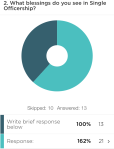
Question #2 – What Blessings Do You See in Single Officership?
Here are list of some of the answers –
“to concentrate fully on ministry”
“freedom from other commitments and time flexibility”
“responding to the will of God and being faithful to his call”
“being called to be like Jesus, totally free to focus on ministry”
“When it’s a busy season, such as at Christmas, it’s nice not to have to worry about a family and be able to focus soley on my job…”
“I was able to concentrate on ministry with no obligation to spouse or children. I was able to use my free time in a very “selfish” way — all I had to worry about was myself. Frankly, one great blessing of single officership is that the Army has structured a number of “rewards” (ICO, Brengle, commission memberships, etc.) so that there is single representation — so if I had remained a single officer my chances of going to ICO would have been much higher than they are now that I am married.”

Question #3 – “What challenges do you see in Single Officership?”
Here are a list of some of the answers –

“It’s all a challenge. It’s difficult to be everything to everyone and expected to be good at it all. People assume that because I’m single, I don’t need ‘family time’ or ‘me time’.”

“1.Have nobody to share the good and bad news etc. 2. And share the work”

“Loneliness, pigeon holed into certain types of appointments. Also single officers are moved at a higher rate than married officers and are convenient ‘plugs’ when there is a breakdown, I had 4 appointments in my first 5 years of officer ship due to this.”

“Even though I am smart enough, I am talented enough, I am responsible enough, being a single officer isn’t “good enough”. What I mean by that is I don’t run big corps on my own, have seminars just for singles that actually address some of my issues, and I am not heard. I had officers in Officer Care and Development ask me at an Officer’s Councils what my needs were. I told them and they forgot! By the time my TOI rolled around a year later the very same officers said they had never heard about these issues before when I addressed them again with another fellow, single officer.”
“Moving more, work alone, treated different than married officers”

“I have had challenges in people seeing me as an adult. My current DC is the first DC I’ve had so far in my officership that treats me like an adult. Having the title “associate” instead of a CO with the fellow officers at the appointment, causes you to be less of an officer (no matter what policies and pocedures says), working along side officers that say, “You’re my kids age” (this is never good). It’s hard to get away from the office many times because people assume you have nothing better to do, so it’s expected you work. Fellow officers who preach sexual purity from the pulpit and then make fun of you to your face for it. It’s frustrating to be told to go find young families when growing a corps, when I don’t relate to them at all. And it’s difficult to do marriage counseling or family counseling. Not having someone to vent to or to bounce things off of.”
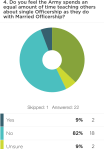
Question #4 – “Do you feel the Army spends an equal amount of time teaching others about single Officership as they do with Married Officership?”

Over 80% of those polled within this question responded “No”. This is a telling statistic. We are not out to criticize or attack our Army, just the opposite, we love our Army. Can we improve and help those who feel this way? Absolutely “Yes”. Perhaps there is a stigma, unspoken as it may be, in the Army and the attitude towards single officers. I have heard the hurtful gossip directed at Single Officers, and I’ve confronted it when I’ve heard it. Sometimes people assume that because someone is single and an Officer that there is something “wrong with them“. There is also sometimes an assumed notion that just because a person is a single officer they are less equipped than a married couple…which is usually baseless and wrong. Can we work towards better education in the Army when it comes to Single Officers? Short answer: Yes.

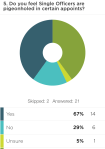
Question #5 “Do you feel Single Officers are pigeonholed in certain appointments?”

Nearly sixty-six percent polled felt that Single Officers were in fact pigeonholed to certain appointments because of their marital status. Assuredly we can see some of the reasoning for certain appointment changes – the expenses of relocated a Single Officer over a married couple is less, as mentioned in question 2 there is more flexibility, and perhaps this makes Single Officers “more portable”. These may be some of the reasonings for certain appointment decisions but is there a way for Leadership to break these molds and pigeonholing? I believe we are improving within this area, albeit slowly. There is still room for much improvement. It would be easy to chalk this survey up as just a bunch of officers complaining and make the comment “why can’t they just be faithful and obedient?” For in many minds being obedient to Army leadership equals being obedient to God…which I disagree with. Sometimes decisions are not made because of God, but because of convenience and less “ripples” in a move cycle. These are not the grumblings of Single Officers and myself, these are perceptions and experiences.

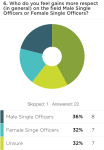
Question #6 “Who do you feel gains more respect (in general) on the field Male Single Officers or Female Single Officers?”
This statistic was almost even – Male Single Officers – 37%, Female Single Officers – 32%.

Responses to this question:
“Because female single officers tend to be a dime a dozen.”

“Fewer single men”

“People tend to listen to male leaders more than female – assertiveness in a woman is seen as a negative thing but for men it’s seen as good leadership”

“I think if you do your job people will show you respect”

“both are equal in my many years as a single officer”

“As a Single male officer, I was always asked in private If I was was a Homosexual because I was not married.”

Question 8 (I’m skipping 7, you can read the results for yourself)
“What could the Army do to better include Single Officers? “

Responses:
“Stop highlighting them as ‘single’ officers. That puts people into a box of single or married. Why not just refer to all of us as ‘Officer’ so as to not make anyone feel separated or singled out?”

“I think the army is making improvements and i am being realistic i do understand that when you have a married couple it’s pretty much your getting two for one, but I think that better things are yet to come in this area just like so many others things that have changed through out time. i also that marrieds without kids can be put into this pigeon hole as well”

“You should show me the same care you would as a married officer and don’t move me around all the time, because you wouldn’t do that to married officers. Give more opportunities to serve in ministries where marrieds cannot. And don’t just shuffle us around because you have NO IDEA WHAT TO DO WITH US”

“Resource us!”

“Find us a mentor or friend or someone that we can call when we feel like we have no one else to turn to, and teach us that it is always OK to call them, and what we say or feel won’t affect our future appointments.”

“Have conferences for singles and other opportunities just like married people. Show us we matter too!”

“Better pastoring (could be true for all officers, though), and not just an occasional bone thrown by a DC’s wife. What I experience and hear from my other single friends is that there is no one to listen to us when we need to share what’s burdensome. Married people have a spouse to share some of the burden, someone who can at least listen at the end of the day/week/minute and say “yeah, that sucks,” but singles (in my experience) don’t often have another officer who listens and supports.”

Question #9 – “What opportunities do you have as a Single Officer that you wouldn’t have normally?”

Response:

“I feel as if I have less opportunities as a single officer, not more.”

“I think sometimes you get to make your ministry what it is. I love to visit with people. To just sit and listen to them, laugh with them, pray with them-I have more time to do that as a single person because I am assisting, to have that ministry.”

“A lot less because so there are so many one starred events that I have to go to”

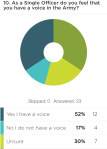
Question #10 – “As a Single Officer do you feel that you have a voice in the Army? “

Positively over 52% of those polled felt that they do indeed have a voice within the Army. Less than 20% felt adversely. This should be considered a good thing. Less Single Officers feel as if they are not heard. This does not contradict earlier questions within this survey it simply reinforces perhaps an area that the Army is fulfilling to some respects. As Officers, decisions made in a Corps are the Corps Officer’s decision regardless if it be a single Officer or married Officer. Leaders within ministries have voices. The real question begs to be asked though, are the right leaders listening to these voices? I believe we are making strides in the right direction…but we’re not there yet.

What I have learned as a Married Officer within this study:
I thought I knew the struggles of all officers…turns out I didn’t. My single Officer friends have helped me glean some very helpful knowledge here. I have learned a great deal as an individual.

Secondly, I have learned that we still have room for improvement within our Army. I didn’t realize that some of my fellow sojourners as Single Officers felt this way. That there are stigmas associated to the perception of Single Officership. I have learned that in some cases a single Officer feels out of place and are treated quite differently than a Married Couple.

Lastly, I have gained a source of deep respect for Single Officers out there who fight the good fight and have answered the call of Officership. You are truly leaders in your own right! You are strong people and I pray that you continue to be emboldened to use your voice, to lead, to change the world and the Army world so that the Mission of Christ is furthered. Thank you for sharing these concerns, hopes, blessings and challenges with us!

Something for the Army world to ponder today.

Devotional Pondering: Stumbling in The Darkness or Dancing in the Light?

“This is the message we have heard from him and declare to you: God is light; in him there is no darkness at all. If we claim to have fellowship with him and yet walk in the darkness, we lie and do not live out the truth. But if we walk in the light, as he is in the light, we have fellowship with one another, and the blood of Jesus, his Son, purifies us from all sin.” (1 John 1:5-7 NIV)

This is one of my favorite passages of scripture. The idea that not only has God saved us through His son Jesus but that in Him there is no darkness. We can learn a lot within this one passages. We can understand that fellowship with us is one of God’s desires. We can understand also that if we aren’t walking towards His light while He seeks to make us right through Jesus, we are still in the dark.

Have you ever attempted to stumble around in the dark in a place that you are visiting for the first time? It’s a little disconcerting. It’s pitch black, you are unfamiliar with your surroundings, and now you are trying to walk in this inky blackness…I will admit it’s a little frightening. I’ve done this and it’s very unsettling to have your arms outstretched and feet tenuously reaching for that next step, and the whole time you are hoping you don’t trip over something and fall.

Walking in the darkness of sin is also very unsettling. I was there…I’m sure you were as well. It’s a kind of blindness. It holds you captive and at times it feels as if you are shuffling your feet with arms outstretched as you wander around in the darkness.

Notice again the last line of this passage – “…and the blood of Jesus, his Son, purifies us from all sin”. Can you imagine again for a moment shuffling in this terrifying darkness hoping to not trip and fall -eyes are useless…and then suddenly THE LIGHT is there to show us how and where to walk. It says Jesus can and will purify us from ALL sin…not a segment, not a limited run and then back into the darkness of sin, NO ALL SIN!! What a blessing that is to hear! What an assurance to us that we never have to wander around in the darkness searching with shuffled feet anymore…ALL sin means exactly that ALL!

Are You Still Wandering In The Darkness?
You don’t have to suffer the darkness of sin any longer.
You don’t have to suffer the dread that accompanies the darkness any longer. You don’t have to suffer the loneliness and emptiness any longer. Jesus paid it all for us. He suffered and died for us. He comes to us in our darkness and our struggling and illuminates our feet and our path and He shows us where to walk within His light.

Stop Acting Like You’re Still In The Darkness If You Know Christ!!
Secondly, to those who already know Jesus and that of His wondrous redemption and light, remember at YOU have been redeemed and start acting like it! Remember it! Share it with others! His light has illuminated your world, your path, your life…so shine! Don’t become consumed by the darkness any longer! Don’t allow the father of lies to trick you into thinking it never happened or maybe that you’re not redeemable…you, me, all of us are God’s children who He desperate wants to save and have fellowship with daily…even moment by moment.

-Just another think to ponder today

Prayer: Dear Lord, thank your for sending your son Jesus into my dark world to save us. Help me to see your light in my life. Help me to see evidence of your glory on this path. Walk beside me and illuminate my feet. Keep me from the dangers of the darkness today. Help me to shine through you so that others might see and find you as well! Lord I loved you. -Amen!

20140701-075132.jpg