Dear Salvation Army – Legacy: May They Find Us Faithful

legacy

Therefore I intend always to remind you of these qualities, though you know them and are established in the truth that you have. I think it right, as long as I am in this body, to stir you up by way of reminder, since I know that the putting off of my body will be soon, as our Lord Jesus Christ made clear to me. And I will make every effort so that after my departure you may be able at any time to recall these things.” 2 Peter 1:12-15

I asked friends of mine on Facebook a few days ago this question:
If you were to be remembered for one thing, what would it be?”  
Some of their responses: 
“He was my friend”
“She loved me”
“They led me to Christ”
“I saw Jesus in her”
“He understood and lived grace”
“She cared for others”

These and many more were wonderful responses given…what would your response be?  
What kind of legacy do you want to leave behind?  What kind of mark do you want to leave on this earth?  

In our Army we have this wonder phrase of “Promoted Glory” which I wrote about this week 
“Dear Salvation Army – Promotion to Glory, Heaven on Earth”
But before this glorious promotion, what can we do now to bring Heaven to Earth? 
How can we lead other people to Christ, to live with grace, dignity, holiness and love? 
Are we even considering the kind of legacy that we want to leave behind us for future generations?  

love

Carve your name on hearts, not tombstones. A legacy is etched into the minds of others and the stories they share about you.” -Shannon Adler 

Tonight in St. Louis (Central Territory, USA) The Salvation Army will be holding a “Promoted To Glory” service for one of our own.  He was a godly man, a friend, a brother, a father.  His legacy is, without a doubt, carved into the hearts of many with whom he had the opportunity to teach, to love and to administer God’s grace.  Over the course of this week I have read tribute after tribute from people from all walks of life.  This man fought the good fight and the world he left behind is so much better because of His contributions to it.  He was able to live out Heaven here on Earth! 

What kind of legacy do you wish to leave behind in this world?  Where can you bring Heaven to Earth today?  Where has God appointed YOU so that His grace might be dispensed upon those who are so desperately in need of it?  He still needs ambassadors who are willing to serve regardless of the response or the fear of rejection.  God has accepted you and me for this holy calling!  Do not take your life for granted and the good you can do within the lives of other people because of the mighty work of the Holy Spirit!   

Light the way

I am reminded of two song lyrics within this context today: 
Switchfoot within their song “Thrive” repeats the phrase “I want to thrive not just survive
Steve Green within his song “Find us Faithful” – 
“…may all who come behind
    us find us faithful

May the fire of our devotion light their way
May the footprints that we leave,
lead them to believe

And the lives we live inspire them to obey
Oh may all who come behind us
find us faithful

lights

May it be our desire to serve the Lord in such a way that those who come after us are reminded of our faithfulness to God and that because of it they too wish to follow in our footsteps.  This isn’t some sort of arrogant desire or a selfish ambition, but rather a deep longing to live a life that reflects Christ and because of it a sweet aroma of sacrifice and holiness will compel others to walk in the same manner.   

What indelible mark are you leaving on this Earth?  
Are you lighting the pathway of Holiness for others?
Are you displaying faithfulness to God through your living?
May we thrive and not just survive!
May those who come behind us find us faithful!

-Something more for our Army and ALL Believers to ponder today!  

Lighting the way to the barn

Dear Salvation Army – Communion Survey & Results

What I don’t wish to accomplish with this article:
It is not my intention to discuss whether The Salvation Army’s stance of the practice of communion (or lack there of) as soldiers and officers is wrong.  I am not going to debate and criticize, nor is it the goal of this article to sway you one way or the other.  

Instead:
It is, however, the intent of this article to simply (as possible) present the facts, discuss the results of the survey that was conducted and lastly formulate my personal opinion (because hey, it’s my blog).  There will undoubtedly be debate, those who will strongly oppose even discussing this topic, and some who will just shake their heads.   I would ask everyone to enter into this discussion with an open mind, to set aside preconceived notions (where possible) and look at this topic objectively.  It is not my intention to undermine the Army’s leadership and/or doctrinal decisions (please don’t think me a rebel or one who questions authority), but rather to look at this topic from all angles.  

Discussion:

When the early believers broke bread together they were really expressing their fellowship in a manner that was both down-to-earth and highly significant.  In a simple common meal they celebrated their life together.  And, at the same time, they recalled the life and death of Jesus Christ and recognized his risen presence amongst them.  

What could be more natural?  Jesus had often broken bread with his disciples (John 6:11).  During his last meal with he had used that simple action to explain to them that as food and drink sustained their physical life, so his body broken and his blood shed in death would bring them spiritual life.  And after his resurrection he had revealed himself in the home of Cleopas in that same simple action (Luke 24:30).

The breaking of of bread was, quite simply, the most natural way for the early Christians to celebrate and reinforce their exciting new fellowship with each other in Christ…The Communion service became separated from its roots in the common meal.  The Church began to believe that the ritual had power in itself to convey the grace of God, even to teach that the bread and the wine actually became the body and blood of Christ.  

This kind of thing encouraged the idea of a special priesthood who alone had the right to administer the grace of God through the giving of the cup and the bread to ordinary believers.  

(Battle Orders, Chick Yuill p. 84-85)

It was against this kind of thinking that our Founders reacted.  
“…There must be no baptismal service that can delude anyone into a vain hope of getting to Heaven without being ‘born again’.  There must be no Lord’s Supper ‘administered’ by anybody in such a way as to show anything like a priestly superiority of one over another – every saved person being a ‘priest unto God”…There must never be a sacramental service at the end of a meeting so as to prevent the possibility of inviting sinners to the mercy seat.” (A statement drafted by George Scott Railton and issued by William Booth in 1881) 

What we can then understand Communion to mean within the context of the early Church and through the above quotes is that gradually the Church began to ritualize this sacred moment within fellowship of believers thereby the origin intent of such a intimate moment became blurred or marred within institutional practice.  

Commissioner Philip Needham puts it this way – 
Perhaps it is not quite accurate to say that the Army ‘discontinued’ the Lord’s Supper.  Let us say, rather, that the sacrament was transported from the high altar…out of the sanctuary and placed back in society.  Could we be so bold as to say that the meal was brought closer to its origins in the Early Church?”  (Philip Needham: Community in Mission) 

Questions to consider: 

discussion
Has the Church (Big C) lost its focus on the importance and relevance of such an intimate fellowship?  Can we practice “Communion” within the context of The Salvation Army if we exercised only the original practice of the Early Church around the dinner table?  Do we lose something when we “throw the baby our with the bathwater” so to speak?  Given the above explanations and quotations have we as an Army completely steered away from the Early Church practice of fellowship in this way?  Lastly, the Church became bogged down with regulations and ritual that it lost the true significance and even corporate practice of what the disciples and Jesus practiced at the supper table…are we in that same danger when we consider sacramental living and that of our regulatory rituals?  Have we stopped preaching holiness and sanctification?

I only ask these questions because when we become organized the danger is we begin to protect things considered sacred when it was never intended to treated as such.  

Survey Results:

survey
Photo Jul 23, 9 21 54 AM

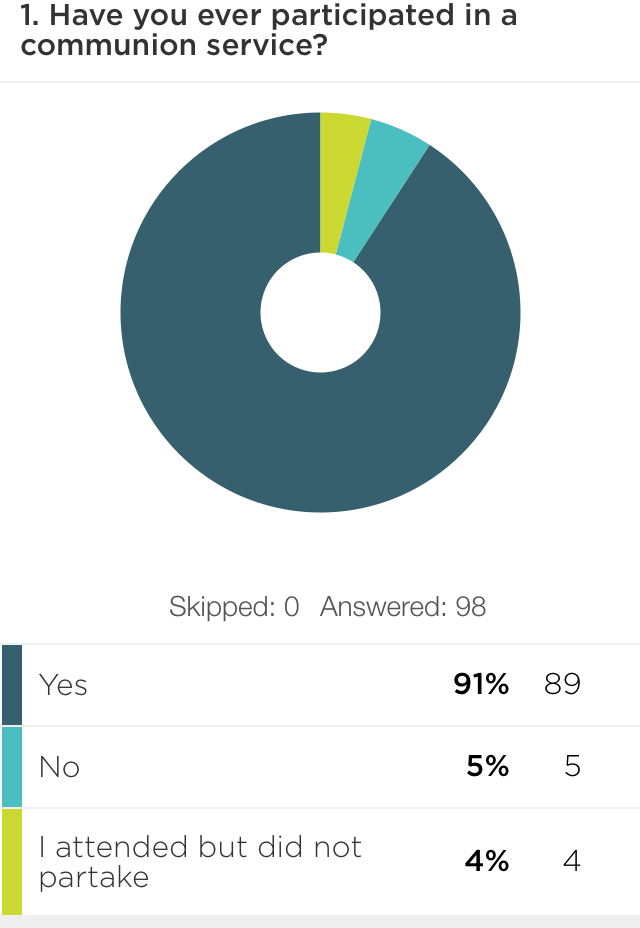
Question #1 “Have you ever participated in a Communion Service?” 


Of those polled 91% said that they have participated in a communion service at some time.  I would venture to guess that most likely these services those participated in were  conducted at a liturgical church some where.   Given this statistic most understand the dynamics of the traditional communion service which involves the bread and wine (or grape juice) depending on the denomination conducting the ceremony.

Question #2:

“Why, in your opinion, does The Salvation Army take such a hard stance against this sacramental practice of the traditional Church? “


Responses: 

It goes back to William Booth’s thoughts…did not want people to be confused on what is expected to be saved.  His people were basically unchurched.” 


Not a hard stance, but a practical one.

Old fashioned idea about not wanting people to cling to the ritual instead of Christ.  If it’s done right, that won’t be an issue.” 

Hard? It is a respectful stance, offering a visible argument against disrespectful and superstitious abuses of these ceremonies.

I thought initially it was because people thought water baptism and partaking in communion was a means of salvation and the decision was made to stop for that reason!

Because of the fear that people will exchange living in Holiness for the sacraments, meaning it doesn’t matter how I live because I partake in communion. Confusing the saving grace of God with ritualistic acts

Photo Jul 23, 9 22 03 AM

Question #3

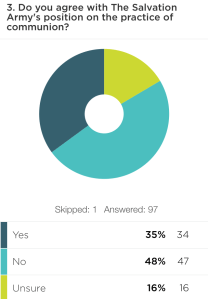
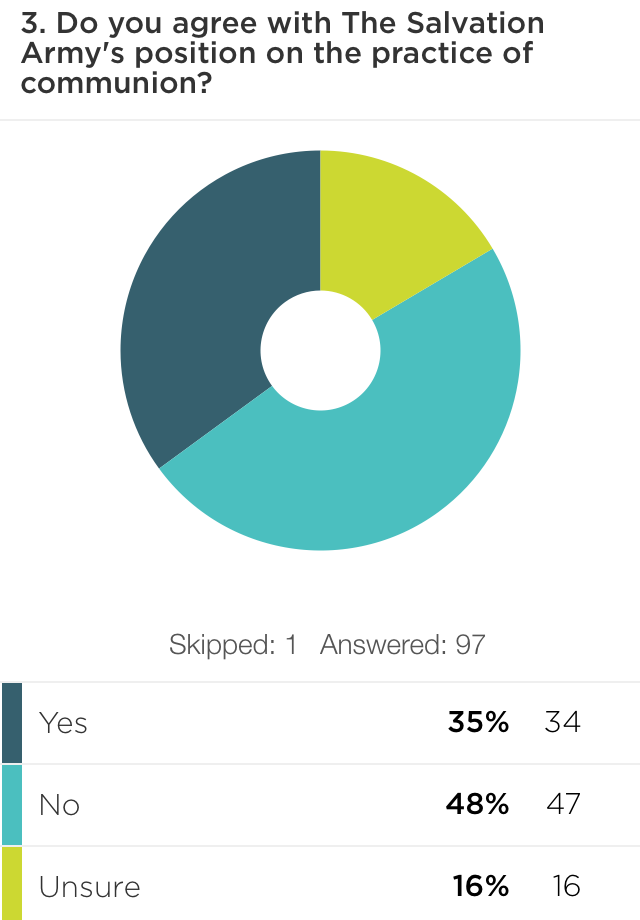
“Do you agree with The Salvation Army’s position on the practice of Communion?” 
35% said ‘Yes’
48% said ‘No’
16% said ‘Unsure’

Something to consider within this question is this: does The Salvation Army and its leaders, including corps officers, take the time to adequately explain this position in formal and informal settings?  


Question #4 

“Are there detractors in participating regularly in communion and if so what are they?” 

Responses: 

The sacred can become commonplace.”

Anything can become routine or old hat. If it loses the significance, it should stop. Like Sunday night mtgs, high collars and open airs

Like any “ritual”, you run the risk of wearing it out. It becomes more about doing the ritual than what the experience means. That’s unfortunate and potential unavoidable. If we could guarantee deep, sound and continuous teaching the value is increased dramatically.

I find practice does nothing for my spiritual life

” see it still as that which separates those who are worthy to take the sacrament with the unsaved or those who’s hearts aren’t right. I’ve heard it offered far too often like this, but Jesus offered the Seder to everyone at the table. I like Booth’s analogy that we need a bigger table, and it is in our homes.

Just as in our stance of zero liturgy, practicing liturgy all the time might cause one to lose meaning because communion become mundane. How should one administer it? Should only corps officers? Should it be wine or grape juice? What type of bread should be used? Could CSM’s administer it? Who is allowed to participate in it? Are soldiers and adherents or also non-believing Salvationists?

I think it is easy to substitute the “practice” of the sacraments (a means of grace) with the daily living out of our salvation. The sacraments could become a Salvationist Yom Kippur where you repent once a year for all your sins of last year and all the sins you will commit next year. “His mercies are new every morning” for a reason.

Question #5

“Are there benefits in participating regularly in Communion and if so what are they?”


Responses: 

Yes. Taking communion requires a deep examination of your heart, attitudes, and behavior.

Old fashioned ideas about not wanting people to cling to the ritual instead of Christ.  If it’s done right, that won’t be the issue.”

If taken seriously, it can be a moment of personal reflection as to the sacrifice of our Lord. Sitting in the corps hall staring at the mercy seat doesn’t always have the same impact. Also, I tended to view the mercy seat as a place where you came when you were really bad and needed forgiveness. However, participating in communion is a reminder of the grace and forgiveness we are offered, even if we do not have a major sin to confess.

It is a nice period of reflection when it occurs.It makes you feel at one with the congregation, but so does the altar call at the penitent form and holiness table.

Participating in the sufferings of Christ, partaking of the presence of Christ alongside his bride the church, fellowship at God`s table, confession of sin and receiving forgiveness

Reaffirming/ reconnecting with God and your covenant with Him. Prior to becoming soldiers we were Methodists who participated in communion. Nobody thought that taking communion was saving us, it was a time to refocus and remember Jesus’ sacrifice.

We know a few soldiers who were raised in a liturgical church who “needed” the sacraments. They were provided for them in a private setting (usually at Easter and Christmas). Their own personal spiritual formation was contingent upon receiving them. Who are we to argue?

Feeling of belonging.

Question 6:
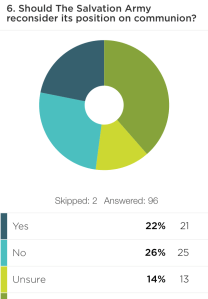
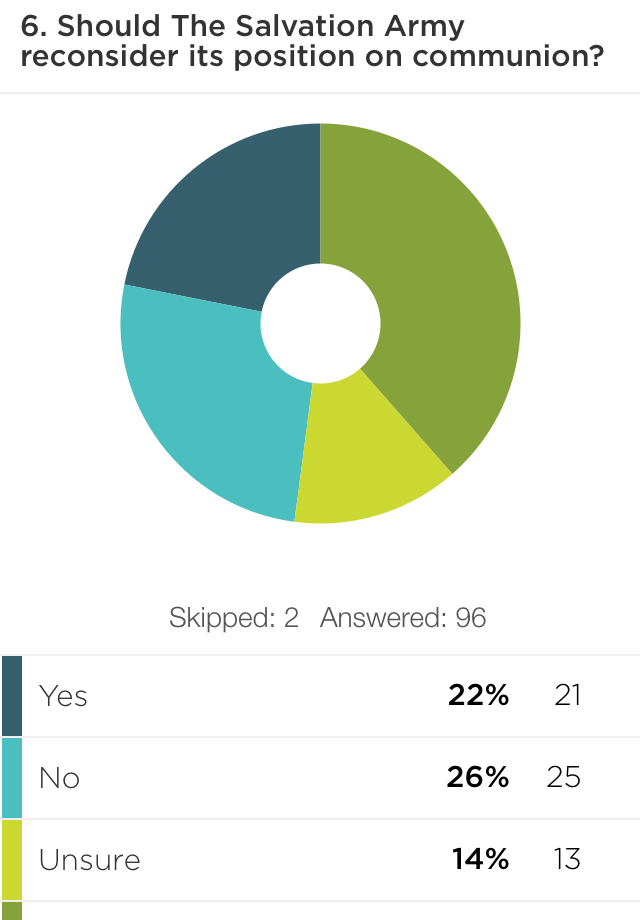
Photo Jul 23, 9 22 11 AM “Should The Salvation Army reconsider its position on Communion?” 

Of those polled –

                        22% said ‘Yes’
                        26% said ‘No’
                        14% said ‘Unsure’

Follow-up question – “If ‘Yes” explain why” (the Dark Green Portion of the graph on left

Responses: 
We are missing out on a beautiful expression of our devotion to Christ.

Our original stance for not practicing communion is no longer valid” 

I hate the prohibition-like attitude towards communion, the mocking from Officers and Soldiers towards those who choose to partake in communion.  I don’t think it should be required but to forbid Officers from administering it is silly – why do we say God can use any space/person/activity to bring Him glory and then put a specific stop to something that does no spiritual harm?” 

It is okay that the Salvation Army does not practice communion, but we lose something by not understanding the practice.  I think the Salvation Army can continue not practicing, but should be more educated about communion.” 

I don’t think we need to change our stance, but I do think we need to know it better so we can teach it better.” 

Don’t threaten discipline due to participating in a SA setting.” 

As (we) will never be fully recognised in places such as South America, and parts of Europe without use of sacraments in worship.” 

Question #7

Photo Jul 23, 9 22 18 AM

“Are there scriptural references that make the practice of Communion wrong?” 

Of those polled – 

2% said ‘Yes’
79% said ‘No’
8% said ‘Unsure’.

Follow-up question – “If ‘Yes” explain why” (the Dark Green Portion of the graph on right

Responses: 
Wrong is maybe too hard a word.  But the passages describing Communion in the NT (the Synoptic accounts and 1 Corinthians 11 for example) describe something far different from modern communion.  The early Church would not recognize what is being done today.” 

1 Corinthians 11:23-32 Paul says it’s a communal meal, says any time we eat together as a church we should remember Christ, and Mark 7:1-23 The elders had decreed how to keep scripture and voided it with their traditions, Jesus charged them with deserting the commands of God and He candidly rejected their authority and called it sin.” 

in 1 Corinthians 11 Communion was addressed but not as wrong.  But that it was being practiced incorrectly.  Paul, therefore, did NOT discontinue the practice, but told the Corinthians how to do it properly.” 

1 Tim 4:7, Romans 14:17

Scriptures like 1 Corinthians 11 make it clear that ‘the Lord’s Supper’ was much more like a “Potluck supper” than the ritualistic emblematic rite that it has become in most churches.  I wouldn’t say that this makes it wrong to do communion, but practice would need to be reviewed.” 

Question # 8

Photo Jul 23, 9 22 31 AM

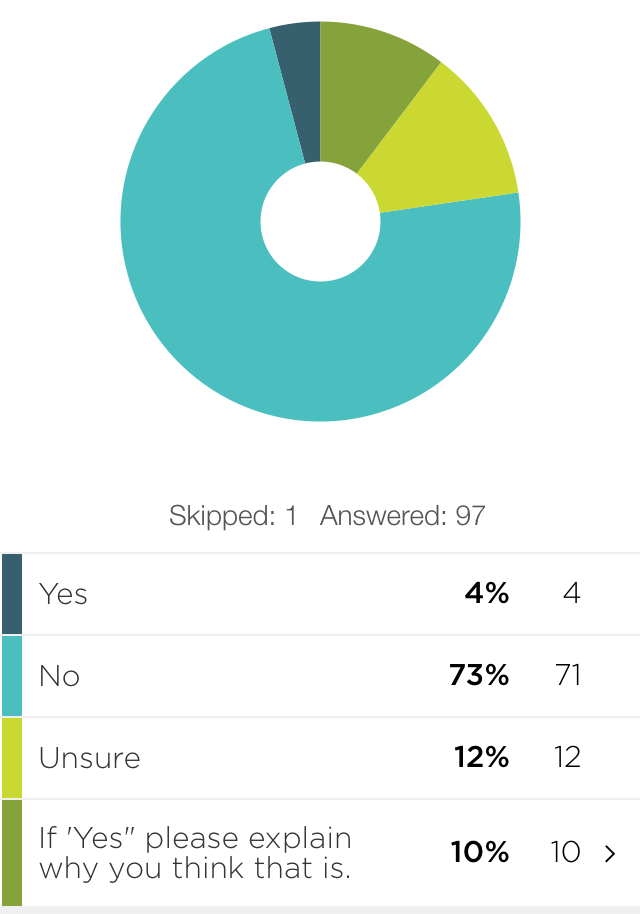
Does the practice of Communion, in your opinion, detract from the emphasis of the workings of The Holy Spirit?  (Within the realms of The Salvation Army demographic)”


Of those polled – 

4% said ‘Yes’
73% said ‘No’
12% said ‘Unsure’

Follow-up question – “If ‘Yes” explain why” (the Dark Green Portion of the graph on left


Responses: 
Communion can easily become a distraction when the focus of holiness becomes the act, rather than the action of the Holy Spirit and the need for personal holiness.  Holiness is foundational to TSA, and its non-sacramental position says something to the Church, and frees the preacher/teacher to explore the range of holiness.

It can.  If we place our trust in ceremony that in and of itself confers grace (that is what a Sacrament is!) then we are excluding the Holy Spirit from being anything more than mechanical.” 

The majority of Army church members didn’t receive their Christian education from TSA.  So you would create chaos for the sake of being like other churches.”

It would create two classes of salvationists.  It would devalue those who do not take part.  The Holy Spirit is impeded by deliberate disunity.” 

“How can we speak powerfully about the sacramental life — EVERY moment can be a sacrament and THEN  turn around and say, but we have this special moment too.  It does not make sense and it detracts from part of theology.” 

Question #9
What did Jesus mean when He said “Do this in remembrance of me”?  (Luke 22:19)

Responses:

When we share in the bread and wine, we are reminded of the suffering of Christ…which He did willingly for you…and me. I love focusing on the suffering of Christ, while partaking…a strong reminder of His great love for me. Words from the old musical, The Witness, tell us in celebrating communion..”take it and eat it, and when you do do it in love for me.

Take time to remember what He went through to bring us salvation.”

Every time you meet round a table remember me.”

There are several answers to this depending on your denominational affiliation(s). I grew up Presbyterian, thus we followed the command that Christ gave to his disciples which was to continue on in His fellowship by practicing communion in fellowship with each other. I was also taught that it is a done in remembrance of his sacrifice AND his returning. I continue to believe this today and take communion when I attend church with my parents who are still Presbyterian – it is very sacred to me and has such a deeper meaning now that I am ordained and commissioned into His service. I continue to stand firm, however, that it is not necessary to my walk with Christ nor in seeking holiness.

He was celebrating the Passover, which was a full (if ceremonial and symbolic) meal. So it either means “whenever you celebrate Passover remember me” or “whenever you break bread remember me.” By the way, Jesus Christ is only recorded as saying that in Luke, and John doesn’t even record the Last Supper. Kind of strange if it was to become a Sacrament as many modern Christians understand it today.

Gathering of believers in fellowship in His name.

Sit down and have a meal together. No ritual, just commensality.


Question #10

“Communion is not necessary for Salvation (this we know) and we should adequately explain this to soldiers and recruits of The Salvation Army, BUT…might we be losing anything in our efforts in avoiding such a practice within our Corps services?  Why or Why not?”

Responses: 

Yes. In thinking of new people coming into the corps family, many have been raised in a church where communion was shared. Many have indicated they do miss this practice in the Army. I have shared communion with women at Women’s camps and have had many thank me and noted how much they missed this sacrament. (I also had a few critics!)

“The only thing we would lose is the togetherness but only if it meant the same to everyone.

Communion is, in my opinion, the first object lesson sermon. It had little or no significance to the Disciples in the upper room when He instituted it. However, communion has become for some, an important aspect of their Christian life. Not because it bring salvation, but because they feel it helps bring them closer to God. Communion is NOT represented well within The Salvation Army, it is ignored and disregarded as a meaningless ceremony. I don’t think ANYTHING that actively calls us to remember Christ, and His sacrifice are things to be ignored or written-off as meaningless.

“I think we lose a lot, it is a real act of worship when the motivation is right, it can assist us in drawing closer to God when we are setting our minds on spiritual things.”

Yes we are, because few officers — not to mention soldiers — understand our position. I have known soldiers who thought they were sinning if they partook! Ridiculous! Our example of emphasizing that which is symbolized above the symbol is sound and, I believe, helpful to the church at large. If we were to ever institute the Sacraments in TSA, it should not be because “Israel wants a king” to be like everybody else, but because we have and teach a thoroughly thought out theology of these ceremonies. And we should NEVER call them Sacraments!”

not if we explain it in a good way.”

“I’m not sure why TSA is so convinced that most people who practice the sacraments think that they are saved by them. I think what is lost is a tangible reminder of our redemption and a physical act of fellowship with our savior and each other. To think that we are above practices that most other churches engage in seems somewhat arrogant and separatist to me.”

One of the secondary motivations for being non-sacramental is our Egalitarianism. The resistance toward women giving Communion to men was absolute in 1865 and could easily be that way today. For the sake of unity we dont practice the sacrements. if we did would people get a spiritually fufilling moment sure, but at what cost? isnt it better to be one church too singleminded in advancing the cause of christ that we make this a non-issue. I believe scripture bears out we keep the rememberance of Christ better than anyone who practices communion.

No. If we are intentional about teaching/preaching/living sacramental lifestyles, then the simple practice of partaking in communion will not enhance our meetings.”


Concluding Thoughts
MY Thoughts…and You Decide…
In concert with Phil Laeger
(Photograph of Holiness table taken by Debby Hudson/Ft. Lauderdale Corps)
We serve a mighty God! AMEN?!

At times man has imposed ritual upon things and places that was never intended to be.  I do not discount the significance for those who participate in Communion, nor do I criticize the act.  It can be a wondrous and beautiful commemoration of what Christ has done for us.  BUT…there is danger in anything losing its significance if done out of ritual and practice without teaching and instruction. 

Secondly I believe this topic to be quite complex and very personal to many people, hence the varying responses in the survey above.  One person even asked, “why conduct this sort of survey won’t it only cause conflict and division?”  This was never my intention and in fact I believe it only serves to display how unique the body of Christ is and how unique each person’s perspectives and convictions are.   

Lastly, if in fact, the original intent of the ‘Last Supper’ and the early Church’s practice of Communion simply meant breaking bread together and eating food whilst recalling the wondrous sacrifice and salvation through Christ, shouldn’t we get back to that?  If this was the origins which became so deeply entrenched in tradition and ritual shouldn’t we reclaim the origin and not the ritual…and more importantly seek to grow in personal and corporate holiness?  Shouldn’t the Lord’s table then be our tables at home as we teach and instruct our children and families?  Anything can become ritual including wearing our uniforms whilst losing any and all of its significance.  

I have more to say on this topic…but I will conclude here. 

So…what do you think?  

Something more for the Army world to ponder today.  


Disclaimer: This survey represents a small portion of our Army and is in no way representative of everyone. We were able to collect a total of 98 responses from this survey (those who participated) and we thank everyone for your responses. Secondly these are responses from people and soldiers of our army and does not necessarily represent the beliefs and personal views of pastorsponderings.org. Thank you for reading and participating.

Dear Salvation Army – You Are Home to Many!

General Booth’s vision for the army was one of safe harbor for the countless souls drowning in the billowing waves of sin.  Today that sea still ebbs and flows, still jostles people about, still causes souls to drown in their depravity.  The Salvation Army is still here ready to pull victims from the waters, prepared to love them regardless of who they are and where they’ve been.   The army has become home to the homeless and a home to others whose “home” was a constant battlefield of alcoholism, drug abuse and physical violence.  

hope1

Reshaping the word “Home”

To many the word “home” brings up anxiety, fear and sadness.  
Many have never lived within a place that was filled with love or acceptance.  


Too often, through abuse and selfishness, children have grown up fearing “home” and have lingered in Army halls and youth programs and even schools because the thought of “going home” meant pain and hurt.  

camp

We as an Army of Salvation can reshape the the word “home” to mean hope and love and family again.  Sometimes it means reporting abuse (which is never easy to do but necessary).  Sometimes it means that we take the initiative and visit the homes of those we minister to in our corps.  Sometimes it means simply being available to youth and even adults who need a place to hang out and someone to talk to.  

I have heard many stories of individuals that came to The Salvation Army because we were open and we became their safe harbor.  In order to escape a less than perfect home they participated in as many programs at the corps as possible and even went to summer camps just to get away.  Through these available programs and through the wonderful summer camp ministries we, unknowingly at times, are reshaping what “home” is to many.  We are replacing the dread and hurt of the word home and in its place we are instilling encouragement, love, peace, joy and hope!  

Be A Home Changer! 
Let us not become prideful in what we can accomplish in the lives of other, but may we continue to strive to be a home changer in the lives of those we serve!  Do not become hardened or calloused by the works of your hands while giving out hope as a precious commodity, instead take the initiative and share Christ’s love regardless of how you feel!  We may never know the kind of impact that we have had on the lives of those we welcome into our corps!  You ARE making a difference for the kingdom through your faithfulness to Christ and in your love for others!  

faith1

The young child who attends a youth program at your corps may one day join our ranks as an officer and boldly declare Christ and give a witness that if not for YOU they would not have known that anyone really cared for them.  You are Home!

The single mom who is broken and burnout on life and still has to make ends meet and find time to love her children may one day declare that if it hadn’t been for The Salvation Army and for YOU that she may have ended her life or simply walked away from her family because the pressures of life and depression had emptied her of the last ounce of hope.  You are Home!  

Be a refuge of faith.
Dear Salvation Army, continue to be that light of hope to the hopeless, the disparaged and  the desperate.  You are HOME to so many!  

The King will reply, ‘Truly I tell you, whatever you did for one of the least of these brothers and sisters of mine, you did for me.‘ (Matthew 25:40) 

Just another thing for the Army world to ponder today.  

Porn-Again Christians The Unspoken Prison

hook

Nearly 30,000 web users are viewing porn each second.

ChristiaNet survey came back with results suggesting that just over 50 percent of Christian men are addicted to pornography. And it’s not just a “guy-thing;” over 20 percent of Christian women are addicted to pornography as well. Coupled with that 37 percent of pastors admit that they struggle with Internet pornography, and 51 percent say it’s a source of temptation. (Source: http://www.christianpost.com/news/pornography-in-the-pew-a-hidden-sin-part-one-59666/)

Pornography is the #1 unspoken sin that is ravaging our churches throughout the world today. This may seem like a strong statement but the effects of such a blight in our congregations and in marriages is staggering. I believe Satan doesn’t have to go far to trap Christian, we are inundated with sexual images every day from commercials to network television…not all images are pornographic but can churn up lusts in our hearts if we allow them to. Proverbs 4:23 says, “Above all else, guard your heart, for everything you do flows from it.” We must guard our hearts by limiting or eliminating the things we allow our eyes to see. You know the phrase “garbage in garbage out”? It evokes this notion that whatever we think on becomes who we are. For example if I wanted to run a marathon I couldn’t just sit on the couch and eat twinkies all day…well I could but I wouldn’t be able to run that marathon that I have set my sights on. I would become out of shape, my muscle mass would be lost and I would have not gained anything because I didn’t exercise discipline.

In the same way if we don’t train our minds and discipline ourselves in what we see with our eyes we will fall prey to the lusts of the flesh. If we don’t guard our hearts against such damaging images and other damaging content out in our world we will fall prey to these sin issues and never grow in our faith. The unspoken prison is more than just porn. What are you reading? What are you listening to? Even these seemingly innocuous things can cause us to consume damaging content that can blur those lines of moral living in our lives today. Be careful what you feast on with your eyes and your ears. Guard your hearts!

Don’t copy the behavior and customs of this world, but let God transform you into a new person by changing the way you think. Then you will learn to know God’s will for you, which is good and pleasing and perfect.” Romans 12:2 (NLT)

chains1

Questions:

How can we fight something so damaiging when no one wants to talk about it?

Is there hope in the Church for porn addicts?

How do we address such an issue?

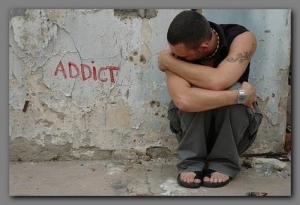
addict


The effects of pornography is not only detrimental to a person’s marriage and other relationships but it can be debilitating to the personal spiritual growth.


If this sin of lust continues to be allowed to fester without getting to the core of the issue, repentance and forgiveness can never be met.

More Statistics:

Did you know that 1.2 million children are being trafficked every year; this is in addition to the millions already held captive by trafficking (UNICEF)

Why would I include this statistic? Because the dark(er) underbelly of the porn industry is that it supports human trafficking and human slavery. Pornography and its use drives up demands for trafficked humans. Did you know that? This is certainly a disturbing conversation, yet this topic needs to be discussed in our churches.

Christians who are addicted to pornography need to know the dangers of this hidden sin! This unspoken prison to many needs to be brought out into the light! Many are struggling today within our churches with this enslaving addiction. The porn-again Christian can find help. We shouldn’t want to pass judgement on anyone, that isn’t our place, but we as Christ-followers need to be a source of hope and encouragement to help live lives accountable and live holiness. I do not have all of the answers but there are many sources out there that can help someone who is struggling with this unspoken prison today. Let me speak directly to anyone who is addicted to porn today: You can be free of this burden! You can find hope and deliverance from your addiction! I have included below a few weblinks that anyone can check out that might help anyone get free from these bonds of your unspoken prison.

Additional Articles & Resources to check out:
http://www.todayschristianwoman.com/articles/2001/may/my-husband-was-addicted-to-porn.html

http://www.feedtherightwolf.org/

http://www.xxxchurch.com/
http://www.breakpoint.org/bpcommentaries/entry/13/25714#.U8_gQBRtyEk.facebook

Something more to ponder within our churches today!

Dear Salvation Army – On Authoritarian Leadership – Healthy Model or Faulty Model?

authority

“Power tends to corrupt, and absolute power corrupts absolutely.”

I have heard it said that the leadership model for The Salvation Army is authoritarian, meaning it is a hierarchical model of leadership. This system of leadership is modeled after the military not only in ranks but also in orders and regulations. One could argue for or against this type of model quite easily, but that isn’t the intention of this article. I would, however like to explore the affects of this type of leadership model within our corps ministries, divisional and territorial ministries.

general

The Good:

We have a chain of support and clearly outlined protocol to follow. There is no question who is in charge within this leadership mainframe. A Corps Officer reports to his or her leadership/department head either the divisional secretary/general secretary and then the divisional commander. This model insulates and protects all involved. We all have a chain of command to report to which keeps things moving and hopefully progressing within our mission to “meet human need in His name”.

The Bad:

obey
Abuse of power sometimes takes place within this leadership model. If accountability (which is paramount here) isn’t utilized for both subordinate as well as superordinate, then respect as well as power will deteriorate. I do not begrudge those in authority over me. I recognize the biblical truths to godly leadership and that of servant hearts for both leader and one who follows. However when abuse of this relationship takes place, as it sometimes does, it can and will disrupt the fellowship and mission of our Army.

highway
Questions to ponder:
Is Authoritarian leadership the model Jesus utilized with His disciples? Is there a negative impact to this style of leadership model? Catherine and William Booth founded The Salvation Army in the Victorian era, that being said, is this model of leadership still the best style to follow? Don’t misunderstand these questions or my intent. I merely ask them to get our minds thinking on the bigger picture.

How do we overcome the “my way or the highway” mentality within such a leadership model? Do/can we stunt the growth of those we lead within authoritarian leadership? Do we limit or control “questioning” leadership in a healthy way? Is questioning leadership a bad thing? Is punishment still dispensed to some subservient members of our army when they have questioned leaders who have felt threatened (perhaps by their own insecurities)?

Unhealthy Dependence – The Corps Level:
One of the detractors of the authoritarian model within corps ministries is an unhealthy dependence on the corps officer to do everything. This may not be true of every corps but many have been led by very strong leaders in the past but perhaps these leaders were not equipped or interested in discipling and honing proactive leaders within the local officer base. One of the unhealthy side effects of dependence is total dependence on the Officer to plan, execute and control the local mission. Though there is some merit to this, Officers ought to be skilled in the area of delegation, and have a willingness to develop a healthy team of leaders who are willing and able to lead in and of their own right.

Corps Officers still should maintain a level of authority but Officers shouldn’t be expected to run everything within the corps ministries. For far too long new officers would come into many of our corps newly appointed there and find that the Officer was expected to run, lead, plan and execute everything. Shouldn’t this corps ministry be a shared venture? Shouldn’t our teams of local officers have more of a say in the local mission having served and lived within that community for most if not all of their lives? Who better to understand the pulse of that community than the local officers? That being said Officers should also be mindful to appoint proactive people for these local officer positions. It may be very easy to appoint “yes” people who will do as we say, but is that what your corps needs? This doesn’t mean that we should appoint strictly “no” people but rather select the strong leaders who are willing to make hard decisions and at times disagree with leadership and differing visions and plans. This kind of healthy conflict sharpens iron provided it is done with in a manner of respect and love with the mission ever in focus.

The unhealthy dependence on the Officer in some corps leads to frustration and burnout to some who lead. Secondly the danger of authoritarian leadership within the corps is that corps members stop thinking for themselves. Unhealthy dependence on the Officer can also lead to a stagnation of internal vision and a crumbling mission for outreach and evangelism. Having a shared vision with multiple team leaders within a corps usually indicates a collective thought process but also strong individuals willing to shoulder the burden as well as encourage and push one another on to greater things within their ministry.

leadership
Authoritarian Leadership of Officers:
For far too long our Army operated under the old iron fist which, at times was more concerned about the mission over the individual needs of its officers and families. For far too long the “My way or the Highway” edicts were handed down to officers from above, and to question was to be punished. Sometimes compassion seemed vacant. Some officers felt trapped, for to relinquish their role within the army meant that they were turned out with little to no personal affects or possessions. At times appointments were made to send a message to some who had perhaps disobeyed…dare I say this practice still occurs. Yet…I am hopeful. I am confident. I am willing to go out on a limb and proclaim my faith in a new army. Not a compromised army. Not a “soft” army. Not a complacent army. But a compassionate army. A more loving army. An army that finally gets it. An army that finally see the investment in its officers. An army that finally begins to shepherd its officers with more care and more effort and more expressions of pastoral edification. After all, who shepherds the shepherd? Who cares for the hurts of officers who in turn have to shoulder the care of many, many broken people in their corps? I am hopeful in this army. THIS is the kind of army I WANT TO BELONG TO! This is the kind of army that will see less and less of an attrition rate among its ranks…if they are cared for and shepherded in this way and not with an iron fist. I am confident in leaders who will rise up and learn from past mistakes. I will boldly follow such leaders who take into account the hurts of hurting officers. I will serve faithfully and love fully those leaders who take the time to listen, truly listen to their officers. Our army needs more and more leaders who are servants first and holy…Lord we need more holy leaders in our midst! Our army needs more leaders who will lead with compassion, who won’t play favorites, won’t entertain the follies of gossip, will maintain respect and integrity and will make the prayerful hard decisions not because they are popular but because they are right.

ServLead_framework-01

If we are growing we are always going to be outside our
comfort zone.
” -John Maxwell.

Perhaps we need to grow a little…we still have room to grow, right?
Perhaps we’ve remained in our comfort zones for far too long.

Probably more questions, but also more for our army to ponder today.
We cannot become what we need by remaining what we are.
― John C. Maxwell

WARNING…Dear Salvation Army, We Are Losing Our Young People!!

"Pasadena Tab Youth Chorus at IHQ"
“Pasadena Tab Youth Chorus at IHQ”

It is a common scenario: An Officer family moves into an inner-city or even rural appointment and finds little to no adult role models that they can trust to instruct their children. In a similar situation a married couple joins the Army corps to serve and to help but also finds little by way of adult, spiritually mature, role models to guide their children while at the corps.

Yes, it is a parent’s job to train their children up (Prov 22:6) but are we lacking strong, spiritually mature leaders within our corps today to assist in this? Is it detrimental to children of Officers as well as families coming into corps who encounter this problem? Where have all of the godly Local Officers and Saintly Sunday School/Corps Cadet teachers gone? Admittedly many of them have been promoted to glory after decades of faithful service…but the question remains why aren’t others stepping up to lead? Where have all the saints gone in our corps?

I have heard from a number of faithful local officers as well as Corps & Divisional Officers who share this sentiment. What are doing wrong? Why are we losing so many pillars only to have no one to take their place?

edification

Edification of our Youth:
We mustn’t neglect this portion of our ministry! As an Army, we are losing young people in droves as they become young adults because there is little keeping them at our corps. This is one of the biggest threats facing our modern Army world. Who will step up to lead them? Who will hold them to godly standards? How can we stave off such a tremendous loss?

We need strong local officers! We need discipled leaders! We cannot settle for warm bodies in Sunday School classes solely because they “show up”. This is an epic crisis. It might not be felt currently in some of the larger metro corps where leadership is in abundance, but drive a few miles away to one of the younger supporting corps or further out into some of the rural communities and this crisis will become more and more evident.

An extension of this crisis begins to reveal itself in local officers, who are spiritually mature, who are there to help serve, who have children at the corps and are beginning to question if, perhaps, it is time to find another ministry to belong to because the edification of the youth (and specifically their children) is sadly vacant due to the lack of leaders.

soldiers1

Are we doing something wrong?
Have we lost a step?
Can we recover from this?

Solutions:
It is certainly not my intention to criticize or direct any blame without attempting to offer some kind of solution or corrective steps. I will be the first to admit that I do not have all of the answers here, but I do want to begin asking these very important questions. What I do know is that if something isn’t done to help local officer families and Officer families, a large portion of the next generation will be lost to the Army…and it has already begun.

truth

We have territorial and even divisional events to send our children to, but coming home to a corps that lacks the kind of leaders our children are seeing at the divisional or territorial level can be debilitating and discouraging. It is rather telling of the quality of leaders we may have when we have to employ our teenagers to teach a class because none of the adults are equipped or mature enough to handle this responsibility.

Solutions

Solution #1 Discipleship, Discipleship, Discipleship!
For years we have done our corps a disservice by not adequately discipling our adults and youth properly. Jesus instructed and lived out model discipleship to His followers. Officers and currently leaders need to continually think of who will replace them when they are gone…who will follow in their footsteps? Who will carry on the legacy? Who can WE train up? We must invest our time in those who need to grow and have the potential to become leaders so that future generations will have someone to look up to and emulate within the corps setting.
Solution #2 Divisional and Territorial Support
A few years ago the Eastern Michigan Division created a program called “The Ambassadors Program”. What this program did was take young adults and send them out into corps that needed young leaders and role models within their youth programs. They helped conduct lessons, tutored young people during after school, played sports with them in gymnasiums, in essence they became mobile young adult disciples and role models. We need more mobile young adult discipleship programs that are sent out into these frontline ministries and rural corps to help with the mission! We need to consider such opportunities as a two-fold solution. (1) The young people being sent (Ambassador or Disciple what ever you call it) are learning how to become strong(er) leaders of our Army by actively participating in ministry as a divisional missionary! They learn through hands-on training and it is a trial by fire. (2) The youth that these Ambassadors/Disciples are instructing and taking under their wing begin to see active and loving leaders who are committed to the Lord and have a passion for what they do! This is the kinds of role models our young people in problematic corps (where leadership is vacant) need.

There are probably many more solutions out there to help with this crisis. My hope is that in writing this and sharing my frustration and fear others will begin to offer ideas and share further solutions. We are losing our youth in the Army. We can probably all share in the blame. Beyond the “blame game”, however, we need to get up, we need to mobilize and begin developing leadership networks to help properly instruct our youth once again so that we do not lose another generation and their parents who are currently testing the waters of other ministries.

Something else for the Army world to ponder today.

keep-calm-and-soldier-on-58

Dear Soldier, Just Quit, You Can’t Possibly Win…

Brazil-Vs-Germany-Semi-finals-World-Cup-2014

World Cup – Brazil Vs. Germany

I watched the World Cup yesterday and witnessed what many are calling the worst lopsided game in World Cup history. It started off quite competitively. Each team was passing and pushing the football into each other’s territory, and then something happened. First the German team scored one goal, and then another…and finally another all within the first twenty nine minutes of play. Before the first and even second goal, the Brazilian soccer team were running and fighting for the ball, they were pressing and forcing plays…then it all changed.

Before the third goal there was fight in their eyes, they were serious about playing the game, and more importantly they were still serious about winning. But…by the third goal, that “fight” look in the eyes had completely evaporated. The effort to press and to win had dissolved as well. The camera panned into the mostly Brazilian crowd and there were tears and weeping, shock and dismay, sadness and grief. It was visually epic, yet disheartening as well. They had been a team with such promise and now they were floundering around, lost, defeated and numb.

The game ended with a historic defeat of 7 – 1. But the game was truly over before halftime. I knew it and so did those watching in the stands. It was all in the eyes. The fight was there, and then it was gone surrendering itself to sunken hearts and defeated souls.

So what does this have to do with Salvation Soldiers? What could football possibly teach us in The Salvation Army? Here’s an epiphany that I had while watching this historical match – Satan would love nothing more than for Soldiers of the Army to capitulate, to pack it in and to walk away from this spiritual battle that we wage. In fact he attempts to convince us everyday to “just quit because there is no way of winning.”

the "fight" had left the fan's faces as well...
the “fight” had left the fan’s faces as well…

Has the fight gone out in your eyes?
It was a very sad moment when I knew that it was all over for Brazil. That fight had gone out in their eyes. Conversely, I have seen soldiers who seemingly walk around having lost the fight in their eyes. Dare I even say that there are Officers in our army who walk around having lost the fight in their eyes too. Perhaps, at times, we have bought this lie from the father of lies. Perhaps we have encountered an obstacle in our ministries and we have failed miserably. Perhaps we barely salvaged the burning wreckage that is our pride and dignity but we have little else to show for our efforts.

There have been times in my ministry that I have felt the burning sting of defeat because soldiers and fellow comrades of the cross have walked away surrendering their uniforms and even their faith. How it hurts the very heart of God when our ranks buckle under such adversities. Has the fight ever gone out in your eyes? Are you nearing that point right now? Perhaps the pressures of appointment has taken its toll on you. Perhaps it seems that the enemy is winning and you were never capable enough to handle this battle. Perhaps you, as a soldier, have witnessed officers come and officers go and the corps never seems to get any larger and a community still seems unreached.

soldiers fighting

Is it really about us winning?
Is that all that matters in our army? Have we solely hedged our bets on statistical success as we lean covetously looking over the fence at other ministries who are booming and exploding with numeric success? Are we walking around with vacant stares singing the old battle songs of our army while the “fight” in our eyes is strangely missing? Have we lost a step as we utter the words to “keep in step all the time”? It was never about how good we look in our uniforms. It was never about how one man and one woman founded such a movement.

It has always been about faithfully allowing God’s holy presence to prod and to prompt us into action. It has always been about God’s glory and never about our glory! It was always about God’s victory, not our victory, though we share in His mighty triumph. Somewhere along the way, perhaps we lost that fight in our eyes because we lost sight of Him. Perhaps somewhere along the pathway of duty we became so focused on “meeting human needs” and worrying about public perceptions that we forgot the “in His name“. I don’t mean to say that human needs are not important but if we do these workings without the passion and fight of Christ behind them, we might as well become just another charity without mission and heavenly aim.

captain

I have seen that look in those footballers eyes in many places in our army. I have seen them in local officers who have served faithfully for years yet question if they have ever produced enough fruit for the kingdom. I have seen them in the tired eyes of officers who, after long days of raising money at Christmas kettles, come into corps where a spirit of dissension and sin has become rampant. I have witnessed that look in the eyes of battle weary employees who wonder how many more days they can make it as the need never seems to find an end. I have even seen that look in the eyes that stare back at me in the mirror from time to time.

Oh dear Soldier…do not buy the lie from the father of lies!
Don’t allow his cunning words and slippery speech to invade your hearts. There will be days when we see defeat. There will be moments where we feel like packing it in. We may even consider walking away from it all…but don’t. For what really matters is faithfulness first to our God, no matter where and with whom that takes us to. Are you prepared to fight on despite the opposition’s tauntings? Are you ready to get back on your knees and wage a spiritual battle that involves more than just our human gifts, abilities and talents? The battle truly does belong to the Lord! If you have exchanged the victorious look of a soldier for that of defeat then get back your knees! Without our humility, supplication and penitence we will be nothing more than a hollow uniform taking up space in a slowly diminishing corps hall.

fighting on

Soldiers of our Army…get back into the fight! Pray in earnest for His victorious might! It has never been about what we can do, but what the power of the Holy Spirit can do through selfless servants of the cross! Do not give up, do not listen to Satan’s lies, face Christ and embrace His victory! Look into the enemies eyes and declare “the world for God!

Something more for the Army world to ponder today, to God be the glory!

Article is also available here – http://salvationist.ca/2014/07/keep-the-fight-alive/

A Slow Death In The Church…

Some churches die suddenly because of disagreements, immoral behavior, and financial ruin. It is a tragedy when God’s bride falls victim to sin, arrogance and pride. What should have been a beacon of light to those still wandering in the darkness without hope has become a victim of the father of lies and to sin. It truly is a tragedy!

There is another kind of death in the church. It is a slow agonizing death, the kind that begins with seemingly harmless words, behind the back comments, and half truths that go unchecked or verified. The idle, never edifying chatter of assumptions and sometimes made up notions. It is a coward’s conversation because very rarely do those suggestions fall directly on the ears of its intended target.

On the topic of gossip and the tongue:
“…Look at the ships also, though they are so great and are driven by strong winds, are still directed by a very small rudder wherever the inclination of the pilot desires. 5So also the tongue is a small part of the body, and yet it boasts of great things. See how great a forest is set aflame by such a small fire! 6 And the tongue is a fire, the very world of iniquity; the tongue is set among our members as that which defiles the entire body, and sets on fire the course of our life, and is set on fire by hell.…” -James 3:4-6

Confession:
I have been both a victim and at times a proprietor of this deadly vice. When this harmful drug of choice enters the church it (sometimes it has already been in your church for years and years) can lay waste to integrity, honesty and even our moral compasses. How damaging and hurtful gossip, slander and biting words can be to fellow believers in Christ. Brothers and sisters, we ought to know better yet why do we allow this sort of thing to continue? Why allow it to remain? I have been deeply wounded at times because of the words of other Christians…and dare I confess, a time or two I wished I could have withdrawn the words that flew swiftly from my tongue and past my lips before I could catch them.

How devastating such a small thing can truly be.
Is there a cure? Some sort of remedy? Can we stave off this infection before it consumes and kills us? Gossip slander, and malice WILL kill the Church slowly, agonizingly yet just as deadly as the instant immoral failings. This cancer of the verbal kind can be treated…it can be stalled, maybe even cured.

fire2

The Remedy:
Here are a few verses to remind us of this remedy –
Let no unwholesome word proceed from your mouth, but only such a word as is good for edification according to the need of the moment, so that it will give grace to those who hear.” Ephesians 4:29

And now, dear brothers and sisters, one final thing. Fix your thoughts on what is true, and honorable, and right, and pure, and lovely, and admirable. Think about things that are excellent and worthy of praise.” Philippians 4:8 (NLT)

For lack of wood the fire goes out, and where there is no whisperer, quarreling ceases. As charcoal to hot embers and wood to fire, so is a quarrelsome man for kindling strife. The words of a whisperer are like delicious morsels; they go down into the inner parts of the body.” Proverbs 26:20-22

Don’t allow these embers to burn. Don’t linger in the company of those who wag their tongues and scorch the earth with their words. Such thinking and speaking are never edifying to the body of Christ and with it the church will die a slow death. Think on the edifying things. Remain true to our calling. Do not become bogged down by the negative thoughts and words in regards to others. Be a source of hope, light, goodness and grace to fellow believers as well as those who have yet to believe. We ARE the body of Christ…so start acting like it.

I have been equally guilty of this slow death…have you?

Prayer: Dear Lord, forgive us when we have failed you and fallen victim to the trappings of a loose and slanderous tongue. Forgive us when we have hurt You and those You have created in Your image through gossip and thoughtless words. Guide us on the pathway of right living and right thinking so that we can be a more effective source of Godly love to the world around us. Help us to serve You through our thoughts, words and deeds. Restore us, renew us and make us Holy. -Amen.

Something else for us to ponder today…

“You’re Reading It Wrong” – 2 Mistakes of Interpreting Scripture

Image

Admit it, at one point or another you have misinterpreted what the Bible has said.  Sometimes we do it by accident while other times our intentions are quite clear.  

The Bible was written by many different people, but we do believe that the Bible was “God breathed”.  That being said, Jesus was the only perfect human to have walked the face of the earth, therefore all other people, including those who wrote the bible, were imperfect.  Each writer experienced life through their own filter and each writer faced their own imperfections.  This doesn’t mean that all the writers of the Bible were bad people, but rather that each struggled with the realities of life and with their own humanity.  Understanding this is important when we read the Bible.  Though we know that God is the same today as He was in the past as well as the future – He is being written about through the life experiences of very human (sometimes very earthy) people.   

This brings me to my point – be careful how you interpret scripture!  Many cults have begun just by taking one single passage in the Bible out of context and applying it to something it was never intended for.  If we are true seekers of The Way then we will want to pay extra attention to the ways we apply scripture and its meanings both then and today!  There are two mistakes that I would like to highlight today for us here (I know there are more) and I hope it will help you as it has helped me. 

2 Mistakes of Interpreting Scripture: 

Image

1.  Context – 
New Christians and even “seasoned” veterans of the Word often do not do the “homework” when reading passages in the bible.  The context of what is written is vital to our interpretation of what is being said.  I have known people (myself included) who at times have simply opened the Bible and pointed to a passage and thought “this verse was meant for me” without studying the initial context.  Of course God can work that way but we should spurred on to really study the deeper meanings and implications of what is being said.  

Questions to ask when studying a passages might include: 
      a.  When was this written?
      b.  Who was this written to?
      c.  Why was this being written? 
      d.  What did it mean for the people then? 

Once we have asked these questions (and possibly more) we can then ask the question – “What does this mean for me today?” 
Context is extremely important!

2.  Culture

Image

Culture in the Bible was vastly different from our culture today!  This doesn’t mean that the Bible is obsolete or out of date it simply means in order to interpret the Bible correctly we have to understand the culture of biblical times.  For instance in Jesus’ day Women were not equal to men nor did they possess many of the rights that men possessed.  Jesus was counter-cultural (even revolutionary) in His day to include disciples who were Women.  

Secondly this becomes apparently clear through the writings of Paul when He says things like – “Women should remain silent in the churches. They are not allowed to speak, but must be in submission, as the law says.” 1 Corinthians 14:34  To understand this we need to understand the Apostle Paul a little bit more and also the context of what is being written.  Paul addressed numerous issues in the early church including a few women who were causing trouble and creating dissension.  The problem becomes worse when many traditional churches take these specific passages of scripture out of context to mean in our day and age Women should act the same when in fact Paul was writing to very specific situations.  There is a danger in painting with large brush strokes here because then we begin to lose the detail and meaning of the words written in Scripture.  

Culture played a big part in biblical times and it still does today.  That doesn’t mean that culture shapes the Word but rather humanity continues to change and alter yet Biblical truths and the words of God are always consistent despite the seemingly inconsistencies of some of the biblical writers.  Make sure when we interpret scripture that we attempt to understand not only context but the culture of the time that passages were written.  


Wrapping it up

Image

Be careful not to take liberties with scripture!  Don’t pick and choose passages that best suit your needs, but rather read it for what it was intended for.  Some are historical narratives, others are prophetical for a specific people and time, while others are meant for instruction of an early church.  One truth should always stand out above the rest:  God desires a right relationship with us.  Throughout the Bible God is always seeking this with those who encounter Him.  There is punishment for those who disobey yet a remnant always remains because God never gives up on us.  In the finality of things Christ comes into full view and we can see just how far God’s Divine love will go to reach us.  The rest of scripture leads us to this place through some very imperfect writers and people – and so are we.  

I could write so much more on this topic…but for now I am thankful to the many instructors and teachers that I have had along this journey…and I am still learning.  

Just something else to Ponder today 

The Salvation Army – Women in Ministry…are we as Progressive as we think?

Image

Please don’t misunderstand my question.  I don’t mean to incite a riot or start a fight.  It’s a genuine question that continually needs to be re-examined.  

If the question was – “Is The Salvation Army more progressive than most churches?”  The obvious answer would be “YES”.  Absolutely we are progressing more rapidly than most churches, but we aren’t most churches are we?  Our mission is slightly different than most churches.  We adhere to communities of lost, need, poor, broken and we will use any and all available personnel in the trenches.  We are certainly progressive in the utilization of women in ministry.  

Image

But…

if the question asked – “Is The Salvation Army as progressive as we can be?”  I would have to say “no”.  
Certainly we are absolutely heading in the right direction.  Certainly we have made great strides in the egalitarian department (wait we don’t have that department yet at THQ?…sorry I couldn’t help myself).  

But…

When it comes to leadership and the selection of leaders how progressive are we then?  

Image

One can make the argument that our last General was a Woman – and I couldn’t argue with that.  One can also make the argument that more female leaders are being appointed to key leadership roles.  However, there are still appointments that occur that make me scratch my head.  Don’t take this the wrong way but sometimes gifts are seen in one of the married couple but the other partner in the marriage is appointed to some odd appointment or a place that they lack any gifting.  

Perhaps it’s not always inequality in the sexes, perhaps its because of specific giftings that are seen in one of the married couples…let me just be frank here – not every female officer wants to be appointed to the women’s ministries department, or the community cares department or another department that didn’t exist until recently.  As I say this it should also be noted that the same can be said of male officers who are appointed because of the giftings of their spouse.  We as an Army are getting better at this but we still have quite a ways to go as well.  

Breaking Old Molds

Image


Old excuse: “This is the way we’ve always done it
This excuse isn’t exclusive to corps deeply entrenched in traditions but is also evident in certain leadership models.  Others would say it another way – “If it ain’t broke don’t fix it”…but sometimes what that means is if it appears nothing is broken…sometimes we don’t see the fractures that have appeared over maintaining the “status quo”.  Sometimes we gloss over these cracks with fresh enamel of “Salute and go”.  

Officers are still people! 
They have hurts, aspirations, ideas, gifts and abilities.  Sometimes these gifts and abilities compliment the marriage team, and other times it is best to allow them to serve in separate appointments.  Every person regardless of their marital status is unique and can operate in many different appointments.  Their voice should matter in appointment decisions.  I recognize that more than ever Officers are being listened to.  I’m also not a fool in to thinking that Army politics “never” plays a part in some decisions that are made.  But if The Army is truly interested in stopping the attrition rate in its Officership core then intently listening to its officers should be at the top of the list.  

Humbly Serve!

Image

“He has shown you, O mortal, what is good. And what does the LORD require of you? To act justly and to love mercy and to walk humbly with your God.” (Micah 6:8).
We are, without a doubt, saved to save (and yes saved to serve)!  Humility doesn’t mean that we don’t discuss our gifts.  Humility doesn’t mean that we don’t sometimes disagree with decisions made.  Humility doesn’t mean that we are “happy” all the time.  But it does mean that where THE LORD leads we will go.  That’s why it is imperative that both leadership, department officers, corps officers and other officers appointed else where serve the Lord first, seek His face, pray earnestly, do what He says, and from that right relationship – lead in whatever capacity is appointed to us.  

Thoughts and Questions:
How progressive should we be when it comes appointments and gender? 
Are we there yet? 
What are the indicators that will be present when we have accomplished true egalitarian ministries? 
Does “pigeon-holing” in the appointment process still take place today?  
How can we change this? (Can this be changed?)

Here’s my purpose for writing this today.
Not to cause trouble…that’s not my intention at all.  Not to ruffle feathers – sorry if I did.  
Not to sound militant or rebellious – I will serve as the Lord leads me.  
But…
Jesus had female disciples in a very male dominated world.  He was progressive in ministry and egalitarian in his choice of followers.  Shouldn’t we be as well?  We have made great strides thus far in our Army…let’s not stop now!  

-Just something else to ponder today. 


Blog at WordPress.com.

Up ↑