Dear Salvation Army, The Voice of Dissonance?

Is there such a thing within our ranks as a dissonant voice?
Is this even something considered?
Sometimes I wonder if individuality can be present within a quasi-militant organizational model such as ours.
Is there ever a place for such a voice?
Can iron sharpen iron without healthy friction?
Is punishment instantly doled out to those with a conflicting voice?

By dissonant I don’t mean a voice of extreme dissent or open rebellion, I mean one who has constructive things to say to the organization as a whole…is this possible?  Does that voice really matter?  Does the Army still need dissonant voices?   Will those voices really make a difference?  Or does it sort of resemble this:

200255304-001

I do not wish to throw gasoline onto a fire.
I do not wish to lick an open wound (I know, gross euphemism…sorry).
But I do wonder what sort of place these dissonant voices have in an army that often times spurns abnormal or divergent (sorry book/movie series) soldiers?

audioWorst Case Scenario of Dissonance:
Divergent, dissonant voices are expelled, sometimes publicly, sometimes quietly with little to no fanfare.
They are driven further and further away from sources of influence and squeezed until they either capitulate or comply to the common “group think”.   Hence the “my way or the highway” leadership model.  Decisions made by leadership within this scenario do not handle constructive criticism of any kind, and will lash out and punish anyone who raises pertinent questions that challenge the present leadership and its decision.

Best Case Scenario of Dissonance: mic
Divergent/dissonant voices are listened to, constructive criticism is welcomed in order to make the Army better.  Leaders still lead and make the decisions but welcome other voices to help make the organization better.  One can still agree to disagree but without the fear of retribution of faulty, insecure leadership.  The best case scenario is not the easiest for the organization, but would preserve its constituency while providing ownership to the “group”.   BUT…Pick Your Battles!
pickDissonant voices can become just like traffic noise if not careful on what battles are waged through constructive criticism.  Traffic noise is loud and indicate when someone is coming, but if you constantly live with the noise, it will eventually become tuned out and ignored.  If one constantly challenges authority and argues with every voice of reason and “unreason” that voice will eventually lose all power and credibility.   If you must challenge authority and leadership…pick your battles and make sure you look for traffic!

Organizational Questions to consider:
Are there times when the voice of dissonance is needed in our Army?
What can one do to ensure dissonant voices of concern are listened to?
How can we tell when we have become the one in need of listening instead of speaking?
Does this army have room to grow and to become better defined and equipped?
How does one know which battles to pick?
When does pride become our blinder and prohibit us from seeing the “big picture” or the “other side”?

Photo Mar 23, 5 21 28 PM
The Resonating Dissonance…

In the grand scheme of things, The Salvation Army was born from such a voice.
William and Catherine Booth began this mission because it seemed that no one else would.
They moved from the “accepted” group think into something new, and the transitional go between was this voice of dissonance.  Jesus was a dissonant voice in His day.  He, at times, upset the “group think”.  He challenged the “law”.  His way was obviously divine, life saving, deeply personal and yet salvation for the whole wide world.  How can we become a resonating voice of dissonance in our world?  How can we bring into the focus the need to become better aligned with Christ?  How can we align our harmony with the orchestra of God?  Can this army thrive within THAT voice again?  I believe that we can.  I believe that it isn’t too late for that.  May we strive to be an ever forward moving army!  May we guide the wounded hearts to Christ.  May we never stand in the way of His Holy Presence and His moving in this body of Christ!  May we use our voices both as individuals as well as an Army to make the name of Christ resound, so that hope is given, love is shared and joy, unspeakable joy is forever dispersed among His people.

Something more for this Army to ponder today.
To God be the glory!

Dear Salvation Army – 3 Questions To Ask Before Becoming An Officer

Dear Salvationists,
this is not 3 “magical beans” reminiscent of Jack and the bean stalk, this is simply an exploration into officership.

The Truth:
Officership is not for everyone.

The Lie:
In order to live out my calling as a Soldier I MUST become an Officer.

I do not say this to discourage anyone from becoming an officer, please do not misunderstand me.
I wish to dispel the myth that in order to be fulfilled in ministry within the army one must ALWAYS become an officer.
I do not wish to undermine anyone’s calling either.
If God has specifically called you into Officership, then by all means fulfill that calling!
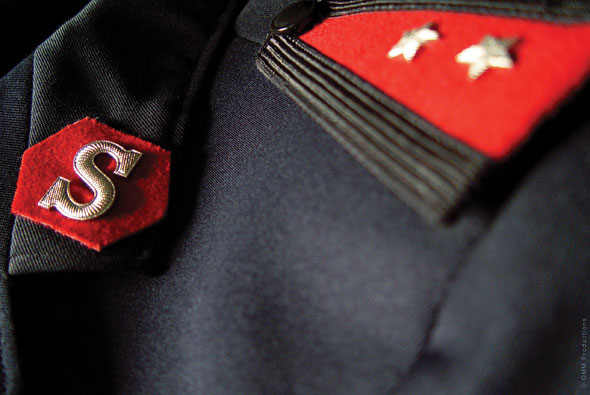
There are, however, some within our army who feel that in order to do more and be more they must become officers only to discover that this was not the right choice for them.  I believe this certainly does contribute to the continued and troubling attrition rate amongst officers.  One way to address this issue (loss of officers) is to ask the hard questions prior to becoming an officer.  Sometimes, not always, individuals enter training with a pie in the sky, unrealistic concept of what Officership looks like, or should look like, and then when they are sent out to appointments reality hits and they begin to say to themselves “this isn’t what I signed up for”.  THQ and DHQ are very good at reminding officers of the covenant that they signed (sometimes too good) but in all honesty some consider this covenant as just another hurdle to become an officer and wear that red trim.

Understandably, the screening process and testing done for prospective candidates has become more elaborate (depending on the territory, it will vary).   With these benchmarks in place it does help to process “qualified” candidates.  In saying this, I recognize some might take offense to this, perhaps because they did not “qualify”, or are currently in the process of becoming an accepted candidate.  To some this is frustrating.  The testing process, like many things in life, is not perfect.  Individuals have potentially made the screening process only to phase out in training or eventually leave the work for a multitude of reasons.

Putting that aside, please allow me to share three important questions one should ask themselves before committing to Officership.
DISCLAIMER: These three questions are merely primer or starter questions and are not meant to be all inclusive.  There are many more variables to consider before taking that important step, but here are three suggested questions to consider:

questions13 Questions To Ask Before Becoming An Officer:

#1 Why do I want to become an Officer?  
When we ask this personal question of ourselves we can hopefully draw some conclusions as to our purpose and intent for wanting to become an officer.  Be honest.  If you can’t be honest with yourself, then who can you be honest with?  Answering this fundamental question of officership can help to further clarify your personal goals in life.  If you feel as if God has specifically called you into this then that should be your answer.  uniIf you don’t know why you want to be an officer – that is your answer (as murky as that is)…and so you explore that possibility.  If you answer this question on the basis of relatives who are also serving in the army and you signed up because it is comfortable and familiar to you – there’s your answer.  I am not saying any, other than God calling you, are completely wrong reasons but they do become the catalyst for what kind of officer you do become.   Perhaps make a list of all the reasons that you want to be an officer, jot them down on a notepad so that you can better see them.  This might help you make a comprehensive decision and not one that you might regret if you enter into this decision half-hearted and unsure.

pray#2 Have I prayed about this?
Another honest question to ask yourself.  Not to scare you or anything but this decision is a big one!  It will impact everything that you do in life.  That doesn’t mean that you can’t change directions later, but it means that you can make the right choices at the onset by simply and prayerfully considering this decision.  Please note that I am not discouraging anyone from becoming an officer, in fact if anything I am pleading to anyone considering taking that step to do so with prayerful consideration which involves the Lord throughout the process in a daily walk with Him.

Start a prayer journal if you’re a writer or can better connect to God in this way.  For some of us articulating these emotions upon the page can help us sort through our spiritual decisions.  Have others pray for you as well.  This is probably obvious, but take the time to ask the Father for guidance.  Be specific.  Pray for support and the proper guidance of other people.  Pray and don’t hide any motives from God, because naturally He already knows our hearts.

#3 Can I Live This Life of Submission? jesus
This is the Officers Covenant that is signed while at College for Officers Training:

MY COVENANT

CALLED BY GOD
to proclaim the Gospel of our Lord and Saviour Jesus Christ
as an officer of The Salvation Army

I BIND MYSELF TO HIM IN THIS SOLEMN COVENANT

to love and serve him supremely all my days,

to live to win souls and make their salvation the first purpose of my life,

to care for the poor, feed the hungry, clothe the naked, love the unlovable, and befriend those who have no friends,

to maintain the doctrines and principles of The Salvation Army, and, by God’s grace to prove myself a worthy officer.

Done in the strength of my Lord and Savior, and in the presence of (the following wording to be adapted to local circumstances) the Territorial Commander, training college officers and fellow cadets.

This calling to become an officer is a sacred decision.
I do not wish to sugarcoat this.  covenant-signing
I also do not wish to paint an officer’s life as always glorious, or always rosy, or always joyful.
These things do happen,  there will be setbacks, heartaches, days of discouragement, stress and disappointment.
When we deal with people, even leaders can and will make mistakes.
We are not perfect people, but we are striving to live a life of humility and submission.
Is this easy?  ABSOLUTELY NOT!
For some of us, this is the hardest thing we could ever do.
Many do not like being told what to do, where to go, and sometimes how to do something.
Politics does happen.
Favoritism does happen too.
Living within a relationship of submission to the Lord in this capacity will not be easy.
We do trust that He knows what He is doing even when we feel others have made leadership mistakes.
We do trust that He will lead and direct even when sometimes the directions seem skewed and wrong.
Submission first to God allows us to live this life under the authority of the Army.
Can you live this way?
Are you prepared to submit to this kind of authority (even when you may not always agree)?

The life of an Officer is rewarding.
It can be fulfilling…but is this the right decision for you?
Only you and the Lord can answer that question.
There are many, many saints in this army.  Some wear red trim on their tunics and some wear blue trim on their tunics…these saints are equally needed and important in this army!!  If God has called you into Officership then get on with it and stop dragging your feet!  If He has not called you into Officership but into a place leadership and service as a soldier and/or employee of this army, then get on with it also – YOU ARE NEEDED regardless if you wear red or not.

Something more for this army world to ponder!
To God be the glory!

Dear Salvation Army, The Shunned

I have written a little bit about this topic before:
Officership, A Calling for a lifetime?

But…
It’s an assumed notion.
Something that we do not generally speak of in our Army, and yet it dates back to our founders, William and Catherine Booth.  What of the shunned?

What do I mean  by ‘shunned’ you ask?
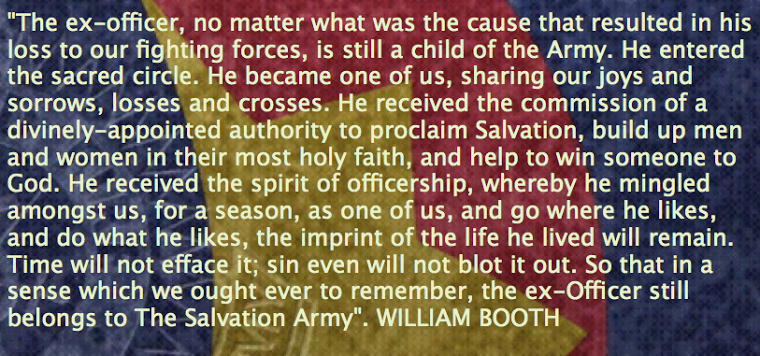
In Booth’s day some disagreements led to the departure of family members from The Salvation Army.  William considered this to be abandoning the cause.  Our founding general in a very real sense shunned these family members and no one was to have anything to do with them.  It didn’t just end there, however, for when family members (not Ballington Booth he is buried in New York) did not please the family with their choice of ‘leaving the work’, were in essence even shunned in death and were not allowed to be buried with William and Catherine Booth at Abney Park cemetery in London.  Some of these members are buried in the same cemetery but there was explicit instruction as to not allow them to be facing William and Catherine.

I seriously doubt (I hope) that our Army “shunning” doesn’t go that deep today, but it is still present.  It is in the unspoken glances.  The momentary intake of breath when a former officer is seen.  The look of uncertainty as to what to say.  “How have you been?”  “What’s new with you?“…these pleasantries just don’t seem to cut it.
shun
Perhaps there is a disconnect between commonalities now…sometimes.
The accepted methods for “dealing” with those who have left the work varies.  Some soldiers and officers are very compassionate and display grace and love and sensitivity in such situations.  Others do not.

The Hypocrisy:  
It is rather easy to chalk all who have left “the work” as abandoners of the faith. But are they?  Do you really know this?  Or, do we sometimes make hypocritical judgement of situations and circumstances that we know nothing about.  I would call that ignorance at the very least.
shun1
Others would simply say “well they knew what they were getting into when they signed their covenant as an officer…”  Well, “yes” and “no”.  I am sure many who have signed the covenant have done so with the best of intentions.  Many who have committed to the cause at that time thinking this was all that they wanted to do in their lives.  There were some who, I am convinced, didn’t truly know what they were getting into even after the rigors of Officer’s training.  You see the real world begins following the service of appointment.  The real world doesn’t look much like the bubble that is training college.  It isn’t the college’s fault…they do their very best to prepare us, but some training has to take place in situations that have many variables and consequences other than a grade in a class.

I think we ought to be careful of hypocrisy in our Army when we rush to judge those who have decided to make difficult life decisions that do not include Officership anymore.  It isn’t black and white, right and wrong.  Life, unfortunately has more color schemes than these.  The assumed notion that all officers who have left or are leaving are due to sin issues or terminations is also hypocritical and ignorant.  Opportunities come to some former officers and they choose to leave to pursue something else.  There is life after officership believe it or not.  There are other ministries as well other than the Army ministry.

We partner with pastors in almost all the communities that The Salvation Army is in…what if that pastor is a former officer?  Can we say “well they weren’t truly called?”  Um…no we can’t.  In fact how dare we say something like that.  Who are we to judge the lives of others, especially if their decision had nothing to do with sin or moral failures.

Questions: 
Do we actively shun people who have left the work today?
Do we shun people subconsciously in the way that we act around them?
Have we closed the doors on people because of their decision to leave the work?
Is it our place to cast judgement?
Is there life outside of officership?
Is officership a calling for life to all?

I do not presume to have all of these answers… but I do know how I feel when I hear these very sad stories of officers who have chosen to leave for many different reasons and the lack of support and/or negative responses they have received which has felt like public shunning.  Does it happen to all who have left the work?  Of course not.  Should shunning happen at all?  Absolutely not…so why is it still lingering?  Why do we glance a precursory judgmental stare at former officers?  Why the stigma?

Sometimes I wonder if we have missed the point as we attempt to reach those who are marginalized when from time to time we are marginalizing former comrades and fellow soldiers of the army.

All I know is that if we conduct ourselves with grace, love, compassion and understanding even if we do not completely understand we can stave off this “shunning” persona in our Army…but it’s going to take some time.

Just something more to ponder in our Army world.
To God be the glory!

The Salvation Army – Women in Ministry…are we as Progressive as we think?

Image

Please don’t misunderstand my question.  I don’t mean to incite a riot or start a fight.  It’s a genuine question that continually needs to be re-examined.  

If the question was – “Is The Salvation Army more progressive than most churches?”  The obvious answer would be “YES”.  Absolutely we are progressing more rapidly than most churches, but we aren’t most churches are we?  Our mission is slightly different than most churches.  We adhere to communities of lost, need, poor, broken and we will use any and all available personnel in the trenches.  We are certainly progressive in the utilization of women in ministry.  

Image

But…

if the question asked – “Is The Salvation Army as progressive as we can be?”  I would have to say “no”.  
Certainly we are absolutely heading in the right direction.  Certainly we have made great strides in the egalitarian department (wait we don’t have that department yet at THQ?…sorry I couldn’t help myself).  

But…

When it comes to leadership and the selection of leaders how progressive are we then?  

Image

One can make the argument that our last General was a Woman – and I couldn’t argue with that.  One can also make the argument that more female leaders are being appointed to key leadership roles.  However, there are still appointments that occur that make me scratch my head.  Don’t take this the wrong way but sometimes gifts are seen in one of the married couple but the other partner in the marriage is appointed to some odd appointment or a place that they lack any gifting.  

Perhaps it’s not always inequality in the sexes, perhaps its because of specific giftings that are seen in one of the married couples…let me just be frank here – not every female officer wants to be appointed to the women’s ministries department, or the community cares department or another department that didn’t exist until recently.  As I say this it should also be noted that the same can be said of male officers who are appointed because of the giftings of their spouse.  We as an Army are getting better at this but we still have quite a ways to go as well.  

Breaking Old Molds

Image


Old excuse: “This is the way we’ve always done it
This excuse isn’t exclusive to corps deeply entrenched in traditions but is also evident in certain leadership models.  Others would say it another way – “If it ain’t broke don’t fix it”…but sometimes what that means is if it appears nothing is broken…sometimes we don’t see the fractures that have appeared over maintaining the “status quo”.  Sometimes we gloss over these cracks with fresh enamel of “Salute and go”.  

Officers are still people! 
They have hurts, aspirations, ideas, gifts and abilities.  Sometimes these gifts and abilities compliment the marriage team, and other times it is best to allow them to serve in separate appointments.  Every person regardless of their marital status is unique and can operate in many different appointments.  Their voice should matter in appointment decisions.  I recognize that more than ever Officers are being listened to.  I’m also not a fool in to thinking that Army politics “never” plays a part in some decisions that are made.  But if The Army is truly interested in stopping the attrition rate in its Officership core then intently listening to its officers should be at the top of the list.  

Humbly Serve!

Image

“He has shown you, O mortal, what is good. And what does the LORD require of you? To act justly and to love mercy and to walk humbly with your God.” (Micah 6:8).
We are, without a doubt, saved to save (and yes saved to serve)!  Humility doesn’t mean that we don’t discuss our gifts.  Humility doesn’t mean that we don’t sometimes disagree with decisions made.  Humility doesn’t mean that we are “happy” all the time.  But it does mean that where THE LORD leads we will go.  That’s why it is imperative that both leadership, department officers, corps officers and other officers appointed else where serve the Lord first, seek His face, pray earnestly, do what He says, and from that right relationship – lead in whatever capacity is appointed to us.  

Thoughts and Questions:
How progressive should we be when it comes appointments and gender? 
Are we there yet? 
What are the indicators that will be present when we have accomplished true egalitarian ministries? 
Does “pigeon-holing” in the appointment process still take place today?  
How can we change this? (Can this be changed?)

Here’s my purpose for writing this today.
Not to cause trouble…that’s not my intention at all.  Not to ruffle feathers – sorry if I did.  
Not to sound militant or rebellious – I will serve as the Lord leads me.  
But…
Jesus had female disciples in a very male dominated world.  He was progressive in ministry and egalitarian in his choice of followers.  Shouldn’t we be as well?  We have made great strides thus far in our Army…let’s not stop now!  

-Just something else to ponder today. 


An Army of the walking dead? Mentoring…How do we get out of the ‘Dry Bones’ valley?

Image

I admit it, the photo is for shock value only…but I want to convey a point with it, so bare with me and please don’t be offended.

Have you ever been burned out, running low, on empty fumes and feel all support has ebbed away from you?  If you haven’t yet experienced that in ministry then perhaps you’re a better person than I or you haven’t truly been in ministry yet.

Let me pick a scab for a moment when I say this: what is the Army doing for mentoring and encouraging its Officers?  All too often I feel (perhaps it’s my fault, but perhaps not) as if I’m crawling to Officers’ Councils on an empty tank.  This is most certainly not an accusation by any means on my divisional leaders, truth be told I love my divisional leaders…but I’m not a hybrid car that can run for hundreds of miles without a refuel…and going to officer’s councils to recharge just doesn’t cut it for me.   One of the biggest problems I see is that as a top down organization we simply do not take the time to encourage our officers on the field as we should.  It goes beyond a card, phone call, or e-mail…it’s personal contact we want.  It’s trust we want, it’s knowing that what we’re doing makes a difference, that we aren’t just another statistical number on the field of officers.  My biggest issue is that we are devoid of mentors, challengers, encouragers and supporters in the Army.  It’s not that people aren’t trying to do this but we’ve become so busy with stuff, so busy with deadlines, so busy with meetings that we forget to find the time for our Officers.

I know I’m not the only one who feels this way…I’m just probably stupid enough to voice this concern.  I don’t mean to pick scabs but we can’t just salute and go when where we’re going we find we don’t have divisional or territorial support or encouragement.  Not to say that it isn’t unspoken, and I don’t want some sort of pat on the back accompanied by a handshake and an ‘atta boy’.  We have lost the discipleship component in our Army…this isn’t divisionally this is nationally from what I see.  I understand there’s a pastoral care department at territorial headquarters but it’s insufficient for the total forces we have on the field.

I was told a long time ago, if you have any kind of criticism you better have some sort of solution or suggestions don’t just be a negative but reinforce the positive.

Here’s a list of the positives: 

1) We care about people

2) We love God and wish to serve and save those people

3) We are nationally and internationally recognized as one of the most trusted organizations.

4) We have sound doctrine and sound ministries

5) We provide and care for financially for our officers and families

These are vital to our ministries and to our families and I will never begrudge the good we do in Jesus’ name.

My desire for the Army is this:

That we stop being an Army of the living dead.  By that I mean we have expectations, regulations, procedures in place for everything under the Sun which is a great thing!  But what we don’t have in place is Leader to Officer mentoring/discipleship in place.  We have phone numbers to call when we’re discouraged, we have a team of “outside” counselors we can talk to but unlike other churches or denominations we do not have a spiritual support system in place by which we can be challenged, encouraged and mentored on a weekly even daily basis.

Some might argue that one needs to find outside mentors to talk with and outside disciplers to challenge us…but who on the outside knows the life of an Officer on the field?   Who knows the challenges we face daily and the criticisms we face from corps members or from the public?  Sometimes, if we’re honest with ourselves, we feel more like the dry bones in the valley with Ezekiel than we’d care to admit.  There has to be something that can be done when we get to this point.  Some of us have privately mentioned feelings of unfulfillment or lack of challenge.  Some would never say this on the record but some don’t feel connected to leadership because we aren’t challenged positively by them.

A wise officer once suggested a type of supporting ministry idea in which Officers were assigned/appointed together for accountability and for growth of each other.  Why not?

Another suggestion was to work within the system to create mentor groups that actually would meet, pray together, share with one another and challenge each other.  But the danger at times can be that it would be viewed as just another program or mundane task that is “assigned” to certain Officers.

So what is the solution to this ‘walking dead’ syndrome?  I know that I am not the only one who has felt this way…there are many who do.  And solutions have to go beyond just assigning prayer groups at Officer’s Councils…these are wonderful but we’re all so busy to keep it up.  Solutions also have to go beyond the minimalist’s suggestions of “just pray about it” or “maybe you need to read/study more of God’s word”.  Let me just say that this last answer is an insult to all who serve as Officers.  Because honestly even the Apostle Paul had supporters and encouragers who remained faithful to him in his ministry.

I don’t believe this is something that we have to ‘grin and bare’.  This isn’t certainly isolated nor is it healthy.  But I do believe there to be worthy solutions out there that the Army could implement in order to “water the bones” so to speak.  As I mentioned before we need too, as individuals must be committed to sharing and being challenged as Officers as well.  None of us, hopefully, signed our Officer’s Covenant form wishing for a mundane “cushy” lifestyle without challenge both physically/Mentally and Spiritually.  If we are to grow as an army and to water the ‘dry bones’ then we have to make our Officers a priority and not assume that they learned it all at training college and they don’t need help, encouragement and support.

Again there has to be more than just ‘yearly reviews’ and other such program offers.  I know our leadership cares for us, but we as Officers need mentors, disciplers and those who will challenge us to continue to grow instead of drying out and become an ‘army of the walking dead’.  If feel that if we were to explore some of the reasons for attrition in the Army, we would find this concern to be rather high on the list.

-Just a thought…but let’s keep this conversation going.

Some mentoring sources:

http://www.mennoniteusa.org/wp-content/uploads/2011/10/MentoringProgramForBeginningPastors.pdf

http://www.ctsfw.edu/document.doc?id=62

http://dunamisinstitute.org/academics/faculty/detail/5-ec4-advanced-and-specialized-ministry/13-mentoring-program-for-pastors-

Officership: A Calling For a Lifetime?

Image

Some officers have struggled with this.  Some officers haven’t.  I have heard some argue about the lifetime calling while others argue the calling ‘for a season’.  I would like to outline both arguments in this article.  My purpose for this? To help clarify, not further muddy the waters.  To shed light on both contentions and for the reader to draw their own conclusion.

So what is the calling of The Salvation Army officer?  Do we deem it sacred?  Is this calling infallible?  Or do people make mistakes from time to time?

First let’s explore the Officer Covenant:

ImageWhat is a Covenant?

In the Bible covenants were made by God to people.  They were also made by people to God.  And lastly covenants could also be made from one person to another.  A covenant is simply a promise or an agreement, something that could be deemed as binding.

So when one enters into a covenant with God this person is making a promise to do or abstain from something.  With the definition of covenant being given, let’s now explore the two main arguments that are prevalent in our Army today.

Image

Argument #1

The Covenant  an Officer makes to God is for life!

I have heard it said that within this calling, a Salvation Army Officer enters this covenant which is sacred.  What makes it sacred?  Certainly not a simple piece of paper with writing printed upon its surface?  Of course not!  There is, at the end of an Officer’s time at training college, a time of commitment made to God before their peers, the training staff and sometimes the territorial commander.  When the soon to be newly commissioned officer sign this covenant page, they are declaring and affirming their calling to serve the Lord in the capacity of Officership.  What is said about this signing by many, if not most, within leadership that it is a solemn declaration that is for a lifetime.

The argument has sometimes been taken to mean that should an Officer resign later on they have broken their covenant with God.  I have heard stories of Officers who have left the work that were told that they had sinned against God for leaving the work and breaking their ‘Officer’s Covenant’.  The Argument seems valid, yet could be construed as far too legalistic in nature.  Who are we as fallible people to claim that another person has turned their backs on God?

There is a need for accountability and a standard to uphold, however this argument presents a challenge in that how do we uphold this perspective as individuals?  In the legal sense should the terms we use be more clear?  legally speaking what does ‘all my days’ mean?  Is it ‘all my days’ that I’m an Officer?  Or are we to take it to mean ‘all my days’ of life that God has allotted me?

I know this sounds superficial but some could interpret this Officers covenant to mean one of two things.  So is this Covenant we sign for a lifetime or for a season?

Which brings me to the second argument:

Argument #2

The Covenant  an Officer makes to God is for a season!

Some would express that within the Officer Covenant there is adequate enough verbiage to  interpret what we sign as a calling ‘for a time.’  This isn’t generally how most view the covenant, however this is a part of argument #2 and its justification.

Do we truly sign our lives away so to speak and in an instant we no longer have independence in terms of where we will stay and where we will go?  Obviously when one becomes an Officer it isn’t because we are hugely overpaid, nor because we feel inclined to become stylishly dressed in uniform.  It is because we wish to serve the Lord and serve others through the means of Officership within the structure of The Army.

But does this necessarily mean that it is for life?  Obviously Officers don’t view it as some sort of prison sentence and we plod on serving 20 to Life.  But what happens should God call one who is an Officer to something else?  Have they broken their Covenant with God or has God simply used the means of man to adjust that covenant into a newer and different territory?

 Furthermore we shouldn’t presume that the workings of man are necessarily the working or the will of God in every instance.  For in our holiness tradition we are taught that through the continued promptings of the Holy Spirit we look less and less like our old sinful self (old has gone, new has come) and more and more the image of Christ.  In so doing we mature in our faith, could it be that in this maturity some have felt compelled to take a greater leap outside of the Army?  I’m not arguing for all who have left, but some appear to have taken this leap.

Lastly on this argument looking back at the context of our Founders, William Booth specifically was quite militant in his view of Officership.  Even his own children who had served within its ranks for a time then leaving were considered ‘deserters’ to the cause.  This paints for many this notion that William Booth propelled and enforced our understanding of this Officers Covenant.

Image

Grace, Prayer & Holiness:

One wonders where grace falls within the Army at times.  When some leaders, a minority mind you, have condemned those who have left the work as traitors and sinners.   Grace rises above such lowly expressions.  We too ought to reflect and pray on how we minister to one another within this army.  How we treat one another, while at the same time reminding each other to live holy lives and continued prayer and devotion.

We are in the business of saving souls, but the saving of souls isn’t done solely by uniforms and ranks and officials…it is done first and foremost by the blood of Christ and secondly the workings of the Holy Spirit.  May we ever be diligent in this fight that we do not ostracize those who have, for whatever reason personal or otherwise, left this calling of Officership.  That we continue to live worthy lives before God first and foremost and that we live within that grace instead of condemnation and militant rules and stiff regulations.

Standards are important, leadership is vital, but grace is often the shepherd loving the sheep and gently and allowing growth to take place out of love instead of might and fist.

Blog at WordPress.com.

Up ↑