

It might seem like an open and shut question to you, but it is certainly more complicated than that.
Scripture does not condemn the consumption of alcohol, many times it calls for the drinking of wine in celebration and as medicine (for Timothy – 1 Timothy 5:23). Of course, there is the warning of drinking too much wine – ‘Do not get drunk on wine, which leads to debauchery. Instead, be filled with the Spirit…”(Ephesians 5:18). Even the disciples and Jesus drank wine. Some will contest that the wine of Jesus’ day was not very potent when it came to its alcohol content…but it still contained alcohol.
Some might contest that the position statement of The Salvation Army on alcohol is not necessarily based on Scripture, but rather societal experience:
“The Salvation Army encourages an alcohol free lifestyle as a way of enhancing the well being and health of all people. As a witness to this, Salvation Army soldiers choose to live an alcohol free life. The Salvation Army recognises the harm alcohol causes in individuals, families and communities. It advocates for reducing the consumption of alcohol, and it offers its services to support and restore people negatively impacted by alcohol use.” (The Salvation Army International Position Statement: “Alcohol in Society”)
It should also be noted that many other denominations have a similar view on alcohol and their church members. 
Some might then ask the question “Why not alcohol?”
What harm could it do?
Perhaps it opens the door…
Perhaps it makes one vulnerable…
Sometimes I wonder why we don’t talk much about the use of Alcohol?
History:
The Booths, upon founding the Christian Mission, and subsequently The Salvation Army, witnessed the effects of alcohol on society, especially the poor. Children were literally stumbling out of bars drunk. It was a blight on the east end of London.
How could one stand by and witness a whole generation of people ruining their lives by drink? Thus, one of the pillars of soup, soap, salvation was teetotaling discipline.
The Present:
I serve in a corps that is surrounded by drunks. 
Just across the street is a closed liquor store, and in front of it an even bigger now OPEN liquor store. There is nothing innately wrong with that liquor store. That store owner works hard to support his family. BUT what is wrong is that this store is located in one of the poorest neighborhoods in our community – right across from The Salvation Army. On the other side of our corps, kitty-corner to us, is a Bar…
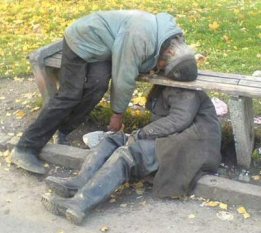 We witness the habitual effects of alcoholism in our very parking lot, when we have to pick up a drunkard (almost daily) and escort him/her to a detox location. It is disheartening to see the utter waste of human life devoured by the bottle. It is very sad to see families ripped apart because of abuse brought on by intoxication and poverty due to the supporting of a habit.
There is nothing wrong with alcohol, but there IS something broken with people, and there is a genetic disposition to addictions…
Drinking is not a sin, although we as The Salvation Army certainly treat it that way…mainly because we receive many who have lost it all because of the affects of alcoholism. That liquor establishment across the street near my corps, is not illegal or wrong, but the affects it has had upon the poor in our neighborhood certainly does not make it right either. Our city will benefit from those tax revenues, but we unfortunately must meet human need in the streets that are bent and broken by it.
My family, a few generations ago, struggled with alcoholism…
My wife’s family has history of alcoholism in it…
Statistics:
- 100,000 people die each year from alcohol-related causes: drinking and driving crashes, other accidents, falls, fires, alcohol-related homicides and suicides. (NCAAD)
- Of the 3.9 million Americans who received treatment for a substance abuse problem in 2005, 2.5 million of them were treated for alcohol use. (Drug Free World)
- Teen alcohol use kills 4,700 people each year – that’s more than all illegal drugs combined. (MADD)
(Source: https://talbottcampus.com/2015-alcoholism-statistics/)
So…
why not alcohol?
You tell me.
Tell us what YOU think as we explore this topic today.
Something more to ponder today.
Additional Links to check out:
Tom Canfield Story

 bearing plants along with the weeds?
 community…today it would take over a year (at least) to close a dying or dead corps and plant a new one elsewhere. I understand that there are many variables to consider, I know we have so many more hoops to jump through, and the right forms must be submitted, and the right studies have to be done…and the list goes on…and it is far too complicated, perhaps more complicated than it ever should’ve been. I wonder if this is why we aren’t growing anymore? Because our hands are bound by massive amounts of red tape and far too many hands have to touch the paperwork as it passes over many desks at various levels of responsibility. Is it no wonder that some just given up? Is it no wonder that some grow frustrated at the snail’s pace? Granted we ought never make rash, uninformed decisions, but are there times when the amount of red tape becomes utterly ridiculous?
 Could this be why younger evangelistic churches seem to be having more success in growing their church plants – because they have far fewer restraints and hoops to jump through? The building process doesn’t take 3-5 years, instead they work a church plant that tithes and contributes to the building campaign? I understand we are not just a church (we are so much more – we are a movement)…but are we a stalled movement in this regard? Or is this the proverbial story of the tortoise and the hare, where wisdom and time win out?
 Sometimes I feel that we as an Army have become so policy heavy that we strangle creativity and the potential for real, sustainable growth. The problem is like this scale, too heavy a balance of policy keepers will lead to a diminished level of creative challengers. On the other side of the scale, too many creative challengers will lead to a diminished level of policy keepers and lack of order and policy.
 Perhaps we have taken our focus off of the mission and exchanged it for regulations and rules.






 I believe we have this big picture idea about God sometimes that leaves God this great big idea out there…but very seldom do we realize that He comes directly to us in our minuscule lives and wants to just hang out. He longs to connect in ways we have never anticipated or believed to be possible. Why is that? Why do we believe in this mighty God and yet, at times, fall short of believe He desires real, authentic relationship with us?


 We Christians are often very good at quoting scripture, especially verses that bring us comfort and strength in times of need. These verses have a way of making us feel good and bring us relief in knowing that we aren’t alone and that we have One who goes before us on this faith journey. But I wonder how intricately do we know the passages that we cling to? Do we know a scripture’s complete context and the full understanding of the words we utter from memorized verses in whatever translation that we’ve memorized them from?
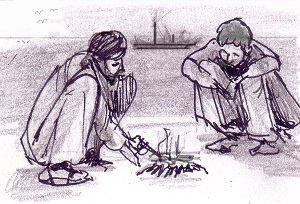 Jesus looked into Peter’s eyes, these same eyes that stared blankly at accusers while his lips denied his allegiance to his Teacher. Jesus asked Peter if he loved Him. Not once, not twice, but three times – the same amount of times Peter had lied and denied Him. Imagine the conviction of that moment. Envision sitting there with the Son of Man and coming face to face with your shortcomings and failures? I am certain that the tears of shame would flow, and my heart would be rent.

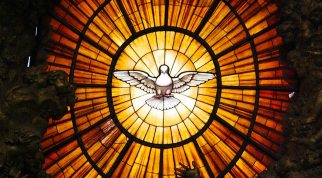 The Holy Spirit is a lot like that in our lives.

 When this abuse is allowed to continue, and it does from time to time, there is inevitably a loss of talent. By that I mean some within the ranks of soldiers and officers alike might leave. Why would they stick around when abusive leadership would seem to go unpunished or addressed and instead is rewarded and only those who are completely complicit to that leadership style are given appointments of authority themselves? In essence an abusive autocratic style will promote the “yes” people, while those with talent (and who had the passion and zeal) but did not always agree might never be rewarded or acknowledged. What could remain would be a hollowed out version of an organization. It wouldn’t be the vision that failed but rather the internal issues of the organization that cannibalized itself.
 autocratic or authoritative leadership model be affecting our movement today? This is a very big question, I know that, but isn’t there a part of you that wonders if we shouldn’t even ask the question in the first place? Why is that? Do we fear that if we ask it we might face punishment or be considered “rebels”? I believe a healthy movement is one who has innovative, creative and outspoken members. A movement is just that, something that continues moves forward, not backward. A healthy movement should be one that accepts constructive criticism and takes corrective steps when needed. A healthy movement is propelled not by unhealthy models of leadership and fear, but by the Holy Spirit prompting and leading His followers onward into the fray.
 Pastor's Ponderings