
Blog

Dear Salvation Army – The Blood and Fire!

For those unfamiliar with this phrase, let me clarify:

The Blood – 
Jesus’ sacrifice on the cross is not glamorous.  He bled and died for our sins and for the sins of the “whosoever”.  His blood covers our iniquity, our sinfulness, our fallen selves.  The blood of Christ provides a way for us to stand before God because Christ has redeemed us and reconciled us to Him.   

The Fire – 
The Holy Spirit fell upon the disciples of Jesus as they waited and prayed.  His Holy Spirit provides us direction, insight, inspiration and guidance.  It is the fire of the Holy Spirit that prods us to live sacramental holy lives.  It is the fire of the Holy Spirit that requires more of us…more than we ever thought possible…more than we ever knew could exist within us.  It is the fire of the Holy Spirit which demands us to surrender everything, to lay down our lives as a living sacrifice so that we can get back up and serve the Risen Savior and do it with every fiber of our beings.  

soldiership

Dear Salvation Army
how are you living Blood and Fire today?  
I don’t mean wearing the uniform and hoisting and waving the flag, for these are simply outward expressions of that inward change…but how are you truly living ‘Blood and Fire’ in your communities and to ‘the whosoever’?  

To the Blood and Fire Salvationists – You keep up the fight!  Keep waging this war, keep fighting in Jesus’ name for those who are still blinded and lost in sin.  Keep pressing onward.  Do not quit…we need you!  Do it all in love, be love and grace and compassion to people who have never felt the kindness and grace of Christ.  Be reflections of Christ in not only word but most importantly deed, because eyes can perceive far faster than ears can understand.  Continue to be that witness not only in your corps’ and homes but in the streets and in the parks and in the schools.  We must not allow that fire to dwindle or burn out.  Satan would love nothing more than for this army to become weary and ill-equipped and bogged down by the drudgery of it all.  Dear Salvation Army, the World still needs you!  The world still needs fighters and soldiers and officers and volunteers to administer God’s grace and hope.  The world still needs YOU!  

To the Weary Tired Salvationist Who Is Ready To Quit  – DO NOT!
There are times when people will fail us.  There will be times when even leadership may succumb to the ravages of this war, for whatever reason, but do not quit.  We need you!  You may be tired.  You may be burned out by seemingly stodgy politics and meaningless banter.  You might have witnessed professions of Christ yet seen little evidence of Christ in others, but do not become disillusioned and walk away!  You are vital!  You are needed!   I have walked that tired and heavy burdened trail.  Many a time I have considered leaving as well.  Many a time I imagine a far simpler life…in fact that “many a time” is very, very recent for me.  I still walk with these burdens and my heart is not yet healed…but I know the Lord will provide!  Stay the course, rest, but fight on!  

To the “Soldier” Only By Rank Or Name…
If you have no passion to live “Blood and Fire”…if you only acknowledge Jesus with your lips but do not serve Him in your hearts consider these words – Either fall on your face at the Altar and pray for forgiveness and seek His healing in your life or Step Away from the front lines!  The world has seen its fair share of falsehoods and phonies, it can sense insincerity and half-truths.  There are already vipers in the grass, do not become another for other soldiers and would be soldiers.  I only use these harsh terms to indicate that this is no game.  This is life and death to souls of men and women everywhere and the business and ministry of Christ is not to be trifled with.  I hope and pray there are very, very few remaining of the mere “Solider” by title alone.  I am also confident that in time the Holy Spirit will reveal those who must be removed from our ranks or reconciled (if possible) those who are not living Blood and Fire.

BE BLOOD AND FIRE! 

army1Dear Salvation Army – It is not just a flag that we wave, it is freedom, redemption, grace, peace, hope and love to many who have understood or received this unmerited gift.  Continue to live Blood and Fire!  Continue to declare God’s redemptive love to all who will hear.  Be His holy hands, provide His holiness in both word and deed to this world around us.  

To God be the Glory!  
More for our Salvation Army to ponder today!   
We found Rest and Relaxation at Serenity Falls…you should too!


This isn’t some infomercial, or advertisement.
Pastors, business people and tired families all need to find a place to rest, recuperate and relax.  We all need a holiday, a vacation from the hustle and bustle of the world around us.  A place to reconnect with our spouses, our children and with that good book you’ve been meaning to finish.

We found that place this week while on vacation.  We had never been to North Carolina and so we wanted to see the Smokey Mountains and had heard about Lake Lure and Chimney Rock.  They have filmed movies here like Firestarter, Last of the Mohicans and Dirty Dancing.

We booked this cabin – Serenity Falls and let me just say “wow“!  The drive coming to the cabin was long and curvy.  There were some interesting views in the mountains, some unique people, yet after driving up the steep drive to the cabin and unloading our belongings we could finally step back and see the majestic views all around us.  This is a secluded piece of heaven.  It is quiet, serene and ideal for large families or for a couple looking to get away.  

As a pastor, ministry to others is important, yet if I never find the time to get away and recharge I will burn out and be useless to those I have been called to serve and love.  If you’re a pastor or in the ministry or just a person in need of some peace and quiet why don’t you check out Serenity Falls.  It is so worth it!  They have all of the modern features a home could have and more.  It’s tranquil, and you will find rest here!  The really nice thing is that you are minutes away from Lake Lure and Chimney Rock which are really interesting scenic places to visit.  There is also the massive Biltmore Estate which is a historic estate chalk full of leisurely activities and tours.  

Here are a couple of pictures of Serenity Falls that I took (there are also some on the website which I hyper-linked here), I can’t say enough how nice a time we had here resting and relaxing…we could seriously stay a lot longer!  

We felt welcome as soon as we drove up!
This is the amazing playground that my kids played on for hours while I lounged on the back porch.

Dear Salvation Army – Let’s Turn Things Upside Down!

For far too long there has been this imaginary ideological organizational structure which told us (erroneously) that the corps and front-line ministries were at the bottom of The Salvation Army pecking order.  Honestly I don’t really get caught up in “who is first” or “who is most important”, yet at times there is this unspoken notion of “climbing the corporate ladder” even in The Salvation Army.  As if corps ministry and front-line evangelism is somewhat lacking in prestige and importance.  Let me make this absolutely clear – If anyone in our Army has signed up for the express purpose of “climbing the ladder” and to “get out of corps ministry” then perhaps that person should consider finding another army to belong to.

army2

The Army isn’t the only place this happens (obvious statement, I know).  The disciples of Jesus had witnessed many miracles and wonders performed by their Rabbi -Jesus and they began to argue amongst themselves about who would be greater.  You can almost hear their ego driven argument, “No, I’m clearly the better speaker”, “But I’m better looking in uniform” (I had to put that in there), “Well, I am so much better with finances”, “Oh yeah, but I have better administration skills“…

According to Luke 9:48 Jesus knew their thoughts and cut them off -“Then he said to them, “Whoever welcomes this little child in my name welcomes me; and whoever welcomes me welcomes the one who sent me. For it is the one who is least among you all who is the greatest.”

Holiness & Humility:
If we could only stop this petty self-defeating ladder climbing mentality.  If only we could keep our eyes on what is most important – Being Holy people and from this allowing the Holy Spirit to transform lives through our actions of evangelism.  If only we could stop looking over the fence at that other corps which seems more prestigious and more prosperous than ours as we covet what they have.  If only we could stop looking at DHQ or THQ as “the next step in our careers”.  If only, if only, if only…  Why is it that we humans, as imperfect as we are, always seem to be so success focused?  Shouldn’t we consider what the Lord said to Samuel when anointing the next (God appointed) king of Israel; “Do not consider his appearance or his height, for I have rejected him. The LORD does not look at the things people look at. People look at the outward appearance, but the LORD looks at the heart.” (1 Samuel 16:7)

How are our hearts?  Isn’t serving God with our everything enough?  Isn’t being loved by the King of Kings and Lord of Lords prestigious enough?

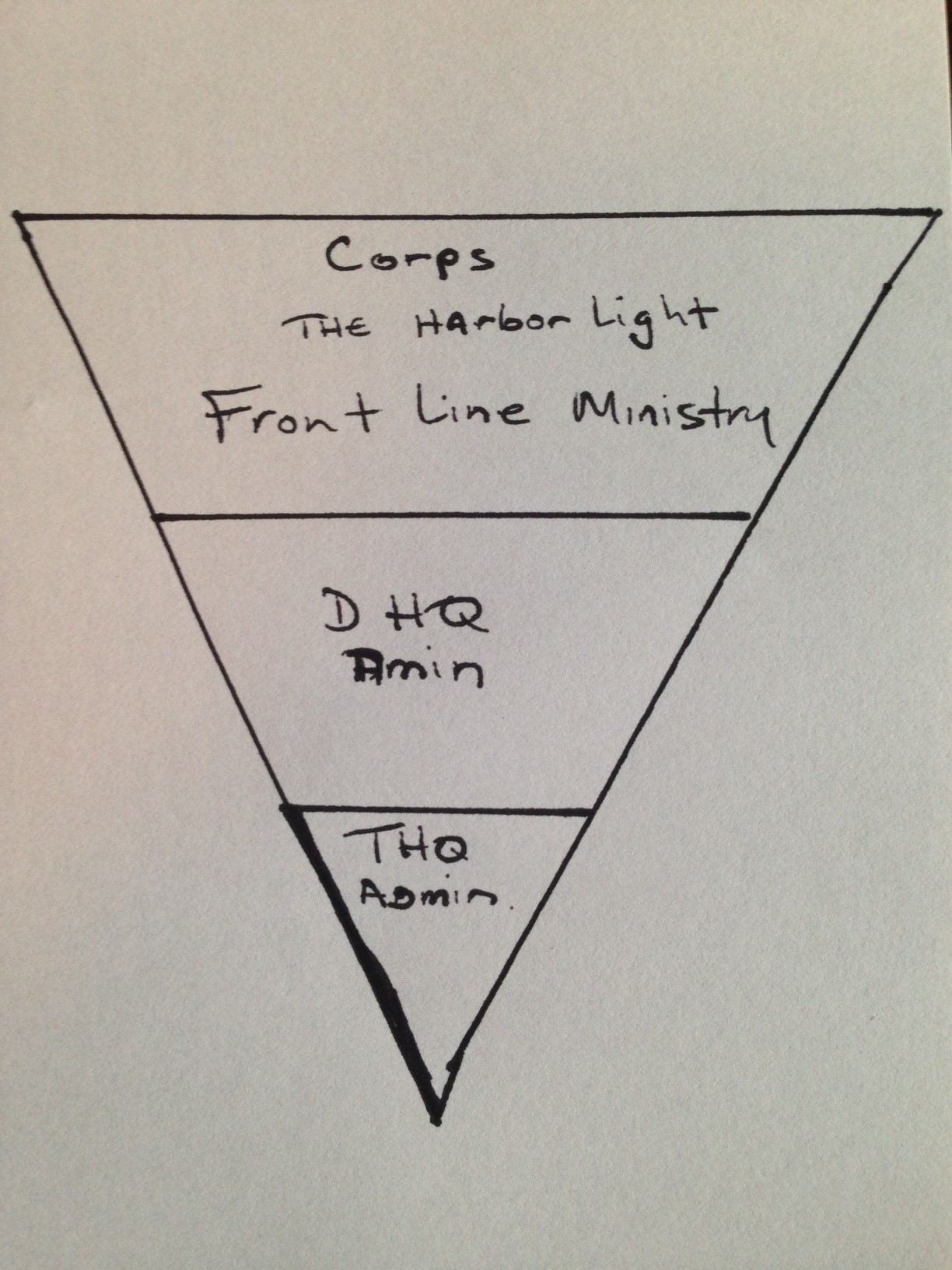
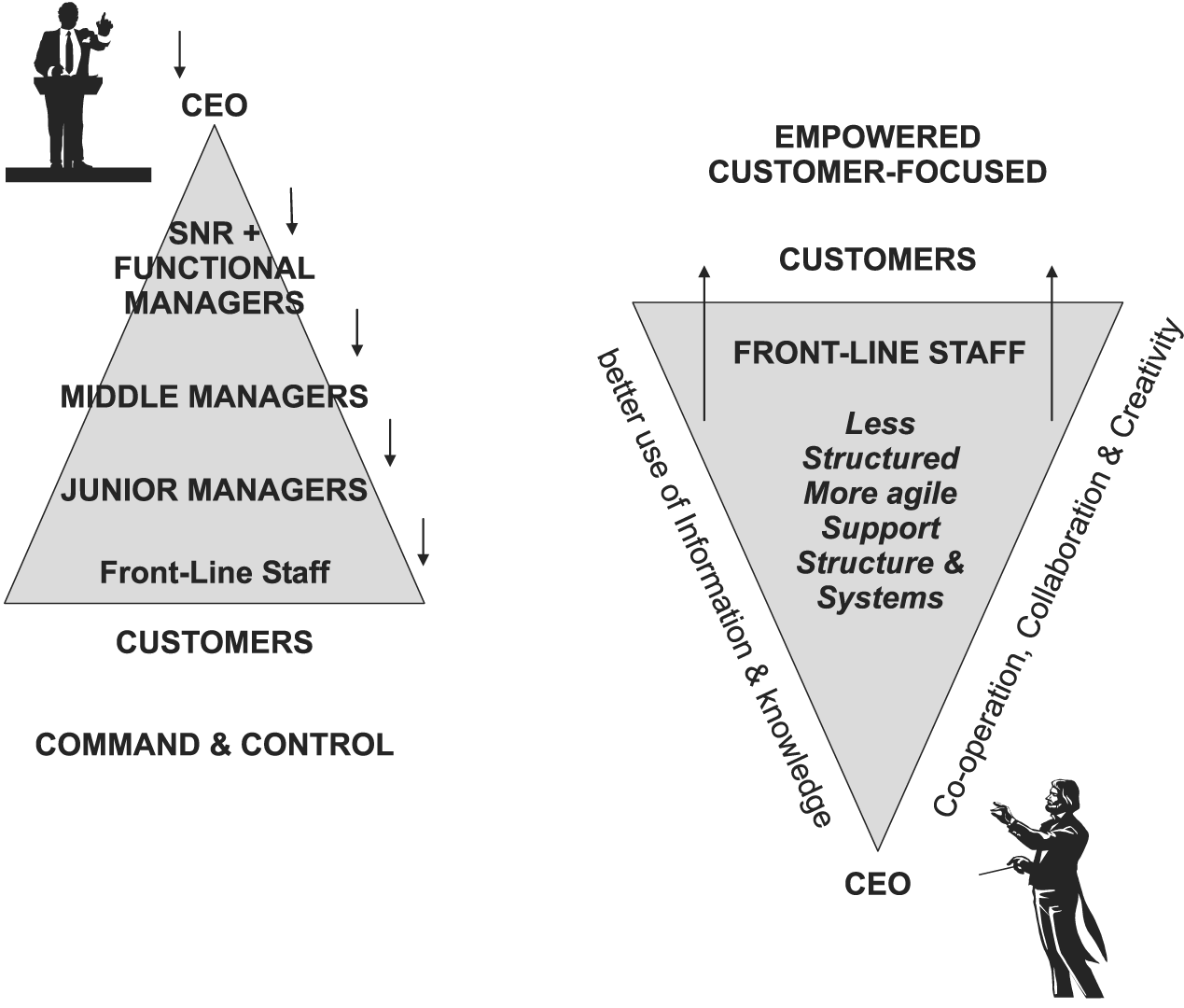
I have included a couple of diagrams today to help us understand how the true model of leadership and ministry SHOULD look like…and I hope this helps:

triangle 2What this diagram represents is the way most organizations and businesses are run in our world today.  From the top down.  But, if we are led by humility and holiness, we would understand that “the least of these” must begin from the bottom – up.  Not to imply that we place leadership at the bottom or that administration isn’t important, but rather for us to understand that without active evangelism and the dispensing of God’s love and grace we run risk of losing everything and having nothing to show for our polished efforts.  If the terms are confusing to you then let me illustrate this (in my best hand writing

…please don’t laugh)

The "traditional" organizational flow chart/hierarchical structure model
The “traditional” organizational flow chart/hierarchical structure model
How leadership and administration (and soldiers) ought to view the structure active ministry and evangelism.


Turning Things On Its Head:

take-up-your-cross
For far too long men and women of our Army have gone about “position” all wrong.  Yes we need administration and leadership but what is our primary purpose?  What is that one principle upon which we are an Army?  Christ-then Others!  If we only look at Salvation Army structure as ranks and office then we are only reflecting worldly hierarchical organizational -money driven, success oriented models, which are rife with politics, maneuvering, ego-driven leadership, power hungry people.  Are we an Army dependent upon these things?  NO!  It cannot be that way with us!  It should not be that way with us…and yet at times it has become inexplicably linked with our internal identities.   We must continually turn this identity upside down!  We must guard our hearts from pride and arrogance and the pursuit of “position” within our Army.  It was never about what rank was placed upon our shoulders.  It was never about what position we held at the corps or divisional headquarters, or territorial headquarters or any other “headquarters”…it IS about serving Christ humbly and from this one vital relationship (our first love) all things ought to flow in our ministries.

Then Jesus said to his disciples, “Whoever wants to be my disciple must deny themselves and take up their cross and follow me.” (Matthew 16:24)

This is something further our Army must continuously ponder…to God be the glory!

Please, tell me what you think by commenting below and leaving responses…let’s continue this dialogue together!

Dear Salvation Army – A disconnected culture or a disconnected Army?

Before I begin, I must say to those who might remark “why would we worry about our current culture?”  That it isn’t the Army’s place to become so immersed in our culture that we lose our mission…however, having said that, there is something to be said about being culturally relevant and engaging of those immersed in it while still preaching the relevance of Christ, salvation, holiness and His wondrous grace!  Do not misunderstand me here, I do not long for an Army fully immersed in culture, but I do long for an Army who understands modern culture and is continually equipped to engage souls who live within modern culture.

soldiership

While it is true that some of our Founder’s methodology from Victorian England might not work today in terms of evangelism, the mold of modern day evangelism is still very much intact!  William and Catherine Booth began a movement that addressed the current needs of their day while engaging the souls of people for Christ.  Their methods were edgy and risky, many “high churches” would never have dreamed of embarking on such methods, yet it met people where they were at and many joined its ranks and the movement swelled.

Today, dare I say, the employment of Victorian era evangelism techniques may not work the way it once did.  I don’t mean to say that we should give up or that we have become an obsolete army, but that we need to modernize and become equipped to engage modern culture.

Questions: 
How do we do this?  What sort of methods do we employ? Which should we avoid?  What are the needs of “the lost”?  Who are the lost?  How do we become more engaged in this culture yet maintain the holy principles and godly purposes?

3 Easy Steps To Becoming More Disconnected With Our Culture:

1) Stay In The Corps And In The Facility And Never Venture Outside Its Walls.  
Long gone (at least in the West) is the use of open-air services and even bar sales of “The War Cry“.  If we wish to become more disconnected with this modern culture then we should further insulate ourselves within the walls of our community centers and corps while we pine for “the glory days” which will inevitably forever be behind us!  horse-blinders

We should also continue to complain about the fact that our attendance is steadily decreasing while we never seek to venture outside the building and into the neighborhoods and downtown streets…in this way we might as well place blinders on our eyes just as horse riders do to prevent the horse from looking around…why should we look around when all we seem to do is look back into the past?  (insert sarcasm here)

2) Pursue More Constricting Federal Dollars, it’s all about the money anyway!

see_saw_fat_guy
We have become very good at modernizing our social services and our national images, so much so that we are recognized as the most respected charitable organization…but is that all we are? A charity?  Do fight for souls of men, women and children?  Or do we simply run to the next fund raiser and spend countless dollars on better social services programming?  I understand we must do both.  I understand that without one we cannot do the other, however is it unequally balanced?  Can we pull back from the “pursuit of money” cliff and say “enough“?  money

Have our hands become more and more bound because of the red ink we have placed on federal and local agreements to service?  Are these agreements now preventing us from engaging spiritually those with whom we serve?  If we desire to become more disconnected with modern culture, we should continue to chase those federal dollars.  We should also continue focusing so much of our efforts on increasing social services programs and inflated staffing while decreasing the size of our worship spaces and perhaps some day leave the bibles and penitent form out of the chapel because we “wouldn’t want to offend or bite the hand that feeds us”.  Again, if we want to become further disconnected from culture…and even worse disconnected from God and His purpose for us, we will push for these things and strive to become the best social service agency in the nation when being a social service agency was never the sole mission of The Army.

3) Forget About The Long-term Needs, Focus Only On The Immediate Needs Of People…And DON’T Offend!

giving-bread
As stated at the beginning, our Founder’s methodology was to engage culture, change lives and win souls for Christ.  William and Catherine Booth didn’t just stop at the “Soup & Soap” of immediate needs, NO!  The souls of people, “Salvation” were the primary targets!  We will cease to be a movement and an Army of Salvation should we lose the focus on “Salvation”!  If we become more concerned with offending people than we do with loving them and longing for their hearts to be changed as well as their physical conditions, then we will have become disconnected!  “For our struggle is not against flesh and blood, but against the rulers, against the authorities, against the powers of this dark world and against the spiritual forces of evil in the heavenly realms.” (Ephesians 6:12 NIV) I don’t propose that we go looking for fights, but we must engage society and that of modern culture if we are to win souls!  We cannot simply worry about offending people because we ask about their spiritual well being…this will (on occasion) take time and trust, but we mustn’t shy away from the long-term needs of those with whom we serve!  We will have done a great disservice to those we are commissioned to serve as well as the Holy Spirit if we merely hand out the immediate “bread” of the day without the lasting impact of His Living Bread!  But…if we wish to disconnect from culture, the world and most importantly our mission for Christ, just hand out bread and food boxes and forget to pray and discuss spiritual things with those we serve.

Finally…
We need to continue to fight!  We must be engaged in culture so that we not only understand culture but we can have the tools to reach those who are lost living in that culture!  We must continually evaluate our “modern methods” and how effective they may or may not be.  We must be willing to take risks, to, at times, throw caution to the wind.  We, as an Army, should not be so bound by governmental constrictions that we place gags on the gospel.  Get out of the corps buildings.  Get out and love others.  Get on with evangelism, relational connections and its vital importance to the lost.  Do not hold back, dear soldier!  We will face opposition.  We will face those who will seek to silence the gospel…but fight on with the power of the Holy Spirit as your guide!  We need holy leaders, holy soldiers, a holy Army if we are to avoid the allure of disconnecting from our mission field!  Go for souls, and go for the worst!  To God be the glory!

-Something more for the Army to ponder today! 

Perspectives Day #5 Featuring Rachel Held Evans – “Jesus Started With the Outliers”

Photo Feb 01, 10 25 52 AM

“Jesus Started With the Outliers”
by Rachel Held Evans 
(via her blog: “Jesus Started With the Outliers”)

Rachel-Held-Evans

It was one of those Twitter conversations I probably shouldn’t have gotten sucked into. 

We were debating whether or not it’s helpful to use language like “act like a man,” or “true womanhood,” or “real men” in our religious dialogs, and I was arguing that the goal of the Christian life is to be conformed to the image of Christ, not idealized, culture-based gender stereotypes. He was making the case that men are “hardwired” to protect women and women are “hardwired” to be protected by men, and so the lifeboats on Titanic prove that women should not teach or lead in the church. I suggested that perhaps the lifeboats on the Titanic point to a more general sense that the stronger in a dangerous situation are morally compelled to protect the weaker in a dangerous situation, and that mothers can be awfully protective of their children after all, and that a man who (for whatever reason) might be weaker than a woman in a given situation should not feel like less of a man if she protects him. “What about a husband who is confined to a wheelchair?” I asked. “Is he ‘less of a man’ because he may be dependent in some situations on his wife’s assistance? And should we perpetuate the stereotype that ‘real men’ must be physically stronger than the women in their lives? 

“Yes, but that’s an unusual circumstance,” he responded. “We can’t base our theology on the outliers.” 

When he said it, something clicked in my head in a way it hadn’t before, something that seems pretty obvious when you think about it, yet is so easy to forget: 

“Yes, but Jesus STARTED with the ‘outliers,’” I said. “If it doesn’t work for them, it doesn’t work.” 

There is this tendency within certain sectors of Christianity to assume that if our theology “works” for relatively privileged (often for white, upper-middle-class American men), then it should work well enough for everyone else, and everyone else should conform to it.

We see this a lot in the gender debates, especially among those who suggest thatthe only way a family can truly honor God is with a husband who functions as the family breadwinner and a wife who functions as a stay-at-home mom to their 2.5. children, regardless of finances or practicality. This may work for some people, but it doesn’t work for the family earning minimum wage, or the couple facing infertility, or this awesome church community of immigrants that shares the responsibility of child-rearing together. 

Same goes for theologies that suggest the poor are poor because of their sins, that if only the sick had more faith or gave more money they would be healed, that the tsunami or the earthquake or the flood that devastated a community was clearly the result of God’s wrath on its gay inhabitants, that we can stop rape by teaching women to cover up better, that sex before marriage makes a person ‘broken’ and ‘unwanted.’

Sure, we don’t always think about women who have been sexually abused when we preach that wives need to be super-sexy to keep the interest of their husbands, or about infertile couples when we talk about how “a woman’s highest calling is motherhood,” or about our African American brothers and sisters and our indigenous brother and sisters when we trumpet America’s great “Christian heritage.” 

But maybe we should. 

If the gospel isn’t good news to the so-called ‘outliers,’ then it’s not good news at all. And, in fact,  if our theology doesn’t start with the ‘outliers,’ then maybe we’re doing it wrong. 

Jesus started with the outliers and made no bones about it: 

“The Spirit of the Lord is on me,
because he has anointed me
to proclaim good news to the poor.
He has sent me to proclaim freedom for the prisoners
and recovery of sight for the blind,
to set the oppressed free,
 to proclaim the year of the Lord’s favor.”
(from Luke 4) 

In the Sermon on the Mount: 

“Blessed are you who are poor,
for yours is the kingdom of God.
Blessed are you who hunger now,
for you will be satisfied.
Blessed are you who weep now,
for you will laugh.
Blessed are you when people hate you,
when they exclude you and insult you,
and reject your name as evil, because of the Son of Man.
But woe to you who are rich,
 for you have already received your comfort.
Woe to you who are well fed now,
for you will go hungry.
Woe to you who laugh now,
for you will mourn and weep…”  (
from Luke 6) 

Jesus talked theology with women. He hung out with prostitutes and tax collectors. He drew crowds made up of the sick and poor. He criticized religious leaders who try to “slam the door to the Kingdom of Heaven in people’s faces.” 

I think also of the Ethiopian eunuch (from Acts 8), a man who was ethnically and sexually “other,” who was welcomed  and baptized without question or hesitation into the early church, but who would no doubt fail all of Mark Driscoll’s rigid categories for a what makes “real man” were he a part of the American evangelical church today. 

Now, the point of this rambling reflection is not to further entrench the imaginary divide between the privileged “in” and the underprivileged “out.” (It should be noted that with the center of Christianity shifting to the global South and East, and with the demographics of American Christianity changing so rapidly, white American Protestants will soon find themselves in a minority, which will make this whole conversation a lot more interesting!)  The point is, we can’t go around dismissing as irrelevant those for whom our pet theologies turn the good news into bad news. We have to start with them instead. 

Because at the end of the day, we’re all in this Kingdom thing together. We’re all loved by God, all in desperate need of grace, all in need of one another. 

In a sense, we’re all outliers. 

Perspectives Day #4 Featuring Rob Bell “What Is The Bible?”

Photo Feb 01, 10 20 20 AM

What is the Bible?

Part 1. Someone Wrote Something

I’ve had a number of conversations recently that somehow led to the Bible. I say somehow because these weren’t conversations with particularly religious friends, and yet what they talked about was their interest in the Bible. 

For some, they readily acknowledge that this particular library of books (Yes, it’s a library. More on that later…) has deeply shaped western civilization in countless ways and yet they haven’t the foggiest notion what it’s actually about other than vague references to David killing Goliath (Although in the book of 2 Samuel it’s written that a man named Elhanan killed Goliath) or ominous warnings about the end of the world (Like in the recent movie This Is The End where Jay Baruchel keeps reading passages from the book of Revelation to Seth Rogen and Jonah Hill and James Franco-as if that’s the book to help you understand why the sinkhole in your front yard just swallowed up Rihanna…) or stories about Jesus doing things like turning water into wine (Really? That’s his first miracle? He makes it possible for people to keep drinking for days on end? Is this why Jesus was accused of being a drunk?)

For others, they’ve heard someone quote the Bible and something about what the person said made them think there’s no way that it actually says that. And yet they don’t have some better or more informed way to counter the explanation they heard other than you can’t be serious, that’s crazy.

And then for others, the Bible caught them off guard. They had an experience, they tasted something, they felt something, they endured something-and they discovered in the Bible language for what they’d experienced. They were wronged by someone and in moments of honesty realized that they wanted that person to die in a violent and gruesome fashion-only to discover these exact impulses described in vivid detail in the Psalms. How is it that someone writing thousands of years ago in a different place in a different language in a different culture could describe with such startling detail exactly what I’m feeling here and now in the modern world? How could something so many have discarded as irrelevant be at times so shockingly relevant?

Good questions.

Questions I’ll get to.

I’ll start with how the bible came to be The Bible,
then I’ll write about 
floods
and
fish
and 
towers
and
child sacrifice-
all in order to explore what’s going on just below the surface of the stories in the Bible.

Then I’ll address some of the ways many people were taught to think and talk about the Bible-

as God’s word, The Good Book, the living word, principles for living, The Word, the absolute standard, THE INERRANT TRUTH ABOUT WHICH THERE CAN BE NO COMPROMISE, God’s view on things, the ultimate owners manual, and so on

-and why those ways of thinking and talking about the Bible aren’t working like they used to for lots and lots and lots of people.

All of which will lead me to articulate a way of understanding the Bible in which your mind and your heart are both fully engaged as you see it and read it for what it is-a funky, ancient, poetic, revolting, provocative, mysterious, revelatory, scandalous and inspired collection of books called The Bible that tell a story, a story I want you to hear.   

First, then, a bit about how we got the Bible.

Someone wrote something down. 

Obvious, but true. And an important starting point. 

The Bible did not drop out of the sky, it was written by people.

Again, obvious, but it helps ground us in how to begin thinking about what the Bible is. Many of the stories in the Bible began as oral traditions, handed down from generation to generation until someone collected them, edited them, and actually wrote them down, sometimes hundreds of years later. That’s years and years of people sitting around fires and walking along hot dusty roads and gathering together to hear and discuss and debate and wrestle with these stories.

The people who wrote these books had lots of material to choose from. There were lots of stories floating around, lots of accounts being handed down, lots of material to include. Or not include. 

(There’s a line in the Old Testament book of 1 Kings 11 where the author writes 

As for the other events of Solomon’s reign-all he did and the wisdom he displayed-are they not written in the book of the annals of Solomon?

Well, yes, I guess they are…it’s just that we have no idea what the author is referring to. Interesting the assumption on the author’s part that not only do we know this, but that we have access to these annals. Which we don’t. 

We see something similar in the gospel of John where it’s written 

Jesus performed many other signs in the presence of disciples, which are not recorded in this book

and then the book ends with this line:

Jesus did many other things as well. If every one of them were written down, I suppose that even the whole world would not have room for the books that would be written.

It’s as if the writer, just to wrap things up, adds Oh yeah, I left a ton of stuff out.)

The authors of the books of the Bible, then, weren’t just writing, they were selecting and editing and making a multitude of decisions about what material and content furthered their purposes in writing and what didn’t.

These writers had agendas.

Luke: I too decided to write an orderly account for you…
The Book of Esther: This is what happened…
John: These are written that you may believe…

There were points they wanted to make, things they wanted their readers to see, insights they wanted to share. These writers, it’s important to point out, were real people living in real places at real times.And their purposes and intents and agendas were shaped by their times and places and contexts and economies and politics and religion and technology and countless other factors.

What does it tell us about the world Abraham lived in that when he’s told to offer his son as a sacrifice he sets out to do it as if it’s a natural thing for a god to ask…?

The David and Goliath story starts with technology-the Philistines had a new kind of metal, the Israelites didn’t. The story is undergirded by the primal fear that comes when your neighbor has weapons that you don’t have-like spears. Or guns. Or bombs.

Why does the Apostle Peter use the phrase there is no other name under heaven…? Where did he get this phrase and what images from military propaganda would it have brought to mind for his listeners?

Real people,
writing in real places, 
at real times,
with agendas,
choosing to include some material,
choosing to leave out other material,
all because they had stories to tell.

That said, two thoughts to wrap this introduction section up:

First, for some the Bible is just a collection of old books. Books written by people, and nothing more. For others, the Bible is a collection of books, but it’s also more than just a collection of books. They’re books, but they’re more than just books.

We’ll get to words like inspiration and revelation and God-breathed later (which I’m a believer in-but I’m getting ahead of myself), but for now it’s important to begin by stating the obvious: The Bible is first, before anything else, a library of books written by humans.

I say this because there is a stilted literalism that many have encountered in regards to the Bible that makes great claims about its divinity and inspiration and perfection but then doesn’t know what to do with its humanity.

Why do the four resurrection accounts in the gospels differ on basic details?

Why aren’t there any clear denunciations of polygamy? Or slavery? 

Why does Paul say in the New Testament that it’s him speaking, not the Lord…?

When people charge in with great insistence that this is God’s word all the while neglecting the very real humanity of these books, they can inadvertently rob these writings of their sacred power. 

All because of starting in the wrong place.

You start with the human. You ask those questions, you enter there, you direct your energies to understanding why these people wrote these books.

Because whatever divine you find in it, you find that divine through the human, not around it.

(I should play my hand here just a bit on where I want to take you: If you let go of the divine nature of the Bible on the front end and immerse yourself in the humanity of it, you find the divine in unexpected ways, ways that can actually transform your heart. Which is the point, right?)

Second, a bit about questions.

Often, especially when people come to a particular strange or gruesome or inexplicable passage, they’ll ask 

Why did God say this?

The problem with this question is that it can leave you tied up in all kinds of knots. (Really? God told them to kill all the women and children? God did? And we’re supposed to accept that, well, that’s just how God is?) 

That sort of thing.

The better question is: 
Why did people find it important to tell this story?

Followed by
What was it that moved them to record these words?

Followed by
What was happening in the world at that time?

And then
What does this passage/story/poem/verse/book tell us about how people understood who they were and who God is at that time?

And then
What’s the story that’s unfolding here and why did these people think it was the story worth telling?

Let’s take one of those stories-
the one about a flood-
and ask these sorts of questions.

RobBell_0

Via Rob Bell’s Blog: 
“What is the bible”


Perspectives Day 3 Featuring Stephen Griswold “The Art Of Worship”

Photo Feb 01, 10 22 53 AM

The Art of Worship

By: Stephen Griswold

What is your definition of worship?  To many it is sitting in church singing certain choruses or songs and lifting hands towards heaven.  While that is a decent definition and describes one way in which people worship there is a great deal more involved.  Worship is not merely a Sunday morning in church repetitive act but rather an everyday act that is ever changing.

worship

 Many people relate music to worship and that is certainly a large part of the worship experience however, there are many other ways that we can worship the Lord on a daily basis.  First we need to understand that worship comes from the heart.  Our worship should be a product of our love for God and a desire to express that love for Him.  So, how can we express our love for God?

 Here are some ideas that may be considered for directing us in our daily worship.  We can express ourselves through music, art, written word, dance, and even silence.  While music is the most obvious expression it should not be limited to listening to songs that are already recorded or written.  Why not try writing your own worship song to the Lord.  Remember it does not have to be perfect it just has to come from the heart.  Perhaps you could take your favorite hymn or chorus and write new lyrics to it that express your own personal feelings and love towards God.

worship2

 Expression through art is another wonderful and often overlooked way to worship.  Through drawing, painting and sculpture we can express our feelings in a unique manner.  Through art one can tell a story without using words.  A painting of a beautiful mountain range may express ones feelings about Gods awesome power of creation.  A drawing of an empty tomb may express our love for God because of His gift of Salvation.

 Have you ever kept a journal or diary?  Why not keep a journal of prayers you have offered to God as a way of worship.  If not a journal how about try writing poems that express what is in your heart.  When was the last time you wrote a love letter to God?

 An expression that has become increasingly popular with our young people has been through dance.  Interpretive dance has become a beautiful expression of worship in the church by taking an existing song and putting movement to that song to help bring it to life in a new way.

worship3

 Another way of worship is simply silence.  When was the last time you just sat silently and listened to God?  What better way to tell God you love Him than to just sit and listen to Him?  There is so much that God wants us to know but we get too busy sometimes to stop and listen.  We need to stop at times and clear our mind and listen to what God has to say to us. 

 Why not try something new this week in your worship time?  Remember it is what comes from the heart that makes worship real.  It is not the perfection of the act of worship that God desires.  It is the real, the honest, the simply act of love that God desires from us.  Worship God today and be blessed in His presence.

Perspectives – Day 2 Featuring Lt. Jared Collins “Go For The Weirdest”

Photo Feb 01, 10 21 39 AM

“Go For The Weirdest”

            I think the biggest mindset change that has happened in my first year of officership is my inclination towards a certain group of people.  I have spent the majority of my life in middle to upper-middle class corps.  These were places that had full brass bands and a large songster brigade and were late to the game with a praise team because it was too new and didn’t fit with the old way of things.  Essentially, the churches I went to were (what I imagine to be) the quintessential American church. 

And, for the record, there’s nothing wrong with that.  In fact, I loved these corps!  When I envisioned my life as an officer, it was serving at these middle/upper-middle class churches.  And, if I’m completely honest, I was afraid of the corps that didn’t fit that mold.

            Inside these middle/upper-middle class churches were always one or two weird people.  Not just quirky, but people who didn’t fit in with the majority demographic of the church.  Often they were greeted as they should have been and shown a decent amount of courtesy, but I don’t know if they were always a part of the church…if that makes any sense. 

I bet you know the type.  These are the people who raise their hand in Sunday School and everyone shakes their head (inwardly or outwardly) thinking, “Oh great, what are they going to say today?”  Then the Sunday School teacher has to listen for 5 minutes before they can get a word in and try to steer the conversation back to the material because the person just rambled on and on until they were on a completely new and unrelated subject.

            It just happened in my office about thirty minutes ago.  Someone came in and wanted to talk.  I got about a total of four words in as she talked about not having a fridge, the start of WWI, how her husband died overseas but she things it was her husband’s twin brother, her struggle with schizophrenia, being healed over the tv by televangelist, the problems she has with presbyterians, and a whole lot more…for about an hour. 

            And in the midst of her talking, abruptly jumping from topic to topic without segue, I realized something.  All through my journey to fulfill my calling, inside my head was this ideal corps that was a middle/upper-middle class church filled with normal people whose problems were credit card debt and secret, but manageable addictions, and which colleges they want their children to attend.  But here I am in a corps that has more than a few people like this lady who can talk for hours about nothing because all she wants is someone to listen to her.  And. I. Love. It!

            My wife and I were a little concerned when we came here because, at last count, there were 82 Christian churches in a town of 20k people.  I joke with my fellow officers that, when evangelizing, the question isn’t, “Do you know Jesus,” as much as it’s “What church do you attend?”  So we thought that any church growth that happened was probably going to be at the expense of another church.

            But then we started our kids programs and discovered all these trailer parks full of kids (and adults, for that matter) that didn’t go to church anywhere and were desperate to come to our corps because they knew that their friends were going to be there and they’d be accepted and loved.

            Sadly, that last part hasn’t always been the case.  We’ve had people leave because the kids (and a few adults too) don’t live up to that middle/upper-middle class church standard.  They don’t dress the way they’re supposed to.  They don’t sit the way they’re supposed to.  They don’t have the same hygiene habits.  Sometimes they don’t even have shoes on when they show up.  It pains me to see a small group of people driven away because of these new people who don’t fit the mold…but there are 81 other churches that fit the middle/upper-middle class church mold they’re looking for.

            So I’m left with the question: what do I do with these people who don’t fit the mold?  Do I tell them that they have to meet a certain expectation in order to attend?  They have to shower before they come?  They have to wear shoes?  They can’t talk during church?  They can’t raise their hand during Sunday School?

On a side note: Answering yes to those questions above, as many churches do (implicitly or explicitly) is the reason why there are people who believe they don’t belong in church.  It seems obvious but it’s something that we lose sight of. 

I had a guy come up to me after church one day and say quietly and ashamedly, “I don’t belong here.  These are all good people and…well I still smoke.”  And my heart broke because I have failed as a pastor when there are people who think they have to live up to a standard in order to be welcome at my church. 

Right?  I HAVE FAILED AS A PASTOR WHEN THERE ARE PEOPLE WHO THINK THEY HAVE TO LIVE UP TO A STANDARD IN ORDER TO BE WELCOME AT MY CHURCH!

Please!  Come to my church!  You can come in a three piece suit, a dress with big ol’ hat, or a tank top and shorts that haven’t been washed in a month.  And, you know what?  Go ahead and forget to silence your phone.  Ask me questions mid-sermon.  Fall asleep.  Sing too loudly.  Sing off key.  Don’t sing at all.  Just know that you’ve found a place that loves you and wants you to know Jesus.

William and Catherine Booth, founders of The Salvation Army, are listed in a book of 131 Christians You Should Know.  In it, the author writes of William, “He and Catherine became itinerant evangelists in Wales, Cornwall, and the Midlands, Britain’s “burned-over” districts. The Booths preached in naphtha-lit tents on unused burial grounds, in haylofts, in rooms behind a pigeon shop—anywhere to fulfill his famous words, “Go for souls and go for the worst!””1

I like to think that he wasn’t just talking about the worst sinners, but the worst that society has to offer.  May I be so bold as to amend his statement to say, “Go for souls and go for the worst, and the weird, and the smelly, and the rambunctious and the ones no other church wants.”  Because we have failed if we make people feel like they have to live up to a standard in order to be welcome at our church. 

It seems like this is a constant theme in the New Testament.  People come to Jesus and are not the kind of people who seem like they should be in His presence.  Cripples (Mark 2:1-12), beggars (Mark 10:46-52), lepers (Matthew 8:1-4), tax collectors (Luke 19:1-10), unclean women who suffer from bleeding (Luke 8:40-48), children (Matthew 19:13-15) all come to Jesus and all are accepted, loved, healed and transformed by Him (often to the astonishment of those around Him). 

One story like this stands out to me.  Matthew 15:21-28 says, “Jesus went away from there, and withdrew into the district of Tyre and Sidon. And a Canaanite woman from that region came out and began to cry out, saying, “Have mercy on me, Lord, Son of David; my daughter is cruelly demon-possessed.” But He did not answer her a word. And His disciples came and implored Him, saying, “Send her away, because she keeps shouting at us.” But He answered and said, “I was sent only to the lost sheep of the house of Israel.” But she came and began to bow down before Him, saying, “Lord, help me!” And He answered and said, “It is not good to take the children’s bread and throw it to the dogs.” But she said, “Yes, Lord; but even the dogs feed on the crumbs which fall from their masters’ table.” Then Jesus said to her, “O woman, your faith is great; it shall be done for you as you wish.” And her daughter was healed at once.”

This is what it is to encounter Jesus: to know that we don’t live up to the standard of God’s holiness and to seek Him anyways, knowing that He wants to make us holy.  And I fear that, too many times, there are well-meaning people like the disciples who want to send away those who don’t belong.  They don’t believe these people are worthy of God, not realizing that all of us, like the Canaanite woman, are no better than dogs in comparison to Him.  And He still loves her.  And He still loves us.

Do we show that love and acceptance to the modern day equivalent of these outcasts?  Are they welcome in our churches?

I always envisioned my officership to take place in an upper-middle class church, but the longer I’m here, the more I’m impassioned to go for the souls, and go for the worst, the weirdest, the smelliest, the rambunctious and the ones no other churches want.  Because we have failed if we make people feel like they have to live up to a standard in order to be welcome at our church.  He accepts us just as we are.

            SASB#293

Just as I am, without one plea,

But that thy blood was shed for me,

And that thou bid’st me come to thee,

O Lamb of God, I come!

Just as I am, and waiting not

To rid my soul of one dark blot,

To thee whose blood can cleanse each spot,

O Lamb of God, I come!

Just as I am, though tossed about

With many a conflict, many a doubt,

Fightings within and fears without,

O Lamb of God, I come!

Just as I am, poor, wretched, blind;

Sight, riches, healing of the mind,

Yea, all I need in thee to find,

O Lamb of God, I come!

Just as I am, thou wilt receive,

Wilt welcome, pardon, cleanse, relieve,

Because thy promise I believe,

O Lamb of God, I come!

Just as I am, thy love unknown

Has broken every barrier down,

Now to be thine, yea, thine alone,

O Lamb of God, I come! 2

1 131 Galli, M. (2000). 131 Christians everyone should know. Nashville, Tenn.: Broadman & Holman.

2The song book of the Salvation Army (American ed.). (1987). Verona, N.J.: Salvation Army National Headquarters.

Perspectives Day 1 – “My Cloud of Witnesses” by Lt. Sean Wise

Photo Jan 27, 12 33 51 PM

My Cloud of Witnesses
By Lt. Sean Wise


I’ve spent most of my life pretty well sheltered from personal loss.  While I had my fair share of mourning with others who had lost loved ones, I hadn’t dealt with a lot of the passing away of anyone who was close to me.  That all changed within the past five months, in which time I lost not only one close friend, but five Salvation Army officers who had a tremendous impact on my life.

While I did spend some time in mourning over each of them, it wasn’t until the most recent Promotion to Glory that this thought came into my mind – “I don’t want to live in a world without Steve in it.”  What struck me as strange about that thought was that Steve wasn’t any more or less a part of my life than the other four, but for a few reasons, his passing affected me more than the others.

My friends Dorothy, George, Bob, and Irene were all in what’s expected to be the later stages of life and had dealt for many years with several forms of illness.  Steve, however, was in his mid-40s, much closer to my age.  He was one that I considered among the godly men to serve as a father-figure (or at the very least, an image of what a father should be) in the time after my father left me.  Even though I had more long-term connections with the others, perhaps this is why losing Steve took a bigger toll on me, causing me to think more about the quality of people who are leaving this earth to go Home.

So why would I think that I don’t want to live in this world without him?  Or without the rest of them?  It’s ultimately about the quality of people that they were.  All of those friends were mirror images of the love of Christ.  They were my encouragers when others were decidedly naysayers.  They were my mentors as I grew up knowing that I, too, wanted to be an officer, showing me the right kind of person to be for the tremendous calling I was following in.  They were quality people – and (pardon the expression), they were among a dying breed.

I want to clarify that my thought was not that I don’t want to live anymore.  I believe it was a kind of message to my mind that I need to remember the impact they had on my life.  It’s my turn now to live out the example that my friends gave to me.  It’s my turn to be Christ’s love.  It’s my turn to be an encourager.  It’s my turn to be a mentor.  It’s my turn to step up and be quality.  If we all took on that challenge, the world wouldn’t run out of quality people.  There wouldn’t even be fear of a shortage.  There are so many who have gone before us who have exemplified that kind of personality.

It’s impossible for me to think of those who have made it Home already without thinking of Hebrews 12:1-3.  Their example challenges me to live a life more free from sin.  Their encouragement caused me to fix my eyes on Jesus.  Their motivation has driven me to press on in the race set before me.  Their success in this life leads me to not grow weary.

May we all find such encouragement from our own cloud of witnesses.  While we often say that our loss is Heaven’s gain, we can also know that their memory can be our motivation.

Servants of God, well done!

 
eternity2_

Blog at WordPress.com.

Up ↑